Community

Healing on hold: Waiting for subsidized housing in Juneau

Kourtney Melton has been on the waitlist at Gruening Park for about eight months. (Photo by Elizabeth Jenkins/KTOO)

Imagine if 100 names stood between you and a place to live. Affordable housing is in short supply in Juneau. And for those looking for subsidized units, the wait can feel extremely long — especially when your family is on the brink of homelessness.

Kourtney Melton tries to check on her housing application at Gruening Park, an affordable housing complex, at least once a week.

She’s been on the waitlist for about eight months. She has three kids, ages 3, 7 and 11. And in her words, it’s starting to get scary. Her family lives in an RV parked in Switzer Village.

“I’m parked in my mom’s driveway, and so we can’t do that. We’d have to have our own lot and pay for our own lot space. They just don’t have one available for us, so we have to move,” Melton said.

As that day creeps closer, Kourtney is running through her options. She could stay at AWARE, a domestic violence shelter. But her boyfriend — not the person she has issues with — watches her kids when she’s at work, and the shelter doesn’t allow men.

She’s advised to call around to different places. Maybe something will open up.

“So, I’m at the top of their waiting list, and it looks like I could be in soon. But it just depends,” Melton said.

Her family used to have dual income, and money wasn’t as tight. She was married. She moved back to her hometown of Juneau with her husband last year after living in Oregon — hoping for a fresh start. She said she didn’t always feel safe in the relationship. The fighting escalated.

Then last summer, her husband took a job commercial fishing. He was gone for weeks at a time. When the season ended, he didn’t come back.

“So I was relieved at first. Now, I’m kind of torn,” Melton said. “I need him here. I need him to help with the kids. And I need help with everything.”
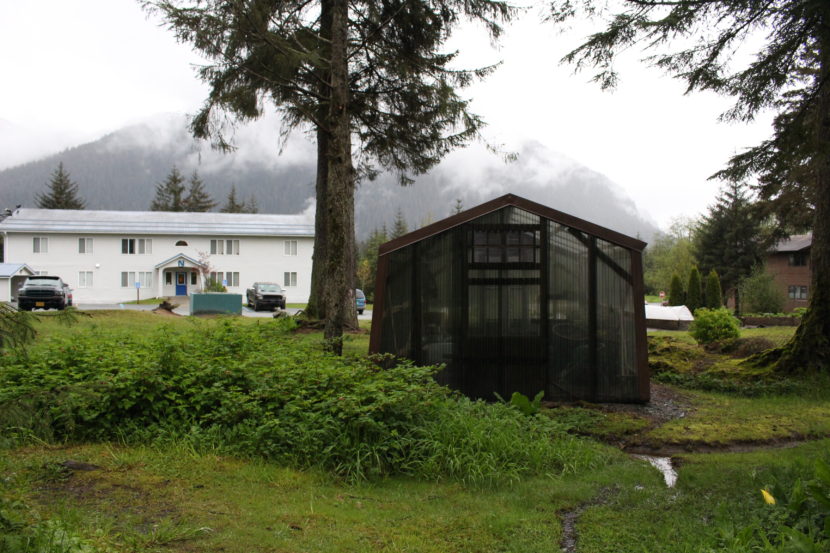
A greenhouse at Gruening Park.
Gruening Park has been around since the 1970s. It was initially created for middle-income housing but later took on a larger range of affordable housing. (Photo by Elizabeth Jenkins/KTOO)

In October, she put her name on the list at Gruening Park. The housing complex has 96 units and about half of those are eligible for a Section 8 voucher. Some apartments are rented out at market value. Others are subsidized based on income.

Kourtney works at a sports bar and grill — picking up extra shifts at another restaurant when the cruise ships are in town. In the off-season, she makes about $1,000 a month. And if she gets into Gruening, she would pay no more than 30 percent of that for rent.

“A lot of times people want to know to exactly when we’re going to have a unit, and that’s really impossible to know,” said Tamara Rowcroft, the general manager.

She said typically, a space opens up every month. But they don’t force anyone to move out. If someone’s income improves, the rent gets adjusted.

“The most you would pay for rent? Well, right now our market rent for a four bedroom is $1,160 a month,” Rowcroft said.

The least someone would pay is $0.

The apartments are first come, first served, and Tamara said the one and two bedrooms are the most in demand. Three and four bedrooms, like the one Kourtney is trying to get into, have the shortest wait. Still, some have been waitlisted for up to a year, Tamara said.

In the meantime, Gruening Park tries to encourage people to apply around, she said. There are other subsidized housing units, and some private landlords take Section 8 vouchers.

Tamara thinks, overall, Juneau is doing pretty good, compared to other cities. But is it enough? 

“Well, no. We need to keep working,” Rowcroft said.
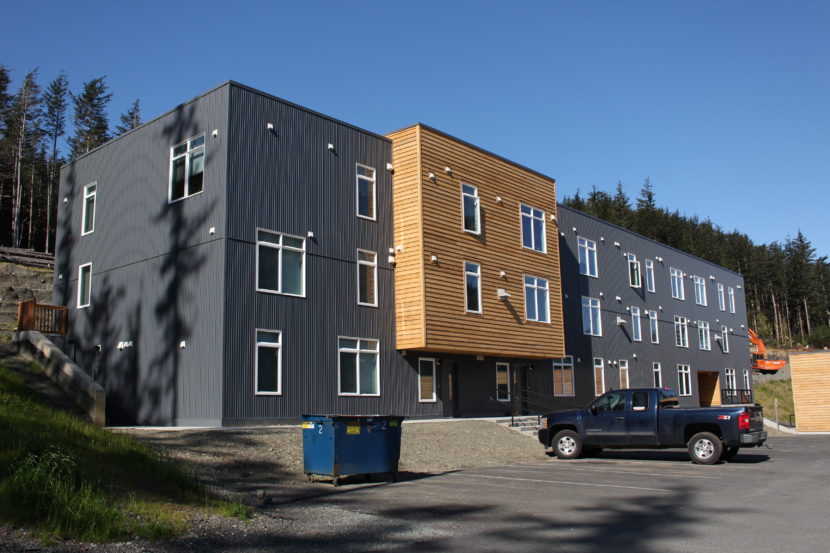
The Terraces at Lawson Creek are a recently completed affordable housing complex on Douglas. (Photo by Elizabeth Jenkins/KTOO)
The Terraces at Lawson Creek are a recently completed affordable housing complex in Douglas, with 40 apartments. Next door, another 40 units are being built. (Photo by Elizabeth Jenkins/KTOO)

With no other options, Kourtney moved her RV from Switzer Village and into a friend’s garage. There are no hookups for water or sewer.

“When we can, if the door’s not locked, we can use our friend’s bathroom or we have to pee outside, like we’re camping,” Melton said.

And her oldest daughter is living with a friend.

“I can’t live without her like this because she’s 11, and that’s such an important time. And me not being there is, like, killing me,” Kourtney said.

Even though she is near the top of the list at Gruening Park, she’s trying to apply to other places. It’s been a challenge without having her own car. Without a phone, she’s worried she won’t get the message if a place does open up.

Kourtney isn’t sure what her future will look like. She just hopes it has four safe walls.

“Don’t even care if I have furniture. I just want to be with all my kids again, all together. Make dinner together. And have, you know, game night. And start healing from their dad leaving, all together,” Melton said. “Because we can’t do it separately like this.”

She’s considering packing up the RV and moving back to Oregon. She said her family can’t wait.

Funding for Chasing the Dream is provided by the JPB Foundation and the Ford Foundation. It’s part of an ongoing series about poverty and opportunity in America.

CtD-Logo2 for Web & Print

Vega String Quartet kicks off Jazz & Classics brown bag concerts

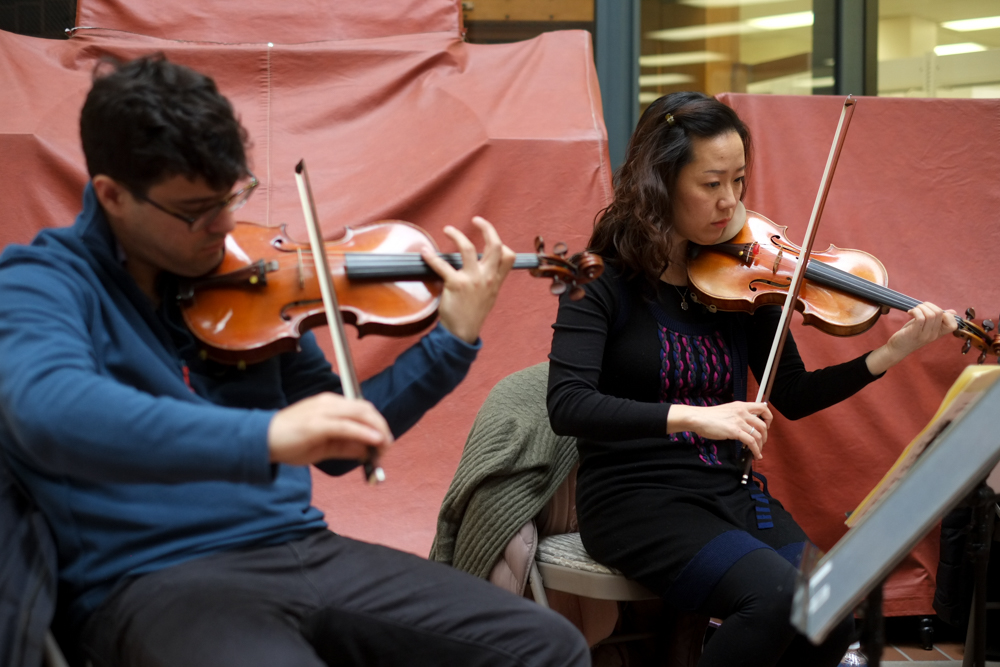
Vega String Quartet members Domenic Salerni and Jessica Shuang Wu play violin at the State Office Building Atrium during a Brown Bag Concert as part of the Juneau Jazz & Classics Festival on Monday, Mar. 9. (Photo by Annie Bartholomew/KTOO)
Vega String Quartet members Domenic Salerni and Jessica Shuang Wu play violin at the State Office Building Atrium during a Brown Bag Concert as part of the Juneau Jazz & Classics Festival on Monday. (Photo by Annie Bartholomew/KTOO)

The Atlanta-based Vega String Quartet kicked off the Juneau Jazz & Classics Festival‘s Brown Bag Concert series Monday. The 30th annual festival runs through May 21 in venues all over town.

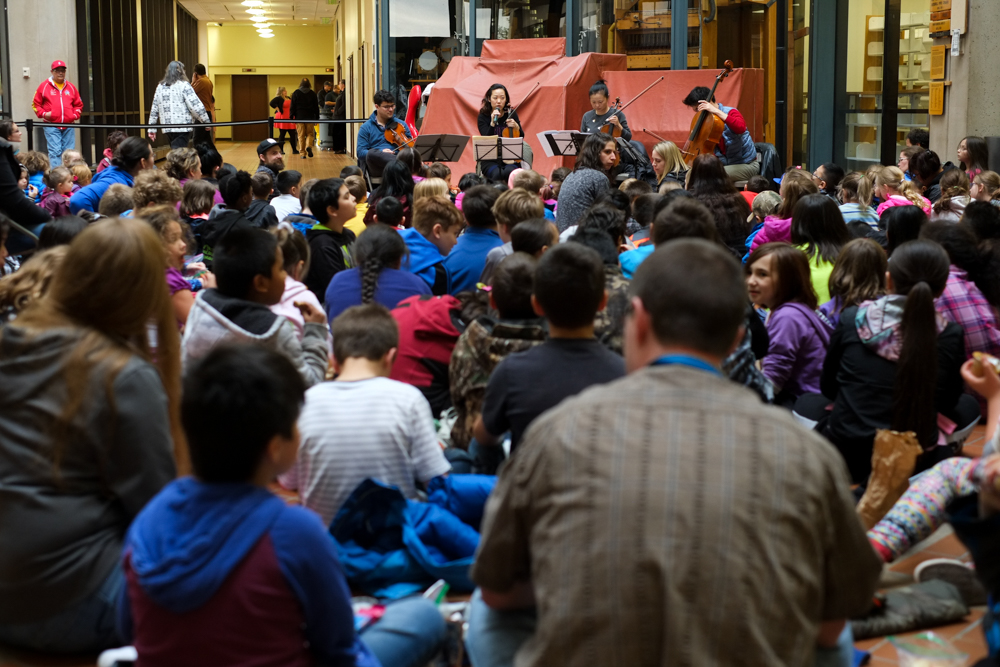
Nearly 200 Juneau students attended the free performance in the State Office Building atrium, including eight classes from Harbor View, Glacier Valley, Montessori Borealis and Riverbend elementary schools. The quartet has a residency at Emory University and shared a program of classical and contemporary string arrangements.

The Vega String Quartet performed for nearly 200 school children at the State Office Building Atrium, Monday, May 9. (Photo by Annie Bartholomew/KTOO)

Here’s their performance of part of Vivaldi’s “The Four Seasons.”

See the entire Juneau Jazz & Classics Festival schedule at jazzandclassics.org.

The quartet’s concert was sponsored by Hecla Greens Creek and Princess Tours, which bused more then 150 students to the State Office Building.

Full Disclosure: Annie Bartholomew is a member of the Juneau Jazz & Classics Board of Directors.

Photo gallery: 2016 Juneau Maritime Festival

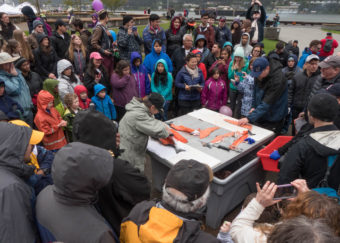
The annual Juneau Maritime Festival was held Saturday, May 7 at Marine Park. Events included a search and rescue demonstration by the Coast Guard, exhibits, a tote race and a regatta. Governor Bill Walker also signed HB 128 “establishing August 10 of each year as Alaska Wild Salmon Day.”

(Click any picture for a slideshow view)

Juneau Assembly approves new pot licensing rules

Voters approved the legal the production, sale and use of marijuana for Alaskans over 21 years old in the Nov. election. (Creative Commons Photo by Brett Levin)
(Creative Commons photo by Brett Levin)

The Juneau Assembly approved new guidelines for a city pot license on Monday. Those seeking to cultivate commercial marijuana will have to apply for the $250 license, in addition to the state’s.

It’s part of the assembly’s attempt to streamline the conditional use permit process and establish new guidelines for marijuana businesses.

Commercial pot grows are zoned for industrial areas and some low-density neighborhoods, like parts of Thane, North Douglas and out the road. Lisa Cone, a North Douglas resident, testified that she wasn’t happy about the possibility of living next to a grow operation.

“We’re at the point where we have to sort of put up with what’s going on at North Douglas. Even though all the neighbors that we’ve spoken with are in disagreement about what’s going on,” Cone said. “But I feel strongly that individuals who are growing out there need to live on their properties.”

The new guidelines say a person must live on site if they are cultivating commercial marijuana in a neighborhood. That could be the owner or a tenant. Grow houses must be set back 25 feet from the property line.

Two people testified that the shifting regulations could discourage new business. They said some of the regs were based on antiquated fears. But Assemblymember Kate Troll said that wasn’t the case.

“We want to proceed with this. I feel that we aren’t driven by ‘Reefer Madness’ in assuming that everyone’s a bad hippy for those previous days,” Troll said.

The assembly approved the city marijuana licensing ordinance and changes 7-2, with Assemblymembers Mary Becker and Jerry Nankervis voting no.

Former Central Council leader receives honorary doctorate

Ed Thomas received an honorary doctorate of laws Sunday. (Photo courtesy of Sealaska)

Tribal leader Ed Thomas received an Honorary Doctorate of Laws from the University of Alaska Southeast on Sunday. Thomas is a director at Sealaska and former president of Central Council of Tlingit and Haida Indian Tribes of Alaska.

He accepted the honorary degree at UAS’s graduation and gave the commencement address.

With ‘stuck’ housing market, a Juneau family lives aboard

Alaska’s capital is one of the most expensive places to live in the nation. With no roads in or out, the city has been dealing with a “stuck” housing market. A report commissioned by the City and Borough of Juneau says 1,000 affordable rental units are needed to keep up with the demand. Juneau’s housing market is especially tough for people living on low incomes.

But one Juneau family is taking matters into their own hands and challenging the convention of what makes a house a home.

Carrie Joy doesn’t have a typical street address. But she has really helpful neighbors. When we can’t find her boat, a stranger springs into action — knocking on doors.

Yachts, sailboats and fishing vessels bob on the water at Aurora Harbor. And nearby, there’s a row of small houseboats. What they lack in space, some make up for in character. They’re fiberglass or made of wood, painted the colors of the rainbow.

Walking down the dock, we see it: the little gray boat with yellow trim. Carrie’s 9-year-old son William invites us through the small door.

We step down into the living room. It’s actually more of a multipurpose space.

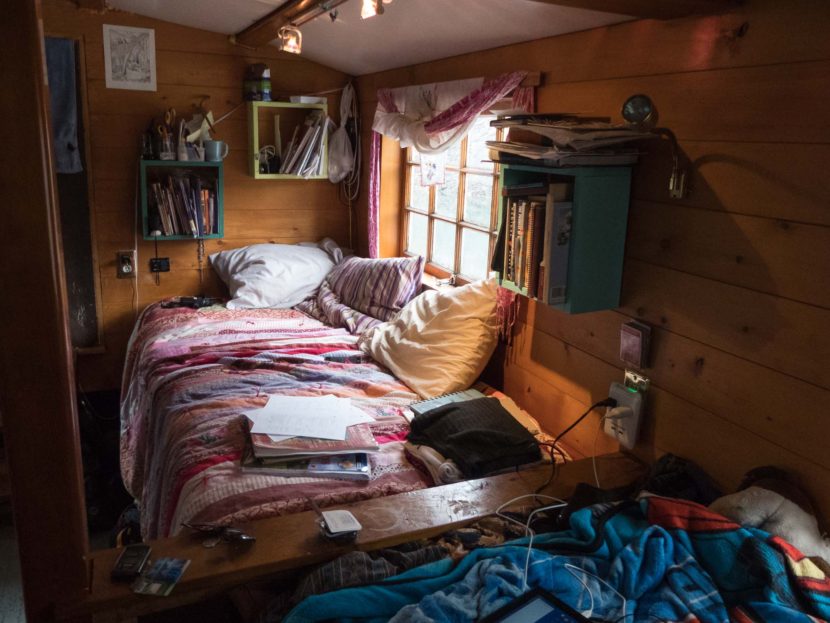
Carrie Joy and her son William's bed against the wall. (Photo by David Purdy/KTOO)
Carrie Joy and her son William’s bed against the wall. (Photo by David Purdy/KTOO)

“This is my bed, my desk, my dining table. This is where William and I do school. This is where I write when I write,” Joy said.

Carrie home schools both children, so it’s also a floating classroom. And it’s the space where William sleeps. His bed touches the foot of Carrie’s. Her 14-year-old son sleeps in the back — with a little more separation — but there’s no bedroom door.

The entire home is just 200 square feet.

“Privacy is a huge sacrifice. We have to be very intentional about giving each other privacy. I mean, you can look around and see there’s nowhere to hide here,” Joy said.

Without walls, personal boundaries replace physical ones. She says everything from getting dressed in the morning to taking a shower can be an obstacle — especially with her youngest, who loves to give running commentary.

“Our life is a musical and typically he sings it,” she says with a laugh, as her son sings a tune.

As a single mom, she decided to buy the houseboat three years ago.

“When I came to look at it, I knew it would be hard,” Joy said. “But it has a shower, it has a flush toilet, and there’s room to put bunks in. And I just loved it. It was so sweet.”

The cost: around $28,000. Carrie used to be a teacher. She was also a state employee. But now she makes money freelance writing and cleaning houses.

“I make ends meet because first of all, I don’t have any debt. And second of all, I keep my expenses extremely low.”

That means making the most of about $1,600 a month. To put that in perspective, that’s less than a third of Juneau’s average yearly income.

She receives food stamps. She’s also eligible for federal cash assistance, but she hasn’t taken it yet. That would mean having to first cash out her retirement with the state, which she wasn’t ready to do until recently. So at the end of the month, is this enough?

(Photo by David Purdy/KTOO)
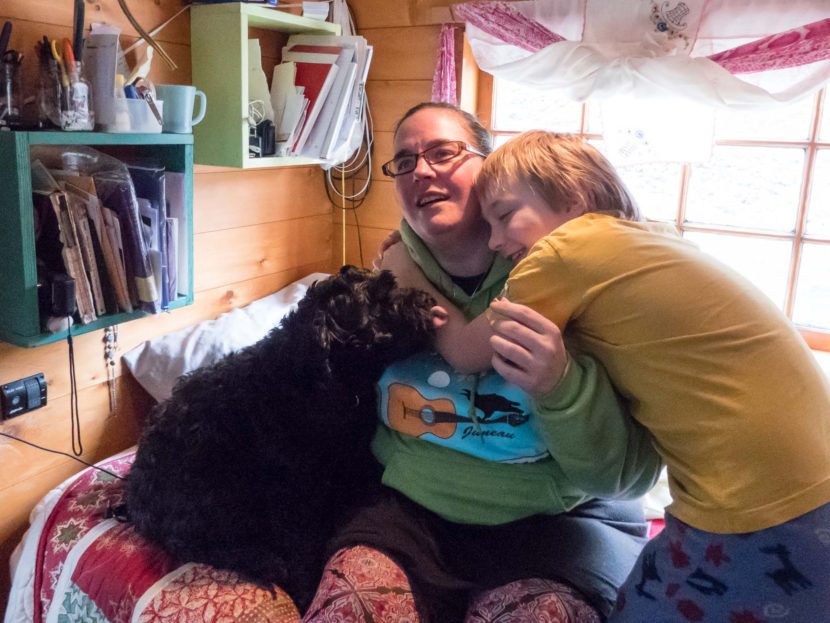
Carrie Joy, her son William and their dog Sadie. (Photo by David Purdy/KTOO)

“Well, I’m still breathing and my children are still breathing and their bellies aren’t hungry. I guess it depends on what you consider a need?” Joy said. “Could we use some different things? Absolutely. Would it be nice to have a door that shuts that doesn’t go to the outside? Yes, that would super rock. But is it necessary? Not at this point.”

Carrie says what is necessary for her family is time. Teaching in the public school system left her feeling burned out. As a parent, she didn’t think one-size-fits-all learning was beneficial for her children, which was why she decided to homeschool.

“Honestly, for me, it was probably a pretty selfish decision because I like reading cool books, I like doing art projects, I liked doing music. … And I couldn’t keep up in school, and teaching my own kids, we can discover those things together,” she said.

Carrie’s family has lived on the water longer than she thought they would. The plan was to save up for a regular house. And she thinks that could still happen, but probably not until after her sons are grown.

Right now, they’re in the process of renovating the boat. And Carrie will eventually have her own room again. She says from the outside, she might look poor.

“But I’m so time-rich and most of the folks who are struggling to make their ends meet are time poor and money poor,” Joy said. “Had I not chosen to live on a boat here in Juneau … There’s no way I could do it and be sane and happy, and anybody who knows me might wonder about the sane part, but nobody will tell you we’re not happy.”

And she’s dating somebody who she says can relate. He lives on a boat, too.

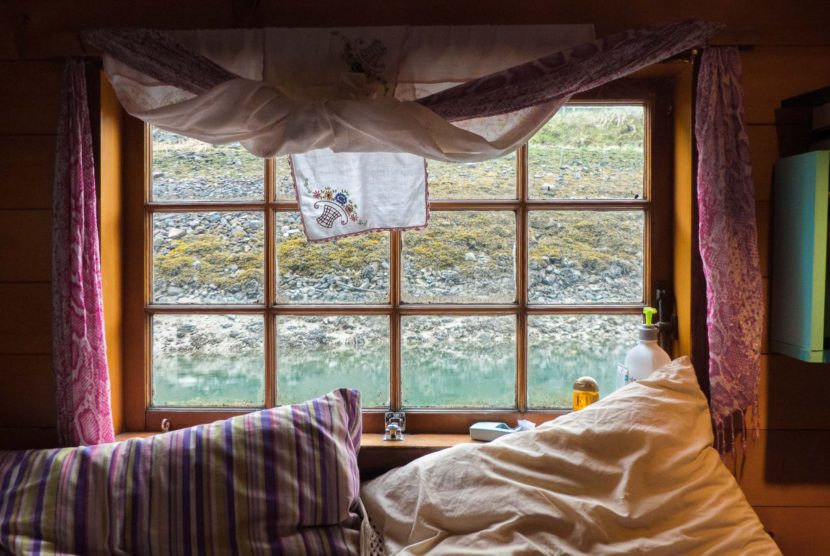
(Photo by David Purdy/KTOO)

Funding for Chasing the Dream is provided by the JPB Foundation and the Ford Foundation. It’s part of an ongoing series about poverty and opportunity in America.
CtD-Logo2 for Web & Print

Site notifications
Update notification options
Subscribe to notifications