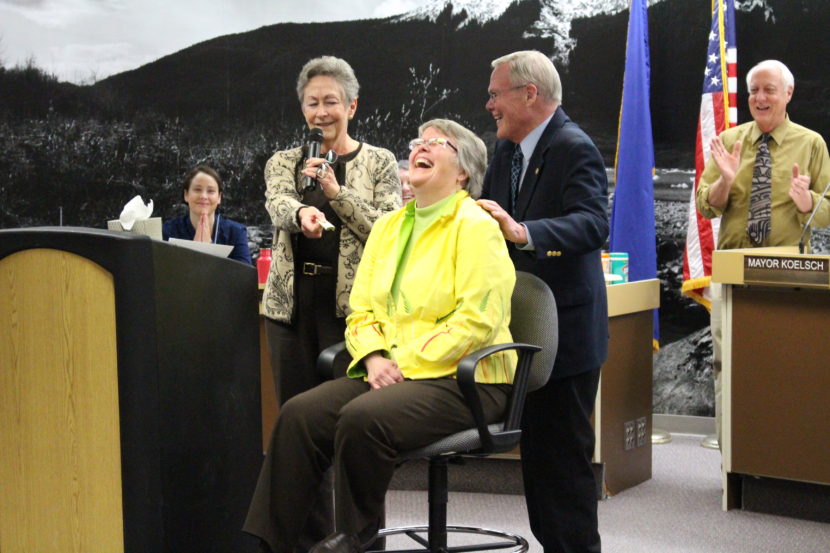
Former Juneau Mayor Sally Smith presents Kim Kiefer with $50. (Photo by Elizabeth Jenkins/KTOO)
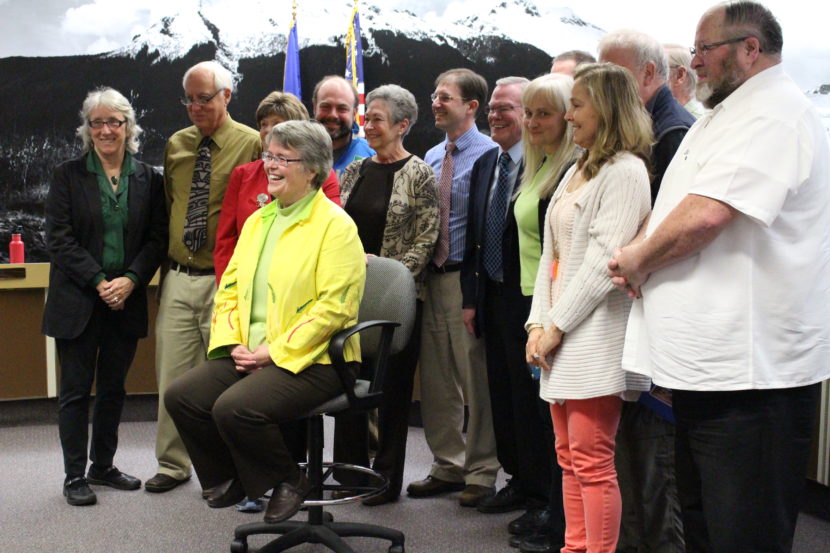
Juneau City Manager Kim Kiefer is retiring after more than 32 years of public service. Her decades-long career was celebrated at last night’s assembly meeting. Five previous Juneau mayors attended to commemorate Kiefer on all of her achievements.
Kiefer was appointed to city manager in 2012. Before that, she ran Parks and Recreation and the Zach Gordon Youth Center.
To a packed crowd, former Mayor Sally Smith reflected back to a time when her band wanted to play at Marine Park for the Fourth of July.
“And the city wanted $50 for us to play a free concert, which was pretty darned annoying,” Smith said. “So I went in and I talked to Kim and I complained about the fact that here were 60 people who were giving their time for Fourth of July and I didn’t think we should have to pay the 50 bucks. And she said you know, ‘I agree.’ And to this day, I have a feeling that Kim Kiefer put in that $50.”
Kiefer’s last day will be April 28. You can listen to the entire ceremony below:
Five former Juneau mayors attended Monday’s event. (Photo by Elizabeth Jenkins/KTOO)
First lady Donna Walker and Gov. Bill Walker talk to a man at Saturday’s Hope, Not Heroin event. (Photo by Elizabeth Jenkins/KTOO)
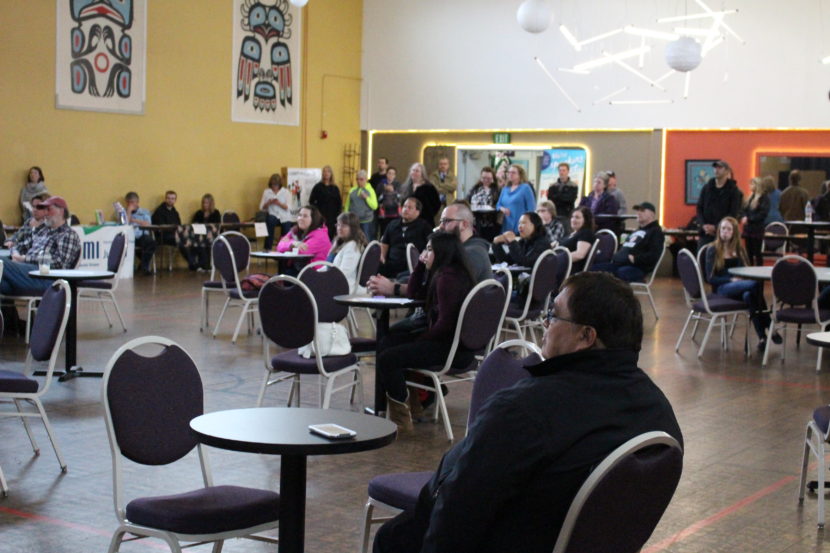
The Juneau Police Department recently held an event to bring people and service providers together called Hope, Not Heroin. Alaska lawmakers were there, as well as Gov. Bill Walker. And for some in the crowd, the event signified how communities are changing the conversation when it comes to talking about addiction.
Hope, Not Heroin started off with a Juneau firefighter describing how he uses Naloxone, also known as Narcan, in the field.
“Giving Narcan, we want to make sure that they are actually overdosing on an opiate,” he told the crowd.
It’s an emergency drug that can save a person dying of an overdose. And it won’t be just emergency responders administering it anymore. Since the legislature passed Senate Bill 23, some Alaska pharmacies could start carrying it as early as the summer. Family members or friends could have access to the drug.
That’s one of the reasons why 19 year-old Nichelle Williams said she wanted to be here: Naloxone saved her life.
“I just came out of treatment from a heroin overdose. And so I came here to help support the bill and everything that’s going on with the heroin stuff,” Williams said.
Williams is exactly who this event is for. Around the room, there are about 31 booths with information about addiction, recovery, even proper syringe disposal. But for such a heavy topic, the atmosphere is light. There’s folky music and a food truck selling pizza.
Rick Hanby is sitting around a table with his wife and kids. He said they decided to come because they’ve known someone who’s struggled with opiate use.
“I think sooner or later, or one way or another, it affects somebody, everybody here. It affects our community. So this is a really good start to get everyone to start thinking and start talking about it,” Hanby said.
Lt. Kris Sell said it’s not common for police departments to organize an event like this. But over the past six months, they’ve tried to use other tactics to reduce heroin use. For decades, she said police across the country focused on the narcotics supply in the War on Drugs.
“And so now we’re acknowledging that it’s the demand that fuels this problem,” Sell said.
Event goers watch the governor’s speech at Hope, Not Heroin. Sen. Johnny Ellis, who helped craft SB 23, also attended. (Photo by Elizabeth Jenkins/KTOO)
Seven people died in heroin-related deaths in 2015. This year, there’s been one. And Sell thinks, overall, 200 people in Juneau use heroin on a daily basis.
“Doubling to about 400 during the summer when we get in highly paid seasonal workers, like in the fishing industry. Some of the tourist industry,” Sell said.
So, for those struggling with addiction who want to get help, she said it can be difficult to navigate what treatment options are available. Unfortunately, in Juneau, the answer is not a lot.
Mitzi Privett, the interim director at Rainforest Recovery Center, said typically, they have some beds available for in-patient detox.
“Recently, we’ve been very full,” Privett said. “And so if someone came in that needed help right away, it would be much harder to serve them. If we had more options, we could say, ‘We’re not available to help but let us refer you to somebody who is.’”
Nichelle Williams was one of the people who was able to get in after her heroin overdose. But she thinks Juneau should have more options. Recently, her friend overdosed and died before she could get help.
“And it was really hard, and she didn’t have the option of treatment because when she went into the hospital, they were like, ‘We can’t help you,'” Williams said. “That’s how most people die in Juneau, if they want help and they try to get help, the hospital can’t help them detox.”
With her recovery, Williams said seeing support — like Saturday’s event — has been huge. But there’s still room for growth when it comes to educating people about addiction.
“When people call me a junkie or something, it makes me feel degraded,” Williams said. “I’m a normal human being. I just have an issue. Just the labeling, it really gets people down. It really does.”
While Juneau waits for more addiction treatment, Williams said there’s something else the community can do to help: be positive and keep the conversation going.
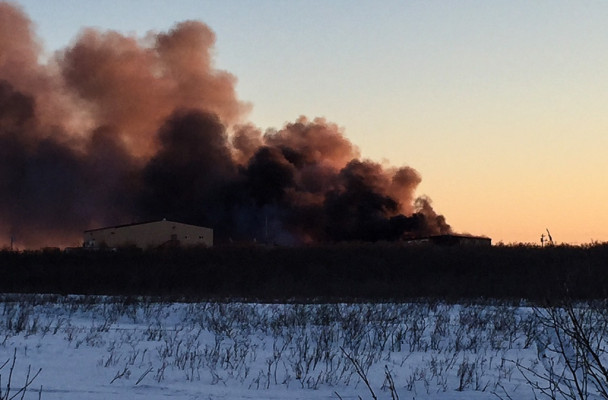
A fire engulfs the Kwik’Pak Fisheries warehouse in Emmonak in March 2016. The blaze destroyed five buildings and caused at least $3 million in damage. The fire’s cause is under investigation. (Photo courtesy Alaska State Troopers)
The City of Emmonak has issued a disaster declaration after a fire destroyed five commercial fishing buildings last month, causing $3 million of damage.
The city manager sent the declaration to Gov. Bill Walker and the Alaska State Legislature, requesting $750,000 in emergency funding.
That money would pay for a new fire truck, cover upgrades to city water lines, and match the city’s donation to the Yukon Delta Fisheries Development Association.
In addition to owning the five destroyed buildings, the association runs Emmonak’s commercial fishing and processing industry, which employs almost 2,000 people around the Yukon River Delta.
Without emergency aid, Emmonak City Manager Martin Moore said the fire’s damage could cripple the area’s economy.
“The community cannot afford to miss a fishing season and the people and businesses will suffer irreparable harm without immediate assistance to rebuild in time for the 2016 season,” he wrote in the disaster declaration.
The city itself is donating $150,000 to the association. That donation will cut water usage fees in half for subsidiary Kwik’Pak Fisheries, provide four acres of land to rebuild on at half the standard rate, and allow free use of the city’s heavy equipment to clean up debris from the fire.
Rep. Neal Foster, D-Nome, will request emergency funding on behalf of the City of Emmonak.
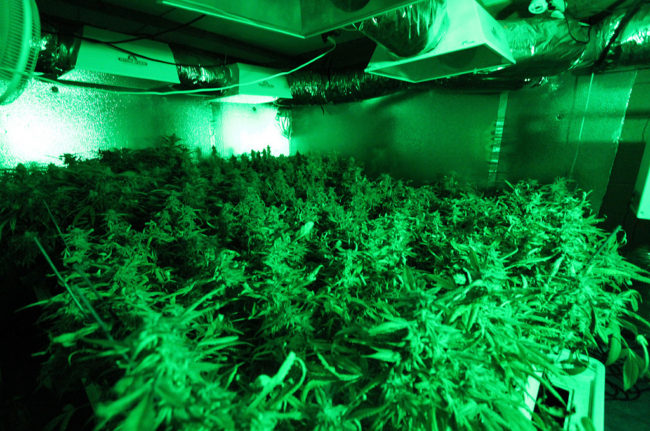
Flowering cannabis plants under green light in an air-conditioned, indoor hydroponic grow operation in Oakland, California. (Creative Commons photo by Rusty Blazenhoff)
The Juneau Assembly is in the process of streamlining conditional use permits for marijuana businesses and establishing new guidelines. Assemblymember Maria Gladziszewski raised concerns over an ad that recently popped up on Craigslist, boasting two acres of “land available for marijuana cultivation” for rent.
“And when we saw people on Craigslist saying, ‘Get in the green rush. Come to North Douglas or out the road and put a shed on the property.’ That was not what was discussed in the marijuana committee,” Gladziszewski said.
North Douglas is a low-density neighborhood where zoning allows commercial marijuana cultivation. The state already requires marijuana business owners be Alaska residents. But now, an amendment to Juneau’s land use code clarifies — when it comes to neighborhoods — they must also live on site. Although, if the owner approves, this would not stop a renter from starting a commercial grow operation.
Marijuana entrepreneurs may also be required to apply for a pot business license in addition to the state’s. The city license would give the municipality more local control if businesses fail to comply with city laws.
The assembly voted 6-3 on Monday to lower the licensing cost from $450 to $250. The assembly will reopen the discussion again on May 2 with public testimony.
At NOAA’s Ted Stevens Marine Research Institute, the water in the lab is cycled to the basement where it becomes heat for the building. (Photo by Elizabeth Jenkins/KTOO)
Recently, the Alaska House passed a bill that could make it easier for one hydro project to get off the ground. If the Juneau Hydropower Inc. plant gets built, the company wants to bring sustainable heat to some residents from an abundant source.
It’s been done before but the company says not on this scale in North America.
In Drammen Norway, warmth is brought to its nearly 60,000 residents with water. At NOAA’s Ted Stevens Marine Research Institute in Juneau, the building is kept a toasty 70 degrees the same way, using a seawater heat pump system.
John Cooper is the facilities manager here, and he’s proud that the building has been kept warm this way since 2011. With the price of fuel today, he thinks it would cost around $180,000 a year to heat the building.
“With electricity, we’re using about $36,000 to heat this facility,” Cooper said.
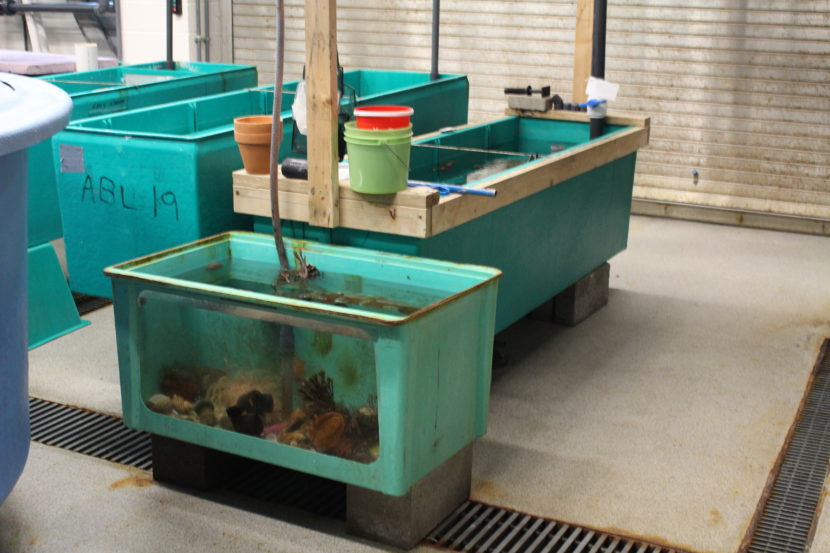
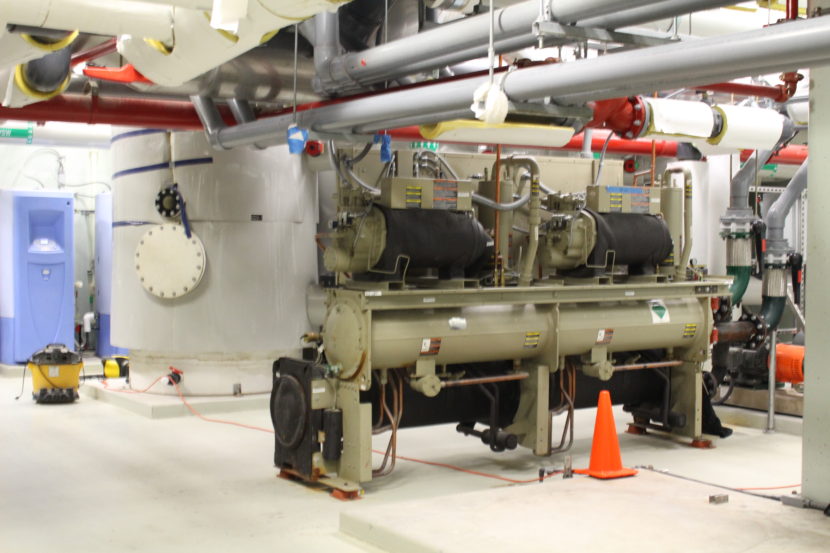
The seawater used in the building’s marine lab — the same water that holds starfish and sea cucumbers — gets cycled to the basement. And that’s where the magic happens.
Kind of like your refrigerator at home, the same technology is used here, but in reverse. The back of your fridge feels warm because that’s heat that’s been transferred away from the inside.
So if you stuck your hand in the Gastineau Channel and, to the touch it feels cold, actually, it’s fair to say there’s heat circulating in that water.
“There absolutely is heat circulating in that water. I’ve got two pipes right here. One of those is before the heat is extracted and one of them is after, and you can feel a difference. So we are physically removing heat from cold water,” Cooper said.
So imagine taking this idea and, like Norway and Iceland, duplicating it on a larger scale.
“Well the district heating has actually been a Juneau idea for the last 20 years, and we’re just taking it to another level,” said Duff Mitchell — the managing director of Juneau Hydropower. He claims the advancement of district heating is to heat what LED lights have been to lighting.
His plan is to build a hydro facility at Sweetheart Lake, south of Juneau, that will generate enough electricity for the project. Seawater would be pumped in from Gastineau Channel. It would have to be around 37 degrees to work efficiently. From there, the heat would be extracted anda closed loop water systemwould circulate the warmth through pipes around the city.
“We’re first and foremost looking at the downtown area,” Mitchell said.
He says places like the federal building, swimming pool and capital complex could be heated with the technology. High-density areas work best.
“So we would spider web out — downtown first. Then we’re looking at the future, if there’s another heat availability in the Gastineau Channel to do Douglas,” Mitchell said.
Keith Comstock, the company’s president, says 78 percent of people in Juneau use oil to heat their homes. Converting to district heating would be relatively simple.
“Because basically, they can leave their existing systems in place and right now, they basically burn oil which heats water, which is then distributed around,” Comstock said. “So instead of getting hot water from the boiler, they can get hot water from the district heat system.”
To be clear, the water itself won’t come from the district heat system; the heat will.
Inside the basement at NOAA’s Ted Stevens Marine Research Institute, seawater is run through a compressor to extract the heat. (Photo by Elizabeth Jenkins/KTOO)
Comstock and Mitchell say their plans are sustainable and minimize the impact to fisheries. But you’re probably wondering who’s going to pay for it and how much is it going to cost? Comstock says so far private, local funders have invested. It’s $125 million for the hydro project, $25 million for the district heating, and that’s not all.
“Building a project like this is kind of like buying a house. If you have the ability to pay your mortgage, someone will loan you money, but you’re going to have to come up with a down payment,” Comstock said.
House Bill 143, which recently passed the House, could help. If the entire legislature passes it, Juneau Hydropower may be eligible for up to $120 million in low-interest loans from a state-backed corporation. And for the remaining expense, Mitchell says they want to negotiate with the U.S. Department of Energy for more loans — not grants.
“It should be the old fashioned American way. You come up with a good product. If you can borrow money and make a business model, you should pay it back,” Mitchell said. “And so especially with the times our state has and with others, I think it would be imprudent for anyone to be asking for money that would otherwise go to our schools and to other things.”
Back at the Ted Stevens lab, John Cooper is showing me the two boilers that once burned 200 gallons of fuel a day. They’re now backups. The room is used mostly for storage, and the space is pretty quiet.
“This is the sound of progress. And I have a 10,000 gallon fuel tank in the parking lot that stays full. It has some stale fuel in it,” Cooper said.
Although Cooper gets to enjoy the seawater heat pump system at work, Juneau Hydropower’s plans don’t extend to his home in valley. The company plans to break ground this summer. They would like to be delivering heat by 2018.
Every year, legislators take a break from their work at the Capitol and head to the gun range. Lawmakers, their staff, and members of the Alaska Correctional Officers Association recently participated in the 19th Annual Legislative Team Shoot at the Juneau Gun Club and Juneau Hunter Education Shooting Complex.
“It is an event that brings together the House, the Senate, the corrections officers, and it just brings some awareness to shooting sports,” said Wasilla Rep. Cathy Tilton, who participates in the legislative shoot every year.
Participants fire arrows in the archery event during the 19th Annual Legislative Team Shoot. (Photo by David Purdy/KTOO)
Participants compete in teams of three, moving at their own pace between four events — archery, handguns, rifles and trap shooting. Instructors are available at each station for those who need a refresher, something Tilton is grateful for when it comes to archery.
“My experience with archery is not nearly as good as my experience with shooting,” she said.
The instructor demonstrates proper form and soon the arrows are flying, most of them into the target.
After the shots are scored and the arrows collected, the team moves on. Next up, Tilton moves on to the handgun range, where she picks out a .40-caliber Glock.
“I feel pretty good about the pistol event,” she said as she waited for her turn on the pistol range. “I’ve been practicing my pistol shooting at another range whenever I have had time, and hopefully, I’ll do OK. This target’s a little small, so it’s gonna take a little bit of skill.”
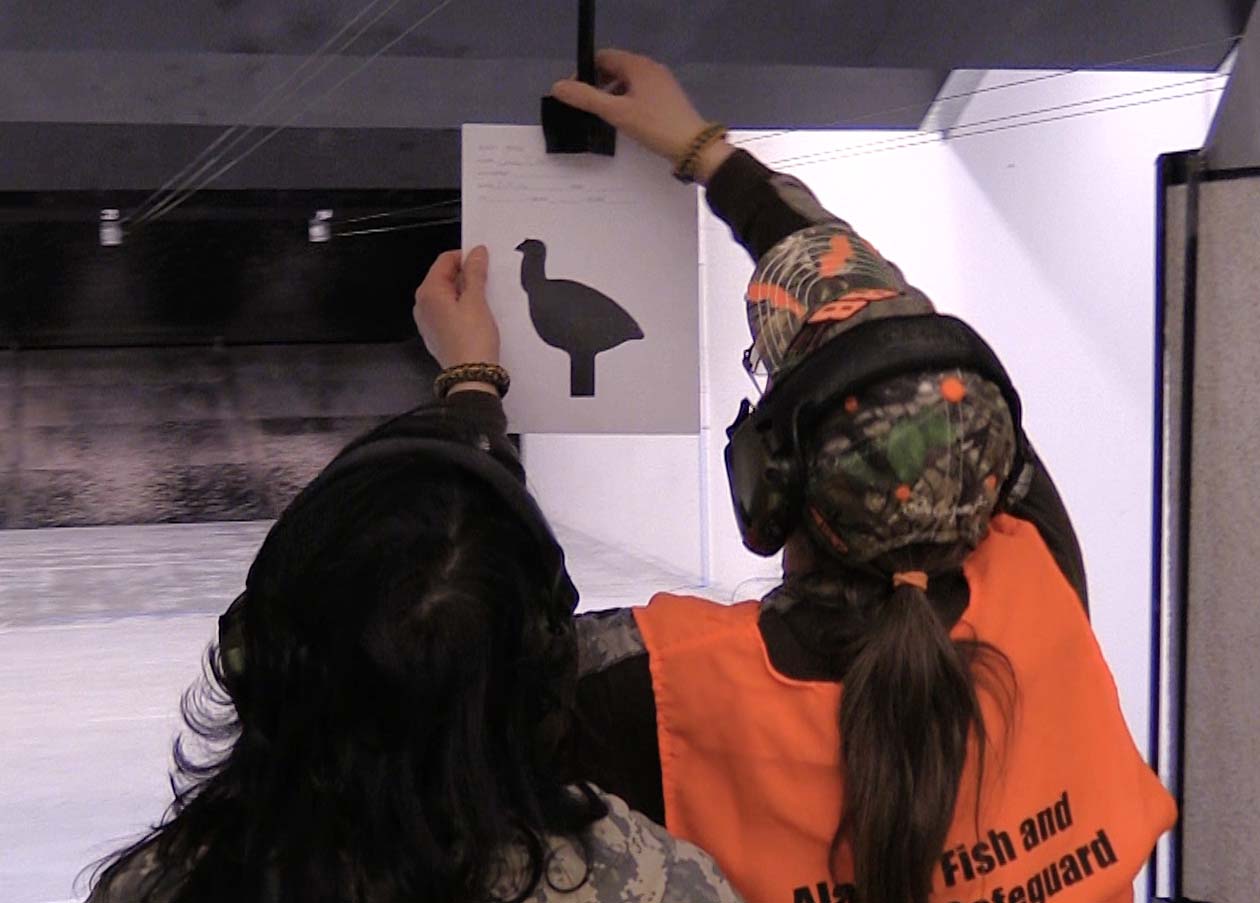
A target for the pistol event (Photo by David Purdy/KTOO)
The target does look small and it looks even smaller when it’s hung up about 50 feet down the pistol range. After two minutes to prepare, Tilton loads her gun. Her long, manicured fingernails make it a little difficult to load cartridges into the magazine.
Out of five shots, three hit the paper but only one in the target area.
After handguns, Tilton moves on to the outdoor range, where she competes with a .22-caliber rifle and, finally, trap shooting with a shotgun. At the end of the day, she says it’s about more than competing or hitting the target.
“As you know, when we’re in the legislature we can have differences of opinion on policy and things like that,” she said. “But it’s always good to get together, to have some camaraderie with each other and just do something where you’re just let your hair down and (are) able to communicate with each other — doing something that’s not in stressful situation.”
As for the competition, Tilton says improvement is the key – she’s happy to report that her team did better than they did last year.
Arrows at the archery range in the Juneau Hunter Education Shooting Complex during the 19th Annual Legislative Team Shoot. (Photo by David Purdy/KTOO)
Participants remove arrows from the targets in the archery event during the 19th Annual Legislative Team Shoot. (Photo by David Purdy/KTOO)
Cathy Tilton poses in front of her target at the Juneau Hunter Education Shooting Complex during the 19th Annual Legislative Team Shoot. (Photo by David Purdy/KTOO)
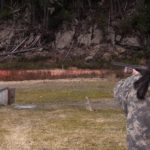
Cathy Tilton participates in the rifle event during the 19th Annual Legislative Team Shoot. (Photo by David Purdy/KTOO)
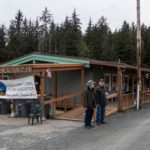
The Juneau Gun Club, where the 19th Annual Legislative Team Shoot took place. (Photo by David Purdy/KTOO)
Cathy Tilton participates in the trap shooting event with a shotgun during the 19th Annual Legislative Team Shoot. (Photo by David Purdy/KTOO)
Cathy Tilton participates in the trap shooting event during the 19th Annual Legislative Team Shoot. (Photo by David Purdy/KTOO)
Cathy Tilton participates in the handgun event during the 19th Annual Legislative Team Shoot. (Photo by David Purdy/KTOO)
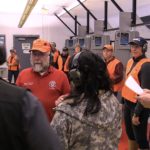
Cathy Tilton and her team listen to a briefing before the handgun event during the 19th Annual Legislative Team Shoot. (Photo by David Purdy/KTOO)
Close
Update notification options
Subscribe to notifications
Subscribe
Get notifications about news related to the topics you care about. You can unsubscribe anytime.