The Juneau Police Department is hosting an event Saturday to help heroin users and those who have lost someone to the drug. Hope, Not Heroin will have food, music and 31 booths with information about addiction and recovery.
Lt. Kris Sell said it’s not common for police departments to organize an event like this.
“No, and we recognize that fact that we need to do something differently because our old tactics don’t work. The old tactics of just focusing on the supply don’t work, so we have to go after the demand,” she said.
Sell said seven people in Juneau died of heroin-related deaths in 2015. There’s been one death this year, and Sell said the police and fire department haven’t had a call since the beginning of March. Still, she said that number tends to increase in the summer.
To connect people with services, Sell said active opiate users are invited to attend the event.
“They are absolutely welcome, and we’re not going to be patting them down. That’s not what this is about. What we want is for them to get information and see what’s out there,” she said.
Hope, Not Heroin will also have several resources for the family and friends of those struggling with addiction. There will be a memorial wall to commemorate loved ones.
Sell said Capital City Fire/Rescue will be there to give information about Naloxone, which can save someone who’s overdosing. Recently, the legislature passed a bill that makes it easier for pharmacist to dispense Naloxone and gives protections to people administering it.
“They’re are probably going have questions like, ‘Do I tell the addict in my family I have this? Will that encourage brinkmanship in using too much of the drug? Trying to get higher and higher and thinking this is a safety net.’ Those are very real decisions that have to be made,” Sell said.
Hope, Not Heroin is on Saturday from 2 to 6 p.m. at the Juneau Arts and Culture Center. Capital City Fire/Rescue will discuss Naloxone at 2:30.
During KTOO’s Morning Edition program on Friday, Kevin Gullufsen of the Juneau Empire provided an update on the final rounds of play at the Juneau-Douglas High School gymnasium.
“It’s a hectic tournament,” Gullufsen said. “There were eight games a day. Six of them now. I am getting a little more sleep now, but it’s a lot to cover. But for everyone involved, it’s tons of fun. Now that teams are getting knocked out, there are a lot of player-fans at this point.”
Listen to Friday’s update from Kevin Gullufsen:
You can check out more of Kevin Gullufsen’s stories at JuneauEmpire.com
Teams representing nine villages from throughout Southeast Alaska are playing in the week-long event.
We checked in with Kevin Gullufsen is covering Gold Medal for the Juneau Empire. He said there is a family atmosphere at the tournament.
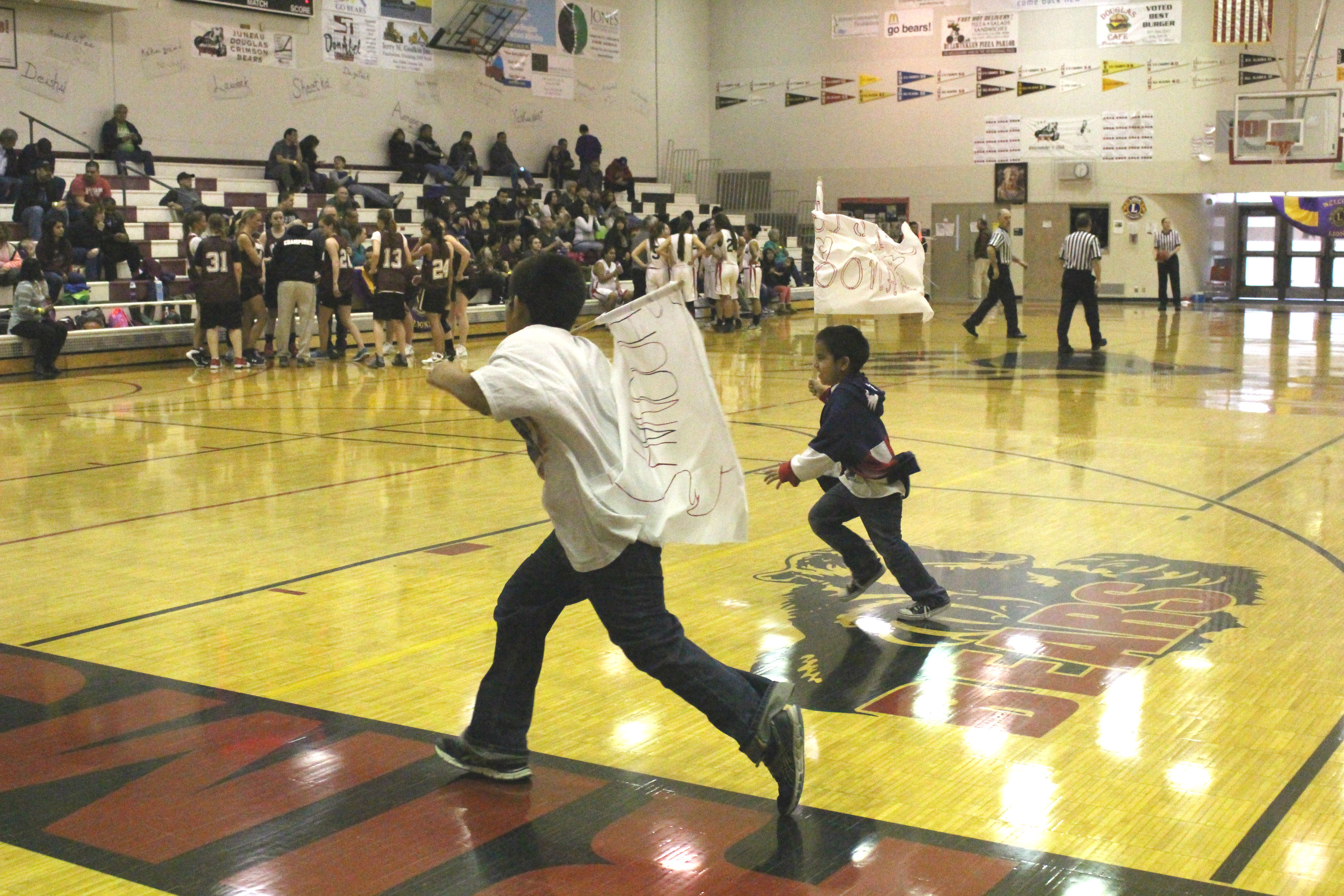
“It’s a lot of fun. People are playing for the pride of their hometown,” Gullufsen said. “It’s a great tournament. It gets real competitive, and people bring all of their siblings. There are kids running around at every time out with banners from their hometown rooting them on. It’s a raucous atmosphere.”
Listen to the interview with Kevin Gullufsen that aired on Thursday’s Morning Edition:
Before statehood, before the Alaska Marine Highway System, there was the Gold Medal Basketball Tournament in Juneau. This year, the event is 70. It brings adult players from across Southeast to compete against neighboring villages and communities.
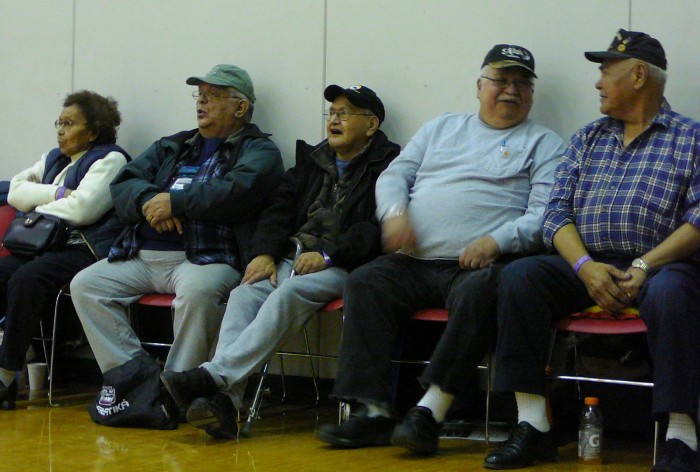
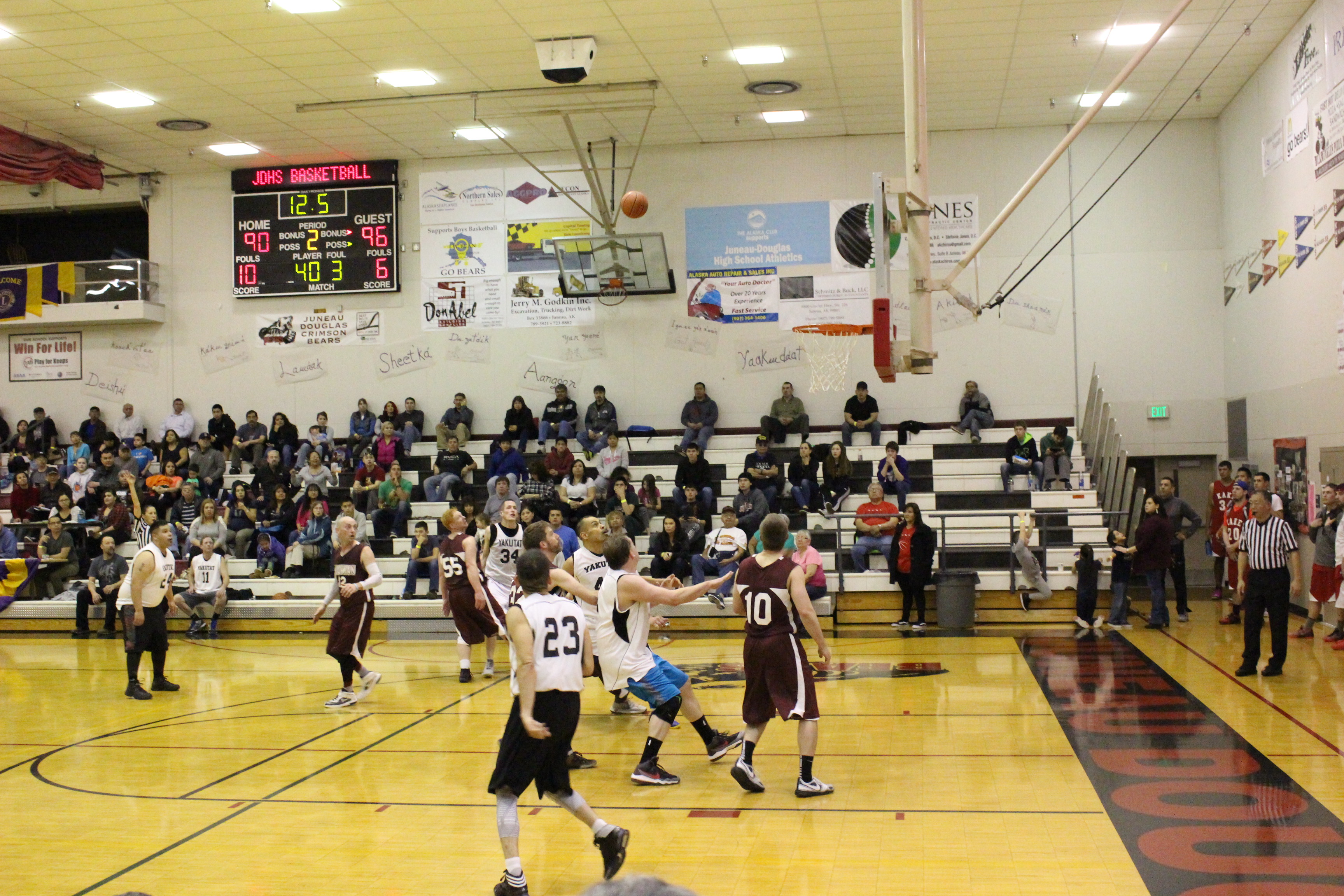
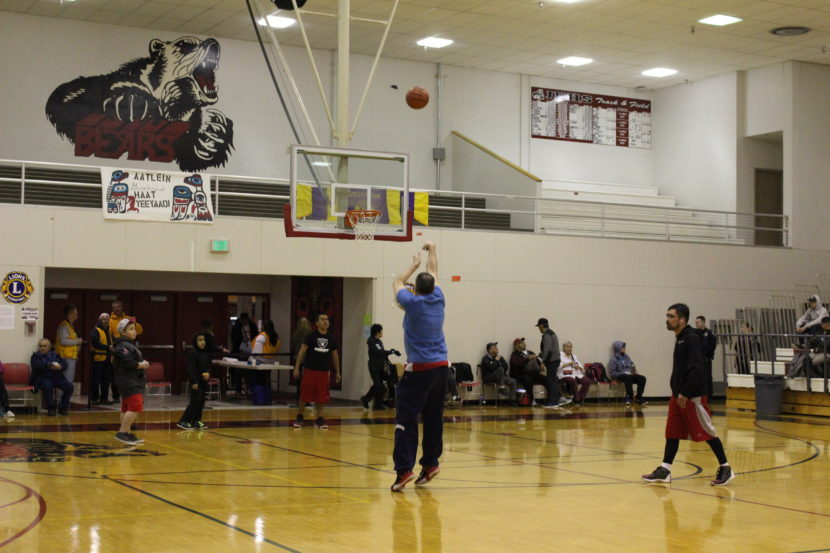
Elders sit along Juneau-Douglas High School’s gym wall. Their eyes are fixed on the players as they warm up before a game — Yakutat vs. Klukwan.
Charlie Williams, 75, is one of them. He lives in Juneau now but has been coming to Gold Medal since the 1940s. Naturally, he’s rooting for his home team.
“All the good looking people come from Klukwan ‘cause they drink that Chilkat water. 21 mile’s where you want to drink your water,” Williams said.
The tournament started back in 1947, a year after another basketball institution — the NBA. Shorts were shorter, the 3 point line didn’t exist, and traveling to Juneau meant making a special trip.
Williams says his parents laid it out like this: if he wanted to go to Gold Medal, he’d have to get better grades than his siblings.
“Well, there’s probably about eight of us kids then competing. Fortunately, I just studied a little harder. We had to do our chores. It wasn’t easy,” he said.
Chopping and carrying heavy wood is one of those chores he remembers being especially tough.
“We really didn’t have that much, and it was really great to come down to the old gym here on Fifth Street. It was quite an experience,” Williams said.
Gold Medal started as a fundraiser for the Boy Scouts. Although villages dominate the brackets now, some of the first teams to compete were Juneau, Petersburg, Ketchikan, and Skagway. Petersburg took home the win that first year.
Yakutat faces off against Klukwan in Tuesday’s Gold Medal game. (Photo by Elizabeth Jenkins/KTOO)
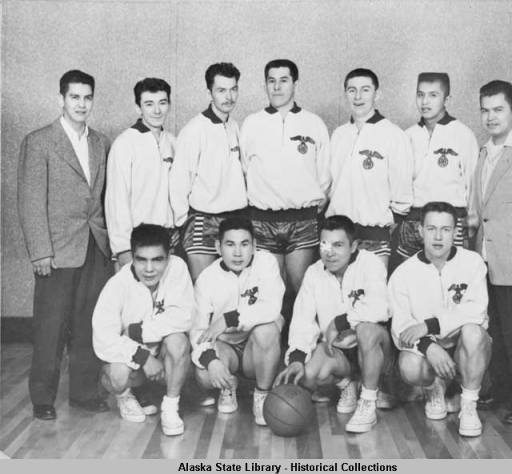
Gil Truitt, a former Gold Medal player, coach, referee and all-around wealth of information on the topic, said Kake was the first village team to enter the tournament in 1949.
Truitt couldn’t be at the tournament this year because it came down to attending Gold Medal or the state high school basketball tournament. But Gold Medal still holds a special place in his heart. He played in the early years with his high school team in Sitka in the late 1940s and early 50s.
“First with Mount Edgecumbe, then Sitka ANB, then Sitka Columbia Lumber,” Truitt said.
In those days, basketball was big in Sitka and had been for a while. One of Sitka’s first teams was started in 1914 by a branch of the Alaska Native Brotherhood. Truitt says pre-internet, pre-ESPN, he looked up to Herb Didrickson — a local player. So when Truitt was able to travel for the tournament with his high school team, he came over on a 14-hour long voyage to Juneau on a fishing vessel.
“It was cold, frightening, scary. You swore up and down you’d never do it again. I’m sure a lot of guys prayed,” Truitt said. “You had to love basketball to travel on those boats.”
That boat would also be the team’s sleeping quarters during the week. Truitt remembers the players would arrive wobbly-kneed from the trip over. And arriving in Juneau back in that day, Truitt says the players — Alaska Natives — didn’t always receive the warmest welcome.
But over the years, “the people were able to see that the Native team like Sitka and Metlakatla were so outstanding and colorful and wonderful to watch, that people forgot about the color,” Truitt said. “And I think basketball helped break down the prejudice that we witnessed.”
Kids run on the court with homemade Hoonah flags. (Photo by Elizabeth Jenkins/KTOO)
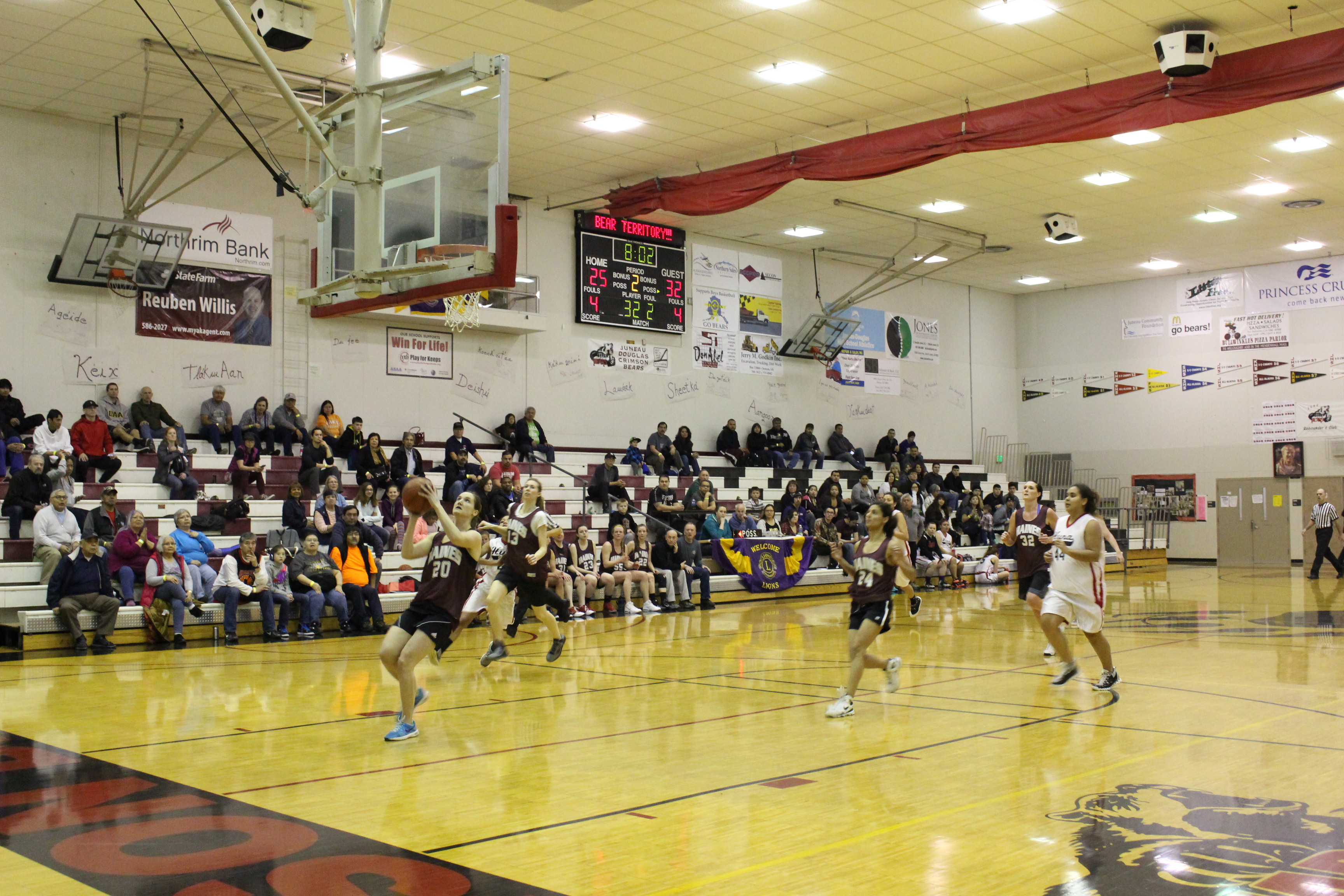
Now the teams travel to Gold Medal by ferry and air — from Hoonah, Kake, Craig, Haines, Wrangell, Hydaburg, Klukwan, Yakutat and Metlakatla. Some things about the tournament have changed. NCAA certified refs are brought in from down South to make sure there’s no local bias and woman-led teams are tearing up the courts.
This is Haines player Jaime Bentley’s first year at Gold Medal. She says, so far, the community excitement for the tournament has made an impression.
“I mean you see family, kids running around. The families are all enjoying this event together. It’s very unique to Southeast Alaska, and I love it,” Bentley said.
For Charlie Williams, sitting courtside, who’s gone to decades of games, it’s about the same thing.
“That’s why I come to the Gold Medal. Friends. Right here,” Williams said with a chuckle.
And of course, the basketball. Williams’ team Klukwan won its game that day.
Players warm up in the gym before an evening Gold Medal game. (Photo by Elizabeth Jenkins/KTOO)
The Juneau Lions Club’s 70th annual Gold Medal Basketball Tournament kicked off at Juneau-Douglas High School this week. This year’s lineup includes teams from Hoonah, Kake, Craig, Haines, Wrangell, Hydaburg, Klukwan, Yakutat and Metlakatla.
Lions Club President Ted Burke has been coming to Gold Medal for 28 years. He said it’s difficult to determine what the attendance will be this year. But so far, the crowds have turned out.
“There are elders and children that run around with flags cheering on their team. It is the greatest. It is the noisiest. It is the most fun you’re ever going to have watching basketball,” Burke said.
The tournament is the Lions Club’s biggest fundraiser. Last year’s tournament brought in around $38,000. After overhead, the money is distributed to culture camps, eyesight assistance and $1,000 in scholarship funds for each competing team.
Students at Juneau-Douglas High School raise money for their activities, too, by staffing food booths.
“And every bit of profit they make goes back into their school program. So one of true, wonderful things about this in my eyes, the young boys and girls are learning to volunteer,” Burke said. “They’re helping themselves and their school as well and that’s vitally important.”
Burke estimates the students could collect up to $16,000 for their school. Gold Medal continues throughout the week with finals starting at 2:45 p.m. Saturday.
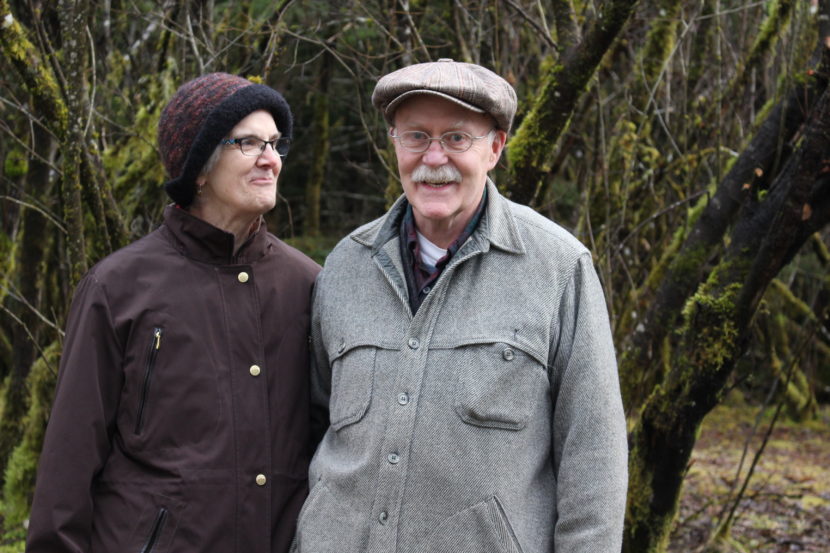
June Hall and Paul Disdier hope to start their marijuana business in their backyard on North Douglas. (Photo by Elizabeth Jenkins/KTOO)
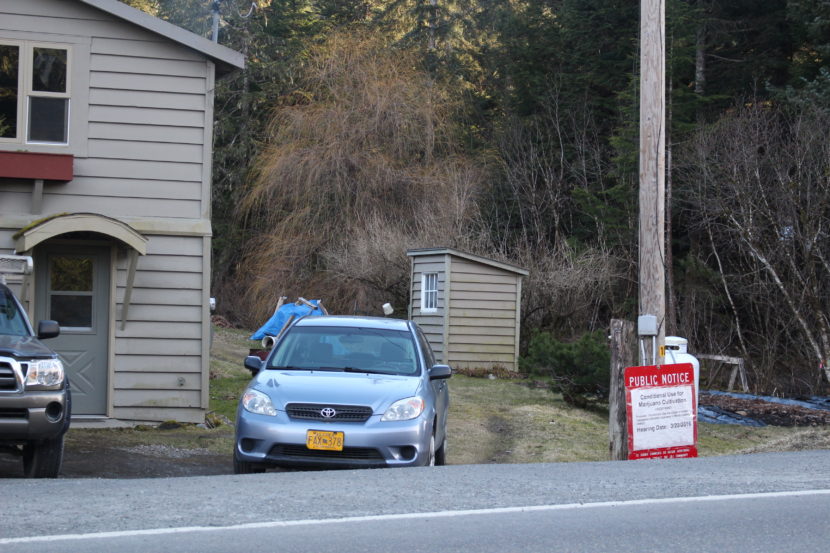
The Juneau Assembly voted back in November to allow limited cultivation on parts of North Douglas and other low-density areas. After one red public notice sign went up at the end of a driveway, it caught some in that neighborhood off guard.
Paul Disdier and wife June Hall have lived at their North Douglas home for over 40 years. Paul’s a retired painter and state employee. June was an art teacher at the University of Alaska Southeast. They say they built a good life here, raised kids. In retirement, they were looking forward to starting something new.
“The size of this building? It’s just going to be a little bit bigger than a one car garage. And that’s about the size of it,” Disdier said. “You know, I’ve said it again, but it’s one eighty-seventh of an acre. We have an acre and a half here.”
Paul and June are building a commercial marijuana facility on their property. At least, they’re trying to. The maximum size allowed in the low-density area is 500 square-feet. They haven’t completed the city permitting process yet. They want the Fireweed Factory to be a family business that will eventually supply their off-site retail store.
They say some of their closest neighbors are OK with it. But they realize not all of the neighbors on North Douglas are.
Before we get to that, let’s go back to how the couple started growing marijuana. It started in the mid-’70s, after the Alaska Supreme Court ruled in Ravin v. the State. That decision made it legal to grow pot for personal use, which Paul and June did. Now, they say it’s helped them with arthritis and the other ailments of aging.
“I just had a knee replaced and wasn’t making no progress as long as I was taking Oxycodone,” Disdier said. “Got off of that and starting making pills out of marijuana.”
So after the Juneau Assembly outlined commercial marijuana zoning, they thought home would be the perfect spot to start the business.
“Since living on North Douglas always seemed to be a place where, you know, you could take advantage of a large residential lot where you had privacy,” Hall said. “And I guess we thought maybe neighbors wouldn’t be as upset as they seem to be.”
Merry Ellefson said she didn’t realize marijuana legalization meant “fighting” to keep her neighborhood “free of industrial cultivation.”
Ellefson, along with a group of other neighbors, submitted around 137 names to the Juneau Assembly. It’s a petition that asks the city to ban commercial marijuana grows in low-density neighborhoods, like theirs. The names were collected from all over Juneau.
Ellefson has lived in North Douglas for 23 years. She said she’s not ideologically opposed to someone growing commercial marijuana, but it doesn’t mix with residential areas.
“I think it’s an issue, like I said, of, we’re not growing tomatoes. And I think that a marijuana cultivation is just that. I’m a coach, a coach at the high school. I’ve coached Nordic skiers. I have a child,” Ellefson said. “I don’t think that it’s conducive to a healthy community where we all pass by on our bikes.”
A member of the state marijuana control board thought Juneau may be the only municipality in Alaska to allow commercial marijuana growth in neighborhoods. But in February, the Skagway Assembly also adopted an ordinance allowing it in low-density neighborhoods.
For Ellefson, the decision flies in the face of Juneau’s city code to “provide a healthy, safe, and pleasant environment” for residents.
A red sign outside Paul Disdier and June Hall’s home announces their intent to obtain a conditional use permit to start a commercial marijuana grow. (Photo by Elizabeth Jenkins/KTOO)
The petitioners are concerned about bright grow lights, the smell and a possible uptick in crime for the all-cash business.
“Personal use: that’s people’s choices. Industrial and commercial belongs in industrial areas,” Ellefson said.
It’s unknown how many 500-square-foot grow houses could eventually crop up in North Douglas. And Ellefson said she’s worried about the zoning tearing the community apart.
“We’re putting in a shop after 23 years of trying to stay out of the rain, and a neighbor came over and wondered if it was going to be a commercial cultivation site,” Ellefson said. “And I don’t know, it’s just that sort of suspicion. What are you doing? Having to be aware of what’s going on in your neighborhood. It shifts the energy and it shifts the connectivity.”
June Hall and Paul Disdier haven’t broken ground yet. They’re waiting to see if their permit gets approved. Recently, an online counter petition supporting commercial marijuana business on North Douglas received 118 endorsements.
And the couple said a lot of neighbors have approached them to show solidarity. They’ve even received cards.
“We’ve been really encouraged. We couldn’t have kept going, honestly,” June Hall said.
After a long pause, Paul Disdier added:
“Without our friends. You know, they’re helping us out. We know a lot of people in this town. We’re honest people, honest business people,” he said, his voice cracking.
They said their facility will be self-contained. Smells won’t emanate next door. There are no noisy generators. You won’t even be able to see the lights.
Quiet retirees may not be what you imagine when you think of pot entrepreneurs.
“But I think we’re typical. My husband and I. And I think the people out here on North Douglas are like us. They’re not scary, lurking individuals,” Hall said.
They hope, when the novelty wears off, the neighbors won’t worry as much about what’s going on in other people’s yards.
In the mean time, the Juneau Assembly has reopened discussion about marijuana zoning in neighborhoods. It plans to meet as a committee of the whole on the topic at 6:30 p.m. Monday. The Juneau Planning Commission will consider the Fireweed Factory’s conditional use permit March 22.
Editor’s Note: A previous version stated: “A member of the state marijuana control board said Juneau may be the only municipality in Alaska to allow commercial marijuana growth in neighborhoods.” In February, the Skagway Assembly also adopted an ordinance allowing it in low-density neighborhoods. The story has been updated to reflect the changes.
Close
Update notification options
Subscribe to notifications
Subscribe
Get notifications about news related to the topics you care about. You can unsubscribe anytime.

 The Juneau Police Department is hosting an event Saturday to help heroin users and those who have lost someone to the drug. Hope, Not Heroin will have food, music and 31 booths with information about addiction and recovery.