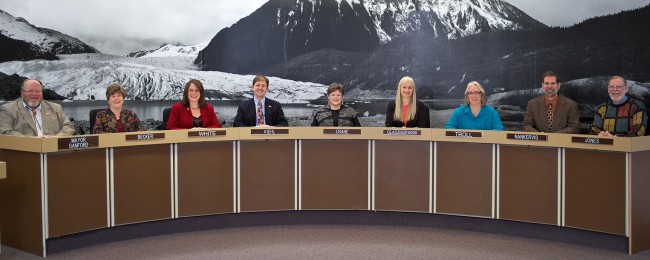
In a news release Monday, Juneau Assembly member Debbie White condemned mayoral candidate Karen Crane’s use of an old assembly photo on campaign materials.
The photo was from the city’s homepage and shows the nine-person assembly — which included Crane at the time — seated and smiling. White said she found out when a friend mistook it as her endorsement of Crane.
The photo used on Karen Crane’s campaign brochure. (Photo courtesy City and Borough of Juneau)
“I guess my biggest concern is that wasn’t hers photo to use. She didn’t have the permission of the people in that photo to use that photo and it’s very deceiving,” White said.
White’s press release says then-Mayor Merrill Sanford, current Mayor Mary Becker, and Assemblymember Jerry Nankervis also oppose the use of the image.
White endorses Crane’s opponent Ken Koelsch, and she feels like the use of her image, along with the other assembly members, could mislead voters. But Crane said that wasn’t her intention.
“There is absolutely nothing in my brochure that indicates that I am receiving any support from any person in that photograph,” Crane said. “It was just a photo of me at work.”
Crane using the image doesn’t violate city codes, according to city attorney Amy Mead. But White believes it could be a campaign violation under state law if it was paid for by public funds.
White said she plans to consult the Alaska Public Office Commission on the matter. At deadline, the commission didn’t have a complaint on record.
Correction: A previous version of this story misspelled Ken Koelsch’s name. We regret the error.
The new sign for the Supplemental Nutrition Assistance Program (SNAP) was unveiled May 19, 2010, at the Department of Agriculture in Washington, D.C. (Photo courtesy U.S. Department of Agriculture)
Applying for food stamps, or the Supplemental Nutrition Assistance Program, requires a 28-page application. But thanks to a new tool, finding out if you’re likely to be eligible takes only 10 text messages.
About 126,000 Alaskans are eligible to receive food stamps. More than one in four don’t because they haven’t applied. Anchorage resident Brendan Babb sees that as a problem not just for families who may be struggling, but for the state’s entire economy.
“It would be $65 million coming from the federal government into local communities because the money has an economic multiplying effect and is spent in the communities people are receiving it in. So it would impact Anchorage as well as very small rural villages,” Babb said.
Babb and a group of volunteers from Code for Anchorage thought the daunting application was part of the problem.
“If you go and look at a 28-page PDF you’re like, ‘Oh, I’ll do this later,’” he said. “I’m guilty of doing this. If a web page doesn’t load in 30 seconds you’re like, ‘Oh I’ll come back and do that.’”
Texting ‘food’ to 907-312-2300 lets you find out your SNAP eligibility in minutes.
So they developed a fast solution. Instead of filling out the whole application, you can answer 10 questions over text messages. You don’t need the internet or a smart phone. At the end, the free service tells you if you are likely eligible or not and connects you to local resources, like the state Division of Public Assistance or local food pantries. You can even request help applying if you qualify.
Text “food” to 907-312-2300. You can also answer the questions on a simple website.
Code for Anchorage provides other services via text message as well, like checking your SNAP balance and Anchorage bus tracking. Text ‘hi’ to 907-312-2080 to find out more.
A couple gave up their dog to Juneau’s animal shelter on a Saturday morning in December. That same evening, they had a change of heart and wanted the dog back, but it was too late. The dog had already been euthanized.
Gastineau Humane Society called the dog aggressive and not a viable candidate for adoption. The Juneau couple wishes they’d been notified before the dog was put down.
Coco was a small, long-haired Chihuahua mix. (Photo courtesy Gordon Garlock)
Gordon Garlock said Coco, a long-haired Chihuahua mix, slept in the bed with him and his wife every night.
“She was just our housedog. She stayed in the house all the time and she’d be sitting at the windowsill waiting for us to come home every day and be so excited. She was just a wonderful dog,” he said.
The 3-year-old small dog was great with their grandkids, Garlock said. They’d had Coco for two and a half years, but with Garlock and his wife retiring, moving to Nevada and planning to travel a lot, he said they made the decision to give the dog up. Garlock said he thought the shelter would find a nice home for Coco.
“Later that evening we got to thinking, ‘Boy, we’d just miss her too much.’ We talked it over and decided, ‘Well, heck, if it’s some place she can’t go with us, we just won’t go there,'” Garlock said.
When Garlock’s wife went back to the shelter Monday morning to bring Coco home, she was told the dog had been euthanized. Garlock wishes the shelter would notify former owners before an animal is put down.
“It seems like at least a courtesy call before you did something like that. You could at least called and asked if we wanted to make sure we didn’t want to get her back before you put her down,” Garlock said.
According to the shelter’s paperwork, Coco was dropped off around 9:45 a.m. on Dec. 12. Later that same day, the dog had been euthanized.
Gastineau Humane Society Executive Director Matt Musslewhite said what happened to Coco isn’t outside of normal operating procedures. Under certain circumstances, the nonprofit shelter will euthanize animals.
“Of course, if they pose a threat of safety to our staff, they’re obviously not going to be good candidates for potential adopters. We just can’t allow an animal that could possibly bite a child to be adopted out,” Musslewhite said.
Shelter records indicate Coco was growling upon entering the shelter. Staff members were unable to remove her leash or examine her because she was “snapping,” “lunging” and “charging.” A vet technician noted Coco “tried to bite her repeatedly.”
Garlock indicated in shelter paperwork Coco had exhibited aggressive behavior toward strangers. But he said Coco had never bitten anyone.
Animal control staff moved Coco to a dangerous dog kennel, according to shelter records. A vet tech originally wanted to give Coco “a few days to settle down.” But later that same day, the vet tech requested Coco be euthanized. The vet tech thought the risk of Coco biting someone was “too great” and didn’t think “she would ever be a candidate for adoption.”
Musslewhite was not involved in this particular case, but he said there’s no advantage to holding an aggressive dog in the shelter for multiple days in hopes of improvement.
“They get more and more aggressive as time goes on, so the longer that you hold them, the more they are a threat to animals around them, their own welfare. These animals can injure themselves in the kennels or they can injure staff members,” Musslewhite said.
A Juneau resident relayed part of Coco’s story on Facebook. She wrote, “I can’t believe they would kill a perfectly healthy dog.” Many people were outraged and there were hundreds of comments. Musslewhite said some shelter employees received death threats.
Gastineau Humane Society takes in animals from all over northern Southeast Alaska. There’s no time limit for how long an animal can stay in the shelter – some have stayed for as long as two years. Last year, 311 animals were adopted out.
Musslewhite said the vast majority of euthanasia cases involve animals who are at the end of their lives. The shelter euthanized 50 animals in 2015. This year so far, three animals have been put down. Most dogs that are relinquished to the shelter go through a medical exam and a behavior assessment before being put in the adoption program.
Musslewhite said senior staff members determine if dogs with behavior issues can be rehabilitated.
“The success of the animal and the welfare of the animal are our primary concern with this,” he said.
Musslewhite said it’s not uncommon for people to change their minds after relinquishing an animal. But once someone signs an owner release form, the animal becomes property of the humane society. That person loses the right to information about the animal. Musslewhite said if you were a new owner of an adopted pet, it would be unfair if the shelter gave your information to a previous owner.
“It’s important for us to draw a line there and say, ‘When you give up the rights to an animal, you give up the rights,’ and trust that we’re going to provide the care for the animal even if that means doing the humane thing and euthanizing it if it’s not a candidate for adoption,” Musslewhite said.
The owner release form that Coco’s owner signed did not explicitly lay out the possibility of euthanasia.
Musslewhite said the form was updated since then so that it does, though he said the change was not done in response to Coco’s case.
A sample of marijuana hash oil in the Alaska House Judiciary Committee, March 6, 2015. Law enforcement officials were holding a “show and tell” about drugs and associated paraphernalia. (Photo by Skip Gray/360 North)
The Juneau Assembly outlawed certain marijuana refining methods for personal use Monday night in a 5-3 vote.
Using methods based on butane and propane are not permitted. The concern is that flammable gases used to make hash oil could cause fires or explosions.
Approved methods include water-, alcohol- and food-based extraction, which could create marijuana infused butter, olive oil or liquor.
On Feb. 23, the Juneau Planning Commission will consider two North Douglas property owners’ commercial grow application. The commission is the gatekeeper for the conditional use permit they need to operate.
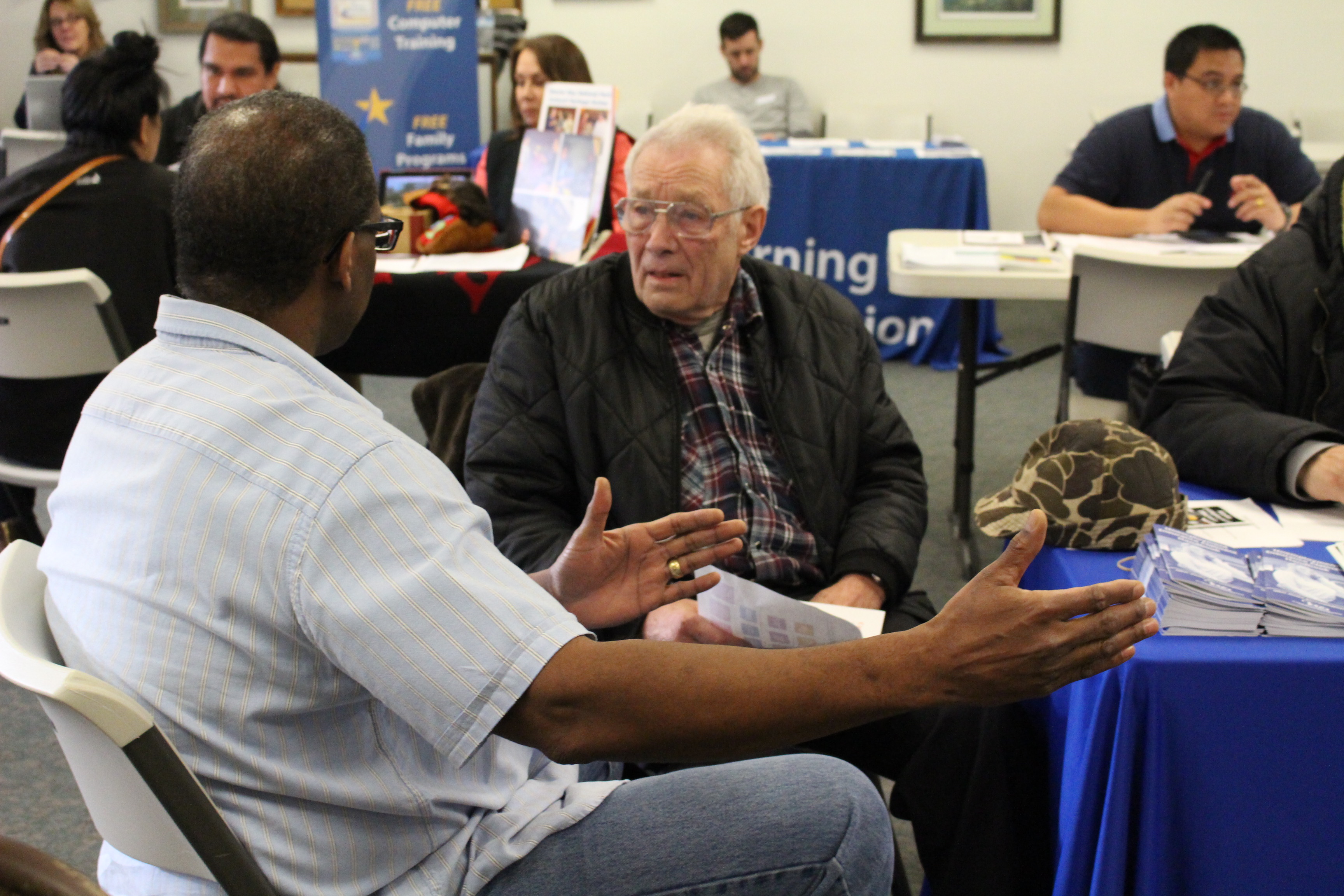
A Wal-Mart employee talks to a Juneau Job Center staffer during a Jan. 29 job fair. (Photo by Elizabeth Jenkins/KTOO)
Wal-Mart says it’s trying to do right by its soon-to-be-laid-off employees in Juneau. For example, it’s flying in trainers to help with job skills. But it’s also been strictly sticking to a corporate policy that left some outgoing employees in the dark about a state-organized job fair held specifically for its employees.
About a minute’s walk from Wal-Mart, a small room at Gruening Park has been transformed into a mini job fair. Up to 168 Juneau Wal-Mart employees could lose their jobs this week, so the state organized the Jan. 29 job fair to help.
“We’ve got TSA, Fred Meyer, Verizon, AT&T, Home Depot, and IGA,” said Ray Brogdon, an employee at the state’s unemployment office.
He says the hope is that Wal-Mart associates can find new jobs before they have to step into his office.
And at about an hour into the event, prospects look good. Some Wal-Mart associates who walked through the door already landed a job interview. But for one of Juneau’s largest employers to be shutting down…
“It’s a little slow right now but we’re looking at probably around 12 o’clock, until we’re done here until 2 p.m., that it should start picking up and hopefully be able to assist everyone that comes in,” Brogdon said.
In the afternoon, it does pick up. And Wal-Mart associate, Bradford Rich, goes from booth to booth to speak to the stores hiring. He found out about the job fair the same way he discovered Wal-Mart was closing: he read about it on Facebook.
“And some other my coworkers had seen it, and we all talked about it. I didn’t realize it was specifically put on for us until I read the whole shebang,” Rich said.
Wal-Mart announced it was closing 154 of its stores in the U.S. in January–potentially laying off 10,000 employees. And Juneau was on that list.
Rich, who’s worked at Wal-Mart for two years, says the news hit him hard.
“Best way to describe it as a family member died. It’s that kind of feeling of loss,” Rich said. “I’m full grown and when I went to work for them I had planned on working there until I retired. And like I said, we didn’t know until that Friday that they were closing down so it was like a death in the family.”
So he says he was excited when he heard the Department of Labor was organizing the jobs event. Rich is a manager at Wal-Mart’s deli. And he wants to find something similar at one of the other stores in town.
But, working his shift at Wal-Mart, he couldn’t find any information that the job fair was even happening.
“They would not allow us to have any job fair. They are going to give us a class on resumes and that’s going to be done at the store. But they will not support the Department of Labor to come into the store,” Rich said.
“Yes, I had heard that,” said Heidi Drygas, the head of the state Department of Labor. “I had heard they had requested that we not be on the premises.”
She says it’s not uncommon for the state to organize this type of response in communities facing mass layoffs. In Bethel, when the Swanson’s grocery store shut down, displacing 80 employees, the Department of Labor stepped in to help with job relocation.
“Typically, employers welcome that sort of interaction with a state agency tasked with reemploying workers so not sure why there was that… I don’t want to say resistance, just decision on behalf of Wal-Mart management,” Drygas said.
A Tlingit-Haida Regional Housing Authority staffer assists a Wal-Mart associate at the job fair. (Photo by Elizabeth Jenkins/KTOO)
Wal-Mart’s corporate spokesperson says there’s a company policy that forbids outside groups from engaging in any demonstration and soliciting or distributing literature at their stores. That includes the state’s job fair flyers. But Wal-Mart is flying in development trainers to help employees with resumes.
Lisa Mielke, the statewide rapid response coordinator, said she wasn’t at the meeting between Wal-Mart and the Department of Labor. The Juneau Job Center was, but officials declined to comment for this story. And Mielke says she’s not sure why the job center wouldn’t talk.
“We have Wal-Marts through Alaska and they’re a big employer that hire lots of people,” Mielke said. “And so we have a good working relationship with them.”
Wal-Mart has 12 other stores in Alaska.
Mielke says the Department of Labor did everything it could to get the word out about the job fair. Staff placed flyers in bus stops, convenience stores — even inside Safeway and Fred Meyer.
Still, one Wal-Mart associate I spoke with didn’t know it was happening, and she missed it.
In all, about 20 Wal-Mart employees scored new jobs from attending the job fair. Magesty Tauay was one of them.
“Well, I like to socialize with people. I like to get along with people. I make friends easily. I don’t have to get used to them,” said Tauay. “I just walk up and said, ‘Hey, I’m Magesty. Nice meeting. You have a wonderful day.’”
She says Fred Meyer and Home Depot offered her a job. And she needs it, because she sends money back to her family in American Somoa.
“Every paycheck I have, if I have that much, I send my parents money. But if they do really need it, I don’t care about myself or anything. All I care about is my parents,” she said.
And she says she heard about the job fair at a meeting that morning at Wal-Mart.
But Bradford Rich says he wishes Wal-Mart would have done more to promote the event.
“I would have appreciated it if they had done that. I just want to thank the people that did this here. ‘Cause at least we did have something to go to,” Rich said.
The Department of Labor plans to hold another job fair for Wal-Mart’s employees after the store closes this week.
The First Alaskans Institute hosted a Racial Equity Summit in Anchorage this week. The event’s dialogues focused on what racial equity is and how we can start to achieve it.
Panelists from around the world discuss steps toward achieving racial equity during a recent Anchorage Summit. (Photo by Anne Hillman/KSKA)
Racial equity and racial equality are not the same thing. Equality means everyone is treated the same or given the same resources. It assumes that everyone starts at the same point. Equity means making sure everyone can arrive at the same point, no matter where they start.
Gyasi Ross is a member of the Blackfeet Nation and lives in Washington. He speaks on social justice and race issues and presented at the summit. He says to achieve racial equity, communities first need to acknowledge that underlying systems deny people of color equal starting points.
“We think that now we have this quote-unquote colorblind society — which doesn’t exist but even if it did exist, so what? The foundation wasn’t colorblind. The foundation wasn’t equal. And that creates a structure that’s on an unequal playing field, an asymmetrical playing field from the very start.”
He gives the example of land ownership. Black people in the United States couldn’t own land until the late 1800s. As a result, whites currently own about 850 million acres of agricultural land. Blacks — just 7 million. Ross says to change that basic inequality, people with privilege need to be OK with losing some of their privilege. But that’s not an easy thing to talk about.
“The point is that equity as a serious conversation, and there might be uncomfortable conversations and some level of displacement, and we have to be OK with that,” Ross says.
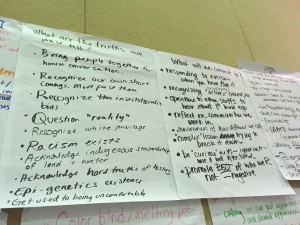
Sheets of paper hold lists of ideas gathered during a two-day racial equity summit in Anchorage. (Photo by Anne Hillman/KSKA)
So how do we get beyond that discomfort? Summit speaker Jay Smooth, who speaks and writes about race and culture, says we need to change how we frame the conversation.
“We tend to frame each conversation as a referendum on whether I am a good or bad person. And if I’m a good person then I don’t need to consider whether I’m prejudice or have any blind spots toward people or whether I’m part of a system that perpetuates injustice even if I’m not consciously contributing to that.”
Smooth says people need to think beyond good versus bad and be actively looking for our own unconscious biases and the ways we perpetuate racist systems.
But for some Alaskans, like extension officer Kari van Delden from Nome, that means first identifying why the conversation is so hard to have. She’s white and helps host conversations about race in her community with Panganga Pungowiyi, the director of Kawerak’s Wellness Program.
“For a long time I was really uncomfortable talking about anything around racial issues,” van Delden says. “So I had to start trying to figure out why is this an uncomfortable conversation for me. And there were a lot of things like I would find myself feeling like I needed to defend something or feeling like somebody would misunderstand me. So I had to start understanding why I was backing away from the conversations or avoiding them before I could even start having the conversations.”
Pungowiyi says one of the first steps for talking about race is acknowledging the history of external and internalized oppression.
“True history about Alaska Native people is not taught, and when that history is kept from you and you don’t know how your families and your communities have gotten into the situation that they’re in with all these symptoms of historic trauma manifesting, like alcoholism, like abuse, like violence. All of these things. The high suicide rate. When you don’t realize there’s a reason for all these things, you become internally oppressed. You just feel inferior.”
Pungowiyi says it’s a feeling you have to heal from–it’s part of a community-wide healing process. She tries to incorporate conversations about race into all aspects of life in Nome. Because if people can talk about it, they can make systems more equitable for everyone.
The First Alaskans Institute hosted the two-day conference in Anchorage as part of its ongoing work on racial equity.
Close
Update notification options
Subscribe to notifications
Subscribe
Get notifications about news related to the topics you care about. You can unsubscribe anytime.