The Skagway Borough Assembly Thursday voted to send a letter expressing concern with a private company spraying herbicide within the town site. Some residents are apprehensive the chemicals could put Skagway’s drinking water quality at risk.
White Pass and Yukon Route Railroad is contracting with another company to spray an herbicide call Oust along tracks this summer. The goal is to cut down on weeds and vegetation to facilitate drainage in the rail bed and clear visual or physical obstacles. Tyler Rose works for White Pass. At Thursday’s assembly meeting, he said clearing weeds is necessary for passenger safety.
“We said this many times, we haul over 400,000 passengers,” Rose said. “The safety of the right-of-way is of the utmost importance to us.”
But some community and assembly members have a different safety concern.
“We’re trying to become a cleaner community,” said Assemblyman Steve Burnham Jr., who helped draft an ordinance in 2014 that put restrictions on herbicides in the borough.
At the time, White Pass was planning to spray Roundup along tracks. The company indefinitely postponed that action in 2014. But recently, White Pass announced that they were again planning to spray Roundup. After another public outcry, the railroad switched herbicides, from Roundup to Oust.
Burnham said he appreciates the gesture. But he’s still concerned.
“I think that is really not what the community wanted when they were sending us letters two years ago about this issue,” he said. “They were concerned about our water quality, our environment, health of the people.”
Water quality seems to be the major concern. Lettersfrom residents note that Skagway has a reputation for pristine drinking water. The town has a waiver from the Alaska Department of Environmental Conservation that relieves the public water system from testing for synthetic organic chemical contaminants – which include herbicides.
Burnham and others worry the spraying could jeopardize Skagway’s clean water exemption and put them on the line for costly testing, or more.
“I think that would be the worst case scenario,” Burnham said. “If things cascade, we’re most likely gonna end up with a source water treatment plant in the next 30 years anyway, but it could significantly increase the need for that.”
Assembly members unanimously agreed to direct the borough attorney to send a letter to White Pass. The letter will voice the assembly’s concern with herbicide spraying in the town-site, south of the 2A Bridge.
White Pass’s Tyler Rose expressed frustration at the meeting. He said they’re trying to be good neighbors by choosing an herbicide that is not in the list of restricted chemicals in local Code. White Pass maintains that since the area they’re working in is a federal right-of-way, it is not subject to local regulations.
White Pass and the herbicide applicator company held a forum right before the assembly meeting to address concerns. Rose said they talked about the ‘widespread’ use of Oust by other railroads and companies.
“And one of the questions we didn’t have answered with what has DOT used, what have other entities used,” Rose said. “Our own municipality has used some of these things, though not on an industrial scale. It’s just very frustrating for us to be treated a little bit differently at time(s), it seems. And we are trying to be as best we can, be good neighbors, but meet those responsibilities.”
Rose told KHNS Friday that White Pass plans to go forward with spraying. He said it will happen ‘sometime in the next three weeks.’
“Right now what we’re planning to do is the entirety of the active line, which would be from Skagway to Carcross,” Rose said.
Also at Thursday’s meeting, the assembly approved the FY ’17 borough budget after a fourth reading.
The assembly postponed discussion about using cruise passenger head taxes to pay for a new water well and tank. That topic may be revisited at the next meeting, on July 7.
The PrideFest 2016 logo. (Courtesy of Identity, Inc.)
Anchorage PrideFest will have increased security this year and will include memorials for the victims of Sunday’s mass shooting at a gay nightclub in Orlando.
Anchorage’s annual PrideFest celebrates the local LGBT community, but this year the celebration is tinged with both sadness and weariness. Drew Phoenix, the director of Identity Inc, said he spoke with the Anchorage Police Department, the mayor’s office and the FBI about increased security during the eight-day event.
“We’re putting safeguards into place and letting people know that all of these agencies take it very seriously. They support us. They are with us. And throughout PrideFest Week, and particularly on the 25th (during the Pride Festival and Parade), there will be extra law enforcement officers providing safety.”
Phoenix said the shooting in Orlando increases his concerns about the community’s safety “because you think, ‘Aw, nothing’s going to happen here in Anchorage.’ But I’m sure all of our LGBT family and friends thought the same. Who would ever think that someone would do something horrific like that? So I take that very seriously as one of our LGBT leaders.”
Phoenix said they’ve also added multiple memorials and moments of silence to the week’s events to commemorate the victims. But he said honoring the victims is about more than remembering them — it’s about taking action to promote the safety of all LGBT communities by creating statewide protections and increasing awareness of LGBT issues.
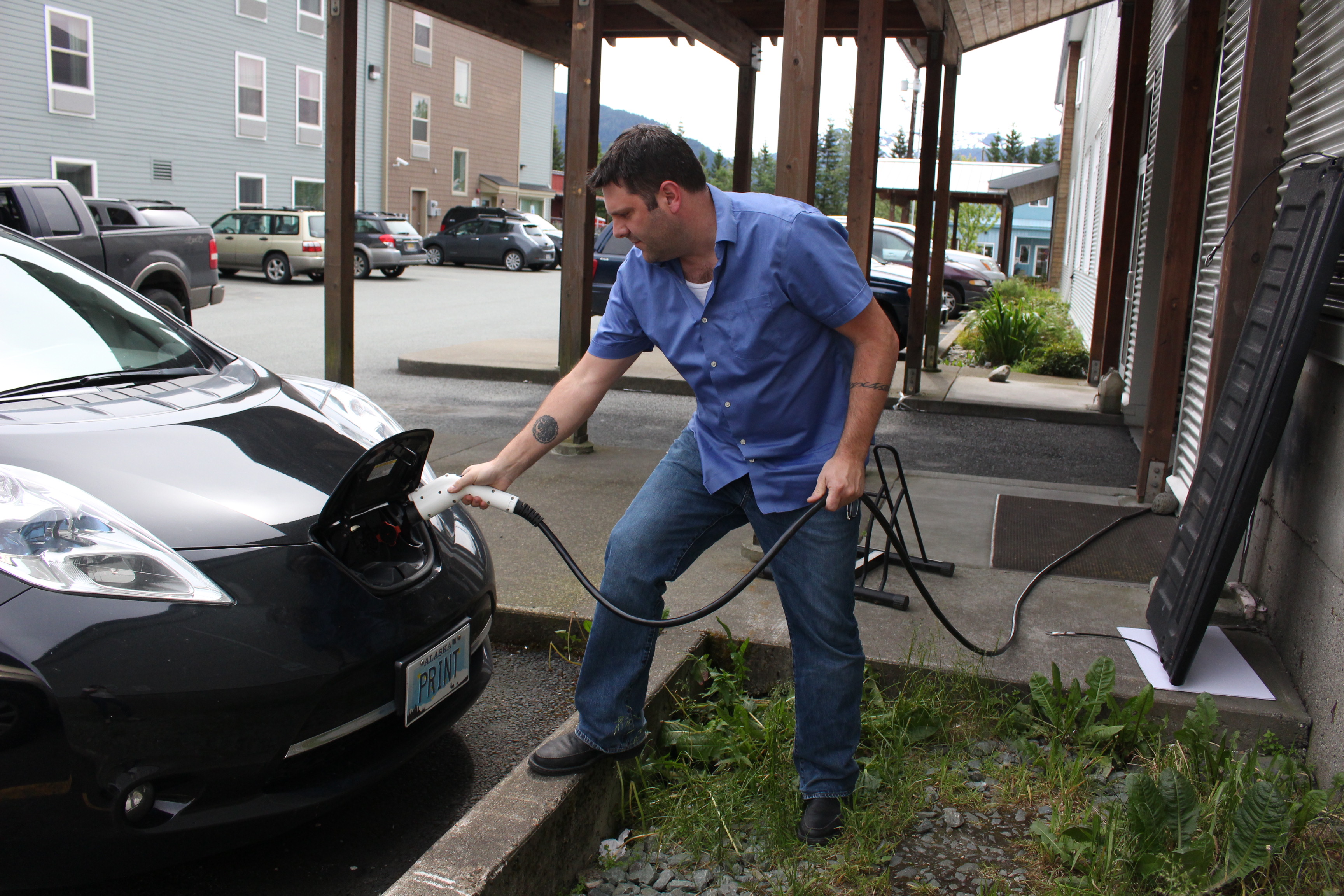
McCain hasn’t been to the gas pump in months — ever since he bought the all electric Nissan Leaf. When he bought the car back in February, he tried to shop locally.
“I went to all the dealerships in town and said, What can you do that’s similar to the Nissan Leaf?’ And nobody quite had the answer,” McCain said.
So he bought one from Washington and had it barged up. He says he wanted the car to help cut fuel costs — the electricity for the vehicle is only about 2 cents a mile. The positive environmental impact was the icing on cake. In Southeast, there’s one thing he doesn’t have to worry about, and it’s something that does worry drivers in the Lower 48.
“Range anxiety. That’s associated with the car, which I never really had,” McCain said. “It’s Juneau, if I get stuck somewhere, oh, well. I’ll call a friend.”
But even that scenario is unlikely because along Juneau’s nearly 60 miles a road, there are a lot of plugs.
Alec Mesdag, a director at the Alaska Electric Light & Power Company, runs down a list of ten public charging stations.
In 2014, he worked with the city’s economic development council to help identify the locations for the charging stations, which were grant funded.
Mesdag says at first some criticized the charging stations as a handout. The electricity is free, and the city doesn’t give away gasoline.
“While that analogy is out there, the biggest difference is the expense is so different,” Mesdag said. “It would literally cost the city more to administer the collection of funds than to give the electricity away.”
Mesdag says Alaska’s capital currently ranks with places like Austin, Texas and Portland, Oregon when it comes to plugs per capita, but he thinks Juneau has the advantage.
“In all honesty, we’re better suited for the vehicles than a lot of those other communities,” Mesdag said.
What some see as an oddity — the city’s remoteness — is actually a superpower for electric vehicles. There’s just not that far to drive. Still, it can be a pain to ship cars here or have them repaired. Groups in Juneau and Sitka are trying to organize regular visits from technicians. Soon, there might be enough electric cars to warrant the trip.
Mesdag says there’s a new Nissan Leaf arriving just about every week. There are about 50 fully electric vehicles, or EVs, now.
“We’ll be close to 100 EVs in Juneau by the end of the year,” Mesdag said.
This couldn’t work everywhere in the state. Fully electric vehicles can have issues in colder climates. Furthermore, it requires cheap — or relatively cheap — electricity, which means it doesn’t make sense in regions that rely on expensive diesel. But in Southeast communities with lower-cost hydropower like Juneau, Sitka and Petersburg, electric vehicles pencil out.
Mesdag thinks they could start to become the new norm.
“A year ago, I would have been less sure this was going to happen, but now people seem to be developing a pretty strong comfort-level with the vehicles,” Mesdag said. “Word of mouth is a big sales tool. And we have a lot of people who own these vehicles now, and they’re pretty happy with their experience.”
Travis McCain says he doesn’t feel like he’s given anything up driving a fully electric car. (Photo by Elizabeth Jenkins/KTOO)
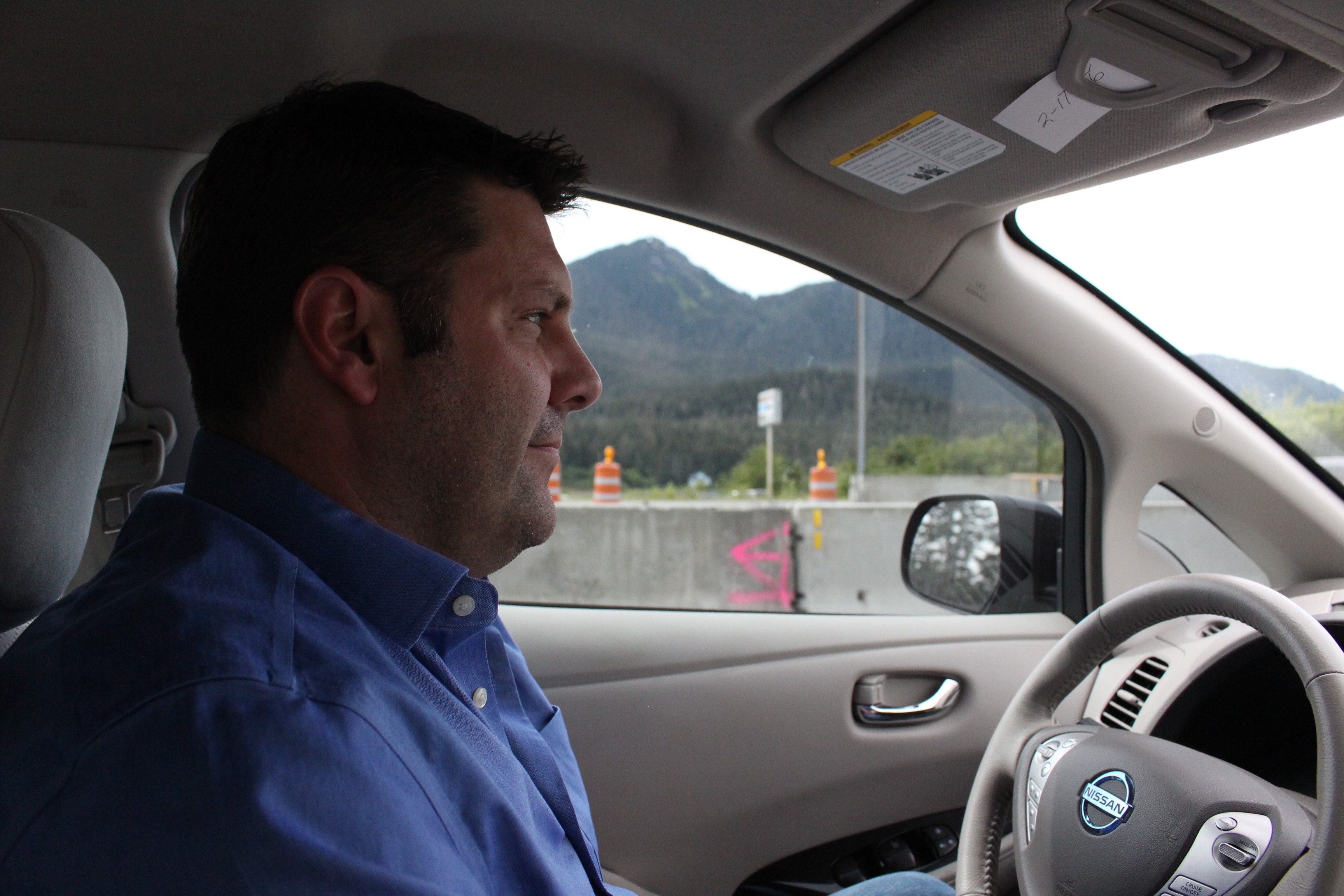
Back on the road in his Nissan Leaf, Travis McCain is going down the list of five people he’s converted to the church of EV, including his sister and fiancé.
He still keeps a truck around to haul his boat, but the Leaf has become his primary vehicle. It’s changed the way he looks at other cars.
“On a nice day even like today, I’ve noticed that I might typically drive with the windows down,” McCain said. “And then as I pull up to an intersection, I put my windows up so I don’t have to smell other’s car exhaust. Getting finicky!”
McCain is in the process of buying another Leaf. It’ll be a delivery car for his business.
Sen. Orrin Hatch speaks during Muhammad Ali’s memorial service in Louisville, Ky. Hatch said they became friends after the boxer came to visit him on Capitol Hill and that their friendship likely puzzled observers. David Goldman/AP
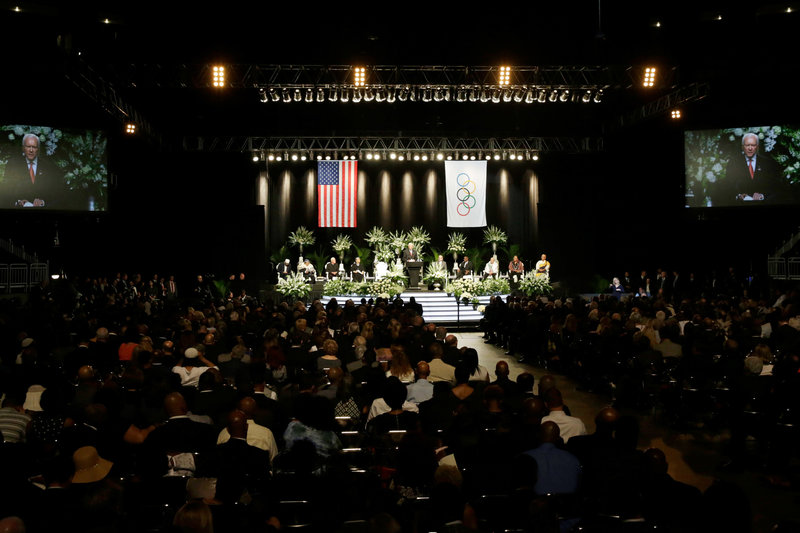
A hometown hero is being laid to rest in Louisville, Ky., as Muhammad Ali, the boxer and humanitarian, is buried Friday. Fans came to the city from far and wide to pay their respects as Ali’s body passed by on its way to a private burial.
Ali died one week ago, at age 74; at a memorial service in the KFC Yum Center in downtown Louisville, the friends he’d chosen to speak — including Billy Crystal, Bryant Gumbel and Sen. Orrin Hatch — discussed Ali’s talents and, more especially, his expansive humanity and his navigation of a troubled era in America’s history.
You can hear the event as part of an NPR special hosted by Melissa Block (see link above). The memorial also featured eulogies from Ali’s wife, Lonnie, and Louisville restaurateur John Ramsey. Religious and cultural leaders also spoke. The final eulogy was delivered by former President Bill Clinton.
Update at 5:55 p.m. ET: Bill Clinton
Clinton begins his remarks by picturing what Ali might say: “Well, I thought I should be eulogized by at least one president.”
He then tells Lonnie Ali, “I thank you for making the second half of his life greater than the first.”
Clinton says he hopes every young person present will do what Ali did: “write his own story.”
He recalls being a kid thinking about how smart Ali was. Despite being a “universal solider for our common humanity,” Clinton says that he always thought of Ali as a “truly free man of faith.”
He later adds that the second half of Ali’s life was the most important, in part because he refused to be imprisoned by Parkinson’s disease.
As part of his recollections about Ali, Clinton says the former boxer once broke up a serious speech the former president was giving by putting two fingers up behind Clinton’s head as he spoke.
Near the end of his speech, Clinton recalls watching Ali light the Olympic flame in Atlanta back in 1996 – and in a rousing moment, he says he was convinced beyond a doubt that Ali, hands and legs trembling, would light the torch and start the competition for hundreds of the world’s best athletes.
Update at 5:45 p.m. ET: Bryant Gumbel
After saying that Ali’s legacy will include how he made people feel, Gumbel says that for young black men who were struggling to make the most of their lives, Ali “gave us levels of strength and courage we didn’t even know we had.”
Gumbel praises Ali for taking on – and overcoming — difficult struggles without changing his nature or become anything other than what he was.
Then he quotes musician Lauryn Hill: “Consequence is no coincidence.”
Update at 5:30 p.m. ET: Billy Crystal
“Thank you ladies and gentlemen – we’re at the halfway point,” Crystal says, drawing a laugh from the crowd that’s now been in the arena for hours.
He then says that when Ali died, “the world stopped,” and Crystal thought back to when they first met in 1974.
At the time, Crystal says, he was a young comedian whose act included an imitation of Ali and legendary broadcaster Howard Cosell.
Crystal also recalls Ali’s strong stance against the Vietnam War — a conflict that was sending America’s young men like him off to war.
“It was Ali who stood up for us,” Crystal said, “by standing up for himself.”
Crystal then recreates the Cosell-Ali bit that centered on the bout with George Foreman in Zaire.
“When I was done, he gave me this big bear hug,” Crystal says, “and he whispered in my ear, ‘You’re my little brother.'”
It became what Ali always called Crystal.
Ali’s message, Crystal says, was that “Life is best when you build bridges between people — not walls.”
“He is gone, but he will never die; he was my big brother,” Crystal says.
Update at 5:20 p.m. ET: John Ramsey Of Louisville’s Ringside Cafe
Praising his ties to Louisville, Ramsey breaks into an Ali impression to say, “How can we lose, with the stuff we use?”
He then talks about “the Ali magic” — the boxer’s ability to connect with people.
Ramsey recalls how he visited the 2000 Olympics with Ali — and how after a boxing match, as cameras caught Ali posing with the winner of the fight, Ali insisted they go visit the loser.
Describing the scene of a bloodied athlete who’d been left alone, Ramsey says the young man immediately brightened when Ali walked in.
“I saw what you did out there, you looked good,” the Champ told the kid, according to Ramsey.
When Ramsey later praised Ali’s courtesy and thoughtfulness by saying, “Muhammad, you’re the greatest,” the boxing legend’s answer was simple: “Man, tell me something I don’t already know.”
Ramsey, you might be able to tell, has a knack for telling stories.
Update at 4:55 p.m. ET: Lonnie Ali
After taking the podium to a loud welcome, Ali’s widow, wearing a broad black hat that obscures her eyes, Lonnie Ali thanks everyone who has come to honor and say farewell to her husband. And she thanks people from around the world who’ve sent prayers via social media.
Recounting the story of how a police officer named Joe Martin helped a 12-year-old Cassius Clay get interested in boxing, Lonnie says it’s a reminder that, “When a cop and an inner-city kid talk to each other, then miracles can happen.”
She then goes on to recount the times Ali faced, from the death of Emmett Till, Malcolm X, and Martin Luther King Jr. to the reign of apartheid in South Africa.
The message, she says, is that “adversity can make you stronger” — that it shouldn’t “rob you of your dreams.”
Update at 4:45 p.m. ET: Valerie Jarrett
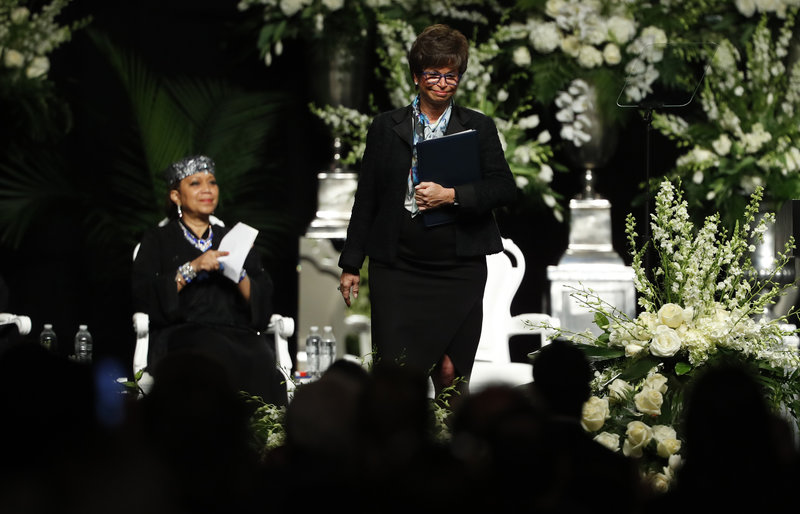
White House special advisor Valerie Jarrett, who will read a statement from President Obama, notes that her family has a connection to Ali, via her uncle.
She then reads a letter from Obama that recalls 1980, when Ali was set on one last comeback, against Larry Holmes.
Valerie Jarrett, speaking on behalf of President Obama during the memorial service, noted the love people had for the champ, saying, “You couldn’t have made him up — and yes, he was pretty, too.” (Photo by Aaron P. Bernstein/Getty Images)
In the letter, Obama notes that at 4 a.m., after Ali had lost the fight an attendant at the boxing ring told a reporter that he had bet on Ali, despite the long odds against him. When asked why, the man said, “I owe the man for giving me my dignity.”
Continuing to read the president’s message about Ali, Jarrett notes the love people had for the champ, and says, “You couldn’t have made him up — and yes, he was pretty, too.”
Jarrett later adds that Ali was a brash and loud voice “in a Jim Crow world.”
Noting Ali’s anti-war stance in the 1960s, Jarrett says Ali was intent on helping others who were struggling, rather than leave the country on his own to escape being stripped of his boxing career.
The message from Obama then notes how Ali lended his dignity to many in America — and helped inspire Obama to believe he could be president.
Update at 4:40 p.m. ET: Attallah Shabazz
Attallah Shabazz, the daughter of Malcolm X, discusses Ali’s relationship with her father.
“As the last of the fraternity reaches the heavens,” Shabazz says she pines for a “tribe” of people with purpose and confidence and glory.
Citing her father’s familiar farewell — “May we meet again in the light of understanding” — Shabazz says she hopes that can happen, “by any means necessary.’
Update at 4:10 p.m. ET: Chief Sidney Hill and Chief Oren Lyons
Chief Sidney Hill, Tadodaho of Onondaga Indian Nation, speaks next, along with Chief Oren Lyons, the Faithkeeper of the Turtle Clan of the Onondaga Nation.
Lyons says they’ve come to honor Ali’s work, “and for the rights and dignity of people of color and the common man.”
He adds that Ali always supported indigenous people’s rights in the U.S.
“We know what he was up against,” Lyons says of Ali, “because we’ve had 524 years of survival training, ourselves.”
Update at 4 p.m. ET: Rabbi Michael Lerner
Rabbi Michael Lerner recounts how both he and Ali were indicted on federal charges for their stances on the Vietnam War. He then says Ali’s stature grew beyond boxing because of his moral integrity, his willingness to risk everything.
“How do we honor Muhammad Ali?” Lerner asked.
“The way to honor Muhammad Ali is to be Muhammad Ali”, Lerner says — something he says includes speaking truth to power.
Lerner then receives rounds of applause as he reels off a list of social issues that need to be addressed — from wealth redistribution to fair sentencing to banning corporate and private money from politics.
Update at 3:45 p.m. ET: Muslim Scholar Speaks
Serving Muhammad Ali, Muslim scholar Dr. Timothy Gianotti says, was “one of the greatest privileges of my life.”
The initial group of eight speakers includes Sen. Orrin Hatch, R-Utah. He began by recounting Ali’s words after beating Sonny Liston: “I am the greatest.”
Hatch then says, “In the world of boxing, he truly was the greatest.”
He then adds that he became a personal friend of Ali’s after the boxer came to visit him on Capitol Hill. And he acknowledges that their friendship likely puzzled observers.
“We were both devoted to our families, and devoted to our faiths,” Hatch says.
“Our differences fortified our friendship,” he adds, “they did not define it.”
Our original post continues:
The official program highlights this quote from Ali:
“Service to others is the rent you pay for your room here on Earth.”
Ali will be buried at the Cave Hill Cemetery, in a private ceremony. But today is a celebration of a man who fought battles in and outside the ring. It was the boxer’s own wish for his funeral to offer a chance for his legions of fans to say farewell.
Thousands of well-wishers got a chance to see the black Cadillac bearing Ali’s body today; spectators tossed flowers onto the hood and windshield of the car. The hearse drove past Ali’s boyhood home and onto the street that was named for him.
One person held a sign reading, “Thanks for all the memories.”
A Haida mask that went to auction in Paris. (Screenshot)
The Paris auction, orchestrated by the company Eve, wasn’t just about selling old relics. Members of the tribes whose ancestors made these artifacts say they are living beings and the spirits of their ancestors are inside of them.
Crystal Kaakeeyáa Worl was in Paris selling her own artwork when she heard about the auction. Worl, her brother and the owners of the gallery hosting them joined a crowd of about 20 people at the auction house to protest.
Worl said she was allowed to sit in on the auction but was warned she would be removed if she made trouble. She said she wouldn’t and sat down.
“For me to be in that room and see the items, I couldn’t get up close to them, I couldn’t touch them, but to see them from a distance and to let them know that I was there before they went into these private collectors’ homes — that was meaningful.”
Worl said these sacred objects were made to identify clans and to document their history; they’re still used in special ceremonies today. She believes they are living people.
“Specifically, the Tlingit people, we don’t have a word for art. For our objects that were used for ceremony and objects that were sacred we called at.óow, which is our sacred objects, which the auction was selling a lot of those items,” Worl explained.
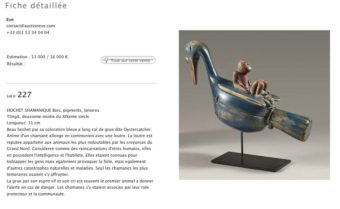
Chuck Smythe is the director of the Culture and History Department at the Sealaska Heritage Institute. He found about 10 Tlingit and Haida artifacts that were put on the auction block. A Tlingit piece was near the top of his stack of printouts. Smythe said it’s a shaman’s rattle.
A Tlingit shaman’s rattle that went to auction in Paris. (Screenshot)
“It’s item number 227,” Smythe said. “It was used in the past and continues to be used today as items which brings spirits to ceremonies, particularly helping spirits that benefit people.”
Smythe said, at auction, objects like the rattle typically sell anywhere between tens of thousands and hundreds of thousands of dollars. He’s heard of a war helmet that sold for just under $3 million. These objects may be sacred to Worl and tribes throughout America but, Smythe said, to collectors they’re just pieces of history, and the tribes who made them are dead and gone.
“They’re not aware of the living cultural communities that still use these items and have used them continuously,” Smythe said.
Smythe said, he remembers one instance when a foundation bought a number of Native American artifacts at auction in Paris and then returned them to the tribes. But, he said that was “highly unusual.”
As for international repatriation, he said the United Nations’ Universal Declaration of Human Rights has provisions to protect cultural property. But he said it is weak on enforcement.
In the United States, it’s illegal for federally funded museums, agencies and schools to sell sacred Native American objects. The Native American Graves Protection and Repatriation Act or NAGPRA requires sacred objects be returned to the tribes when they ask for them. The law doesn’t apply to private collectors and it doesn’t mean anything in France.
“What I learned in France is the only way we could withdraw or stall an item from being auctioned is to provide some kind of hard evidence for them that the item was stolen,” Worl said.
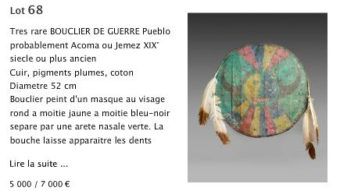
Worl said an Acoma Pueblo war shield was proven to have possibly been stolen and it was removed from the auction. As for the Tlingit at.óow, the fact they were in Paris was all the proof she needed.
An Acoma Pueblo war shield that may have been stolen was pulled from the Paris auction. (Photo courtesy of the company Eve)
“We would never sell an object like that. That is evidence that these were stolen items,” Worl said.
But that argument probably wouldn’t fly in French court. Worl said the auction house never responded to requests from around the U.S. to halt the auction and it didn’t acknowledge the protesters.
She believes the best way to prevent more Native artifacts from being sold abroad is to teach people about Native culture and explain how important their sacred objects are to them. She said that’s one of the reasons she protested.
“Maybe one of the buyers that was there that saw us, maybe they will decide to return the item they bought to the right community,” Worl said.
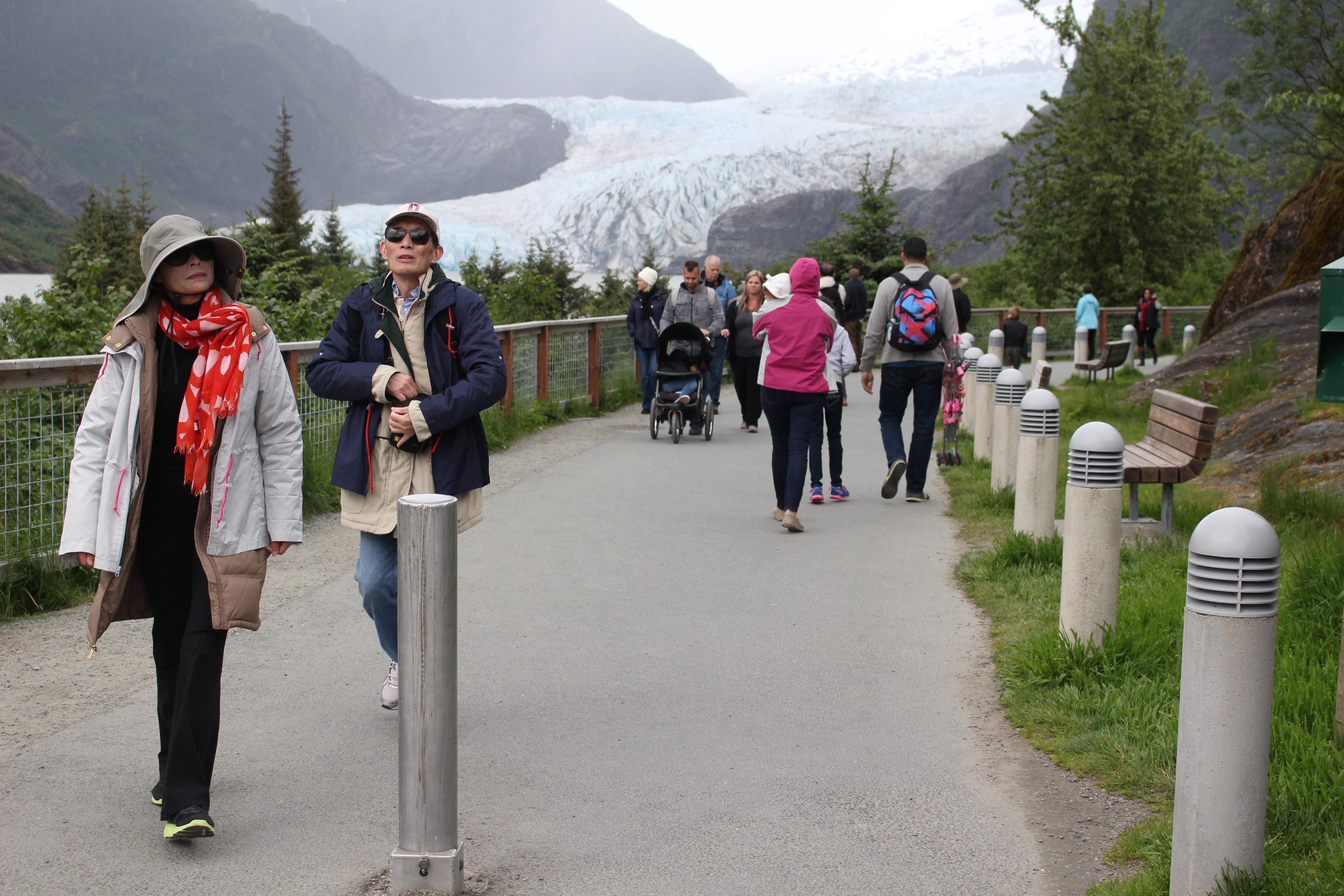
About 80 percent of the people who come to the Mendenhall Glacier in the summer are tourists. (Photo by Elizabeth Jenkins/KTOO)
On a busy summer day, thousands of people — mostly cruise ship passengers — visit Juneau’s Mendenhall Glacier. The U.S. Forest Service wants those tourists to take in the dramatic views, but also consider why the glacier is shrinking. Visitor center director John Neary is making it his personal mission.
That means trying to make the message stick — long after the tourists are gone.
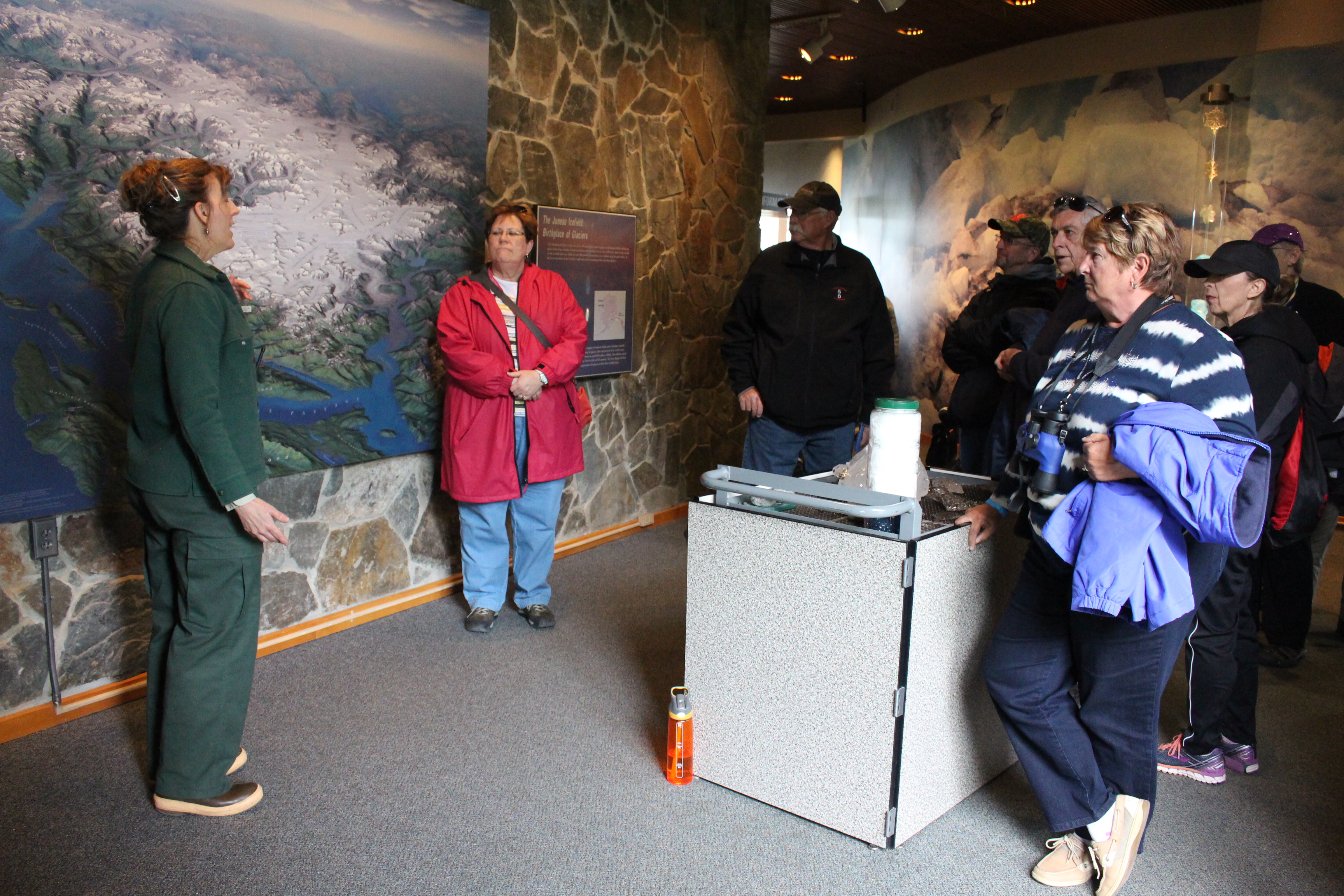
In a wing of the Mendenhall Glacier Visitor Center a small crowd of onlookers is watching a debate between a man and an employee about climate change. The tourist is wearing a floppy hat and red shirt. He’s leaning on a silver tipped cane as he listens, waiting for a chance to respond.
Kat Pratt, a ranger and interpreter, was delivering talking points on sea level rise when the man — who didn’t want to give his name — challenged her. He thought rising temperatures are cyclical, not caused by people. And the climate change scientists are paid off by environmental groups.
It goes on like this for about 15 minutes. Until they move onto something they both agree on: The glacier looks blue. Pratt seems unfazed.
“I get it about once a day usually and some of them get more confrontational. Maybe some not educated as that last gentleman, and there’s a lot to learn,” she said.
She said it encourages her to do more research, and she learns how to talk to visitors from different backgrounds. Many have never seen a glacier before and haven’t been confronted with the effects of climate change. Aside, from say, experiencing a hot summer.
Kat Pratt talks about the effects of climate change inside the Mendenhall Glacier Visitor Center. (Photo by Elizabeth Jenkins/KTOO)
“It became our central topic really just in the last few years,” said Neary.
He’s not afraid to admit he’s on a mission. He wants the more than 500,000 people who visit the glacier each year to know that it’s rapidly retreating due to climate change, and the 18 interpreters who work for him are prepared to talk about it. He said initially, not everyone was game.
“There was resistance, and I think people viewed it as a negative thing. And uh, you know people on vacation. They don’t want to hear about negative things,” Neary said. “They want to think about the positive (things) — watch the whales, see the eagles. That sort of thing. I get that. That’s understandable.”
But he said it’s all connected. Compounds from glacial silt wash down and feed the plankton that whales and other species depend on. Salmon spawn in nearby waters.
In the past 30 years, Neary’s noticed an extreme visible difference in the glacier. He started at the Forest Service around that time. And at first, for him, Mendenhall wasn’t a big deal.
“It didn’t seem very special to me to be honest. It was just a glacier,” he said. “You appreciate things as they become diminished in your life, you look at them differently when they are disappearing.”
Now, Neary uses that when talking to visitors. He tells them about the time he was out hiking on a steep trail beside the glacier and his dog fell 90 feet onto the ice. Don’t worry, the dog survived.
“But the story comes back to me when I go back out there and realize that spot which I climbed is now more than a half mile away,” Neary said. “And there’s no glacier, there’s dense alder thicket there. So there’s big changes.”
To address those changes, Neary wants to make changes to the visitor center, too. He wants the building to be LEED certified in the next few years. That means it will be energy efficient and produce less greenhouse gas.
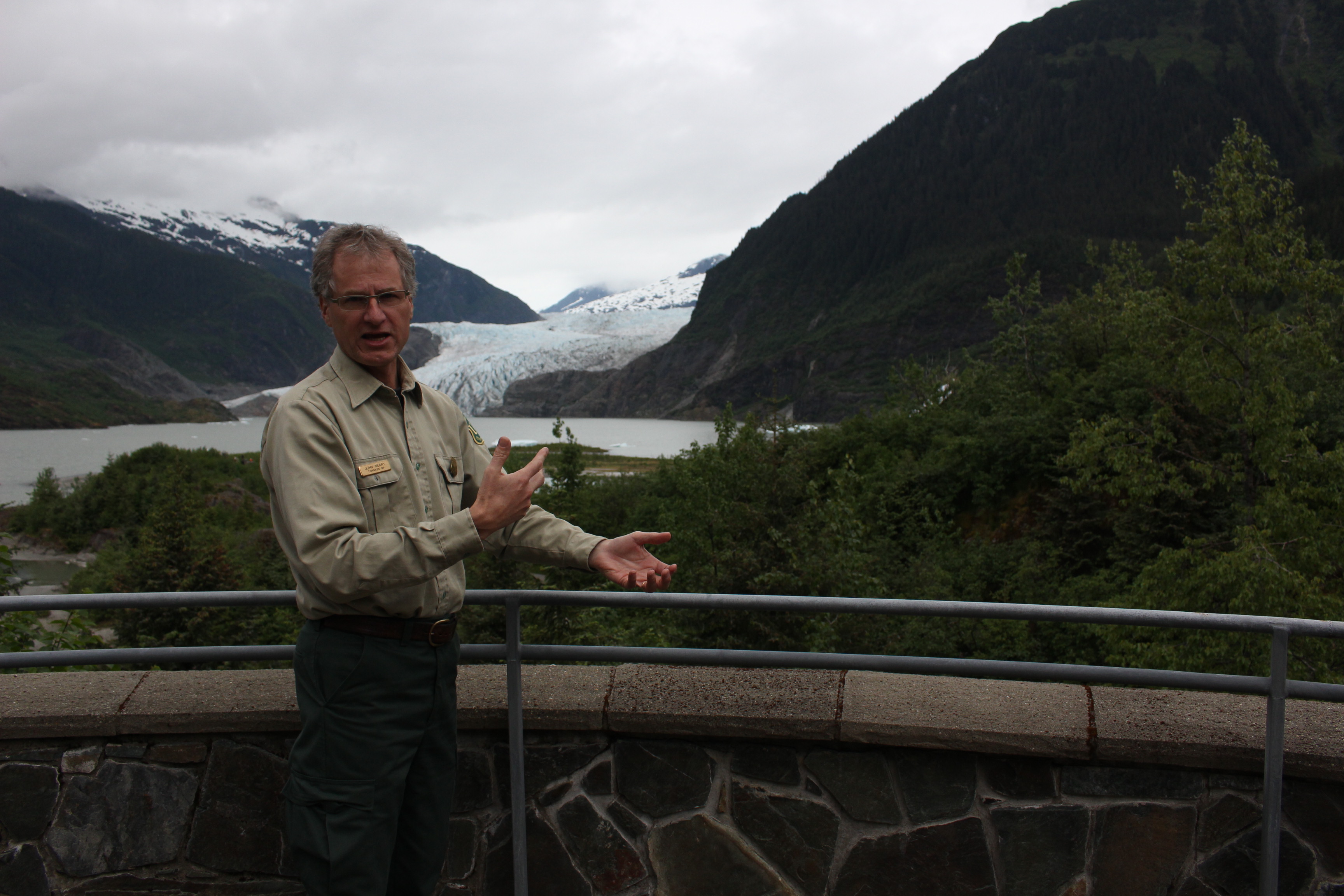
At first, John Neary says the Mendenhall Glacier “didn’t seem very special.” But as it’s diminished, he’s made it a point to explain to visitors why it’s shrinking. (Photo by Elizabeth Jenkins/KTOO)
This approach has captured the attention of other countries. Eleven delegates from Norway are visiting in June. Neary said they’re interested in seeing what the visitor center is doing and also sharing ideas. Chilean park officials are planning a trip in the fall. Neary wonders if parks around the world are trying to figure out what their role should be when it comes to climate change.
“I think we are one in a million in the setting that we have. But I’d like to think that the conversation is happening everywhere,” Neary said.
Inside the visitor center, an interpreter lures a crowd over to touch a slick hunk of glacial ice. People stop to take selfies with it and snap pictures.
“Would you like to see some photos of the glacier in the past?” the interpreter asks.
The photos start in the 1950s and show the progression of how much the glacier has changed.
“You can’t replace it right?” a man asks. The interpreter tells him, “No, we can’t.”
Anna Laing — one of the people who watched the presentation — traveled all the way from Glasgow, Scotland, to be here.
She said being on vacation, she had no idea she’d learn so much about climate change.
“It’s just a statement that’s just out there, normally,” Laing said. “And it doesn’t really mean much to you until you really see the physical evidence of it. Especially, since we’re able to touch the glacier there and know what we’re losing.”
Some scientists say the Mendenhall Glacier won’t be visible from the visitor center by the end of this century. John Neary hopes tourists have that in mind when they return back home.
Close
Update notification options
Subscribe to notifications
Subscribe
Get notifications about news related to the topics you care about. You can unsubscribe anytime.