Paul Desloover tapes a flag onto a float for Juneau's Veteran's For Peace group before Juneau's Independence Day parade on July 4, 2016, in Juneau. (Photo by Rashah McChesney/KTOO)
The City of Juneau's Pipe Band practices with an audience before Juneau's Independence Day parade on July 4, 2016, in Juneau. (Photo by Rashah McChesney/KTOO)
A group representing Alaska Airlines dances before walking in Juneau's Independence Day parade on July 4, 2016, in Juneau. (Photo by Rashah McChesney/KTOO)
Members of the Southeast Alaska LGBTQ+Alliance dance at their float before Juneau's Independence Day parade on July 4, 2016, in Juneau. (Photo by Rashah McChesney/KTOO)
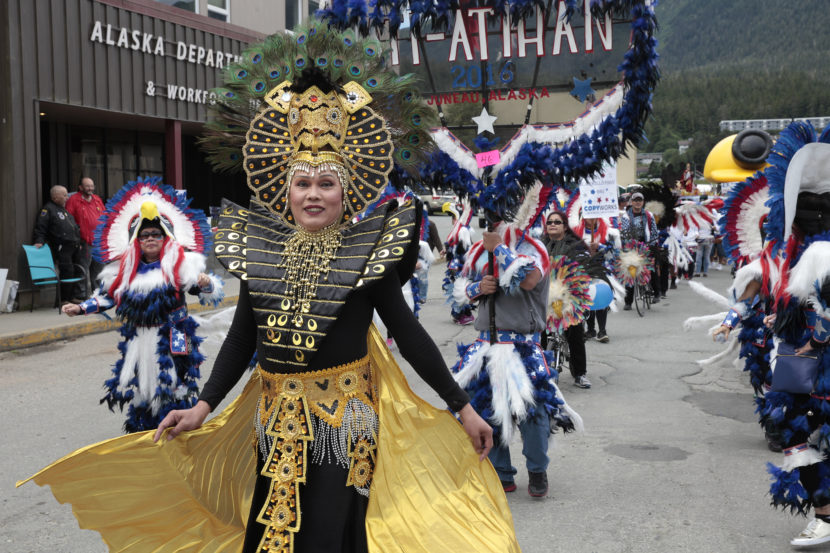
Costumed Shoefly representatives wave and throw candy to the crowds for an Independence Day parade on July 4, 2016, in Juneau. (Photo by Rashah McChesney/KTOO)
Leroy Romero, of Juneau, waits to drive a trolley with members of the Fusion Dance Company for Juneau's Independence Day parade on July 4, 2016, in Juneau. (Photo by Rashah McChesney/KTOO)
Rylee Caron helps Lisa Marx lace up her sleeves as the two prepare to walk with the Society for Creative Anachronism group in Juneau's Independence Day parade on July 4, 2016, in Juneau. (Photo by Rashah McChesney/KTOO)
Costumed Shoefly representatives wave and throw candy to the crowds for an Independence Day parade on July 4, 2016, in Juneau. (Photo by Rashah McChesney/KTOO)
Hundreds turned out for an Independence Day parade on July 4, 2016, in Juneau. (Photo by Rashah McChesney/KTOO)
Members of the Juneau Rollergirls demonstrate during an Independence Day parade on July 4, 2016, in Juneau. The photographer was skating with the team. (Photo by Rashah McChesney/KTOO)
Members of the Juneau Rollergirls demonstrate during an Independence Day parade on July 4, 2016, in Juneau. The photographer was skating with the team. (Photo by Rashah McChesney/KTOO)
Hundreds turned out for an Independence Day parade on July 4, 2016, in Juneau. (Photo by Rashah McChesney/KTOO)
Members of Filipino Community, Inc. dance during Juneau's Independence Day parade on July 4, 2016, in Juneau. (Photo by Rashah McChesney/KTOO)
A woman tosses candy during Juneau's Independence Day parade on July 4, 2016, in Juneau. (Photo by Rashah McChesney/KTOO)
Hundreds turned out for an Independence Day parade on July 4, 2016, in Juneau. Photo by Rashah McChesney/KTOO)
Members of Filipino Community, Inc. dance during Juneau's Independence Day parade on July 4, 2016, in Juneau. (Photo by Rashah McChesney/KTOO)
Members of Filipino Community, Inc. dance during Juneau's Independence Day parade on July 4, 2016, in Juneau. (Photo by Rashah McChesney/KTOO)
Candy is prepared at the Veterans of Foreign Wars Post 5559 float before Juneau's Independence Day parade on July 4, 2016, in Juneau. (Photo by Rashah McChesney/KTOO)
A Sarah Palin imitator poses for a photo before walking with the Southeast Alaska LGBTQ+Alliance in Juneau's Independence Day parade on July 4, 2016, in Juneau. (Photo by Rashah McChesney/KTOO)
Cody Galletes, 16, considers firing 16-year-old Savannah Meketa's bow as they wait to represent Juneau Douglas High School's football and cheerleading programs before an Independence Day parade on July 4, 2016, in Juneau. (Photo by Rashah McChesney/KTOO)
Crowds prepare for Juneau's Independence Day parade on July 4, 2016, in Juneau. (Photo by Rashah McChesney/KTOO)
Baskets of candy awaiting distribution during Juneau's Independence Day parade on July 4, 2016, in Juneau. (Photo by Rashah McChesney/KTOO)
Maggie Polizzotto, recovers from a sugar high in a motorcycle sidecar before riding with the Shriners during Juneau's Independence Day parade on July 4, 2016, in Juneau. (Photo by Rashah McChesney/KTOO)
Kara Longstreth of Eugene, Oregon checks her lipstick before representing the International Brotherhood of Electrical Workers in Juneau's Independence Day parade on July 4, 2016, in Juneau. (Photo by Rashah McChesney/KTOO)
A tube man hovers over a float over the Juneau Family & Urgent Care float as it heads along the parade route. More than 49 organizations and hundreds of people turned out to march in Juneau's Independence Day parade on July 4, 2016, in Juneau. (Photo by Rashah McChesney/KTOO)
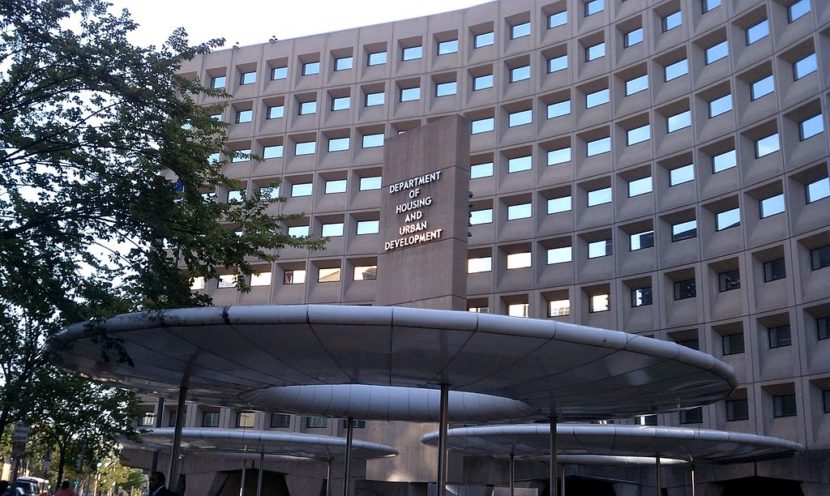
The Robert C. Weaver Federal Building in Washington, D.C., in the United States. As of September 2010, the building housed the U.S. Department of Housing and Urban Development. (Creative Commons photo by Wikimedia Commons)
The federal government wants to know, among other things, how tribes use federal resources to improve housing.
The U.S. Department of Housing and Urban Development plans to create a special committee to gather that information. Lourdes Castro Ramírez is head of HUD’s Office of Public and Indian Housing. She said her office will bring together people running federal programs and tribal representatives around the country at least twice a year to discuss priorities for Native housing.
“We believe that the creation of a committee that allows for regular feedback, regular discussion — and really, also an opportunity to identify best practices and models that are working across Native American communities — will help further our impact and will also help inform the future of Native American housing programs,” Ramírez said.
There will be up to eight tribal representatives and at least one of them will represent Alaska.
Ramírez said federal funding for housing programs has become scarce and it’s especially important for her agency to have a firm understanding of how Native communities use that money.
The deadline to comment on the agency’s planned Tribal Intergovernmental Advisory Committee is July 23. Comments can be left on the Federal Register website.
Artist Ricky Tagaban organized the Two Spirit Pride reception to begin Juneau’s pride week, held on June 11. Speakers included Freda Westman, former Alaska Native Sisterhood Grand Camp President. The next day was the Orlando shooting. (Photo by Emily Kwong/KCAW)
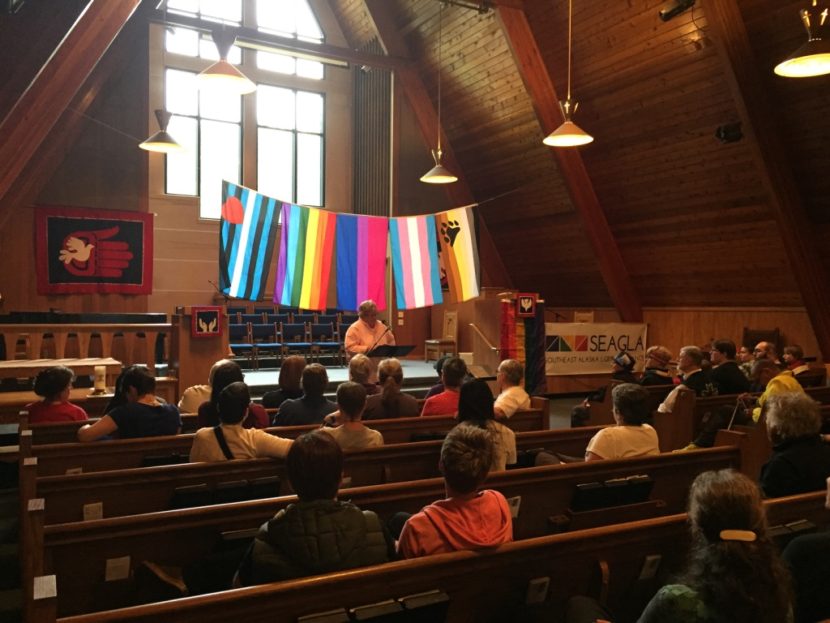
In gay communities all over the country, there is a before and an after — a before June 12, 2016, and an after. The shooting at Pulse, a gay nightclub in Orlando, killed 49 people and was the largest act of violence against the LGBTQ community in US History. And it happened as Pride events were taking place all over the country, including a reception at Juneau’s Northern Light Church mere hours before.
The reception on June 11 was organized by artist Ricky Tagaban. He wanted to create a space for others who are two-spirited, embodying both a male and a female person. Like writer Vivian Mork. She was amazed that over 100 people came.
“We gathered at the Northern Lights Church to celebrate two-spirited people – gay native people,” Mork said. “It was the first time I’ve ever known of that happening in Juneau.”
Tagaban set out pilot bread and salmon spread, coffee and tea and an open mic. Rick Peterson, President of Tlingit and Haida Central Council, talked about how the council authorized same-sex marriage in February 2015 — months before the Supreme Court ruling. The media went crazy. He did 20 interviews in one day and a reporter kept asking, “Why are you doing this?”
“If you’ve all watched the movie Princess Bride, there’s a marriage scene in there and the Rabbi, or whatever, he’s like, “Love, Love.” And that was my answer to everything,” Peterson said. “She’s like, ‘Why are you doing this?’ Love. ‘Why are you doing this?’ Love.”
Love, it seemed, was the answer in the room that day. Other speakers reflected – some cautiously, some joyfully – on how far America has come. Gay people can get married now. Come out in school. Tribal court judge Debra O’Gara, who grew up in the era of the Stonewall Riots, marveled at how there was less to be afraid of for the next generation.
“I came out 40 years ago and it was the Native community in Seattle who shunned me,” O’Gara said. “And to stand here and see my community is great.”
It’s not perfect, she said, but every year it gets better. A lot of people came away from the reception with the same feeling. And then, the next morning, it was June 12th.
“My heart sank when I saw the headlines the next morning,” Mork said. “I so wanted it to be a horrible Facebook hoax. I didn’t want it to be true. But it was.”
Mork was up early to catch a plane the Louisiana. James Hoagland, who was at the reception and organized Juneau’s Pride Week, is a well-known drag queen in Juneau. Two of his friends were performing at Pulse that night. Over the phone, he learned how one got out quickly and the other hid in a dressing room for hours, only escaping after a SWAT team removed an air conditioning unit – creating an escape portal for hostages in the wall.
Hoagland identified, strongly, with the victims. “Young people who were just out to dance and be in community and have a good time,” Hoagland said. “And that so easily could have been us.”
If the Two Spirit Pride reception affirmed safety and acceptance, Orlando violently asserted an opposite claim: that being gay in America is still dangerous.
“I’ve had nightmares all week about being shot on stage while performing,” Hoagland said. “Somehow, I had to put that aside enough to go forward with the biggest show that we’ve ever had in Juneau on Friday night.”
That drag show, called Glitz, packed Centennial Hall with 500 people. While the shooting was in Hoagland’s words, the “elephant in the room,” it didn’t stop people from coming out for Juneau’s Pride Week. Quite the opposite. “I think people felt even more comfortable and confident being loud and proud because we know we have an obligation too,” Hoagland said.
But after pride week is over, what do you do? What kind of courage do you need to get up in the morning and continue to be yourself? Hoagland’s husband recently said to him, “I may be killed for being gay in my lifetime. And I’ve found peace with that.”
“The victims in Orlando didn’t die for no reason,” Hoagland said. “I hate that they lost their lives, but the fact that they did has changed the world.”
As for Mork, she spent her plane ride writing and recorded this message from her hotel room in Louisiana.
“This is pride month and odds are there is a gay person near you who is hurting over this. Tell them you support them. Tell them you love them. Gunalchéesh.”
Soon after the shooting, the Juneau Assembly took hearings on an anti-discrimination ordinance, for gender and sexual identity. And in a city with no gay bars, the Southeast Alaska LGBTQ Alliance, or SEAGLA, plans to make the rounds at Juneau business with rainbow stickers for the windows. That way, those in Juneau can be assured that if they enter that bar or restaurant, they will be treated with respect inside, no matter who they love.
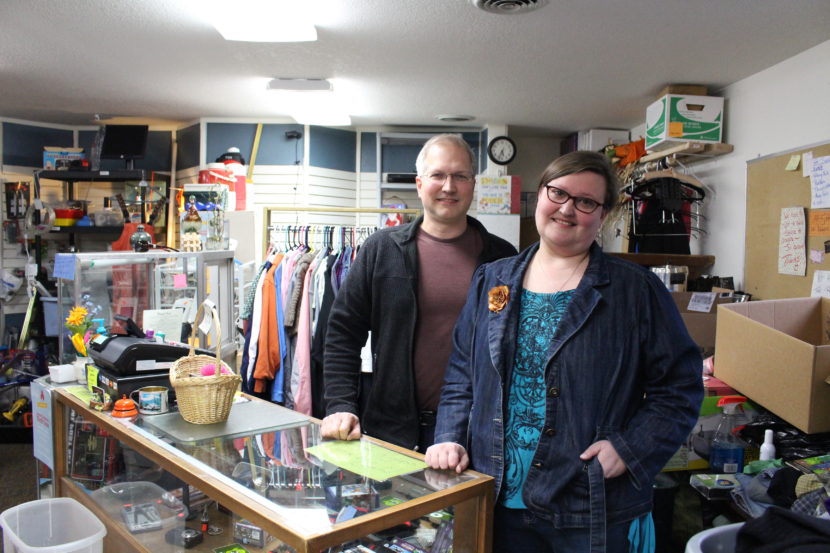
Rebecca and Mark Dundore want to give their employees pay raises and increased hours, but they say it’s caused anxiety for some of their staff. (Photo by Elizabeth Jenkins/KTOO)
A pay increase should be a happy event in a person’s life, but for some it can evoke fear. That’s because more money earned could mean less money overall when public assistance programs get cut off.
Rebecca and her husband Mark Dundore own Juneau Treasures Thrift Store. A place that’s filled to the brim with eclectic used items. Their shop is doing well. So well they’re opening a second location that will sell mostly secondhand furniture. But in the course of running their business, they’ve run into some issues with staffing.
They have three employees right now, who make between $10 and $12 an hour. That’s more than Alaska’s minimum wage.
But when they’ve offered pay increases or more hours, they didn’t get the response they expected. One employee was worried she would lose her public assistance.
“We wanted her to work almost full time, and she couldn’t do it because she has six children, and they’re on food stamps,” Rebecca said. “We wouldn’t be able to give enough to get her off the food stamps support entirely, and she wasn’t able to take anymore ‘cause she was afraid she would lose the food stamps.”
Rebecca says it was an awkward situation. They’ve even had employees volunteer to work for free, so as not to make too much money and wind up going over.
“That’s a really serious concern for a lot of people around here,” Rebecca said.
Per capita, Alaska has the most households on public assistance in the nation. That’s according to statistics from the U.S. Census Bureau.
Anna Schetky and her husband live in one of those households. Anna works for Rebecca at Juneau Treasures. She decided to transition to the part-time job after learning of her pregnancy. Before she worked in a stressful environment with at-risk kids, and she hoped the move would be good for her and the baby.
But it meant losing the family’s insurance. So she signed up for Denali KidCare, a Medicaid program.
“Due to the major drop in income, we also were trying to get on WIC,” Schetky said.
That’s food and nutrition assistance for women, infants and children.
“All of those things were kind of looming over us. And we had to sit down and start crunching some numbers,” Schetky said.
She says with that first WIC voucher, she was able to stock up on perishable items, milk and some veggies. It helped supplement what they got at the food bank.
When she first started at Juneau Treasures, she was making about $10 an hour.
“All of a sudden they’re like, ‘Hey, you’re doing a great job, we want to offer you more hours and more pay,’ and I just kind of looked at them and I was like, ‘I don’t know if I can do this,’” Schetky said. “I had to sit down again and start crunching pennies basically, to see if we could still keep these benefits to see if we could make enough money to survive.”
She says the WIC office advised she would be on the cusp of making too much. To be eligible, she couldn’t make more than about $3,800. Her gross household income would be about $4,000 a month. So she decided to drop WIC.
“For right now we’ve had to find our little groove and not really swerve one way or the other because we want our baby to be covered,” Schetky said.
She is still covered by Denali KidCare. The income limit for that is $400 higher.
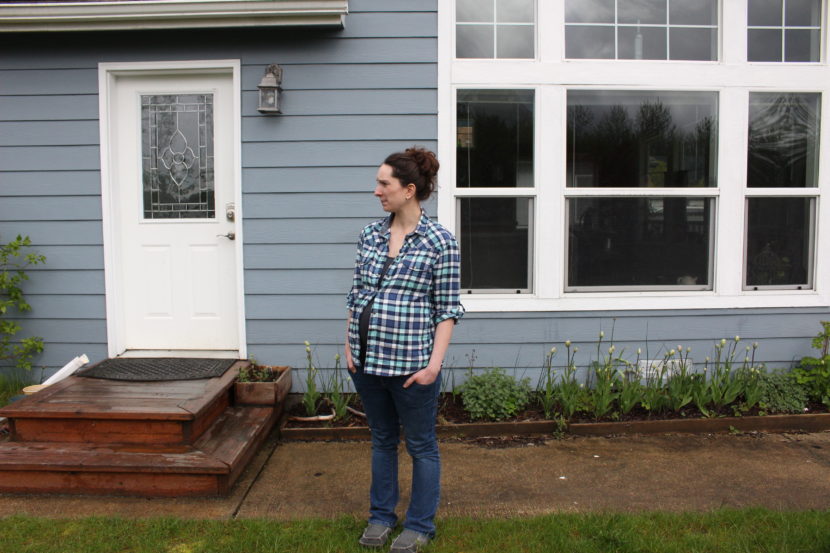
Anna Schetky at her home in Juneau. (Photo by Elizbeth Jenkins/KTOO)
A WIC representative thought Schetky might still qualify. Being eligible for one might automatically qualify her for the other. But for the past few months, she’s bee paying for the expense out-of-pocket. She wants to grow a garden to help offset some of the cost.
Rebecca and her husband Mark Dundore say they make enough to keep the doors open at Juneau Treasures but not enough to pay more than $12 an hour.
“I think to bridge that gap, we’d have to pay almost $15 or $16 an hour. It’s a small business, with all the other taxes and fees and stuff, we just can’t do that right now,” Mark said.
One of the solutions they’ve come up with is having a bunch of part-time employees, but they realize there’s no easy fix. The problem isn’t as simple as having employees who don’t want to work.
“I would say that’s probably the exception.” Rebecca said. “Everybody we’ve encountered anyway has just worked really hard and been energetic and we’ve really appreciated that.”
For now, they might have to show that appreciation in a weird way: by offering their employees less.
Funding for Chasing the Dream is provided by the JPB Foundation and the Ford Foundation. It’s part of an ongoing series about poverty and opportunity in America.
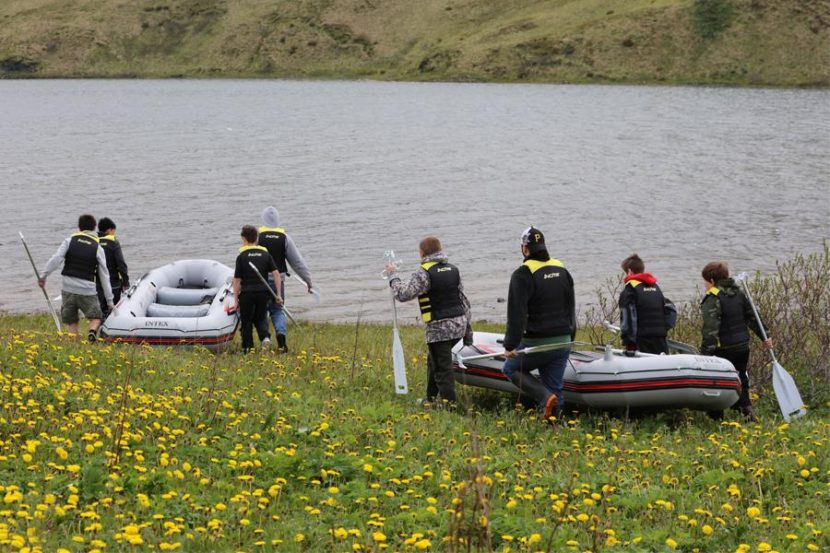
A group of young and adult men outfitted in life vests, huddled together by Iliuliuk Lake on a sunny and windy Saturday afternoon. Off to the side was an inflated rubber raft piled with oars. They appeared ready to go out on the lake, but there was an underlying idea bigger than just the activity of paddling.
“So, what we’re here for, myself, Dimitri, Jeremiah, and there’s a couple of others who you might see in the next trip if you come on the next trip, we’re kind of part of a group called Compass,” said Carlos Tayag.
He’s a recreation coordinator at the Unalaska community center. But at that moment, he was a volunteer.
“We’ve taken a pledge to do that, to be mentors and guides for other young men.”
As they inflated a second raft, Tayag explained that last year, a group of men from Unalaska attended a workshop on mentoring, specifically using Compass. Compass is an Alaskan program created in response to requests from various entities for a resource that can be used to guide men in their conversations with youth. The goal was to help Alaska’s young men learn to respect themselves and others. A strategy for this is to engage them in conversation while doing simple and fun activities.
Tayag motioned to the lake to illustrate how the community is surrounded by water, the inspiration for the rafting activity.
“We have a couple of good lakes, so we decided that rafting was a good activity and a bonfire just to hang out and chill,” Tayag said.
Compass participants lift rafts to Iliuliuk Lake. (Photo courtesy Dmitri Dela Cruz)
“I’m here because it seems like a fun thing to do,” 15-year-old Amiel Fernandez agreed. “I haven’t been on a boat in the middle of the water a lot.”
The conversations went beyond water safety. The young men were getting guidance from male role models on redefining masculinity and are encouraged to explore healthier, nonviolent models of manhood.
“The message is really simple. I think the whole thing about Compass is just getting guys comfortable with, one, being themselves, and two, talking about who they are and where they come from.” Tayag explained. He added that men typically have a harder time expressing their feelings. The objective was to provide youth a chance to be able to open up without judgement, which Tayag believed was part of coming of age for young men and their quest for identity. “I think that’s the most important for me, is just kind of having those open honest conversations and letting people be who they are.”
This program is a collaborative effort of Unalaskans against Sexual Assault and Family Violence, Alaska Network on Domestic Violence and Sexual Assault, City of Unalaska Department of Public Safety and the Department of Parks, Culture, and Recreation.
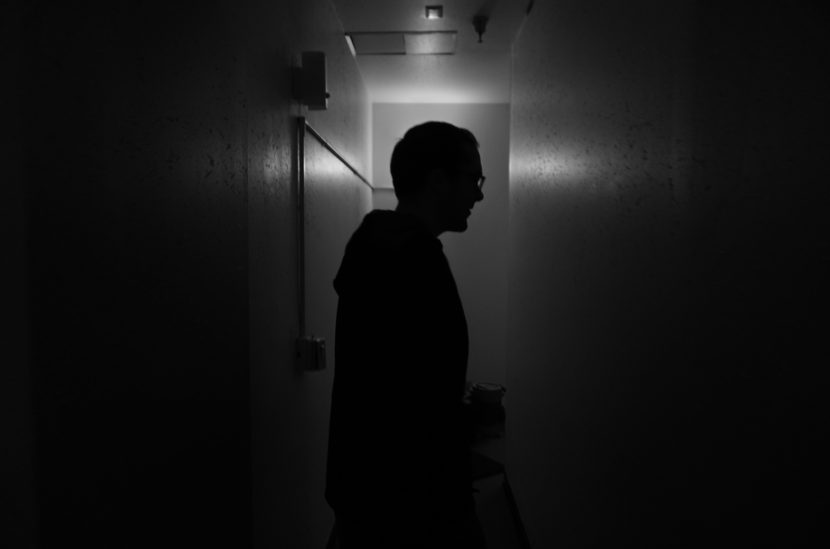
Matt Magnusson gives a tour of the Catholic Community Service’s Family Resource Center in a wing of St. Ann’s Center on Friday. He jokes that this hallway is haunted. (Photo by Jeremy Hsieh/KTOO)
In an old hospital cafeteria, voices and footsteps echo off the nearly bare walls and empty offices. Toys and big stuffed animals are strewn about in various states of packing.
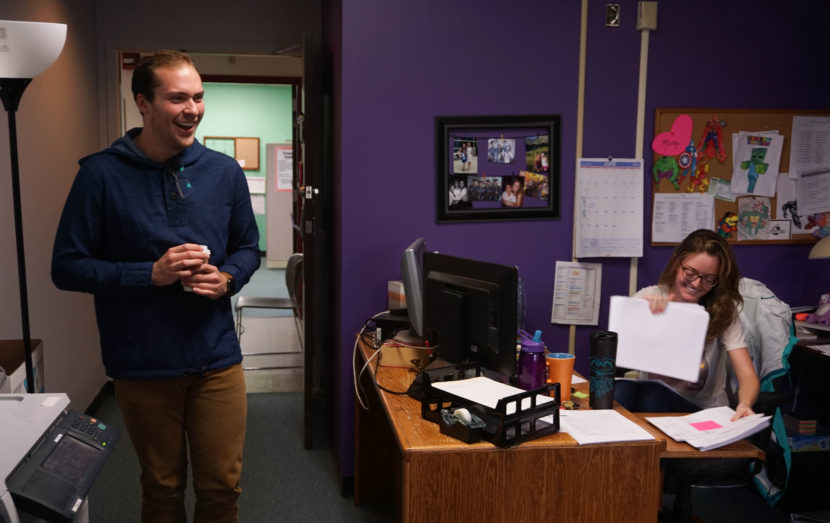
Matt Magnusson is showing me around a wing of St. Ann’s Center where Catholic Community Service ran its youth behavioral health program, which is shutting down because grant funding dried up.
Matt Magnusson and Molly McCarville are among the last employees at Catholic Community Service’s Family Resource Center in Juneau. The center is shutting down at the end of the month because grant funding dried up. (Photo by Jeremy Hsieh/KTOO)
It’s where the 20-year-old has worked for about a year and a half. He helped kids with issues like post-traumatic stress disorder, reactive attachment disorder and bipolar disorder.
Catholic doctrine teaches that homosexuality is also a disorder, and acting on it is immoral. As an openly gay man who doesn’t identify with any religion, you’d think Magnusson would have to navigate a minefield of identity politics at work.
(Photo by Jeremy Hsieh/KTOO)
“Through talking with my friends and other gay people, they have a lot of problems sometimes with their jobs,” Magnusson said. “And I’ve never once had a complaint working here when it comes to my sexuality. Which, that’s a really wonderful thing to be able to say as a gay person. A lot of times people have nowhere close to that experience, which is horrible. To come to the place where you spend most of your time during your life and be discriminated against, that’s just an awful thing.”
That’s also in keeping with Catholic doctrine that discourages “unjust discrimination” toward gay people. Vatican bishops advise receiving gay parishioners with respect and sensitivity.
However, Magnusson’s nonprofit, which the bishop of the Catholic Diocese of Juneau can influence through its governing board, would be within its rights to fire him simply for being gay.
The Juneau Assembly wants the public to weigh in on a proposed ordinance that would make that illegal. The equal rights ordinance would outlaw many forms of discrimination, including that based on sexual orientation and gender identity. With a few exceptions, it would apply to public institutions as well as private sector businesses, employers, schools, and housing and lending institutions.
What:Juneau Assembly Committee of the Whole on proposed equal rights ordinance Where: Assembly Chambers at City Hall, 155 S. Seward Street When: 6 p.m. Tuesday, June 21
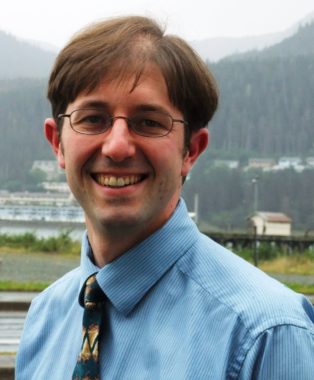
Deputy Mayor Jesse Kiehl introduced the measure last week.
Agencies like the Alaska State Commission for Human Rights enforce anti-discrimination laws based on race, sex, age, religion and other traditionally protected classes.
The 12-page ordinance he’s proposing would protect those new classes in addition to the ones already covered.
The ordinance would not create a new city agency to handle enforcement, but Kiehl said it would give victims of discrimination the grounds to take an employer, business, landlord, lender or other institution to court where state and federal laws don’t apply.
In the early ‘90s, the Juneau Assembly considered a similar measure. A watered down version eventually passed that was limited to job discrimination within the municipal government.
Kiehl thinks today’s Juneau is ready for broader protections.
“Since then, I think that we live in a world where people now realize that they know gay people,” he said. “Where, 20 some years ago, there was too much risk of physical violence against gay people for them to let it be known who they really are. And ultimately, that’s what we’re talking about, it’s discrimination based on who you really are.”
Magnusson, who grew up in Juneau, said for the most part the community’s been a loving and accepting place to be himself. For the most part.
“I’ve been in the store where I’ve heard people make comments under their breath behind me, and that’s just a part of being gay,” he said. “Whenever I go to Seattle, I can totally let my guard down. Like, I can walk with my boyfriend down the street holding his hand. No problem. Walking down the street in Juneau we won’t do because … we stand out too much. There’s locals that look at us. Even the tourists kind of notice it a little bit because it’s a different thing for Juneau, Alaska. It’s a small town, you don’t see that.”
He said Kiehl’s ordinance is necessary and welcome.
Kiehl said he’s shared the ordinance with faith leaders and thinks he’s crafted it in a way that won’t affect First Amendment religious freedoms. Like other communities that have tried this, he does expect some reluctance.
“There’s a lot of fear — but actually, no problems. So that’s what I suspect will come as we work to pass this,” Kiehl said.
The ordinance must go through the committee process before a final vote by the Juneau Assembly.
Close
Update notification options
Subscribe to notifications
Subscribe
Get notifications about news related to the topics you care about. You can unsubscribe anytime.

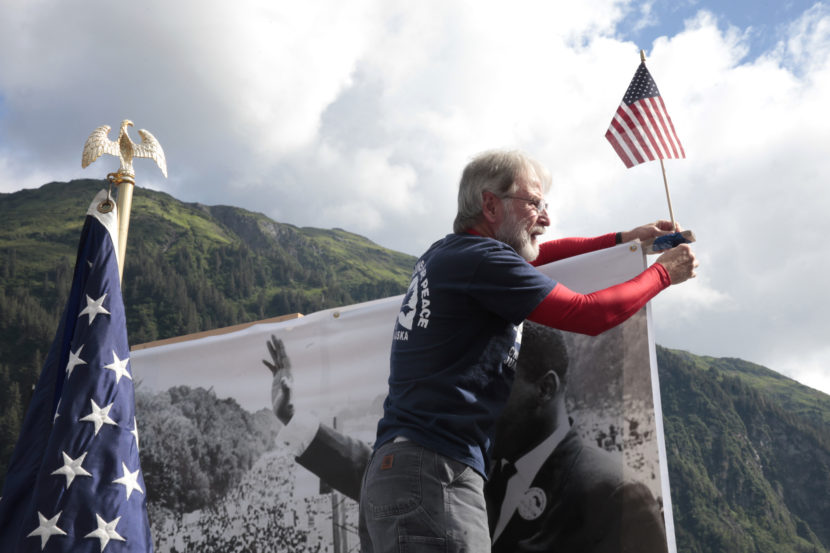 Paul Desloover tapes a flag onto a float for Juneau's Veteran's For Peace group before Juneau's Independence Day parade on July 4, 2016, in Juneau. (Photo by Rashah McChesney/KTOO)
 The City of Juneau's Pipe Band practices with an audience before Juneau's Independence Day parade on July 4, 2016, in Juneau. (Photo by Rashah McChesney/KTOO)






 The ordinance would not create a new city agency to handle enforcement, but Kiehl said it would give victims of discrimination the grounds to take an employer, business, landlord, lender or other institution to court where state and