Community

City pressure, fire dangers push homeless resources over capacity

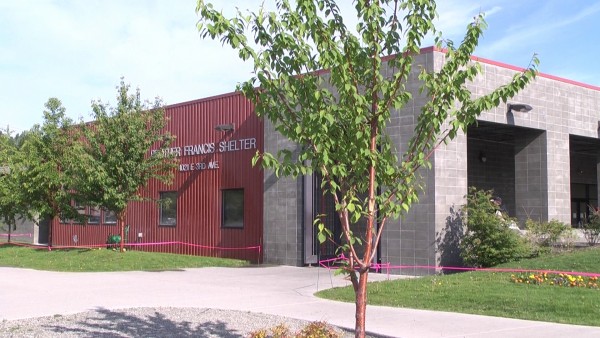
The Brother Francis Shelter in downtown Anchorage. (Photo courtesy of Catholic Social Services.)

Anchorage’s homeless shelters and social services are drastically and unexpectedly overwhelmed as a consequence of a shifting policy pushing people out of homeless camps.

Summer is usually a relatively quiet time for direct service providers working with the city’s homeless population. Typically people are living in camps or doing seasonal work, according to Lisa Aquino, the executive director of Catholic Social Services, which oversees the Brother Francis Shelter in downtown Anchorage. This summer the shelter has consistently been at maximum capacity.

“Almost every day there’s 240 people inside,” Aquino said.

That number doesn’t include the 50 to 70 people a night the shelter can’t accommodate, who have been sleeping outside.

Aquino was one of three social service providers to testify before the Anchorage Assembly’s committee on homelessness Wednesday. They all said they are seeing the same large influx of people in need of help, taxing staff, and making it hard to keep up with even basic things, like serve enough food during meal-times.

Part of the reason is growing pressure on unsanctioned camps in parks and along trails throughout the city.

“There’s been a real concerted effort by the municipality, by the police department, to crack down on camps,” Aquino said. “They’re letting people know to leave camps and that they should come down to Brother Francis Shelter and Beans Cafe and connect with services.”

The dry conditions and elevated fire dangers are other factors driving the crackdown on camps. Multiple fires within the municipality have broken out this summer, with at least one blamed on homeless campers.

Lisa Sauder, the director of Beans Cafe, told the committee the situation is creating new problems, like people coming to the campus with all their possessions. Without campsites, people have nowhere to store their things. Sauder explained Beans has freed up a portion of storage space so people can secure their belongings while they get food.

Service providers also say they are also seeing a higher volume of people coming to the facilities.  Covenant House Executive Director Alison Kear said in 20 years of work she’d never seen so many people arriving during the summer, including a drastic uptick in minors between the ages of 14 and 16-years-old. Aquina with BFS said they’re seeing more and more senior citizens coming into the system for the first time.

Assembly member Bill Evans chairs the committees on homelessness and public safety. He said during a short interview, the point of the city’s focus on driving homeless individuals out of camp sites is intended to “consolidate” people around social services.

However, without sufficient housing options brought online yet under the city’s broader Housing First strategy, it has created an unforeseen short-term problem.

“Between now and then, unfortunately, there’s no quick fix,” Evans said. “We have a long-term program in place that we think will address this, it’s going to be difficult this summer, it’s going to be difficult for about a year now. But things are looking up in the sense we have new grants in that I think will curb this in the long run.”

Evans hopes that 30 to 50 housing vouchers will become available soon, taking some of the pressure off the service providers in the area.

Meanwhile, the agencies said they barely have enough resources to keep up with a problem nobody saw coming, and that they expect it to last for weeks.

 

Two-vehicle collision leaves Egan Drive blocked Saturday


Authorities investigate a two-vehicle collision on Egan Drive Saturday, July 23, 2016. (Photo by Kelli Burshaw/KTOO)
Authorities investigate a two-vehicle collision on Egan Drive Saturday, July 23, 2016. (Photo by Kelli Burkinshaw/KTOO)

A two-vehicle collision left a portion of Egan Drive partially closed for 30 minutes on Saturday afternoon. Officer Jason Vansickle said a driver travelling inbound on Egan was turning left toward Fred Meyer when the vehicle was t-boned by another vehicle travelling in the outbound lane.

Vansickle said the vehicles were carrying seven people. They were all transported to Bartlett Regional Hospital for mostly minor injuries. He said one person’s injuries were more significant, but he did not believe they were life-threatening.

Alcohol is not believed to have been a factor in the crash. Vansickle said the accident was most likely a case of driver error. The investigation is ongoing.

Ferry breakdown strands passengers in Petersburg

Joe Yuhas and brothers Steve and Larry Banwart were stranded in Petersburg after the Columbia ferry broke down on Wednesday. (Photo/Abbey Collins)
Joe Yuhas and brothers Steve and Larry Banwart were stranded in Petersburg after the Columbia ferry broke down on Wednesday. (Photo by Abbey Collins/KFSK)

Nearly 200 passengers were stranded in Petersburg this week after a mechanical issue on one of Southeast Alaska’s main ferries caused it to stall there Wednesday morning. KFSK’s Abbey Collins met a few of those passengers before they left town late Thursday night.

Larry Banwart and his brother Steve were living the dream – riding their motorcycles up the Alcan from Phoenix.

“I had a three-week vacation, my brother came down to meet me,” says Banwart. “And we decided we were going to ride our bikes to Alaska.”

“It’s our bucket list,” says Steve Banwart.

They reached Alaska and boarded the Columbia ferry to head back down to Bellingham, Washington. That’s when they hit a snag.

“I called my boss this morning and told him I’m going to be a few days back to work,” says Banwart.

That’s because they were stuck in Petersburg after the ferry broke down Wednesday morning. Banwart says passengers have been told the best case scenario gets them to Bellingham, Washington Saturday evening.

“Best Case. Worst case we have no idea,” says Banwart. “Live here.”

Alaska Marine Highway System spokesman Jeremy Woodrow says a mechanical issue with the ship’s starboard engine required the ferry to remain moored. That issue has since been resolved and the boat sailed to Ketchikan late Thursday night. It’s expected to depart for Bellingham about 48 hours behind schedule.

The Columbia is one of Alaska’s main ferries, running routes between Skagway and Bellingham. It will now be running on a revised schedule through the end of the month. The ferry will then be dry docked in Ketchikan for a few days while an oil leak is repaired. It’s expected to be back up and running on August 3.

While waiting in Petersburg, passengers were provided free meals. As far as sleeping goes, Woodrow says people are given staterooms if they are available. But some, like the Banwart brothers, slept in tents – others wherever they could find a spot.

Steve Banwart says he doesn’t mind the camping or the delay.

“I don’t have a job so I have nowhere to go. Doesn’t matter to me if we get stuck here for another week,” says Banwart.

Joe Yuhas, a motorcyclist from Minnesota, says he’s not too concerned about getting home later than expected, but he did have to cancel all of his reservations for his road trip back.

“So based on whenever we land I’ll reschedule everything to get home,” says Yuhas. “All my hotels have been cancelled. I’m freewheeling it all the way home from here.”

There were a few alternatives for people – other ferries and some flights. But for those headed to Bellingham, the Columbia is only ferry option.

Yuhas and the Banwarts have their motorcycles on the ship, so they stayed on board until the engine started running.


Without quorum, tribal delegates push AVCP demands to October

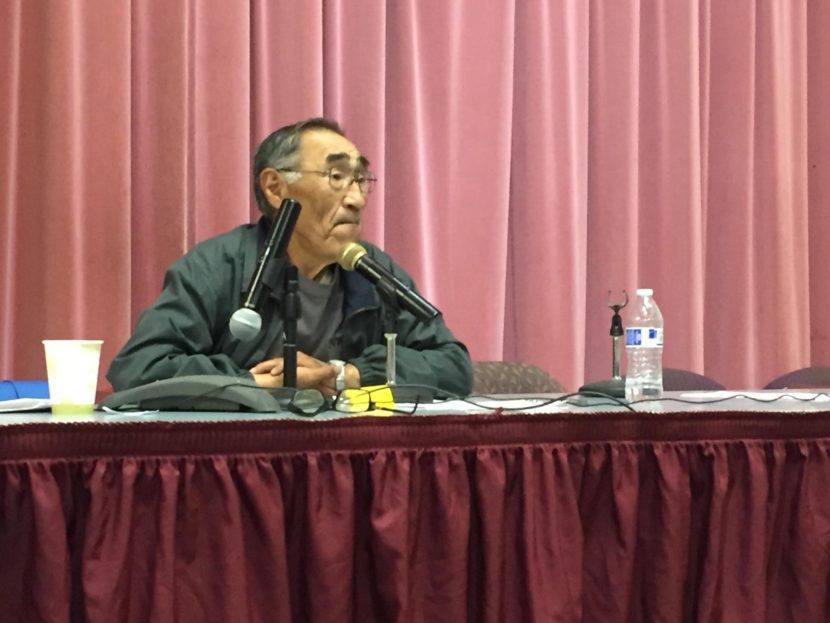
Newly appointed meeting Chair Ivan M. Ivan at the Yupiit Piciryarait Cultural Center in Bethel. (Photo by Charles Enoch/KYUK)
Newly appointed meeting Chair Ivan M. Ivan at the Yupiit Piciryarait Cultural Center in Bethel.
(Photo by Charles Enoch/KYUK)

Tribal delegates in Bethel this week tried to hold an emergency meeting of the Association of Village Council Presidents.

They want the AVCP administration and executive board to provide answers on financial matters and respond to what some delegates see as a mismanagement of power and lack of transparency within the organization.

AVCP administration and executive board members did not attend nor sanction the meeting, which began Tuesday and ended Wednesday.

Only 13 tribes sent delegates; 38 were needed to constitute an official meeting under AVCP bylaws. For lack of quorum, the delegates are pushing their questions and demands to the October annual meeting.

AVCP acting president and legal counsel did not respond to KYUK’s emails seeking comment on the meeting.

Half ton of food donated to homeless Anchorage youth stolen

Authorities are investigating the theft of more than a thousand pounds of food that was intended to feed homeless youth in Anchorage.

KTUU-TV reports the estimated $1,000 worth of food was reported stolen in late June. The food had been collected during an annual food drive conducted by the National Association of Letter Carriers.

The food went missing from a shed at Anchorage Community Mental Health Services, where it was being stored until space opened up at Covenant House, a nonprofit that serves homeless and at-risk youth.

The agency’s Jennifer Smerud says the stolen items include Ramen noodles, canned vegetables and other food items easy for children to carry and prepare.

Anchorage police spokeswoman Renee Oistad says officers haven’t yet located a suspect, but an investigation is ongoing.

Police And Black Lives Matter Hold A Cookout, And Praise Rolls In

A Wichita police officer poses with residents at the First Steps Community Cookout on Sunday. (Photo courtesy Wichita Police)

Members of the Wichita, Kan., police department spent Sunday afternoon eating and talking with people from the community, at a cookout that was planned with the local Black Lives Matter group.

The event was called the First Steps Community Cookout — a reference to its goal of bridging the gap between police and the community they serve. Taking place instead of a protest that had been planned for Sunday, the cookout came about after Wichita Police Chief Gordon Ramsay had a lengthy meeting with activist A.J. Bohannon and other members of the local Black Lives Matter movement.

Bohannon told member station KMUW that the cookout gained even more importance after news emerged of a gunman’s deadly attack on police officers in Baton Rouge on Sunday morning.

“We can get on the same page and say those things that are in Baton Rouge don’t trickle over into Wichita, Kan.,” Bohannan told KMUW. “My heart goes out to the families, those officers in Baton Rouge, but I think the fact that that did happen makes this event more meaningful. I definitely think this is a start for this community, and I definitely want to keep it going.”

Photos from the scene show uniformed police officers — many of them wearing radios and other gear they use on patrol — talking with smiling residents, dancing and playing basketball at McAdams Park.

The cookout was a hit on social media, with Wichita Mayor Jeff Longwell noting that on his Facebook feed, news about police hanging out and dancing with would-be protesters had risen above the feud between Taylor Swift and Kim Kardashian to top the list of trending topics.

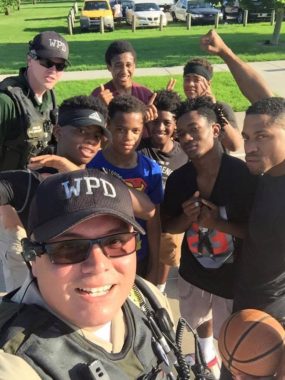
Officers pose with young men on a basketball court during a community cookout in Wichita, Kansas. (Photo courtesy Wichita Police)

One photo in particular drew some notice because of a young man’s unsmiling pose alongside several officers — but that young man, MarQuell Woods, later posted an update on his Facebook page, declaring that he was “playing ball with students from West High School. I should have smiled I guess but we had fun.”

A woman who says her kids are in the photo echoed that idea, calling the event historic and saying, “It was a bonding moment where the police saw them as children and my [sons] got to see them as people! It was a great first step Chief Gordon Ramsey and Wichita PD!”

The Wichita Eagle reports on another scene from the cookout:

“At one table, three men — a black man, a Hispanic man and a white man — sat down with burgers next to police Lt. Travis Rakestraw to share their ideas.

“It was the first time since 1992 that Jarvis Scott, the black man, said he’d sat down with a police officer, and the other two said it was their first time ever sitting down with an officer.”

After the event, Ramsay thanked those who came — and issued a challenge to other police departments to hold similar barbecues.

“It takes two parties to make a healthy relationship,” the police chief said.

In response to one of the department’s many tweets about the barbecue, one Twitter user wrote, “This makes me happy! First time in a while that anything in the news made me smile. There is hope.”

The cookout also echoes a theme that we here at NPR have been covering lately: noncomplementary behavior, the act of departing from an established script when that script is likely to lead to conflict. In this case, both sides departed from what could have been a now-familiar story of clashes between protesters and police.

Our friends at the Invisibilia podcast explored other examples of noncomplementary behavior in their most recent episode.

Copyright 2016 NPR. To see more, visit http://www.npr.org/.
Site notifications
Update notification options
Subscribe to notifications