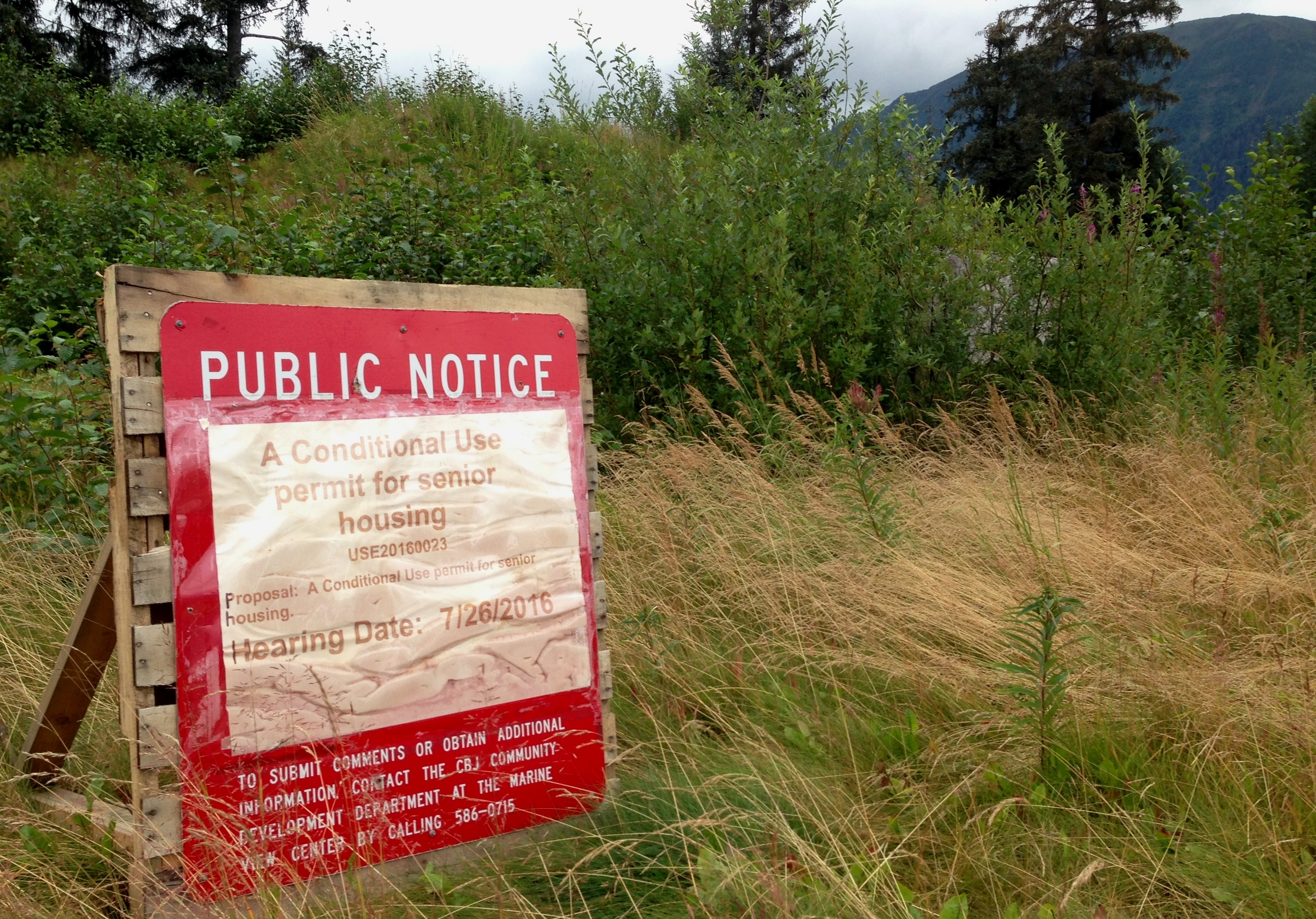
A sign advertising a public meeting marks the location of a planned senior housing building at Vintage Park in the Mendenhall Valley . (Photo by Ed Schoenfeld/CoastAlaska News)
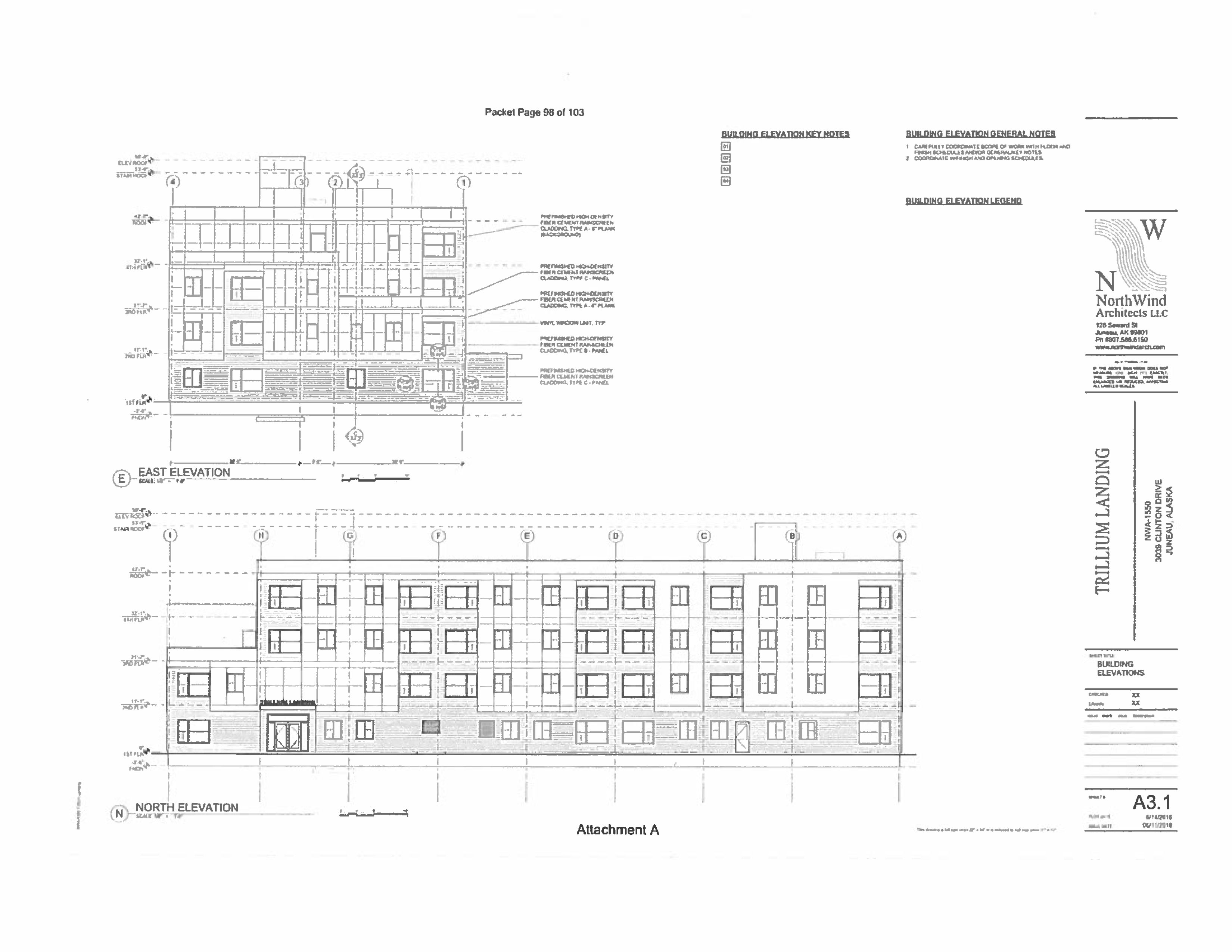
A Seattle-based company is one step closer to building a 49-unit senior housing facility in Juneau. If successful, it would cater to a region’s housing market that’s been historically difficult for everyone, especially Southeast’s aging population.
Earlier this week, the Juneau Planning Commission approved a conditional use permit for GMD Development, LLC. The majority of the beds in the proposed housing unit will be low-income affordable housing.
Assemblyman Loren Jones thinks it’s a positive step for the community.
A page from GWD Development’s proposal for senior housing, which would include a four-story building with 49 living units. (Image from Regular Commission Meeting Agenda)
“Where it’s at, it’s going to be next to the assisted-living facility,” Jones said, “so there’d be a senior complex there in the valley, and I think it’s very important for Juneau for that to take place.”
The location of the site is off Clinton Drive, near Safeway. The non-profit Senior Citizens Support Services Inc. plans to build a 90-apartment, assisted-living facility in the same area.
Jones said the proposed housing project would help a market that really needs it.
“I have every anticipation there may yet be some construction work this fall, but I would suspect construction would hopefully start next spring,” he said.
Earlier this year, KTOO reported on the shortage of senior housing in for Southeast’s aging community. A 2014 market study estimated that over the next 30 years, Juneau will need more than 300 additional beds to meet demand, given the city’s limited space.
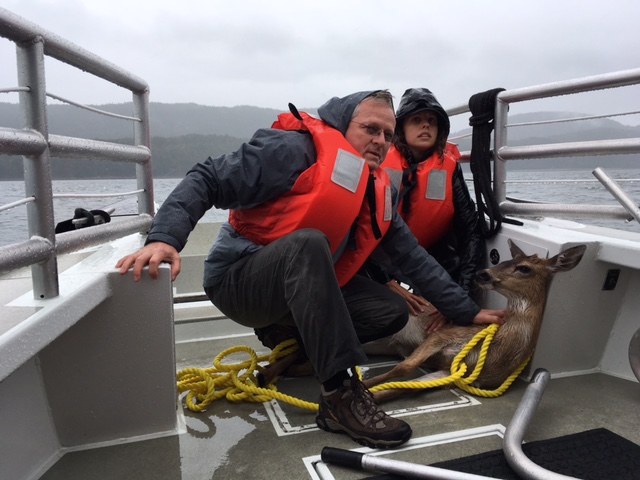
(L to R) Orlando, Fla.-based tourist Zoran Kojic helps Gastineau Guiding Company Naturalist Audrey Benson hold down a deer Wednesday, after they saved the animal from drowning. (Photo courtesy of Jasna Kojic)
While passing the west side of Juneau’s Shelter Island on Wednesday, an 18-passenger tour vessel saw more than just whales.
Audrey Benson, a naturalist with Gastineau Guiding Co., was on the tour when the crew got some news over the radio.
“We heard that there were two deer that were swimming across in the water,” Benson said. “So after we watched the whales for a bit our passengers were curious and wanted to see the deer, and so we motored over to them and it turns out there was only one.”
And it was struggling to stay above water. After a larger tour boat tried to rescue the animal a few times, it gave up. But Benson, along with the passengers and crew, decided to keep trying. They were eventually able to lasso the deer and pull it onto the boat.
“The deer was immediately bewildered and disoriented and it was shaking a lot, it was shivering a lot,” she said. “Its teeth were chattering. It tried to stand up but collapsed because it was so weak.”
The crew was able to drop the deer off at Shelter Island—but not before it tried to swim back into the water again.
“It was the craziest thing I’ve ever seen on any of my tours,” Benson said. “I mean, you never know what’s going to happen but for a deer rescue—I’ve never even been that close to a deer, I’ve never touched one—and to have an opportunity to assist this struggling animal, it was very intense.”
The other deer disappeared before the group reached it, and is presumed to have drowned.
The Alaska Department of Fish and Game said it’s very uncommon for deer to drown, adding that deer regularly swim from island to island.
Juneau residents discussed race relations at the UAS Student Recreation Center on Sunday, July 24, 2016. (Photo by Quinton Chandler/KTOO)
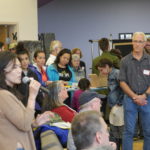
Christy NaMee Eriksen speaks to the audience. (Photo by Quinton Chandler/KTOO)
Lance Mitchell performed a play at Sunday’s event. (Photo by Quinton Chandler/KTOO)
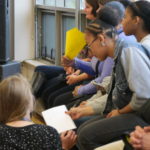
Skylar Wright recited a poem Sunday, July 24, 2016. (Photo by Quinton Chandler/KTOO)
Christy NaMee Eriksen addresses audience at UAS Student Recreation Center on Sunday, May 24, 2016. (Photo by Quinton Chandler/KTOO)
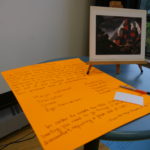
Conditions for attendees’ discussion about race relations. (Photo by Quinton Chandler/KTOO)
Art piece on display. (Photo by Quinton Chandler/KTOO)
One of the art pieces on display (Photo by Quinton Chandler/KTOO)
Audience member checks out art piece. (Photo by Quinton Chandler/KTOO)
Local artist, Christy NaMee Eriksen, and her friend Melissa Garcia Johnson sent out an invitation to share art and discuss racial justice and violence at the University of Alaska Southeast Student Recreation Center in Juneau Sunday. Dozens of people attended.
The event had three parts: A visual art exhibition, live performances and multiple conversations about race relations in the U.S.
“We’re welcoming, what we’re calling, a creative conversation around racial justice and anti-violence for our community. We’re calling it a creative conversation because we think there are a lot of ways that people can talk about race, talk about racism and racial justice, and talk with each other and we’re choosing to do ours today through art,” said Eriksen.
Attendees examined art pieces, listened to a play, two poems and had the opportunity to voice their own frustrations and ideas.
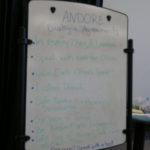
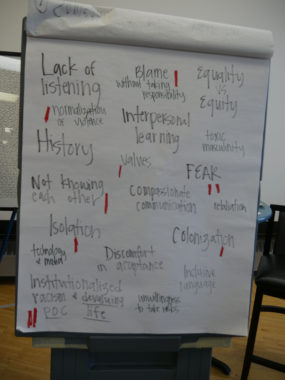
A list of the issues attendees discussed Sunday, July 24, 2016. Photo by Quinton Chandler/KTOO)
Juneau Police Department Lt. Kris Sell said having the conversation was a good idea.
“There have been incidents across the country that have concerned people about police use of force. I think that if people have concerns, we need to drag that out and talk about that because we only function if we respect each other,” Sell said.
She said she felt a little uncomfortable when some of the artists criticized police in their performances.
“There was this desire deep down that maybe I want to withdraw, maybe I feel like people are looking at me as the enemy. Like they’re seeing me as the police, not Kris that shares a community with them,” said Sell.
She thinks that same defensiveness is felt by a lot of people during hard conversations and that it’s important not to give into it.
Organizations that helped organize Sunday’s event:
Black Awareness Association of Juneau
Sealaska Heritage Institute
University of Alaska Southeast
Juneau Arts & Humanities Council
Perseverance Theatre
UAS Native and Rural Student Center
Northern Light United Church
Juneau Police Department
Juneau Interfaith Coalition
Juneau People for Peace and Justice
AWARE
Juneau Violence Prevention Coalition
Alaska Native Sisterhood Camp 3
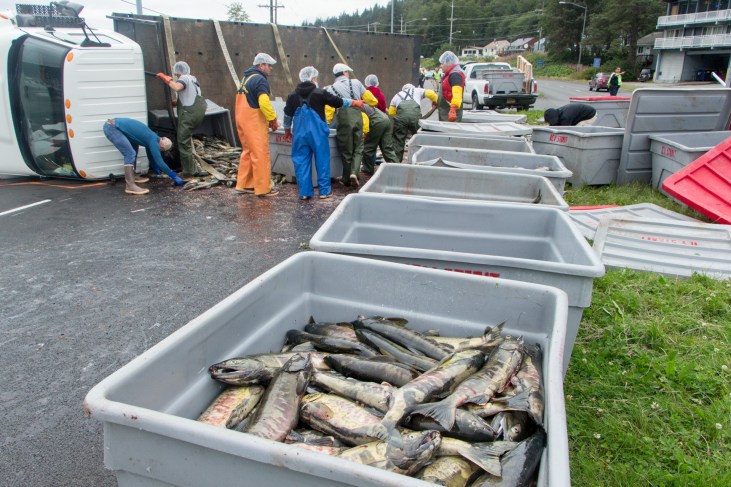
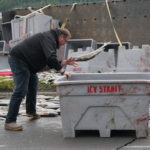
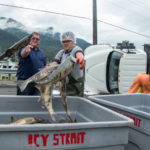
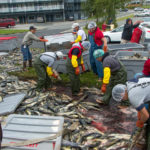
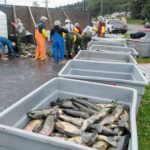
Crews load salmon back into fish totes after a tuck rollover on Egan Drive on July 25th, 2016. (Photo by Mikko Wilson/KTOO)
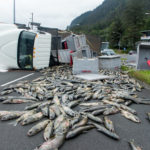
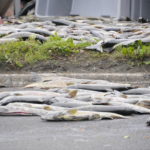
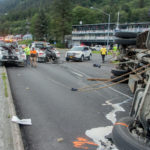
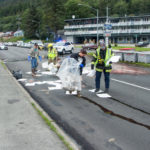
An assembly line of workers collected piles of chum salmon that spilled onto Egan Drive near Highland Avenue after a truck tipped over about 3:30 Monday afternoon. The incident took place near Juneau-Douglas High School and the Breakwater Hotel.
“So when the vehicle rolled over onto its side, it lost its load and the fish were spilled over the intersection. The inbound lanes of Egan Drive were completely blocked,” Juneau Police Lieutenant David Campbell said.
Traffic backed up for several hours while police diverted vehicles. Drivers were asked to avoid the area if they could. Outbound lanes were shut down to just one lane of traffic while a tow truck was called to the scene to remove the overturned vehicle.
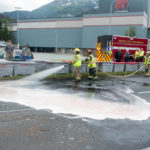
Egan Drive was fully reopened by 7 p.m. Capital City Fire and Rescue hosed down the highway to remove the slime.
Chuck Bill, CEO of Bartlett Regional Hospital confirmed that the truck driver was evaluated and then released.
Police and witnesses estimated the weight as between 10,000 and 16,000 pounds. Several people at the scene said the spilled salmon were considered contaminated and unfit for human consumption.
Note: This report has been updated with additional information. A new report is posted here.
16,000lbs of salmon spill from a rolled truck on Egan Drive on July 25th, 2016. (Photo by Mikko Wilson / KTOO)
A Juneau Police Department cruiser closes the inbound lanes of Egan Drive after a truck rollover on July 25th, 2016. (Photo by Mikko Wilson / KTOO)
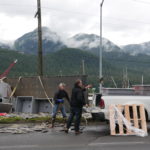
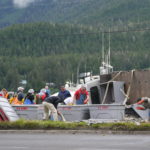
Crews clear fish from Egan Drive on Monday, July 25, 2016. (Photo by Lakeidra Chavis / KTOO)
Crews load salmon back into fish totes after a tuck rollover on Egan Drive on July 25th, 2016. (Photo by Mikko Wilson / KTOO)
Crews clear fish from Egan Drive on Monday, July 25, 2016. (Photo by Lakeidra Chavis / KTOO)
16,000lbs of salmon spill from a rolled truck on Egan Drive on July 25th, 2016. (Photo by Mikko Wilson / KTOO)
16,000lbs of salmon spill from a rolled truck on Egan Drive on Monday, July 25, 2016. (Photo by Lakeidra Chavis / KTOO)
Crews load salmon back into fish totes after a tuck rollover on Egan Drive on July 25th, 2016. (Photo by Mikko Wilson / KTOO)
Crews load salmon back into fish totes after a tuck rollover on Egan Drive on July 25th, 2016. (Photo by Mikko Wilson / KTOO)
Crews clear fish from Egan Drive on Monday, July 25, 2016. (Photo by Lakeidra Chavis / KTOO)
2 tow trucks work to upright an overturned flatbed truck on Egan Drive on July 25th, 2016. (Photo by Mikko Wilson / KTOO)
Traffic backed up on Egan Drive and Glacier Highway as JPD directed traffic, 1 lane at a time, around a rolled truck on Egan Drive on July 25th, 2016. (Photo by Mikko Wilson / KTOO)
Capital City Fire/Rescue personal assist in placement of absorbent pads to clean engine oil from Egan Drive following a truck rollover on July 25th, 2016. (Photo by Mikko Wilson / KTOO)
Firefighter Krista Telnes and Captain Todd Cameron of Capital City Fire/Rescue wash salmon slime from Egan Drive after a truck rollover on July 25th, 2016. (Photo by Mikko Wilson / KTOO)
Esther Burdick comes up empty in the Bobbing-for-Fish Heads event during the 2015 festival. She would eventually land her humpy. (KCAW photo/Robert Woolsey).
The Sitka Seafood Festival has issued a call for help after the 2016 event was placed on hold earlier this year.
Alicia Haseltine, vice president of the festival board, said the decision was made after the festival lost several of its leaders.
“Last year was our sixth year, and each year it’s continued to grow,” said Haseltine. “As it’s grown, the amount of people involved kind of stayed the same, so the workload wasn’t getting distributed as much as we’d hoped. Unfortunately about half of our board members ended up leaving town, including our director, which makes it very difficult to continue going how it has been going.”
In previous years, the festival offered cooking classes, meals, films, music and games focusing on the community’s fishing industry and seafood traditions.
The festival was run by volunteers. After year two, a nonprofit was established. Now, Haseltine said they’re looking for another organization or corps of volunteers to bring the festival into the future.
“To see it continue to grow we’d like to shift focus a little bit and see if we can get a fishing organization or someone in the tourism business or someone in the culinary industry who might want to spearhead it, and we can continue working on it from there,” said Haseltine.
Current board members and volunteers are holding a meeting to discuss the future of the Sitka Seafood Festival at 6 p.m. Aug. 18 at the Sealing Cove Business Center.
Harborview Elementary School Monday, May 11, 2015 (Photo by Jeremy Hsieh/KTOO)
Bridget Weiss is director of student services for the district. She wants to do a better job identifying all the students who need an extra hand meeting the district’s core curriculum standards.
It’s well-known not all children learn in the same way or at the same pace, but it’s not always easy to realize which kids need extra attention. Weiss is excited about a method that tracks kids’ academic progress and shows the district which ones need an intervention. The method is called RTI, which stands for Response to Instruction.
“In some places, it’s often referred to as Response to Intervention. It is a program based on the philosophy of identifying students’ needs early and attacking those with special interventions outside of the regular core curriculum,” Weiss said.
She said the strategy is being used in other schools around the country. The Juneau School District has used parts of it in a few schools in the past, but now it’s trying to use the strategy district-wide. Weiss said elementary schools used Response to Instruction last year to improve reading skills.
“Some schools are saying, ‘Hey, we really want to spend another year just focusing on reading, because we’re close, we’re not quite there, we really want to get expert at this whole RTI process with reading.’ Some schools are saying, ‘We’re chomping at the bit. We really want to get after math,’” Weiss said.
Student behavior is also on some schools’ RTI to-do lists.
This strategy has a lot of moving parts, but Weiss gave a brief explanation on how it works:
She said it lumps students into tiers according to their performance. Tier 1 is the district’s core instruction that every kid in every classroom is getting. At this level, educators are evaluating how effectively they’re reaching every student in the district.
Tier 2 is for kids who have a “higher level of need.”
“Which would mean they get some additional time in a small group, adding some instructional methods to what they’re getting in the regular classroom,” Weiss said.
She said if a student is “significantly behind,” they’re moved into the Tier 3 category.
“Which just means more time. So we increase the amount of time and focus that they’re getting and some of the strategies that we use,” Weiss said.
She said one of the most powerful parts of RTI come into play after kids are placed in a tier. They’re monitored for improvement. If a student in Tier 2 is getting additional small group instruction and it’s working, educators might keep giving that student more of the same.
“Or is it not working and they need more time, or do they need a different intervention altogether,” Weiss asked.
Finally, if students just aren’t showing enough improvement after multiple assessments and interventions, the district will consider the possibility that it’s dealing with a learning disability and move them towards special education.
Weiss said, “There’s a continuum of work happening here from looking at all kids who might need some assistance, and then narrowing and applying effective practice, as well as identifying students who might need even more than what RTI can do for them.”
She said because RTI is not just relying on teachers’ thoughts and feelings about their students’ abilities, there’s a better chance of catching kids who might otherwise fall through the cracks. It’s a systematic review of students’ performances over time.
Weiss believes RTI can help identify kids’ individual challenges so they can solve them early in their educational careers.
Each student’s data is also unique to them, not to the school. So when students change schools, their data travels with them.
Close
Update notification options
Subscribe to notifications
Subscribe
Get notifications about news related to the topics you care about. You can unsubscribe anytime.