JUNEAU — Juneau police say they were able to arrest a robbery suspect with the help of a witness who chased the man down and detained him until officers arrived.
The Juneau Empire reports that officers had responded Sunday night to a report that Michael Hoyt, 38, had taken a cellphone from another man. A 45-year-old Juneau man who had been nearby then stepped in to stop Hoyt.
Juneau police Lt. David Campbell says the witness was able to keep Hoyt restrained by resting his body on him until police arrived.
Hoyt was treated for injuries at a hospital before being taken to a Juneau correctional facility.
Police say neither the witness nor the alleged robbery victim sustained any injuries.
Hoyt was arraigned on the second-degree robbery charge Monday.
No one knows the challenges of living with a mental disorder better than someone who has been diagnosed with one. That’s the argument the founder of a new nonprofit made to explain why his organization will be effective helping improve life for the mentally ill, starting with housing in Juneau.
“I suffer from a mental illness and have for about 25 years,” said Gregory Fitch, the founder of the Mental Health Consumer Action Network, or MCAN. He has schizoaffective disorder, “Which is minor schizophrenia, I also have bipolar and I have what’s called borderline personality disorder.”
“I got together and started to realize that maybe we need to come together as a people to have our voices heard. That’s what MCAN is about. MCAN is about reaching the top level of policymaking, have our voices and concerns heard, so we can get better benefits from policies that affect us,” Fitch said.
He calls people who, like himself, suffer from mental illness “consumers.” He said the word is already widely used in mental health care and it reduces the stigma attached to the words “mentally ill.”
He first thought of starting MCAN eight years ago while working for another community organizer. He said his battle with mental illness slowed the process for getting MCAN off the ground, but recently he found himself in the right place and decided it was time.
“I got better on the right medications. It’s working and I said, ‘You know what? It’s time to do this.’ So we did it. We incorporated in April.” Fitch said. “Since then we have built a massive organization. We have a major president onboard who (was) the president of ACORN International, his name is Wade Rathke. He supports us. We have a local board of representatives here in Juneau.”
ACORN International is the organization Fitch worked for when he first imagined MCAN. A funding shortage and public embarrassment from an embezzlement scandal forced ACORN to disband in 2010 after 40 years of activism.
MCAN founder Gregory Fitch on Friday at KTOO. (Photo by Quinton Chandler/KTOO)
Fitch is not a registered lobbyist yet. Under State law, he doesn’t have to register until he gets paid. His first goals on MCAN’s list are to educate people on the issues the mentally ill face and to offer a solution to one of their biggest problems – housing.
Dominic Smith is helping Fitch launch MCAN. He’s also a consumer. He said he has a slew of diagnoses starting with clinical depression and attention deficit disorder.
“I have generalized anxiety disorder. I have panic attacks, sometimes they can be minor and it’s just, you’re irritated, agitated and people think you’re just a jerk. They think you’re angry and violent, but I’m not a violent person,” Smith said.
Also on his list are post-traumatic stress disorder, seasonal affective disorder and insomnia.
“The big thing is when I have anxiety or a panic attack, I cannot function. Sometimes I cannot even breathe,” he said, his voice starting to shake. “Sorry if I get emotional but it’s even been so bad that I have flashbacks to my childhood.”
Smith said he came from Wisconsin after years of saving and planning his move to Juneau. He said he came to town with a place to live, but he was accused of stealing a laptop and had to leave.
“And it turns out that next evening they found their computer,” Smith said.
He lived in hotels for a while, then he started camping in the woods and he said he’s not the only one.
“I have many friends that live in boats, people that live in cars and people that just live in the woods like I do,” Smith said.
Recently he found a place to live but he was camping out long enough to get acquainted with the challenges of homelessness. He said multiple items were stolen from him and he was barred from entering businesses because he looked homeless.
Fitch believes MCAN will be able to help other consumers like Smith so, even if they hit a rough patch, they won’t have to sleep in the woods.
“Possibly a shelter situation for the consumer, by the consumer. We’d like to see the mental health community involved in this definitely. This is a long-term goal of ours,” Fitch said. “We’d like to possibly break ground on this within a year.”
Fitch said MCAN will find a headquarters in a few more weeks and then they’ll start making headway. He said they’re serious, that in four months they went from an idea to a social welfare nonprofit, securing support from community members, state legislators and Gov. Bill Walker.
Tracy’s King Crab Shack in Juneau in July 2013. (Creative Commons photo by mark byzewski)
If you’ve visited Juneau, you’ve probably heard of Tracy’s King Crab Shack — the waterfront restaurant famous for its crab bisque. It’s become the subject of another skirmish in Juneau’s local restaurant wars.
The shack has been around for more than a decade and garnered increased popularity after appearing on Bravo TV’s “Top Chef” in 2013.
This will be the famous crab shack’s final season at its current waterfront location.
Michael Tripp is the majority owner of the business that leases the property to the restaurant. He said in an email that their businesses couldn’t reach an agreement on a new lease. It won’t be renewed next year.
Tripp said the property is under contract with another local business, but he wouldn’t say with whom. Tripp said the business relationship with LaBarge was professional and respectful.
David McGivney and Tracy LaBarge sit outside Tracy’s King Crab Shack. (Photo by Elizabeth Jenkins/KTOO)
LaBarge said in an email that the situation is unfortunate and saddening.
“It was always our intent to purchase the building, and in my last conversation with the current owner, I made a verbal offer to purchase or to renegotiate the current lease. I did not hear back from the building owners regarding my offer, and was surprised to get an email stating they had chosen to deal with another restaurant group.”
A “Łuq’a Nagh Ghilghuzht” sculpture by Joel Isaak depicts traditional Dena’ina life at fish camp outside the Kenaitze Indian Tribe’s new Dena’ina Wellness Center in Old Town Kenai. (Photo by Patrice Kohl/Redoubt Reporter)
Alaska got a glowing report in a checkup from a top federal health care official. Though there are issues that need further treatment and support, communities showed a healthy dose of innovation in delivery and integration of care.
Mary Wakefield, acting deputy secretary for the U.S. Department of Health and Human Services, toured Alaska from Aug. 1 to 4, visiting Barrow, Fairbanks, Circle, Anchorage and Kenai. But she wasn’t bringing a prescription from Washington. Instead, she got ideas for the treatment of health care in rural communities that can be brought to other areas of the country.
“I’ve seen some phenomenal examples of Alaska Native and American Indian communities that are really focused on comprehensive services that are delivered effectively and very efficiently on behalf of their communities. So there’s some wonderful examples to draw from this state and from these communities and try to think about how we might apply some of these examples in other parts of the United States,” Wakefield said.
HHS provides funding for a wide range of community services. A big part of the department’s presence in Alaska is through Indian Health Services, which funds facilities and programs administered through Native tribes throughout the state.
During her visit to Kenai on Aug. 4, Dr. Wakefield toured the Kenaitze Indian Tribe’s Head Start program, elder center, tribal court and Dena’ina Wellness Center, which offers medical and dental care, behavioral health services and a wide variety of general health and wellness programs. The center provides care to Alaska Native and American Indian people. Behavioral health services are available to anyone in the community.
Jaylene Peterson, executive director of the Kenaitze Tribe, says it was an honor to meet with Dr. Wakefield.
“This is an unprecedented visit. It was an amazing time that we were able to share with the deputy secretary, and we were able to show her what we’ve been able to accomplish with funds that have not always met the true need. So we’ve been blessed by this trip. I believe that she has learned much about the Alaskan community and why things are so different and more challenging here in an Alaskan setting,” Peterson said.
Peterson hopes the visit will help remove some stumbling blocks that come with HHS funding. She says that some of the reporting and training requirements can be onerous.
“I don’t disagree that we should be accountable for the funds that we receive, but sometimes it can be a lot more than should be required. So, there are ways that I believe that we can be smarter with our money,” Peterson said.
Primarily, though, the tribe wanted to show its holistic approach to health care.
“It’s just phenomenal. The leadership, the commitment, the approach that is innovative in terms of the integration of a wide range of services on behalf of the people who are served here is absolutely exceptional,” Wakefield said.
Before her trip to Kenai, Wakefield participated in a summit in Wasilla on opioid abuse.
“It is an absolute epidemic in every state the across the country, including right here in Alaska. And there are some pretty serious problems in communities within the state that are really adversely impacting families and putting special burdens on law enforcement, (and) special burdens on health care providers,” Wakefield said.
She says the Obama Administration is focusing efforts on making sure health care providers have the clinical skills necessary when prescribing opioids, closing the gap between people who want treatment and access to that care, and making sure people who have overdosed have immediate access to life-saving medications.
Among its many social services, the Kenaitze Tribe offers a chemical dependency recovery program.
Skagway Assemblyman Dan Henry was sentenced this week to just over a year in federal prison.
Henry was convicted of failing to file his income tax returns over a four-year period. How Henry’s prison sentence will impact his service on the borough assembly remains to be seen.
Henry has served in Skagway government for about 20 years.
His current three-year term doesn’t end until 2017. However, he’s been ordered to report to a federal prison facility by Nov. 1 of this year.
That’s about a month after municipal elections, in which two other assembly seats are up for grabs.
Mayor Mark Schaefer briefly mentioned the predicament at an assembly meeting Thursday.
“I think we’re all aware of Assemblyman Henry’s personal situation,” he said. “I’m discussing with the attorney on how we’re going to proceed in the matter.”
Requests for comment from Schaefer and Henry were not returned.
The question of whether Henry’s prison sentence disqualifies him from service on the assembly is up in the air.
Skagway Borough Code states an assembly seat shall be declared vacant if a member is physically absent from the municipality for 90 consecutive days, with a caveat: the other assembly members have the power to excuse that member, allowing them to continue service.
Henry could try to call in to assembly meetings, but members are limited to four call-ins within a calendar year.
If Henry were to resign his seat or be excused, another question remains.
Would the sitting assembly members appoint someone to the empty seat, or would voters get to decide in the October election?
Orion Hanson was one of a few residents who spoke at the Thursday meeting asking for Henry’s assembly seat to join the other two on the ballot.
“If there is to be a third vacancy on the assembly, I think it would be democratic to have that opportunity for the voters to vote on that in this upcoming election,” Hanson said.
The two seats up for election this term are occupied by Spencer Morgan and Tim Cochran. As of Friday afternoon, no one had declared candidacy.
Haines police chief Heath Scott wants to expand the four-officer department, but placing a school resource officer at Haines School District is no longer a priority. (Jillian Rogers, KHNS)
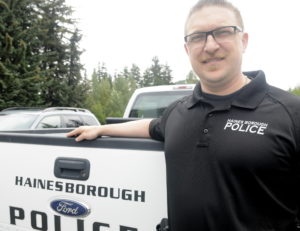
Haines police chief Heath Scott wants to expand the four-officer department.
Initially, Scott thought potential expansion could include a school resource officer for the Haines School District. But after more consideration, he’s stepped back from that idea.
Scott said placing a school resource officer at Haines School was a priority for him, at first.
“Fundamentally that comes out of me being a parent, a taxpayer,” Scott said. “I see the benefit of school resources officers in communities I’ve worked in in the past.”
Habra said from what he heard from the administration and school board, a resource officer is not needed in the school, he said in an interview a few weeks ago.
“There was some movement on (the school resource officer idea) prior to having that discussion with the administration here, with the board here,” Habra said. “So that’s a premature decision.”
“I think the new school administrator, having a new borough manager and having me coming in, the general consensus among us is that we need to take some time so that we understand our roles, understand what the community needs,” Scott said.
Scott came into the Haines job with a “preconceived notion” of a police department that has a good relationship with the community, he said. He’s realized that it’ll take time to build trust.
Even if he did want to put an officer in the school right now, Scott said, it would be irresponsible given the department’s limited manpower.
“Here’s the major concern. There’s 24 hours in a day, and you have four officers.”
The level of staffing isn’t acceptable to him, he said. That’s why Scott encouraged former acting chief Josh Dryden to apply for a Community-Oriented Policing Services, or COPS, grant through the U.S. Department of Justice. It’s a three-year grant that funds 75 percent of a new officer’s salary, up to $125,000.
“Prior to me coming, you’ve had a department of at times two (officers), at times three, and those guys are tired,” Scott said. “They have to go on leave, they have to go to training. And I have to be cognizant of this stuff.”
Scott expects to hear back about the grant this fall.
Directing limited manpower to the school probably wouldn’t be in the community’s best interest, because the Haines force is small and stretched, Scott said. He still thinks it might be a good idea in the future.
“If the community wants it, and the school system wants it, the police chief wants it, the mayor, and borough and assembly wants it, it’s a good idea,” he said. “And I just don’t know if all of that’s there. It may be too early to say that. Now, it would irresponsible to say we’re not doing it. Because we don’t know what may come in two years, and it may be the right time then.”
For now, Scott says he’s resolved to pay attention to what the community wants and take changes – like putting an officer in the school – slowly. But he does plan to apply for grants and talk to the borough about how to expand the department.
Close
Update notification options
Subscribe to notifications
Subscribe
Get notifications about news related to the topics you care about. You can unsubscribe anytime.