Community

Louisiana Takes Stock Of The Damage After Devastating Flooding

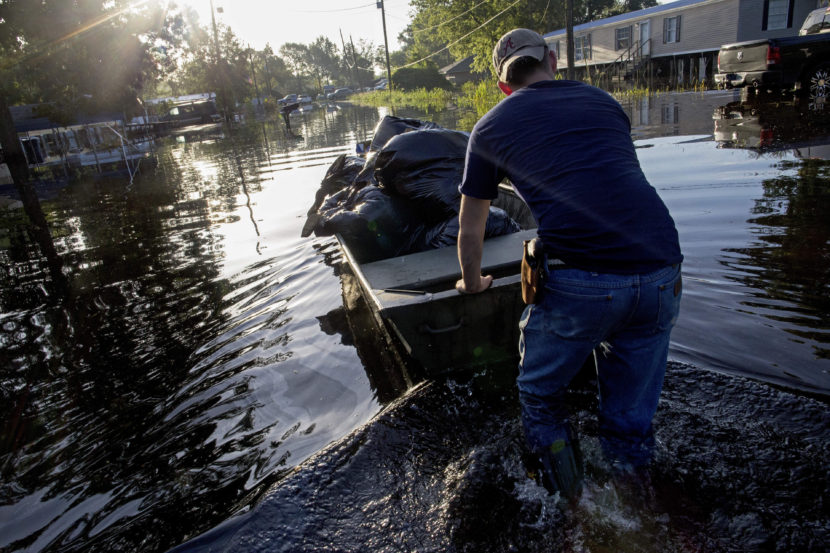
Daniel Stover, 17, moves a boat of personal belongings from a friend's flooded home in Sorrento, La., on Saturday. Max Becherer/AP
Daniel Stover, 17, moves a boat of personal belongings from a friend’s flooded home in Sorrento, La., on Saturday.
Max Becherer/AP

Louisiana is entering recovery mode after devastating flooding killed 13 people and damaged at least 60,000 homes across 20 parishes.

But as Louisana Gov. John Bel Edwards told CNN, that process is “going to take many months.” He added that even though this flooding was “unprecedented and historic,” many are “just now realizing how significant it was.”

The Red Cross said the Louisiana flooding “is likely the worst natural disaster in the United States since 2012’s Superstorm Sandy,” and response efforts are “expected to cost at least $30 million.”

Edwards emphasizes that the state “really needs help.” Here’s more:

“Typically by this point in a storm, I think Red Cross would be receiving a lot more donations, I think there would be more volunteers signing up. Although we have some of that in place now, it would be very helpful if people would donate to the Red Cross, to the Baton Rouge Area Foundation, and also to come volunteer to help people get back in their homes as quickly as possible.”
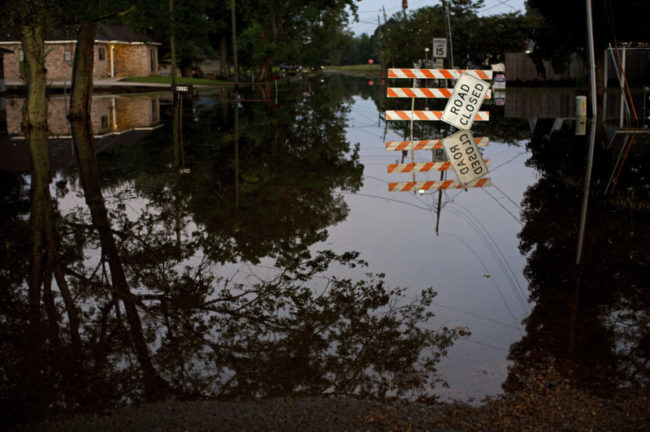
Standing water closes roads in Sorrento, La., on Saturday. Max Becherer/AP
Standing water closes roads in Sorrento, La., on Saturday.
Max Becherer/AP

The governor’s office said “102,000 have registered for federal help,” as the Associated Press reports. FEMA spokesman Rafael Lemaitre said “more than 25,000 have filed flood claims.”

State officials estimate that 60,000 homes were damaged. But a report from the Baton Rouge Area Chamber, a local economic development group, put the number at 110,000. From member station WWNO, reporter Ryan Kailath explained the discrepancy to our Newscast unit:

“The higher local estimate is actually the total number of homes in the floodplain area, whether or not they’re damaged. The much smaller number that officials keep repeating is the number of homes that have been reported damaged.

“Because payouts can be tied to damages, each side has an interest in setting the number. After Hurricane Katrina, the numbers were still being debated long after the storm, with state estimates much higher than federal ones.”
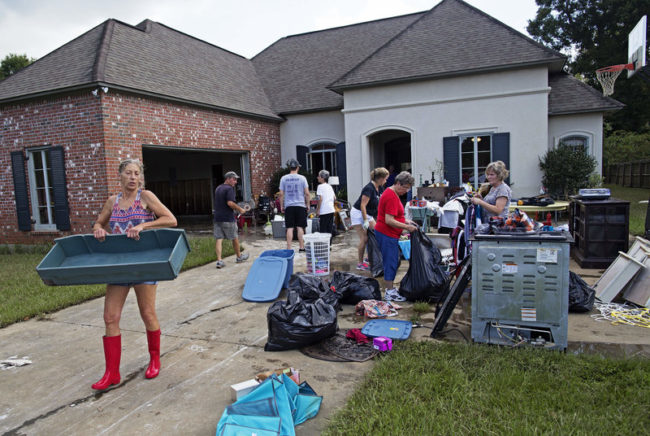
Raven Harelson, 59, (left) carries a drawer to the trash heap in front the home of Sheila Siener, 58, as friends and family help to clean out the flood damaged home in St. Amant, La., on Saturday. Max Becherer/AP
Raven Harelson, 59, (left) carries a drawer to the trash heap in front the home of Sheila Siener, 58, as friends and family help to clean out the flood damaged home in St. Amant, La., on Saturday.
Max Becherer/AP

Regardless of the number of structures, The Advocate said residents are beginning to dig out their waterlogged homes, creating “massive debris piles” on the streets of Baton Rouge.

“Clothing and children’s toys, along with water-soaked carpeting and sofas and damaged refrigerators and stoves and the bric-a-brac of daily life were stacked outside houses” in the Baton Rouge area, as the newspaper reported.

Mike Johnson told The Advocate that his family home was flooded and “just about everything” was lost. “The hardest part of it is a lifetime of accumulation gone in a couple of hours,” he said. “Now it’s back to the drawing board.”

As Kailath reported on Weekend Edition Sunday, tens of thousands of South Louisiana residents were taken by surprise at the rising floodwaters, despite warnings.

He said “family after family” told him the same tale: “They heard the warnings, and thought — it won’t happen to me.”

That may be because many of areas hit are inland, and not ones that typically experience flooding. “People have a hard time grasping things they haven’t experienced,” Marshall Shepherd, the former president of the American Meteorological Society, told Kailath.

According to Shepherd, “people around the world are going to see more and more weather for which they have no reference point.”

Meanwhile, multiple counties in south and central Texas are threatened with flash flooding, with reports of water rescues.

Copyright 2016 NPR. To see more, visit http://www.npr.org/.

Homer art gallery hosts “Decolonizing Alaska” exhibit

An innovative new exhibit at Bunnell Street Arts Center has turned a spotlight on Alaska’s long history of colonization. Asia Freeman, the curator of “Decolonizing Alaska”, says colonization has had a powerful influence on the state.

“As a resource state, Alaska has been colonized by forces for centuries now, that have defined and shaped our identity as a state,” said Freeman.

The exhibition tells a multitude of stories from many perspectives.

"Counting on Liberty" by Rebecca Lyon. (Courtesy of Bunnell Street Arts Center)
“Counting on Liberty” by Rebecca Lyon. “I have printed her image on a combination of a US twenty dollar bill and the American flag and given her a cartoon crown of the Statue of Liberty.” – Lyon (Courtesy of Bunnell Street Arts Center)

Rebecca Lyon’s mixed media piece “Counting on Liberty” represents the long struggle for women’s rights.

“It’s a piece of artwork that I silkscreened an image of my great grandmother, Anastasia Nutnaltna,” said Lyon.

Lyon’s great grandmother was sold into slavery as a young girl. According to family history, she was later purchased by Lyon’s great-grandfather, an immigrant from Sweden.

“She had a very difficult life but if you look at the photograph and the demeanor of her look, as she looks out in the audience, you can see such pride, strength. Even in an age when she had little or no rights,” said Lyon.

Her grandmother wears a cartoon crown similar to the Statue of Liberty. Lyon says that she hopes to draw more attention to the issue of who should be on U.S. currency. Surrounding the image of her great-grandmother, Lyon has positioned a contemporary Athabascan counting cord. The knotted deer hide is covered with buttons and memorabilia, documenting the history of the women’s rights movement.

“It’s all in this bright Plexiglas color and bright colors to get your attention, to scream at you across the room and say ‘let’s talk about women’s rights,’” said Lyon.

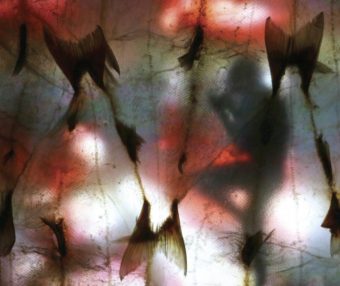
Across the room, Joel Isaak’s “Visions of Summer” is playing on a loop. He describes his artwork in pretty simple terms.

“It’s a fish screen TV screen,” said Isaak.

A hazy video of his family at fish camp is visible through translucent salmon skins that he whipstitched together.

Silhouetted on the screen is a video of him dancing. To create the video, Isaak danced for hour-long stretches at night, when the studio was empty.

“I’d go to the dance studio at my school and I’d dance all night long,” said Isaak.

For Isaak, his art not only celebrates his Dena’ina heritage, it captures some of what makes the natural world so extraordinary.

“The sense of wonderment, kind of intrigue, otherworldliness. When I’m dip-netting at the beach, I feel fish run into me and you can’t see it. So it’s kind of a little portal into another world,” said Isaak.

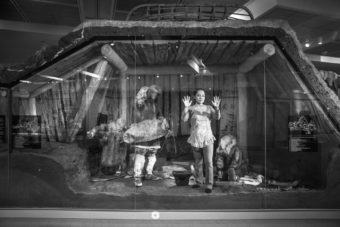
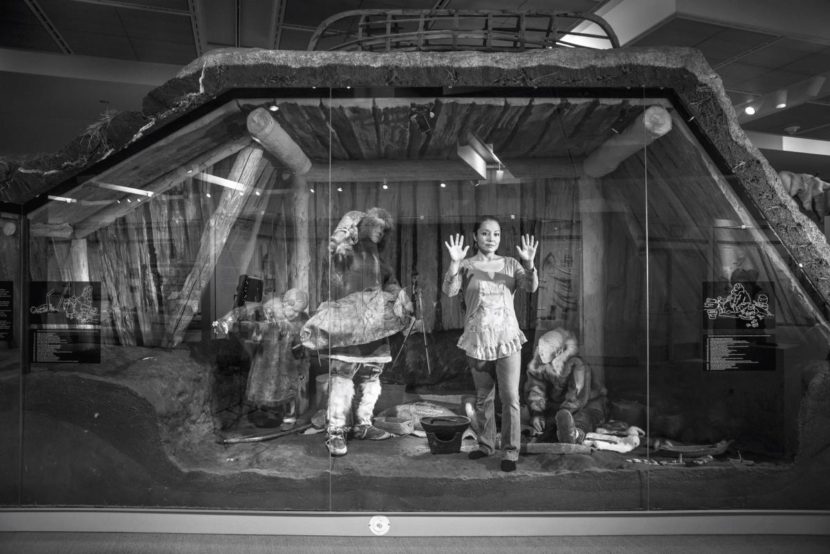
Artist Mike Conti stands beside his black and white photograph of a young Yup’ik woman named Jacquie.

“I call it Yup’ik Ena, which means “Yu’pik house” and then in quotes “White gaze,” said Conti.

"White Gaze" by Michael Conti.
“White Gaze” by Michael Conti. (Courtesy of Bunnell Street Arts Center)

The photograph shows the woman wearing jeans and a kuspuk. She’s standing inside of an Alaska Native diorama full of stiffly posed mannequins in traditional dress.

“It’s like a cross-section, so you’re looking through glass and Jackie has her hands up, like she’s pressed against the glass. Then in the glass, you can see a reflection of me, the photographer. So that’s the white gaze part,” said Conti.

As a self-described “white guy”, Conti is acutely aware of how often the Alaska Native narrative has been in the hands of outsiders.

“The control of the perception is in the viewer. In this case, the white photographer,” said Conti.

For curator Asia Freeman, this collaboration of native and non-native artists is part of what makes the show so groundbreaking.

“I think the thing that is most exciting is to actually say out loud that this type of show hasn’t happened before. I can’t think of an example where native and non-native artists come together to explore and challenge the longstanding effects of colonization through their work,” said Freeman.

The “Decolonizing Alaska” exhibit at Bunnell Street Arts Center runs through the end of August. Over the next year, it will travel to Valdez, Washington DC, Juneau and Anchorage.

Hillary Clinton walks a fine line between police and Black Lives Matter

Sitting between New York City Police Commissioner Bill Bratton and policy adviser Maya Harris, Democratic presidential candidate Hillary Clinton spoke during a meeting with law enforcement officials earlier this week in New York City. (Photo by Drew Angerer/Getty Images)

As Hillary Clinton began a meeting with police chiefs from departments around the country, she expressed gratitude to those on the force.

“They represent officers who get up every day, put on their uniforms, kiss their families goodbye and risk their lives on behalf of our communities,” the Democratic nominee said at the Thursday gathering in New York City.

During the brief part of the meeting that was open to reporters, Clinton referenced Dallas, where five police officers were shot and killed in July. She also talked about Baton Rouge, La., where police fatally shot Alton Sterling, a 37-year-old black man, while he was on the ground.

Clinton said there’s a lot of work to do to repair trust between communities and police.

“We need to work together to bridge our divides, not stoke even more divisiveness,” she said.

Clinton struck a similar theme earlier this week in the battleground state of Pennsylvania. While campaigning before a largely white audience in Scranton on Monday, Clinton mentioned the protests in Milwaukee, which broke out after police shot and killed a black man there last weekend.

“Look at what’s happening in Milwaukee right now,” Clinton said. “We’ve got urgent work to do to rebuild trust between police and communities and get back to the fundamental principle: Everyone should have respect for the law and be respected by the law.”

Clinton’s Republican rival, Donald Trump, also talked about Milwaukee this week. During a campaign stop in the nearby suburb of West Bend, Trump accused Clinton of being anti-police because of her calls for reform of the criminal justice system.

“She is against the police, believe me. You know it and I know it and guess what? She knows it,” Trump told the crowd.

Critics on the left, including groups like Black Lives Matter, have accused Clinton of being too slow to address concerns from African-Americans and their allies — a key part of Democratic base — about aggressive policing. Clinton herself has acknowledged that tension.

“I know that just by saying all these things together, I may upset some people,” she said.

Speaking to the African Methodist Episcopal Church General Conference on the day after the Dallas police shootings, Clinton called for national guidelines on the use of deadly force and better training for police.

“I’m talking about criminal justice reform the day after a horrific attack on police officers,” Clinton said. “I’m talking about courageous honorable police officers just a few days after officer-involved killings in Louisiana and Minnesota.”

While Hillary Clinton tries to navigate those conversations, Donald Trump is walking another line.

This week, he’s been praising police while promising to bring “law and order” to African-American neighborhoods. So far, though, he’s been making that case in front of mostly white audiences.

Copyright 2016 NPR. To see more, visit http://www.npr.org/.

Ketchikan to host ‘Plunge for Peace’ to recognize officers

KETCHIKAN — A Ketchikan woman is leading an effort to show local and state law enforcement agencies that they have the community’s support by taking a plunge in the Pacific Ocean.

The Ketchikan Daily News reports that the “Plunge for Peace” event, organized by Debbie Karlson, will take place Saturday at Ketchikan’s Knudson Cove. She says docks will be cleared of boats to make way for jumpers.

Karlson says idea for the plunge came out of wanting to show support for law enforcement following the killings of police in Dallas and Baton Rouge, Louisiana.

Ketchikan police Chief Alan Bengaard says Ketchikan is fortunate because support for officers “has always been huge.”

The Plunge for Peace event will recognize Ketchikan police, Alaska State Troopers and the U.S. Coast Guard.

Threatened by rising seas, an Alaskan village decides to relocate

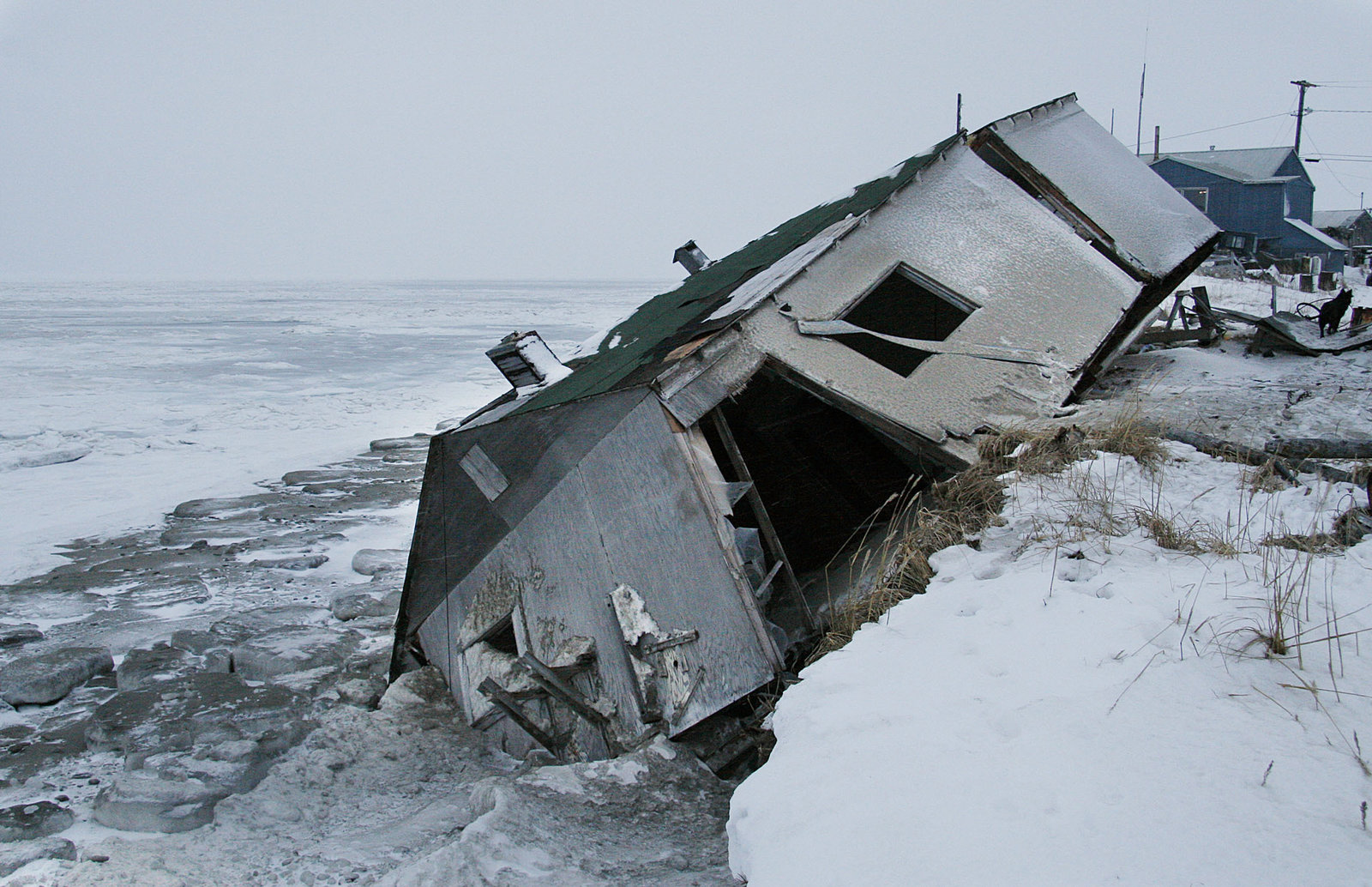
An abandoned house at the west end of Shishmaref, Alaska, sits on the beach after sliding off during a fall storm in 2005. (Photo by Diana Haecker/Associated Press)

Rising sea levels have eroded an Inupiat Eskimo village for decades. Now, residents of Shishmaref, Alaska have officially voted to relocate.

The island community, located near the Bering Strait, opted to move rather than remain in place with added safety measures to protect against the rising waters. The city clerk’s office told NPR that 94 votes favored relocating and 78 votes wanted to protect in place.

Now, according to the clerk’s office, the city council will meet to discuss the options for where to relocate. A recent feasibility study assessed four possible sites, and the clerk says those options have been narrowed down to two.

Esau Sinnok, an Arctic Youth ambassador from Shishmaref, wrote in a recent blog post that the community has “lost 2,500 to 3,000 feet of land to coastal erosion” over the past 35 years. He said his family has moved 13 houses in 15 years, “from one end of the island to the other because of this loss of land.”

On All Things Considered, Sinnok explained that he supports relocating the village “so we’ll have a community called Shishmaref for future generations.” Here’s more:

“Shishmaref will be underwater within the next three decades, and if we do not do anything, we’ll be forced to move to another city like Nome or Kotzebue or Fairbanks or Anchorage, and not many people will move to the same place. So that means our unique community of Shishmaref will soon die out because we have our unique dialect of Inupiat Eskimo language, our unique Eskimo dancing, our unique gospel singing translated in Inubiat. All that will soon die out if we do not move as a community.”

It’s a community that relies on hunting and fishing, he said. “A majority of our diet comes from the land and the sea. We hunt for caribou, moose, musk ox, bearded seal, walrus and gather traditional berries like the cloud berry, blueberries, blackberries.”

Tribal coordinator Jane Stevenson recently told The Associated Press that “she is leaning toward remaining at the current site because it’s closer to subsistence foods such as fish seal and walrus that people rely on for much of their diet.”

Sinnock said that some of those who want to stay belong to an older generation, who say “they want to stay in place because they’ve lived there all their lives and that’s where their parents and grandparents grew up too.”

The town’s mayor, Howard Weyiouanna, also argued that staying at the current location would be the most cost-effective, according to the AP. As the wire service reported, “either scenario selected in the Aug. 16 vote would cost millions – money the community of nearly 600 doesn’t have.”

Shishmaref is one of at least 31 Alaska Native villages where erosion due to climate change poses an imminent threat, according to a 2009 report from the Government Accountability Office. Twelve of those villages were exploring relocation options.

According to the Thomson Reuters Foundation, “scientists attribute coastal erosion in Shishmaref to global warming that has thawed sea ice that once shielded the island from storm surges.” It added that the village’s “permafrost, the layer of permanently frozen soil on which it is built, is melting as well.”

This is not the first time the community has voted on whether to relocate – Shishmaref voters decided to relocate in a 2002 poll, but that never happened due to a lack of resources. But Sinnock told NPR that he thinks such a decision would be handled differently now:

“I think that we learned a lot more than we did 14 years ago. I think the momentum we have now will lead to finding the available resources, and I really hope that this story, our story, goes out to the federal government, like to President Barack Obama, so that they can really know what effects of climate change are in Alaska.”

He added: “It’s crazy to know that your only home will soon be underwater if the federal government doesn’t do anything to help you out.”

Copyright 2016 NPR. To see more, visit http://www.npr.org/.

Riders hone skills, hit the road to round up stuffed toys for kids

The Panhandlers Motorcycle Club’s two big summer events are coming up this weekend.

The rodeo begins at noon Saturday at the Panhandlers’ Club House on Engineers Cutoff Road, where riders will demonstrate their skills with a series of competitions. Anyone with a Harley-Davidson motorcycle can participate in the competition.

With the exception of children and dogs, everyone is welcome to watch.

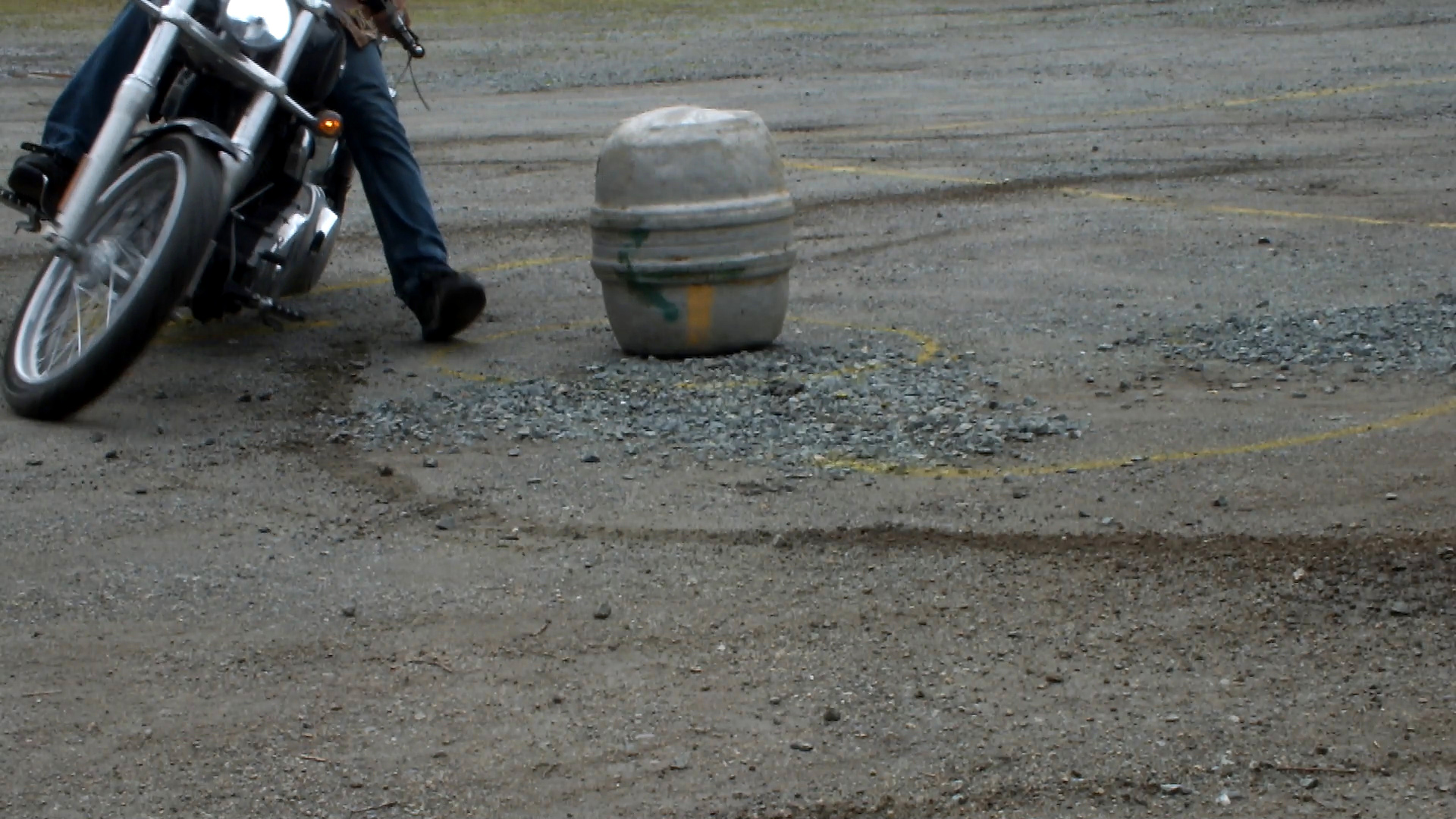
The events test a variety of skills. There’s Lancelot, a fresh take on medieval jousting that is intended to test a rider’s ability to control their motorcycle with one hand and a locked throttle. The slow race tests balance. In the keg push, riders try to push a beer keg straight ahead with their front wheel. The pub crawl is a medley of multiple events that include riding, shooting, ax throwing and a little beer. The event is intended to test a rider’s ability to quickly get off their motorcycle, help a fellow rider with a problem and get back on the road.

Panhandlers at the 2015 rodeo demonstrate some of the events in this video:

“We like to test our individual skills,” said Craig Fowler, president of the Panhandlers. “Because if you can master the skills that we have here when you’re on the road and someone pulls out in front of you, you don’t run into them.”

A Juneau rider competes in the Barrel Race during the Panhandlers' annual Rodeo in 2015.
A Juneau rider competes in the barrel race event during the Panhandlers’ annual rodeo in 2015. (Photo by Matt Miller/KTOO)

The rodeo will be followed the next day with the annual toy run to round up stuffed animals for children at Bartlett Regional Hospital, Juneau.

“People around the community have helped us so much. With open arms, they welcome the toy run,” Fowler said. “If you have a kid that goes into the hospital or in an ambulance and has any kind of fear, they say ‘What do you like? You like Barney? You like dinosaurs?’ We always stockpile them every year.”

The toy run begins at 1 p.m. Sunday with the motorcycle lineup at Donna’s Restaurant parking lot, 9131 Glacier Highway, in the Mendenhall Valley.

Riders will likely proceed to downtown Juneau before ending at the Douglas Fire Hall. There, ribs and pulled pork sandwiches will be served up from 2 to 4 p.m. The public can join in with a $10 cash donation, or a new stuffed toy worth at least $10.

Stuffed toys can also be dropped off at Louie’s Douglas Inn, 915 3rd St., Douglas, or the Triangle Club Bar, 251 Front St., downtown Juneau.

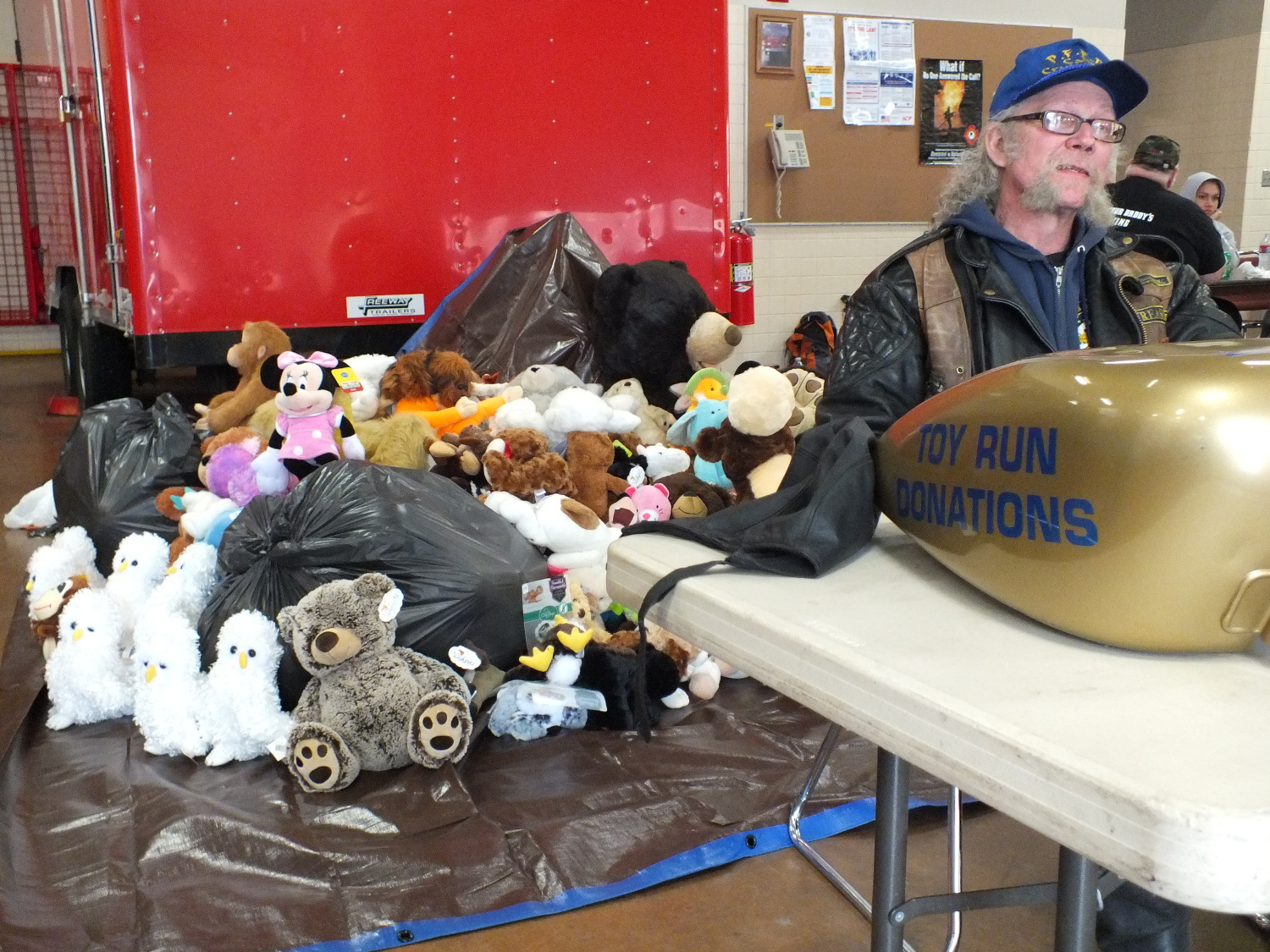
Panhandlers MC Treasurer Mark "Brillo" Chitty accepts donations during the 2015 Toy Run. (File photo by Matt Miller/KTOO)
Panhandlers MC Treasurer Mark “Brillo” Chitty accepts donations during the 2015 toy run. (Photo by Matt Miller/KTOO)
Site notifications
Update notification options
Subscribe to notifications