Community

Sept. 11 marked turning point for Muslims in increasingly diverse America

(Illustration by Ashley Mackenzie for NPR)

Fifteen years after the attacks of Sept. 11, Americans have grown aware not only of the danger of terrorism but also of the reality that their nation is far less white, Christian and European than it used to be.

“Culturally, we’re a country of Bollywood and bhangra and tai chi and yoga and salsa and burritos and halal and kosher,” says Diana Eck, professor of comparative religion at Harvard University and author of A New Religious America.

Through her direction of the Pluralism Project at Harvard, Eck and her researchers have documented the growth of an “interfaith infrastructure” in the country.

“After 9/11,” she says, “it became important to know more clearly who is in our community. The level of ignorance was cracked. It is far from solved, but I think 9/11 did bring a moment of awakening that the ‘we’ of the United States is changing.”

A recognition of America’s increased diversity is especially critical for the Muslim American community. The Sept. 11 attacks were carried out in the name of Islam, and a majority of Muslims in the United States have said it became harder after those attacks to be a Muslim in this country.

In response, many are taking the responsibility themselves for improving relations with their neighbors. One important consequence of Sept. 11 was that Muslims, most of whom are immigrants, concluded they needed to become more socially and politically engaged.

“Before Sept. 11, Muslims — the majority of them — were living here physically, [but] mentally and spiritually they were living back home,” says Zahid Bukhari, executive director of the Council for Social Justice at the Islamic Circle of North America.

Interfaith efforts in those days were scorned as un-Islamic, he says. Bukhari, who moved from Pakistan to the U.S. in the 1980s and now lives in Frederick, Md., urges his fellow immigrant Muslims, including the most devout, to turn their attention away from their native lands and focus on their adopted homeland.

“God will not ask them, at the Day of Judgment, what they have done in Karachi or Lahore or Istanbul,” Bukhari says. “God will ask me what I have done in Frederick, with my family, with my neighbors. Did I become a symbol of goodness or a symbol of badness?”

Part of this new engagement effort among immigrant Muslims has been to promote more civic participation.

“There were a lot of controversies whether we should take part in the political process,” Bukhari says. “Was it halal [Islamically permissible] or haram [prohibited]? Now that debate is over.”

The struggle to improve the image of Muslim Americans has not been easy. A 2014 survey by the Pew Research Center found that of eight major religious groups in the country, people ranked Muslims at the very bottom.

But Besheer Mohamed, one of the researchers on the report, says one conclusion was that the more interaction there is between Muslims, Christians and others, the better their relations.

“Muslims were rated the lowest, but people who say that they knew a Muslim personally rated Muslims significantly higher than people who said they didn’t know Muslims,” Mohamed says.

As a religion, however, Islam remains controversial in the United States. A separate Pew study found that the number of people who say Islam is more likely than other religions to encourage violence has grown in the past 15 years, and partisan differences over the issue have intensified, with Republican and Democratic views diverging widely.

A major rupture between Muslim Americans and the Republican Party appears to be another post-Sept. 11 development.

In the 2000 election, a survey by the Muslims in the American Public Square (MAPS) project at Georgetown University and Zogby Analytics found that immigrant Muslims, especially those from Arab countries, preferred George W. Bush, the Republican candidate, over Democrat Al Gore. They appreciated Bush’s criticism of the racial profiling of Arab-Americans, and many aligned with conservative positions on social issues and the Republican emphasis on personal responsibility over government welfare.

After Sept. 11, however, immigrant Muslims overwhelmingly abandoned the Republican Party, with just 7 percent backing Bush’s re-election in 2004. (African-American Muslims voted against Bush in large numbers in both elections.)

That trend is likely to continue this year, with Republican candidate Donald Trump on the record as saying “I think Islam hates us.”

A survey earlier this year during the Republican and Democratic party primaries found that Trump had the lowest support of any candidate, favored by just 4 percent of Muslim voters.

While Muslims face the most suspicion in the United States, other religious minorities also encounter hostility. The Pew survey that placed Muslims at the bottom in public esteem found Buddhists and Hindus, two other immigrant faith groups, ranked lower than Christians and Jews.

“These are growing pains,” says Harvard’s Diana Eck. “There’s no question that this moment in America is an especially painful one. [But] I have no doubt that the course of the United States as a multi-religious nation that is gradually coming to terms with its own diversity is one that will win out.”

What is needed, Eck says, is for Americans to unite around the “common principles” that bind the nation.

“They are constitutional principles,” Eck says. “They are principles that have to do with a sort of ethos, a cultural ethos of neighborliness.”

“Diversity is a given,” she says. “These [immigrant] movements are not things that are somehow going to be stopped and everyone sent home. This is part of the natural evolution of who we are as America.”

Copyright 2016 NPR. To see more, visit http://www.npr.org/.

Licensed child care availability up 21% in Juneau

Issy Kako-Gehring holds her two-year-old daughter x. Issy runs the Gehring Nursery School in Juneau. (Photo by Lakeidra Chavis/ KTOO)
Issy Kako-Gehring holds her two-year-old daughter, Ally. Kako-Gehring runs the Gehring Nursery School in Juneau. (Photo by Lakeidra Chavis/ KTOO)

Licensed child care availability is up 21 percent in Juneau compared with last year, according to a local organization.

Child care providers and its supporters say that’s good news for a market that historically has struggled to meet demand.

Joy Lyon is the executive director the Association for the Education of Young Children, a Juneau-based organization that researches and provides services for child care in Southeast Alaska.

“We’re really excited that now we 21 percent more child care spaces than we did last year, at this time, so there’s an increase of 80-some spaces that is  the result of three different initiatives.”

One of the big initiatives relaxed city zoning rules that apply to child care centers, which the Juneau Assembly passed late last year.

One change let at-home child and day care providers have up to 12 children, instead of eight, without needing a permit from the city.

“The zoning laws have led to four new group homes, so they’re able to provide support for more children,” Lyon said. “That’s the model we hope to encourage for the other 30 family child care providers, and then two new centers have started since last year, which has led to the increase. One of the centers would not have been able to start without that change to the zoning laws.”

That center is the Gehring Nursey School.

Gehring Nursery School worker Allison Cadiente-Laiti-Blattner reads to a group of children. (Photo by Lakeidra Chavis/ KTOO)

On a recent morning there, about a dozen babies and children are running around, eating snacks and preparing to paint. Some are crowding in a circle to listen for an impromptu story time.

The five women that work at the day care also have their own children here. One teacher says watching her children grow up while working is a bonus.

Amy Myers is an administrator at the daycare. After getting pregnant two years, she says one of her first thoughts was: What about child care?

“I heard that there were waitlists for pretty much every day care,” she said, “and then not only were there waitlists for child care, there were no infant spots.”

She says if you’re lucky, the search starts early.

“So really it’s that moment you find out you’re pregnant, you have to get on a waitlist for somewhere,” Myers said.

Myers decided to be a stay-at-home mom, and eventually started working at the day care center.

Issy Kako-Gehring runs the center and says just two years ago, it couldn’t have existed under the city’s zoning rules for child care providers.

In 2014, she says she began meeting with Juneau Republican Rep. Cathy Muñoz and Juneau Assembly member Jesse Kiehl to address the issue. Those meetings eventually led to the zoning changes.

Two other initiatives have also contributed to additional childcare availability, Lyon said.

The first is the Hiring, Educating and Retaining Teaching Staff, or HEARTS initiative, which the city sponsors. The program’s goal is to the provide educational resources and help retain child care teachers.

The second initiative is a $1,000 grant that Lyon’s organization offers to new child care startups.

Kako-Gehring said families turning over is another factor.

“Part of that reason, I think, is that a lot of families are moving,” she said. “We’ve had at least 10 families in the last year, to move out of state, young families.”

Juneau has an aging community and the cost of child care here forces families to make important decisions, she said.

For mothers, she said, do you work and pay a thousand dollars a month for your child to be in day care, or do you stay home and watch them grow up?

“There’s a lot that’s involved in this 21 percent and it has to be looked at from every angle,” she said. “The 21 percent increase could also mean that less women are in the workforce.”

Kako-Gehring said her day care isn’t at capacity. That’s a good thing, she said; her workers aren’t overwhelmed. But when they do open a spot — it’s filled almost immediately.

A few other child care centers I called in Juneau had long waiting lists, too, especially for infants. But for the first time in five years, child care capacity in Juneau is rising.

How the Catholic Church documented Mother Teresa’s two miracles

Catholic nuns attend visitors at the Missionaries of Charity house in Kolkata on Aug. 26. (Photo by Bikas Das/Associated Press)

Hundreds of Catholics have been declared saints in recent decades, but few with the acclaim accorded Mother Teresa, set to be canonized by Pope Francis on Sunday, largely in recognition of her service to the poor in India.

“When I was coming of age, she was the living saint,” says the Most Rev. Robert Barron, the auxiliary bishop of the Archdiocese of Los Angeles. “If you were saying, ‘Who is someone today that would really embody the Christian life?’ you would turn to Mother Teresa of Calcutta.”

Born Agnes Bojaxhiu to an Albanian family in the former Yugoslav republic of Macedonia, Mother Teresa became world-famous for her devotion to the destitute and dying. The religious congregation she established in 1950, the Missionaries of Charity, now counts more than 4,500 religious sisters around the world. In 1979, she was awarded the Nobel Peace Prize for her lifetime of service.

Humanitarian work alone, however, is not sufficient for canonization in the Catholic Church. Normally, a candidate must be associated with at least two miracles. The idea is that a person worthy of sainthood must demonstrably be in heaven, actually interceding with God on behalf of those in need of healing.

In Mother Teresa’s case, a woman in India whose stomach tumor disappeared and a man in Brazil with brain abscesses who awoke from a coma both credited their dramatic recovery to prayers offered to the nun after her death in 1997.

“A saint is someone who has lived a life of great virtue, whom we look to and admire,” says Bishop Barron, a frequent commentator on Catholicism and spirituality. “But if that’s all we emphasize, we flatten out sanctity. The saint is also someone who’s now in heaven, living in this fullness of life with God. And the miracle, to put it bluntly, is the proof of it.”

Monica Besra, 35, poses with a portrait of Mother Teresa at her home in Nakor village, 280 miles north of Kolkata, in December 2002. Besra claimed that prayers to Mother Teresa resulted in her recovery from abdominal cancer, something documented by the Vatican as a miracle. (Photo by Rana Chakraborty/Associated Press)No other Christian denomination posits this notion of an individual in heaven mediating between God and humanity.

“It’s not a little supernatural, it’s completely supernatural,” says the Rev. James Martin, S.J., whose book, My Life with the Saints, recounts his own spiritual journey. “But that’s the difficulty a lot of people have with religion. The invitation is to say, ‘There’s something more than the rational mind can believe, and are you OK with that?’ ”

Roman Catholic authorities embrace the idea of miracles from heaven with such confidence that they invite skeptics to challenge them. Before candidates qualify for sainthood, the miracles attributed to them must be proven. If someone is suddenly healed after praying to a would-be saint, the Vatican has doctors verify there’s no medical reason for it.

A group advocating sainthood for Marguerite d’Youville, a nun who lived in 18th century Canada, for example, sought an alternative explanation for the sudden recovery of a woman with incurable leukemia who had prayed to the nun 200 years after the nun’s death. The assignment went to Dr. Jacalyn Duffin, a hematologist at Queen’s University in Ontario.

Duffin agreed to do the investigation, but only after warning the group that she was not herself a believer.

“I revealed my atheism to them,” Duffin says. “I told them my husband was a Jew, and I wasn’t sure if they’d still want me. And they were delighted!”

The group reasoned that if Duffin, as an atheist, found there was no scientific reason the woman should have recovered, who could doubt it was a miracle? In fact, after her investigation of the woman’s recovery, Duffin agreed that the woman’s healing was — for lack of a better word — miraculous.

Intrigued by the experience, Duffin investigated hundreds of other miracle stories chronicled in the Vatican archives in Rome. She came away convinced that “miracles” do indeed happen.

“To admit that as a nonbeliever, you don’t have to claim that it was a supernatural entity that did it,” Duffin says. “You have to admit some humility and accept that there are things that science cannot explain.”

A few miracle stories in recent years have involved nonmedical situations, such as when a small pot of rice prepared in a church kitchen in Spain in 1949 proved sufficient to feed nearly 200 hungry people, after the cook prayed to a local saint. More than 95 percent of the cases cited in support of a canonization, however, involve healing from disease.

Hard-core rationalists would not be likely to see such cases as evidence of a “miracle,” even while acknowledging they have no alternative explanation. Devout Catholics, on the other hand, readily attribute such occurrences to God, no matter how mysterious they may be.

“In a sense, it’s a little arrogant of us to say, ‘Before I can believe in God, I need to understand God’s ways,’ ” says Martin. “To me, that’s kind of crazy, that we could fit God into our minds.”

Canonization procedures have undergone a series of reforms in recent years. Pope Francis has instituted changes to make the promotion of a candidate less subject to organized lobbying efforts. In fact, Vatican authorities routinely interview at least a few people who doubt the suitability of someone for sainthood. (Among those contacted during the early stages of Mother Teresa’s review was Christopher Hitchens, who wrote a highly critical assessment of Mother Teresa’s work, calling her “a fanatic, a fundamentalist and a fraud.”)

The miracles requirement has also changed over time. In 1983, John Paul II reduced the number of miracles required for sainthood from three to two, one for the first stage — beatification — and one more for canonization.

Some Catholic leaders have called for the miracles requirement to be dropped altogether, but others argue vigorously against this. Bishop Barron says that without the miracles requirement for sainthood, the Catholic Church would offer only a watered-down Christianity.

“That’s the trouble with a liberal theology,” Barron says. “It tends to domesticate God, make everything a little bit too neat and prim and tidy and rational. I kind of like how the miraculous shakes us out of a too-easy rationalism. We’ll affirm everything great about modernity and the sciences, but I’m not going to affirm that that’s all there is to life.”

In one sense, the sainthood of Mother Teresa may speak to present-day Catholics in a way previous canonizations did not. Martin, editor of the Jesuit magazine America, notes that in a posthumously published collection of her private journals and letters, Mother Teresa: Come Be My Light, the nun so widely revered for her spiritual purity acknowledged that she did not personally feel God’s presence.

“In my soul I feel just that terrible pain of loss,” she wrote, “of God not wanting me, of God not being God, of God not existing.”

Martin says Mother Teresa dealt with such pain by telling God, “Even though I don’t feel you, I believe in you.” That statement of faith, he says, makes her example relevant and meaningful to contemporary Christians who also struggle with doubt.

“Ironically,” he says, “this most traditional saint becomes a saint for modern times.”

Copyright 2016 NPR. To see more, visit http://www.npr.org/.

Forest Service gives go ahead for Kuiu Island timber sale

In 2014, the U.S. Forest Service repaired streams on Kuiu Island damaged by logging in the 1970s. Now, 23 million board feet could be harvested on the north part of the island. (Photo by Elizabeth Jenkins/KTOO)
Kuiu Island in 2014. At the time, the U.S. Forest Service was repairing streams on the island damaged by logging from the 1970s. Now, 23 million board feet could be harvested on the north part of the island. (Photo by Elizabeth Jenkins/KTOO)

An old growth timber sale recently announced in a Ketchikan newspaper has one conservation group scratching its head.

That’s because this type of harvest — near valuable salmon streams — won’t be allowed in the future.

The U.S. forest service is working on a new timber plan in the Tongass National Forest, which is expected to be finalized by winter.  

In the meantime, forest managers are moving ahead with timber sales under the old rules.

Recently, in the Ketchikan Daily News an ad appeared along with advertisements of cars for sale and apartments for rent. The forest service was looking for a buyer for 866 acres of old growth trees on north Kuiu Island.

“You know, no one would know about it unless you’re reading the back pages of the Ketchikan paper,” Austin Williams said.

He learned about it from a Trout Unlimited member in Ketchikan. Williams is the director of law and policy for the organization.

What troubles Williams about the timber sale is where it’s slated to happen.

“Right in the middle of some of the most valuable and important fish and wildlife habitat in the region,” he said.

It’s one of a group of watersheds, known as the Tongass 77, that environmental groups want protected.

Logging can cause erosion,  creating problems for spawning salmon, Williams said.

Just a few years ago, the Forest Service repaired streams on Kuiu damaged by timber harvests from the 1970s, back when there were no regulated buffers along salmon streams.

That’s changed and this particular sale went through an environmental assessment and a public comment period before becoming final eight years ago.

“There’s been no opportunity for public involvement since the decision came out in 2008,” Williams said. “And you know, a lot has changed since then.”

One major change: soon sales like this won’t be possible.

The Forest Service is about to come out with an amended timber plan for the Tongass. Old growth logging in these watershed areas won’t be allowed.

Jason Anderson, a deputy forest supervisor, said sales that have already been approved — like the one on Kuiu — can move forward.

“We would not have necessarily crafted this sale under the new plan,” Anderson said. “But we’re also operating in that change-over period.”

Anderson said the Kuiu sale is happening now because the “market conditions” are right.

He’s not sure how many outstanding timber sales exist like this.

He thinks — compared with the overall size of the Kuiu sale —  the trees in the watershed area represent a relatively “small percentage.”

“While I can recognize the concerns that are out there. I think on the whole, the transition spells out how a lot of this will occur in terms of bringing forward more young growth over time,” Anderson said. “Being very deliberate about what old growth is offered. And again, considering and protecting those watersheds that have the highest fisheries value in the region.”

The Forest Service approved the Kuiu timber for export, which means the trees aren’t likely to go to local mills.

That’s OK with Owen Graham, the executive director of the Alaska Forest Association, a timber industry group.

The Kuiu sale is made up of a lot hemlock, a low value timber, he said.

“Those chips used to go to the pulp mills and now they have to be barged 800 miles south,” Graham said. “The economics of trying to harvest timber and manufacture on a remote island like Kuiu is pretty difficult.”

There are no pulp mills left in Southeast Alaska. The Forest Service’s red tape doesn’t make it any more cost effective for domestic buyers, Graham said.

Still, he thinks the Kuiu Island timber sale is significant for the logging jobs it does keep in the region.

The public should have another say before old growth trees are cut down in a watershed, Williams said.

“You know, one of the things about Southeast Alaska is that largely our fisheries are intact and our watersheds and streams are healthy,” Williams said. “But if we don’t take care of it, we risk losing those.”

The objection period on the amended Tongass plan ends this week.

The Forest Service is accepting bids for the Kuiu island timber sale until September 13.  

Editor’s Note: We’ve updated the story to clarify the definition of the Tongass 77. 

School board candidate juggles race and Facebook

Dan DeBartolo is one of four candidates running for the Juneau School Board. (Courtesy of Dan DeBartolo)
Dan DeBartolo is one of four candidates running for the Juneau School Board. (Courtesy Dan DeBartolo)

A Juneau school board candidate is figuring out that life in the public eye will require making some unforeseen changes to his life on social media.

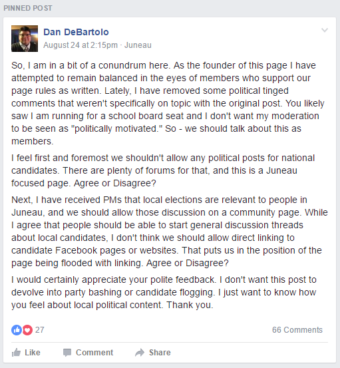
Dan DeBartolo is the creator and a moderator of the Facebook page Juneau Community Collective. It’s a public group with more than 5,500 members. Since DeBartolo started it a couple of years ago, the page has been a popular place to discuss community issues. But lately, he’s seeing more and more people talking politics.

“Now that I’m involved in an actual local candidacy for a school board seat, I felt like I was put in an odd position, because I’ve had to remove some posts because they directly advocated for a local house seat or a municipal seat, and they weren’t naturally part of just a conversation on the page,” DeBartolo said.

He said he realized if he removes political posts that break the page’s rules, there’s a danger it’ll look like he’s acting in his own interests as a political candidate and not as a neutral moderator.

“I didn’t see it coming,” DeBartolo said.

He said his decision to run for school board largely hinged on the amount of time he’d spend away from his family.

“I certainly didn’t think about the span of it touching my online life or even who I was going to bump into in the street saying, ‘Hey thanks for running for school board,’” DeBartolo said. “So, it has opened my eyes to a whole new world.”

DeBartolo asked the collective how he should handle the conflict of interest. So far, he’s received 66 public responses as well as some private messages. He said the majority were against posts about national elections because there are plenty of other forums to discuss them. Some told him to stop moderating political posts and some said he should stop moderating the page altogether.

Dan DeBartolo asked the Juneau Community Collective about his desire to continue moderating the Facebook page while running for school board. (Courtesy of Dan DeBartolo)
Dan DeBartolo asked the Juneau Community Collective about his desire to continue moderating the Facebook page while running for school board. (Courtesy of Juneau Community Collective)

DeBartolo said he’s going to keep moderating but he’s giving oversight of the political posts to other page administrators.

“There are other issues that are going on that have nothing to do with the school board and have nothing to do with the education system that I believe I contribute to as, not only a moderator but as a citizen,” DeBartolo said.

He said he wants to make sure there’s a fair discussion of those issues and he doesn’t want to overburden the other administrators with his entire share of the work.

DeBartolo added, “To a certain degree it’s my baby in a way, and I don’t want to let it go and not be a part of it anymore altogether when I believe there’s middle ground.”

DeBartolo has created a campaign Facebook page to further separate his political activity from the Juneau Community Collective.

He said his wife recently pointed out that since he’s set his sights on public office, it’s possible there’ll be many more aspects of his life he’ll have to reexamine through the lens of a political candidate.

Grounded by fog, would-be travelers watch Huna Tribal House festivities from afar

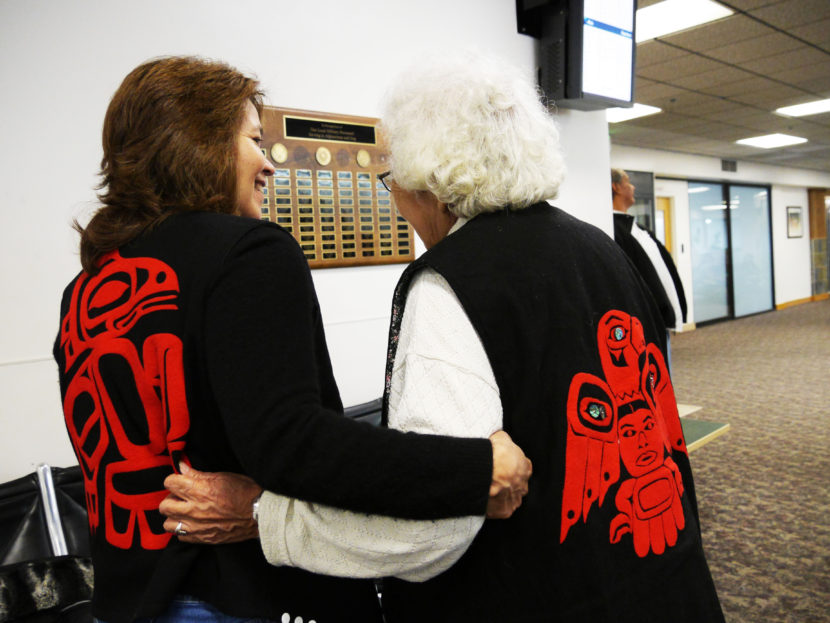
(From L to R) Valerie Hillman shows off her clan's crest, the T'akdeintaan's Raven, while holding arms with Hoonah tribal elder Lillian Austin, who's clan crest is the Shangukeidí's Thunderbird. (Photo by Lakeidra Chavis/ KTOO)
Valerie Hillman shows off her clan’s crest, the T’akdeintaan’s Raven, while holding arms with Hoonah tribal elder Lillian Austin, who’s clan crest is the Shangukeidí’s Thunderbird. The women were on standby to go to Gustavus at Juneau International Airport on Thursday. (Photo by Lakeidra Chavis/KTOO)

Hundreds of people gathered Thursday at Glacier Bay National Park and Preserve to celebrate the opening of a newly completed Huna Tribal House and the National Park Service’s 100th anniversary.

Not everyone could make it. Some event speakers and tribal members — including me —  got stuck at Juneau International Airport because of fog near the park. But that didn’t stop us from watching the event from afar.

Two decades in the making, the Xunaa Shuká Hít, which roughly translates to Huna Ancestor’s House, celebrates the four major Huna Tlingit clans that lived in the area that became Glacier Bay National Park and Preserve. According to the park service, villagers fled an advancing glacier hundreds of years ago. Clan members couldn’t return to area because it was taken over by the National Park Service in the 1980s.

But as the fog cleared Thursday morning, and tribal members paddled to the shore in newly carved canoes, Glacier Bay called its people back to their homeland.

Planes traveling to the area weren’t able to land. About a dozen people leaving from Juneau couldn’t attend and Republican U.S. Sen. Lisa Murkowksi was one of them.

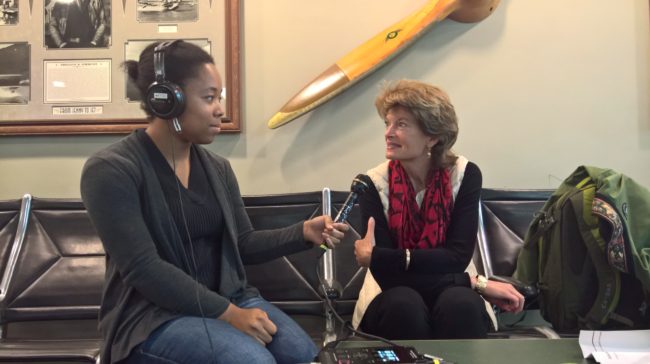
Lakeidra Chavis and Sen. Lisa Murkowski 2016 08 25
KTOO reporter Lakeidra Chavis interviews U.S. Sen. Lisa Murkowski at Juneau International Airport on Thursday. (Photo by Jeremy Hsieh/KTOO)

“We are sitting here waiting for the fog to lift in Gustavus, along with a fair number of Alaskans who are hoping to go out, to be part of the celebration,” she said.

She was hoping to catch a late morning flight, but it didn’t work out. At that point, the terminal’s only television was tuned to live coverage of the event.

The last time Murkowski was in Gustavus was in 2012. Officials were trying to break ground for the tribal house.

“I saw the details and the plans,” she said, “I was really looking forward to being able to see it ‘live and in color,’ as they say. So maybe we’ll yet get out there today, but it remains to be seen.”

Across the lobby, Bert Frost sat with a couple of his colleagues. He’s the regional director for the National Park Service in Alaska. He said it’s an important part of American history — and this event emphasizes that Alaska Native history is a part of that.

“A lot of people don’t understand that there’s a Native tie to those lands,” Frost said, “it wasn’t just created in 1917. This is the homeland for the Huna Tlingit.”

He hopes that the tribal house will help rebuild the relationship between the tribal community and the National Park Service.

“We always haven’t had a great relationship with the Native people,” he said. “So through this effort of building this tribal house and the things it represents to the Huna Tlingit and the National Park Service, is the coming together for all of these entities.”

Adrienne Fleek also works for the park service as the Alaska Native Affairs liaison.

“There’s a really big commonality between the mission of our organization, of preserving and protecting special places in America for future generations,” Fleek said, “with the Alaska Native way of being, of preserving and protecting our resources.”

She’s planned to meet up with family at the ceremony and is dressed for the occasion.

“I have a traditional Tlingit vest on,” Fleek said. “On the back it is a Raven emblem and on the front is Coho. Traditionally when you go to a ceremony, you wear regalia to show who your family is.”

And she wasn’t the only one sporting regalia.

Around the corner, Lillian Austin is watching a livestream of the event. She’s wearing a traditional black vest, with her tribe’s Thunderbird stitched on the back — one of the four big clans from Glacier Bay.

“It’s pretty good, that building there,” she said. “It took them five years to do this building, it’s got all of the different clans’ designs, we’re Thunderbird.”

Austin is a tribal elder who grew up in Hoonah, and spent summers in Glacier Bay as a child. Her nephew, Herb Sheakley, is one of the carvers for the project.

As of Thursday afternoon, she was still waiting for reliable transportation to the event.

Austin said like everyone else in limbo at the airport, she was excited and hadn’t seen the tribal house.

If the weather permitted, it would be the first time she’s visited Glacier Bay in more than 50 years.

Site notifications
Update notification options
Subscribe to notifications