Community

Library celebrates new Harry Potter book with improvised Quidditch game

The Harry Potter books are having a second wave.

Author J.K. Rowling released Sunday a new play, “Harry Potter and the Cursed Child,” which inspired literary events all over the country.

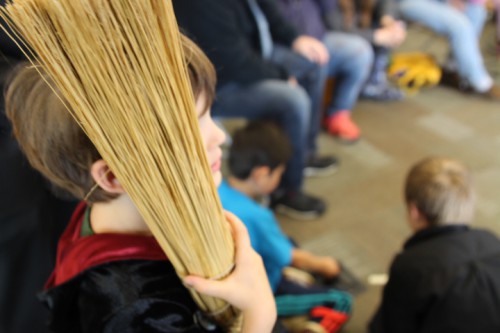
Sitka Public Library held a tournament in honor of the books’ No. 1 sport – Quidditch, a game played by witches and wizards on flying broomsticks.

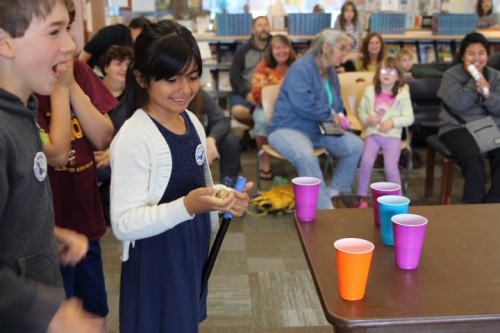
So, to adapt the game to our gravity-bound world, the library had to get creative. The sounds of ping-pong balls could be heard hitting the table.

This is tabletop Quidditch. It looks a bit like ping-pong, except students have to bounce balls off the table, through one of three hoops, and into a cup on the other side — make it through the hoop and earn a point, but sink it in the cup, but miss the hoop, then they have to answer a trivia question:

“Who teaches defense against the Dark Arts in Harry Potter’s 3rd year at Hogwarts.”

“Professor R. J. Lupin”

The students are on their game. But the biggest fan here may be the librarian, herself. Maite Lorente has always been a big fan of everyone’s favorite bespectacled, boy-wizard. So much so, she named her dog after him.

“When the seventh book finally was published — that same summer, my dog was born, and the poor thing has to carry the name of Harry Potter forever, because it’s a passion of mine,” Lorente said.

So when she heard that the theme for summer reading programs across the country was “On your mark, get set, read!” encouraging kids to go outdoors and be active, she just knew she had to incorporate the wizarding world’s favorite pastime.

“At the beginning we wanted to do an outdoors one, but that would have required a lot of time, so we just decided to go for an indoors Quidditch tournament,” she said.

She researched her options online, and transformed a ping-pong table into a Quidditch arena. Players have to hold onto a real broom with one hand while they toss the ping-pong quaffles with the other. But there was a bit of confusion about the brooms at the beginning.

“There was a moment where I realized that I had to explain to them that we were not going to be flying with brooms,” Lorente said. “And I think some of them got a little bit disappointed. But I just explained to them that librarians can do almost everything, but to this date none of us have gotten the secret of how to fly with a broom yet.”

The kids didn’t end up being too disappointed. They got pretty into it. Elliot played for Gryffindor, and he said there were a few moments when he wondered whether they’d make it to the end of the tournament.

“It was pretty fun and pretty tense,” he said. “Sometimes I felt like whenever one team got the snitch, I got really scared wishing they won’t get it into the cup. I was glad Slytherin didn’t win that round. They were doing pretty good, that’s why I didn’t want them to win that, so we had an easier time.”

It’s easy to lionize Gryffindor, but each house has its merits. Ravenclaw is smart, Hufflepuff is kind and Slytherin is ambitious.

“I love when they come and they say ‘I want to be in the Hufflepuff house,” Lorente said. You assumed that Gryffindor was going to be filled, and that was the case, right away. When I have a Ravenclaw or a Hufflepuff or a Slytherin come in, you know that makes my day.”

Partying on a Tuesday night, first responders hang out with the community

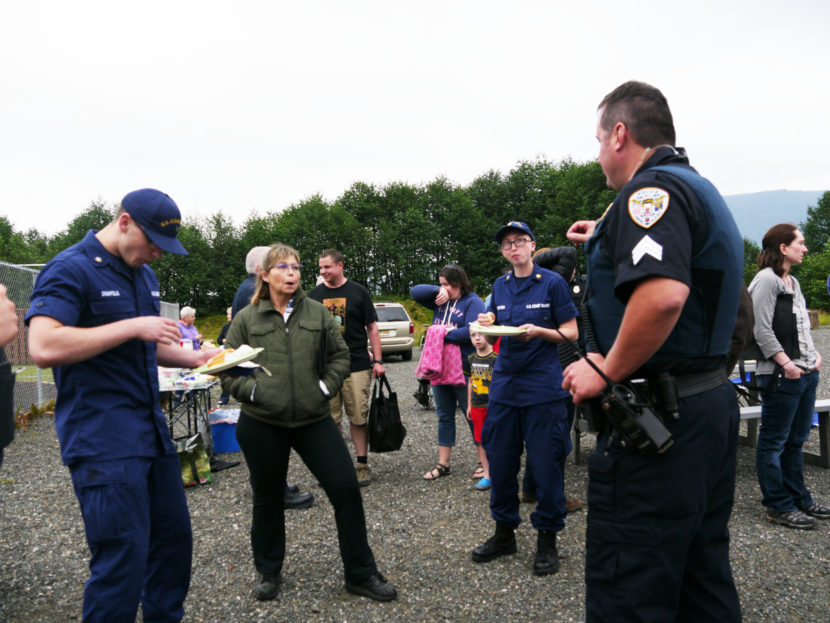
Juneau Police Department Sgt. Chris Gifford speaks with a two Coast Guard members and a community member during National Night Out, Aug. 2, 2016. (Photo by Lakeidra Chavis/ KTOO)
Sgt. Chris Gifford of the Juneau Police Department speaks with two Coast Guard members and a community member during National Night Out event in Juneau on Tuesday. (Photo by Lakeidra Chavis/KTOO)

Tuesday evening, first responders showed up to 18 block parties in the capital city. Although they wore their badges, they were there to take part in the fun. The event was part of National Night Out, a national program focused on raising awareness about public safety.

In a large meeting room inside the Juneau Police Department, things are a bit busy.

Police officers are rationing out the cool vehicles they’ll ride in for National Night Out. Dozens of law enforcement officers, members of the Coast Guard, and the National Guard, among other groups, are preparing to attend 18 different parties across the city.

In order to attend them all, they’ve split into five teams. Sgt. Chris Gifford led one of them.

“So this is good for them to see us in a positive way and for us to see the community in a positive way,” Gifford says. “We’re just here eating hot dogs and showing off police cars.”

Gifford and his team, which includes a firetruck, two police cars and two members of the Coast Guard, visited four parties spread out across the Mendenhall Valley, Lemon Creek and a neighborhood near the airport.

At a cul-de-sac in the valley, Dee Ojard is chatting with neighbors. She also works for the police department. Ojard says events like this are a nice opportunity for community bonding, especially for the officers.

“These are people that they don’t ever see unless they’re in distress,” she said. “So, it’s nice to see them when they’re not in distress.”

Ojard’s worked for the department for 11 years, and helped organize Juneau’s first National Night Out nearly a decade ago.

“There are a lot more parties; there’s a lot more involvement, so I think it’s a good thing,” she said.

Throughout the two-hour event families chatted with law enforcement and safety officials, kids took photos, learned how to find fingerprints on a soda can and checked out the police cars.

Outside the First Church of God near the airport, Elwin Blackwell is celebrating the event with his family. His parents are sitting outside the church’s doors, while his brothers, nieces and nephews, and children chat and run around.

His church has participated in the National Night Out before, and he helped organize the event this year.

“I think it’s a good thing for neighbors to build that sense of community, to keep an eye out for each other,” he said.

Not every police department in the state took part in the event, but the Anchorage Police Department hosted a large party in the Mountain View neighborhood.

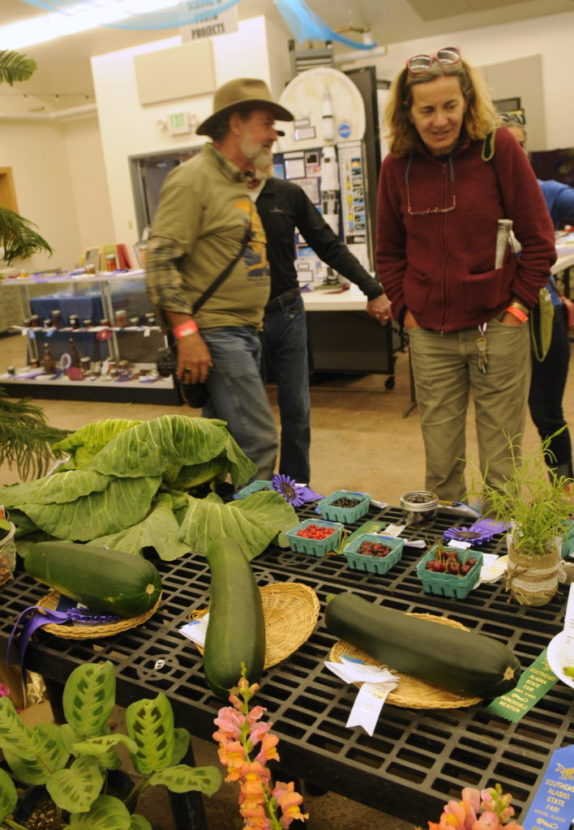
Another Southeast Alaska State Fair wraps up

Fairgoers ride the Ferris wheel at the 48th annual Southeast Alaska State Fair. (Photos by KHNS)

The official theme of this year’s Southeast Alaska State Fair was “Spirit of Southeast.” But perhaps it should have been something like ‘Exceeding Expectations.’

The clouds parted and the rain held off over the weekend for the 48th –annual fair. Top-notch music, rides, exhibits, contests and, of course, the food exceeded organizers’ expectations.

“It went great,” says fair director Jessica Edwards. “The weather held out, which we were all really surprised about. People had a great time. The music was wonderful, the programs were great, the contests were well attended and well participated, and we just had a great fair.”

Edwards said she learns something every year. A highlight for her was getting to spend part of Saturday afternoon riding the train and playing games with her daughter.

“From the staff perspective, Saturday was the smoothest Saturday we’ve ever had,” she said. “And that just is really nice because at that point in the event, you’re pretty tired and when things just come together, you get a little euphoric about it.”

This weekend saw hundreds and hundreds of people taking in all the sights and sounds – and food – over four days.

Songs from the Southeast
Bands and solo acts from all over Southeast and beyond took to multiple stages, keeping the crowds dancing and singing along.

One of the most anticipated musical acts was actually made up of four brand new bands. After a week of furious song writing, lessons and rehearsals, the young women of Girls Rock Camp fame took center stage on Saturday.

The four bands, called The Shadow Drifters, The 907 Rockers, Last Minute, and Fear the FluffStars!, were made up of mostly rookie rockers. All the songs were original works and, for the most part, the girls got to pick their own instruments.

Nora Prisciandaro of Haines was in the band Last Minute. The group’s song was called “Overcome.”

“It was about how you get up on your bad days that you have,” she said.

She already had some experience with the guitar, and wanted to continue the path to becoming a guitarist. The best part of the weeklong camp was making new friends, Prisciandaro said. And writing a song from scratch.

Abigail Tidlow-Tranel of Skagway was the bassist and singer for Fear the FluffStars. The FluffStars sang a tune called “Somewhere,” about an eagle taking flight. Tidlow-Tranel said writing the song was challenging, but she already looks forward to next year.

Director and Rock Camp founder Monica Lettner said the week and the final performances went better than expected. So good, in fact, that she’s hoping to double the number of participants next year from 20 to 40.

Lettner told the crowd on Saturday afternoon that the girls learned to overcome fears, develop friendships and become empowered to, well, to rock out.

“We talk about how to support each and how to not buy into the stereotype that girls have to mean to each other, or catty with each other,” Lettner said. “We learn how to support. We learn how to celebrate each other’s strengths, and all of these smiles and beautiful works of art prove it.”

She said the highlight for her was seeing the progress throughout the week.

“Having campers that were really, really scared on the first day, come through in the end and absolutely love their instrument, love their teacher and love their band and performance,” Lettner said. “That to me is the biggest success, when they’re positive and they’re feeling confident. It doesn’t matter what I think, it matters what they think when they walk off that stage.”

This year’s more established musical acts were an eclectic mix of rock, country, reggae … you name it, really.

Speaking of fair sounds, kids laughing, crying and squealing with delight could be heard wherever you chose to roam. The Ferris Wheel, as always, was a big hit with the little ones.

Pigs enjoy attention
Past the carousel, the train stop, and the line of carnival games, was the barn. Mud and Charlie, two young, huge pigs were enjoying the attention on Friday.

“These are just homegrown, backyard pigs,” their owner Cristy Wright said, who thinks everbody needs some pigs.

Fair treats
For many, the music and happy kids, rides and animals are great, but what really gets people excited is the plethora of once-a-year fair food.

Judith McDermaid has been to 22 state fairs in Haines.

“This is the only time you can get corn on the cob that is fresh and sweet and juicy,” she said. “They always have something new. I go for the old stays, like pulled-pork sandwiches and burgers. Fair food! I mean cotton candy and kettle corn … it’s once a year. It’s so good!”

In case you want to plan for next year, the tentative dates for the 2017 Southeast Alaska State Fair are July 27-30.

Techno contra brings new life to traditional dance in Sitka

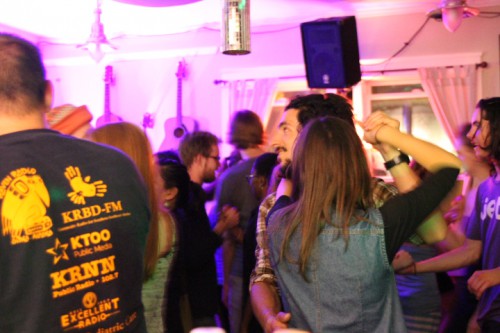
A lively crowd dances at Techno Contra. Photo by Katherine Rose/KCAW
A lively crowd dances at Techno Contra. (Photo by Katherine Rose/KCAW)

If you live in Sitka, you’ve definitely heard of contra dance. And if you live on planet earth, you’ve certainly heard of techno or electronic dance music, or EDM.

You may not expect much of a cross-section between the two communities, but once a month at the Larkspur Cafe that’s exactly what you’ll find.

Contra dancing is a type of folk dance, with European and Appalachian origins. It’s sort of like square dancing, but couples stand in lines. They progress down the line, repeating the dance with the couple standing across from them, all set to folk music.

“I never liked dancing actually,” Ben Timby said. “Then someone roped me into a dance from the band. So I set down my banjo and was like ‘okay.'”

Timby has been dancing contra for a while. He even met his girlfriend, Tiffany Justice at a contra dance in Asheville, North Carolina. Once she tried it, she was hooked. She loves all kinds of dancing, but contra offers a special sense of togetherness.

“I had a few friends who asked me to try it out,” she said. “It seemed like it was very inclusive, which i liked about it. In the same night I danced with a 16-year-old and a 90-year-old. I just really really liked that I felt this sense of community in the dancing and it wasn’t exclusive in any way.”

The couple kindled their relationship at Sitka’s traditional contra dance held once a month with music by a local group, Fishing for Cats. About December of last year, Thimby wanted to try something different.

“There’s a number of us who’d already been doing the traditional contra dancing,” Timby said. “I think we were just sitting around having beers or at a jam and I just mentioned this idea, and Kari (Lundgren) was on board.”

Lundgren is a contra dance caller, the person that teaches the group each of the dances. She is a longtime Sitka caller, but Timby wasn’t sure what she’d think about some of the music.

Lundgren loved the idea, though there were a few logistical challenges. Contra tunes are between 100 and 120 beats per minutes. Techno music is more like 120 to 150 beats per minute. Tempo-wise it’s the difference between a stroll and jog. So, Timby and Lundgren had to find the sweet spot where upbeat music meets danceable meter.

“Ben picked really good music. People can only dance so fast. You have to actually give them time to complete the move,” Lundgren said. “Some of the music has an extra measure in it. Sometimes we have to pause and go ‘and wait’ and wait and wait. Go now!”

Techno contra also attracts a younger crowd, and often participants have little to no experience. Seeing a younger crowd at a contra dance helps keep the tradition alive,” Lundgren said.

“The tradition is graying a little bit. When you look at some of the dance camp footage,” she said. “This is actually bringing in the next generation of dancing, and that’s the important part, is just keeping contra alive and making it relevant. Very likely some of those folks would feel confident walking into a fiddle dance if they were in Minneapolis visiting their sister.”

The group is looking into holding dances in Juneau, Fairbanks, and even Bellingham, Washington and Portland, Oregon. In Sitka, techno contra has become so popular, the partipcants are considering upgrading to a bigger space for the next dance in August.

Tour boat captain fired; naturalist tells of vessel sinking

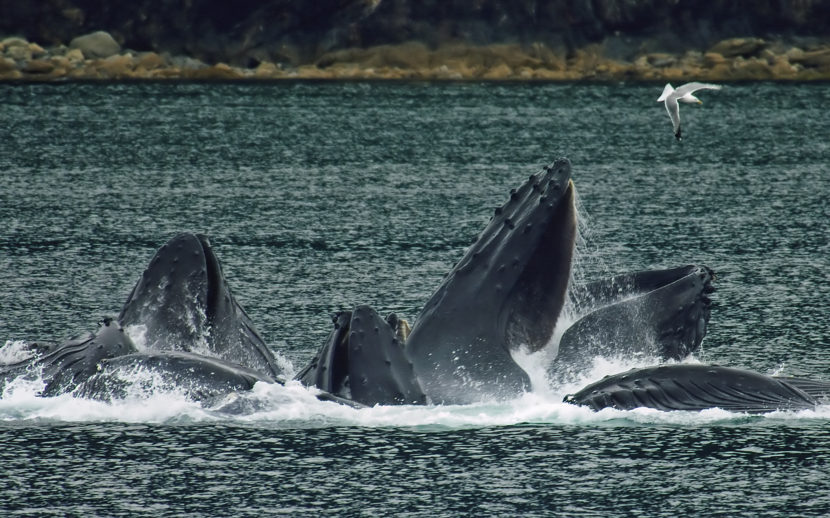
Humpback whales in North Pass between Lincoln Island and Shelter Island in the Lynn Canal north of Juneau. (Creative Commons Photo by Evadb)
Humpback whales in North Pass swim between Lincoln Island and Shelter Island in the Lynn Canal north of Juneau Saturday, August 18, 2007. (Creative Commons Photo by Evadb)

Multiple boats helped rescue 18 people from the Dolphin Jet Boat Tours whale-watching vessel, Big Red, which struck a rock and sank Sunday.

The Coast Guard received a distress call that the tour boat was taking on water at 12:17 p.m. Sunday.

Douglas Ward, the owner of Dolphin tours, said he was shocked by the accident and was grateful everyone made it off the boat safely.

The Big Red’s captain was fired, Ward said.

Mike Clasby, a naturalist with Dolphin tours, said he and the Big Red’s captain were bringing 16 tourists back to Juneau after a tour.

They were between Shelter Island and Aaron Island, passing the southern tip of Aaron Island in Favorite Channel. The boat struck an uncharted rock, according to Coast Guard spokeswoman Lauren Steenson, petty officer 3rd class.

He said the sinking couldn’t have taken more than five to six minutes.

“I was facing the stern of the boat and looking at the passengers and all of the sudden there was this horrific bang,” Clasby said. “I thought we hit a whale. Then I realized that it was a little more than that because I ended up on the floor of the boat.”

Clasby first checked on the passengers and the captain, he said. Then went to see whether the engine compartment was damaged.

“I said, ‘OK, I’ll be right back,’ and I went back and opened the stern (door), and popped open the starboard hatch, and there was water coming in the engine compartment,” he said.

With water coming on too fast, Clasby thought about deploying the life raft but said he instead decided it was more important to get everyone in life vests first.

“The captain and I went towards the back, and then (water) was really coming onboard,” Clasby said. “We made a plan that he was going to try and get the life raft, which was now underwater actually, released.”

That’s when he said they saw a boat.

“I yelled, and yelled, and screamed, and he was waving, and I was waving and all of the sudden this boat called Sea Ya waved back and turned towards us,” Clasby said.

The Sea Ya was the first vessel to reach the Big Red. The Juneau harbormaster’s office said the boat measured about 30 feet long. Clasby said it wasn’t big enough, but they still managed to fit almost everyone aboard.

“Then all the sudden the boat (Big Red) sank,” Clasby said. “It was taking that much water on. There was four of us that didn’t make it onto the Sea Ya, we were hanging on the edge. And the captain, who was the last one off of our boat, had a life jacket and he drifted away, unfortunately, which turned out to be OK.”

Clasby and remaining passengers made it aboard the Sea Ya, he said. The captain later was retrieved from the water.

The St. Herman, Allen Marine Tour’s boat, collected the Big Red’s passengers and returned them to shore.

Capital City Fire/Rescue reported all of the tour boat’s passengers and crew refused medical treatment, including one person who suffered a knee injury.

Sawmill Farm, Tongass farm country

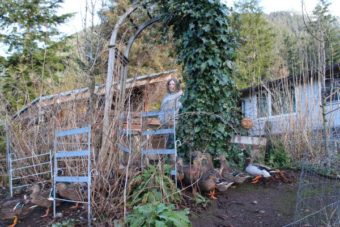
Daniels oversees the ducks. She’s awaiting an order of pigs from Washington, set to arrive in August. In five years, she hopes to secure a USDA processing facility to sell local pork. (Emily Kwong, KCAW – Sitka)
Daniels oversees the ducks. She’s awaiting an order of pigs from Washington, set to arrive in August. In five years, she hopes to secure a USDA processing facility to sell local pork. (Emily Kwong/KCAW)

Bobbi Daniels has struck gold, except it’s green and squishy.”

“I’m getting grapes,” Daniels said. “Everything loves grapes. The chickens, the geese. I won’t give it to the geese.”

The Tongass Rainforest isn’t what you’d picture as a candidate for farm country. The terrain is rugged, the soil unstable, and it rains over 100 inches a year. The vast majority of Sitkans get their meat and dairy products off a barge, shipped hundreds of miles. But Bobbi Daniels of the Sawmill Farm is determined to change that.

If the Sawmill Farm is an ark, Daniels is Noah. She has 500 mouths to feed every day. But rather than order hay or grain online, Daniels collects cast-off produce from the grocery store. Like these grapes.

“People just aren’t going to buy them,” Daniels said. “And so the grocery stores are really in a hard spot.”

That’s where Daniels comes to the rescue, her shopping cart a teetering cornucopia of greens that she loads into her box truck. I hop into the passenger seat and there’s a carton of quail eggs at my feet.

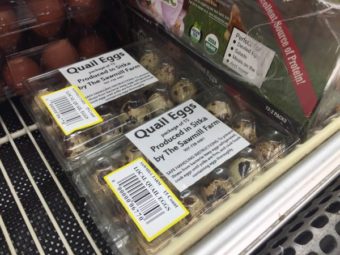
Seamart Quality Foods, where Daniels collects her produce, now sells her product. The quail and ducks eggs will soon be joined by chicken eggs. (Emily Kwong, KCAW – Sitka)
Seamart Quality Foods, where Daniels collects her produce, now sells her product. The quail and ducks eggs will soon be joined by chicken eggs. (Emily Kwong/ KCAW)

And those eggs, which are a lovely coffee colored shade with brown speckles, are a token of victory for Daniels. Just three weeks ago, Seamart began offering her eggs to customers.

“They keep selling out, so I think that’s the best response you can get,” Daniels said.

Daniels runs her errands with the focus of a honey bee, gathering nectar for the hive. At first glance, you’d think she’s a fisherman, wearing XtraTuffs, but make no mistake, Daniels is a farmer. A farmer on a mission.

“When I was little, it was family farms and by the time I graduated from college, it was big agro-business,” Daniels said.

Daniels worked on some of those farms. And when she moved here from Indiana in 1998, she was troubled by the food cycle in Sitka.

“We’re taking thousands of tons of food that is perfectly good to feed animals and we’re barging it out of Sitka,” Daniels said. “And then we’re barging this factory farmed poor-quality meat back to Sitka. That’s insane.”

So, Daniels started the Sawmill Farm in 2001 to attempt to close that loop. Financially, the farm isn’t breaking in but they’re making some progress. Daniels and her business partner hope to have rabbit and chicken meat on grocery store shelves soon. But the learning curve for island farming has been pretty steep.

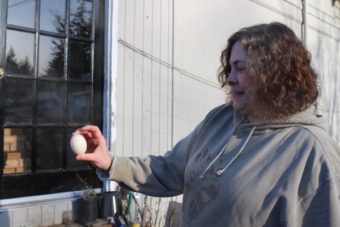
Bobbi Daniels grew up in farm country in Indiana. She’s bringing her agricultural knowledge to Sitka, operating the Sawmill Farm since 2001. (Emily Kwong, KCAW – Sitka)

“There’s nobody to turn (to) who did this first to get any advice from really,” Daniels said.

Eagle and mink predation was terrible this winter. And try as she might to get the settings right on the chicken enclosure, the chicks kept piling on top of each other, crushing the ones beneath.

“When you come in the morning and that’s the scene, it just breaks your heart on every single level,” Daniels said. “We don’t want animals living in miserable conditions. That’s the kind of farming we don’t like.”

Even though she was counting on those broiler chickens for profit, Daniels is determined to figure out what went wrong before ordering more. She’s an animal lover first, farmer second. It’s time to visit the farm. We turn out the ducks for the day. And then stop by the goat herd, where Missy from Wrangell is getting milked today. Her goat herd, by the way, is spoiled rotten. She feeds them alfalfa that’s been misted with molasses and allowed to ferment.

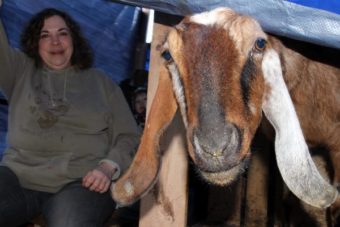
At one point, Missy swings her face towards me and we’re snout to snout.

“That’s how they get to know you,” Daniels said.

Now, selling raw milk is illegal in Alaska, but Daniels gets around that by selling shares of the herd. If you buy the goat, you get the milk. And because you can’t have goat milk without bucks to start the breeding process, Daniels envisions one day loaning her bucks to other farms.

Milly, a milk goat from Wrangell, turned to sniff my breathe. “That’s how they get to know you,” Daniels said. There are fifteen does in the goat herd. (Emily Kwong, KCAW – Sitka)
Milly, a milk goat from Wrangell, turned to sniff my breathe. “That’s how they get to know you,” Daniels said. There are fifteen does in the goat herd. (Emily Kwong/KCAW)

“Kind of have a buck library, where you can check out the buck of your choice for your own goats,” Daniels said.

And that’s really the second part of Daniel’s mission: to support families and small-scale farms around Southeast who want to localize their food.

“When I eat a rabbit, when I cook a rabbit – okay, I still can’t do the killing, I’ll admit that – but I’m there and I’ll do everything else, I’ll skin and gut and all that kind of stuff, but if you waste anything, there’s this huge awareness that something died for my dinner,” Daniels said. “And you look at your plate and what you eat and how you eat differently when you are involved in making it happen. And I think it’s a really good change.”

Daniels is frank that the Sawmill Farm will never be able to keep up with the demand in Sitka. But more important to her than putting meat on the table is telling people the story of where it came from.

Site notifications
Update notification options
Subscribe to notifications