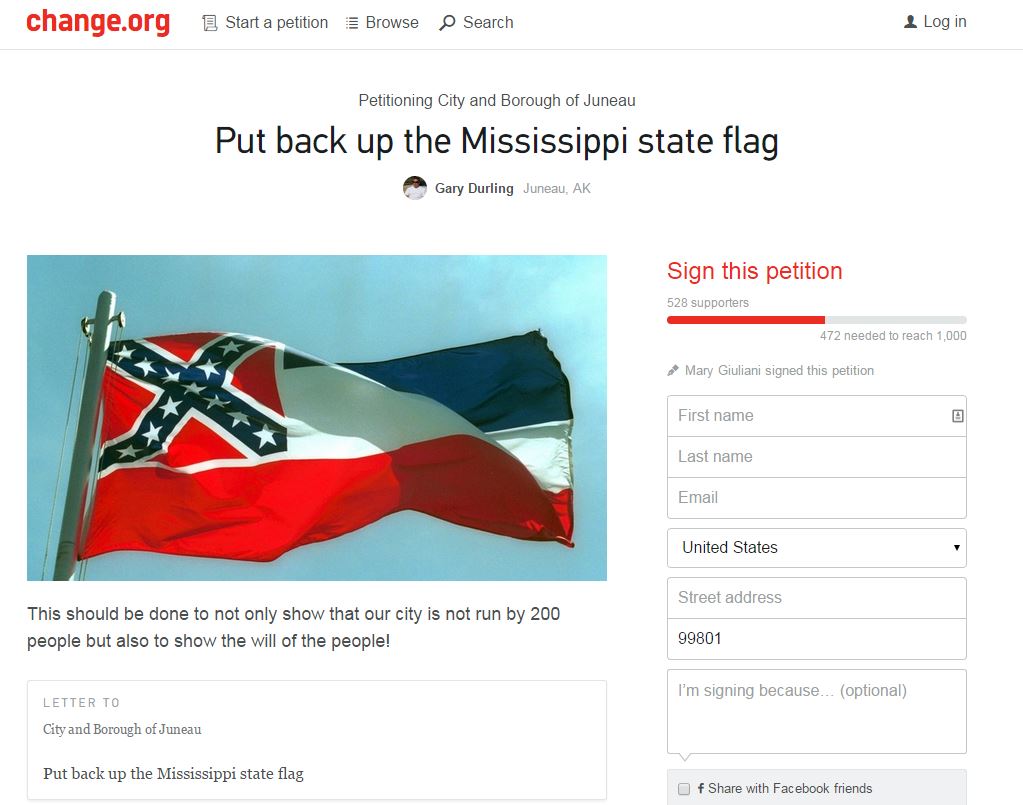
A screenshot of the Change.org petition to put the Mississippi flag back up as part of Juneau’s all-states flag display.
Yesterday evening, Juneau resident Gary Durling started a petition to put the recently removed Mississippi flag back up. The petition, addressed to the City and Borough of Juneau, has more than 500 supporters, most of who are largely from Juneau and the Southeast region.
The flag, which features a full image of the Confederate flag in its upper left corner, was removed Saturday morning after a monthlong debate. It was replaced with the Magnolia flag, the state’s first official flag.
Criticism of the Confederate flag has grown after the racially charged mass murder of church parishioners at a historic black church in Charleston, South Carolina, last month.
After taking down the Mississippi flag, volunteers donated it to the Juneau-Douglas City Museum.
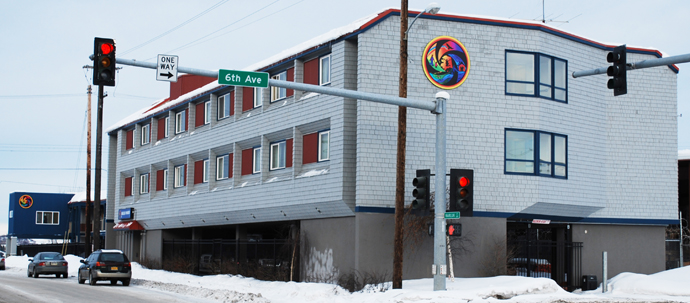
Anchorage’s Housing First facility, Karluk Manor. (Photo courtesy of RurAL CAP)
Anchorage is struggling with how to address serious and expensive problems stemming from chronic homelessness. On Tuesday, the new mayor’s administration announced a dramatic plan to more than double the city’s capacity for housing the most severely affected population living on the streets. The sudden move isn’t without controversy.
Melinda Freemon is the director for the Department of Health and Social Services, and she says the addition of 56 housing units fits within Anchorage’s Comprehensive Plan for addressing homelessness.
“DHSS is supportive of this model because it is considered the nationwide best practice: permanent supportive housing actually does end chronic homelessness for high users of safety centers across the nation,” Freemon says.
The plan also funds “intensive case management,” the official term for the comprehensive help clients receive to regain control over their lives.
“They provide assistance with accessing medical care for the tenants, they provide them with shopping opportunities, employment opportunities,” Freemon says. “They would facilitate substance abuse treatment, mental health treatment, and all of the services that go along with helping people retain their housing.”
Providing shelter and help is not cheap, but advocates and city officials are quick to point out the cost of treating symptoms instead of the causes of homelessness is even more expensive. The municipality has spent millions of dollars on studies proving how costly it is just managing the most high-cost users of emergency services.
That’s partly why news from the mayor’s office was such a surprise: the Administration is chipping in just $200,000, but the funding is essential for accessing a much larger pool of grant funds $3.5 million ($3,595,717 to be exact) for a multi-year budget paying for the treatment. Originally that money was dropped into the city’s budget by the Sullivan Administration for a controversial pilot program that would have sent 10 people for a short-term course of aversion therapy in Seattle. Now, the funds are helping renovate the Safe Harbor facility by 4th Avenue and Sitka Street to accommodate long-term tenants.
“All the units needed upgrading–so just new flooring, new paint on the wall, but in order to make it serve a special needs population or a highly disabled population, like many people who are long-term homeless, we’ve had to make some safety improvements.”
Corrine O’Neill is a housing director at RurAL CAP, which is administering the project. The statewide nonprofit bought the Safety Harbor facility last winter, but had struggled to find funds to keep it up and running.
“And Rural CAP felt it was really important to save this housing and that it would exacerbate the homeless problem in Anchorage if we didn’t save these assets. But we also inherited some of the same struggles they had in terms of operational costs.”
Long-term residents are expected to start moving in by September. The funding will also make vouchers available for subsidized housing spread across different parts of the city. The project will end up similar to Karluk Manor, a wet-housing facility that’s just a few blocks away–a factor that’s hardly insignificant for critics of the plan.
Christopher Constant is president of the Fairview Community Council, and says the neighborhood wasn’t consulted ahead of the decision to support more long-term supportive housing–an issue with a contentious history in the area.
“We take on more as a community than any other neighborhood in this town–between Mountain View and Fairview, you know, we are the city’s social service epicenter,” Constant says.
Constant says it’s not only unfair to residents, but it makes for bad treatment policy, keeping those people in the middle of treatment within the same geography and social circles they may be struggling to get away from.
A spokesman for the Berkowitz administration says the president of Mountain View Community Council was contacted about the plan, along with the chair and vice-chair of the Anchorage Assembly.
The Mississippi Magnolia flag flies on Egan Drive, in downtown Juneau. (Photo by Lakeidra Chavis/KTOO)
Former Assemblyman Marc Wheeler has set up a fundraiser for local volunteer group Friends of the Flags. Wheeler has so far raised more than $500 of the campaign’s $1,000 goal.
The funds will support Friends of the Flags, “and their courageous decision to replace the Mississippi state flag with the Mississippi Magnolia flag,” according to the website.
Friends of the Flags is a volunteer group that organizes and maintains the all-states’ flags display in downtown Juneau during the summer. After a monthlong debate over removing the flag—which has an image of the full Confederate flag in its upper left corner —the flag was removed last Saturday morning.
The funds will be donated to the group after paying the cost of replacing the flag, approximately $120, according to the website.
Some residents are asking for the removal of the Mississippi flag on Egan Drive because of the Confederate imagery in its upper left corner. (Photo by Lakeidra Chavis/KTOO)
After a month long dispute, the Mississippi flag on Egan Drive is coming down. Former Assemblyman Marc Wheeler received a permit earlier this morning to remove the flag this weekend. The flag has been debated ever since last month’s mass shooting at a Black church in Charleston, South Carolina.
Wheeler says he spoke with Friends of the Flags organizer Judy Ripley and longtime volunteer Jim Carroll, who said the group decided to allow the flag change.
Wheeler says he’s very happy about the decision.
“I just feel really grateful to the Friends of the Flags and really proud of my community,” Wheeler said. “It’s great to be standing with cities like Jackson, Mississippi, Hattiesburg, Mississippi, Grenada, Mississippi , the communities around the country that are refusing to fly this flag.”
The Department of Transportation issued the permit as it has authority over the right of way along Egan Drive where the flags are posted.
Wheeler says he will also try to fix the California state flag, which was blown off earlier this summer.
The Mississippi flag will be replaced with the Magnolia flag, the state’s first official flag.
Editor’s note: This is a developing story. Please check back later for more details.
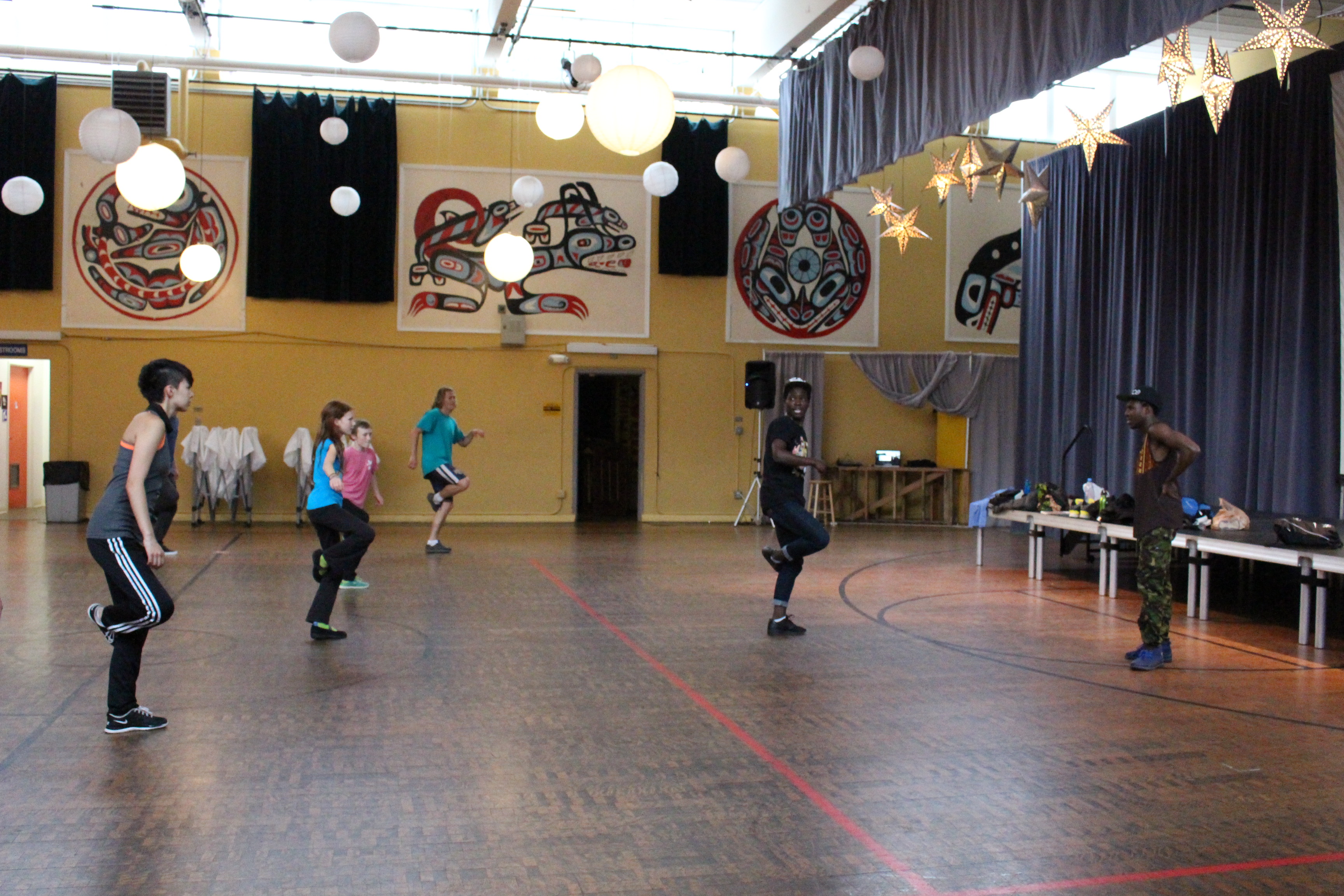
Fahad Kiryowa shows a class how to master the basic moves of breakdance. (Photo by Elizabeth Jenkins/KTOO)
A visiting breakdance duo has been teaching Juneau residents some new moves. They’re featured in a documentary that’s playing in town over the weekend about hip hop culture and social change in Uganda.
See the dancers perform tonight at 6:30 at the JACC. “Shake the Dust” premieres at the Silverbow Backroom at 8 p.m. Saturday.
About 12 people ranging from toddlers and teens to adults are learning the fundamentals of breakdance at the Juneau Arts and Culture Center.
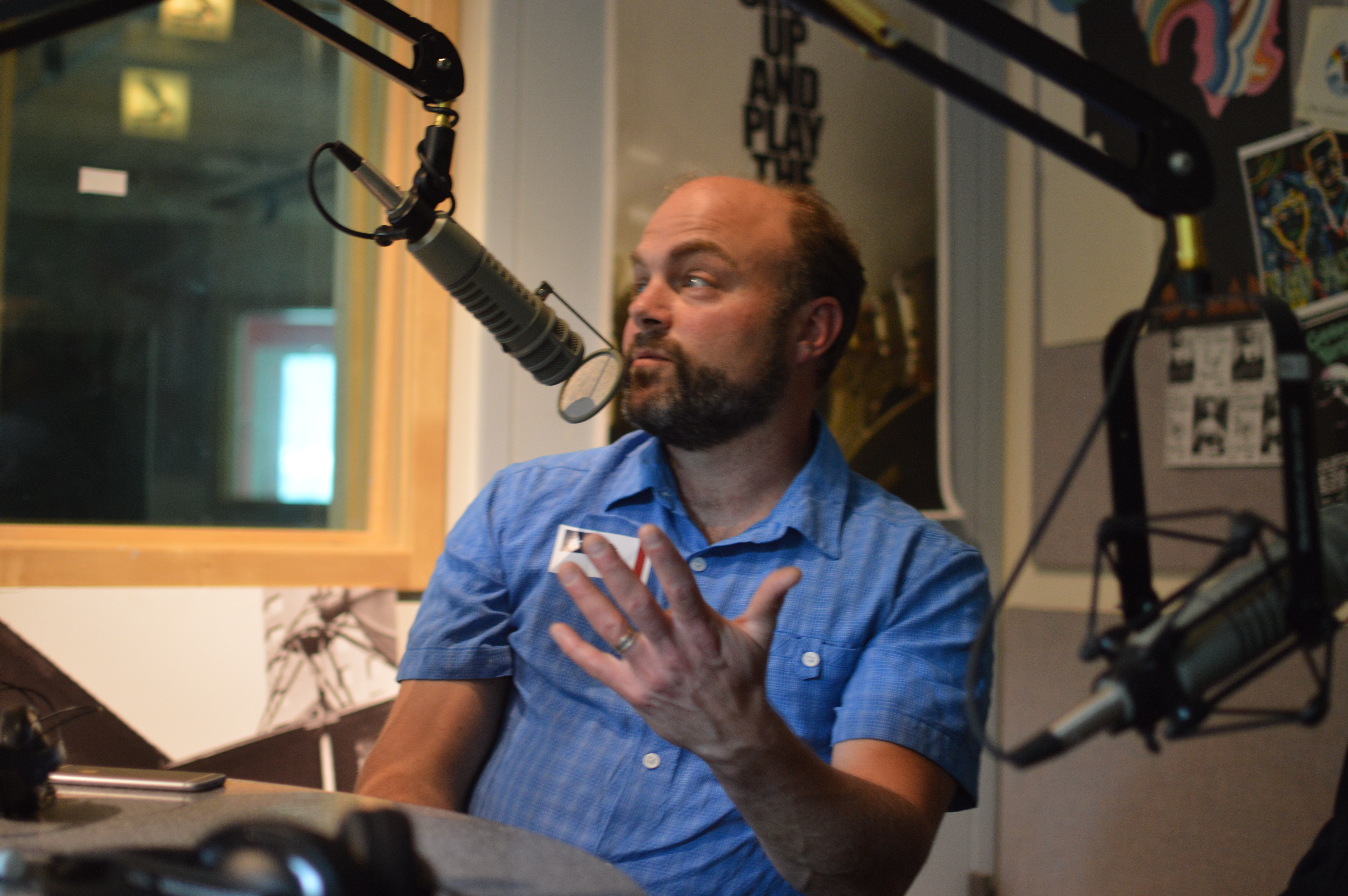
“Breakdancing is one of the elements of hip-hop. It’s the way you use your body,” says Fahad Kiryowa, the dance teacher who lives just outside Kampala in Uganda.
Breakdancing is often characterized as being low to the ground. There’s spins and flips. It’s a full body workout.
But Kiryowa is taking it slow with his new students.
He’s here in Alaska teaching with Eric Egesa.
Juneau-born Rachelle Sloss convinced the pair to come up to her hometown. She’s lived in Kampala for several years and became fast friends with the two through Breakdance Project Uganda.
“By the end of my first week there, I was totally sold on this place with so many great dancers and this great community,” she says.
The dancers just attended a youth leadership camp in Colorado.
“And the camp funded their international flights. Then they were here and we thought, ‘Let’s go to Alaska,'” she says.
(Photo by Elizabeth Jenkins/KTOO)
Egesa started dancing when he was a kid. He says it took some effort to convince his parents that breaking was a good thing.
“Anything football or any sports, back in Uganda when children join anything, they just go into drugs,” he says.
The director of Breakdance Project Uganda came to visit Egesa’s house to talk with his parents. It’s a nonprofit that offers free dance lessons and mentorship to at-risk youth.
Egesa’s parents said yes.
Kiryowa says breaking entered his life at the right time.
“I couldn’t listen to my parents. I was chilling with the gangs because that’s what I see people doing,” he says. “So I was just like that. Stealing, that was one of the things I always did.”
But he didn’t want to go down that path.
“When I started doing breakdance, they said if you love this you have to quit the other one. It was at first hard for me, but when I got into dance I loved it. And I was like, ‘Oh, I’m stopping this.’”
After a while, people started to notice a change in him.
“My mom was like ‘Wow. Are you still on drugs?’ I was like, ‘No.’ I changed my life, dance changed my life,” he says.
When he’s home in Uganda, Kiryowa says people see him as a leader. The dancers are looking forward to sharing their stories of Alaska back home.
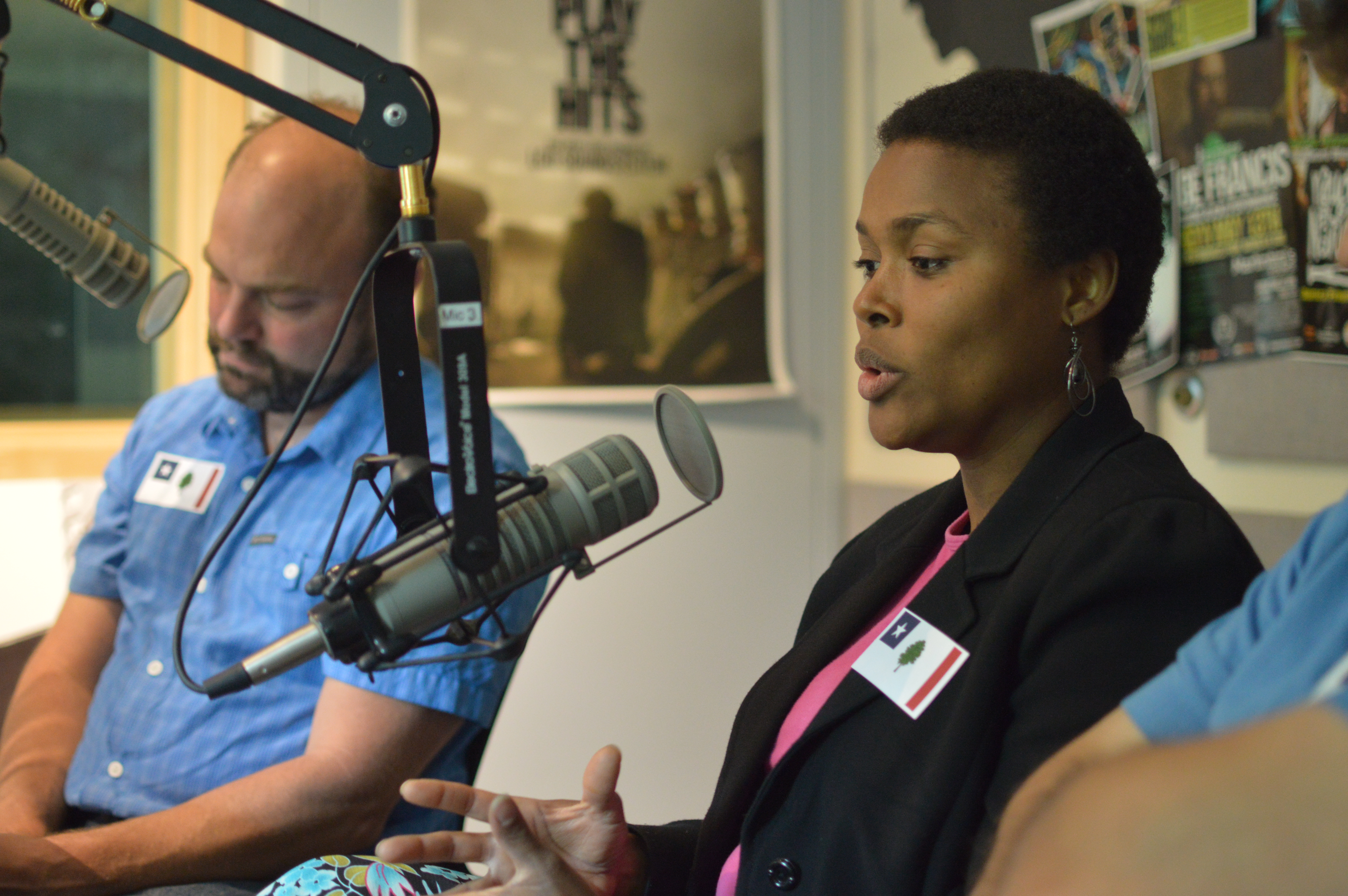
Latarsha McQueen, secretary of Juneau’s Black Awareness Association speaks about her decision to support removing the flag. (Photo by Jennifer Canfield/KTOO)
Nearly 200 people have signed a letter asking for the removal of the Mississippi flag downtown because it features an image of the Confederate flag.
After dust settles from the controversy, the people spearheading the removal of the flag are unsure what’s next in combating racism in the state’s capital.
“What do we do from here? Because I don’t think anyone has the answer,” Secretary of Juneau’s Black Awareness Association Latarsha McQueen says. “Once we’re able to be honest with ourselves and with each other, then we can move forward and do something about it, but I don’t know where we go from here.”
McQueen is among the nearly 200 people to sign a letter asking for the removal of the Mississippi flag in downtown Juneau.
The flag, which features Confederate imagery in its upper left corner, is a part of an all-states flags display organized each year by a volunteer group called Friends of the Flags.
Controversy surrounding the flag began a month ago, after the massacre of church parishioners at a historical black church in Charleston, South Carolina.
McQueen, who grew up less than two hours from the church, says she’s dealt with racism her entire life and has become desensitized to it.
Recently McQueen, former Juneau Assemblyman Marc Wheeler and the local Rev. Phil Campbell discussed their decision to call for the flag’s removal.
Former Assemblyman Marc Wheeler discusses views on the Confederate flag. (Photo by Jennifer Canfield/KTOO)
For Wheeler, it’s imperative to understand the flag’s significance, especially in relation to violence against blacks.
“Somebody told a story about seeing that flag around the head of a person that was hanged. So if you can’t imagine that, what that must be like, maybe you shouldn’t talk about it,” Wheeler says.
Prompted by the events in Charleston, they believe removing the flag is a step forward.
But local writer Ishmael Hope says that while he supports the flag’s removal, it sidesteps the larger problem — racism in Juneau is nothing new.
For Hope, the flag controversy looks at an overt example of racism, without addressing deeper issues.
“When you have terrorism in Black churches, it doesn’t ignite a civil rights movement, it starts a national conversation about a flag,” Hope says.
Juneau’s largest minority populations are Alaska Natives and Filipinos.
Hope, who’s Iñupiaq and Tlingit, says more open discussions about racism and privilege is a part of the solution.
The Rev. Phil Campbell, of Northern Light United Church, talks about the importance of acknowledging one’s privilege, as a step toward ending racism. (Photo by Jennifer Canfield/KTOO)
Campbell, a supporter of the Black Awareness Association and member of the Alaska Native Brotherhood, says that it’s never too late to start the discussion.
“I don’t think there’s ever a wrong time to do the right thing, so now is the moment we have,” Campbell says.
Juneau Mayor Merrill Sanford says he will let the issue play out on its own.
“I went off to war when I was young, and fought for our flag and fought for our country. All of those flags are a part of our country, whether it be good or bad,” Sanford says.
In an email sent to a supporter of removing the flag, Friends of the Flags organizer Judy Ripley says while she understood the horrific attacks in Charleston, the mission of the group is to display the official states’ flags.
Ripley encouraged the woman to write the governor of Mississippi.
Close
Update notification options
Subscribe to notifications
Subscribe
Get notifications about news related to the topics you care about. You can unsubscribe anytime.