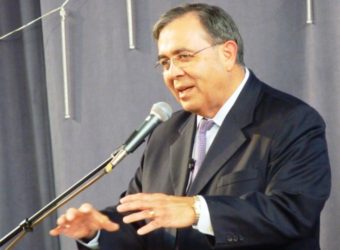
Byron Mallott, Democratic candidate for governor, will leave Sealaska’s board next month to concentrate on his campaign. (KTOO News)
Bryon Mallott will leave Sealaska’s board of directors next month to spend more time campaigning for governor.

He’s served on the Juneau-based regional Native corporation’s governing body – or been its CEO – since 1972.
Mallott, a Democrat, is all but assured to challenge Republican Gov. Sean Parnell in the November general election.
In a press release, he said he would complete his term, which ends at the corporation’s June 28th annual meeting. But he will not seek re-election to the board.
Sealaska Chairman and former state Sen. Albert Kookesh says the board supports Mallott’s decision.
“I think it was good step that he took to, one, allow him to concentrate on the governor’s race and, two, open it up for shareholders so he didn’t just hold onto his seat and have to give it up after that if he got elected,” he said.
When Sealaska board incumbents leave, they often step down before the next election. The board then appoints a replacement, who can run as an incumbent.
Mallott’s decision leaves an open seat with no heir-apparent. That eases the way for other candidates. They include a recently-announced slate of shareholders with business experience outside the corporation.
“The people who are running on that slate have good intentions,” Kookesh said. “They want to run a clean race and I commend them for that. But we also have people who are independents who are running. And you have to commend them and recognize their want to be involved too.”
Sealaska will distribute ballots to its almost 22,000 shareholders on May 15th. They must be cast by June 26th.
In addition to Sealaska service, Mallott’s been Yakutat and Juneau mayor, Alaska Permanent Fund executive director and Alaska Federation of Natives president.
Spokesman Randy Wanamaker says the candidates are worried about Sealaska’s poor performance.
“With the information that the last dividend was not really based on Sealaska’s earnings, perhaps it’s time for new ideas and new energy, new talent to provide their expertise to the company,” he says, “to move the company toward profitability.”
Smith serves on the Juneau Assembly and runs a commercial real estate company. Taug is controller for the Southeast Alaska Regional Health Consortium. Ross Soboleff is a former Sealaska spokesman and Margaret Nelson is business development manager for a construction company.
Wanamaker says they support term limits for Sealaska board members.
“It ensures that there’s always a continuous flow of new ideas into the company and new energy. And we bring in new experience,” he says.
The challengers also want to link executive bonuses to business success. They say they will pay more attention to shareholder suggestions.
Only four incumbents on the regional Native corporation’s 13-member board are up for re-election.
Other independent candidates have indicated they will run. Incumbents are usually challenged, but few coordinate their campaigns or run as a slate.
Sealaska spokeswoman Nicole Hallingstad says corporate law keeps her from commenting on the slate before ballots become available, but it’s well within tradition.
“This independent proxy is an example of shareholders who are exercising their rights as shareholders as set forth by the state of Alaska and Sealaska’s own bylaws,” she says.
Proxy ballots will go to the corporation’s almost 22,000 shareholders on May 15th.
Election results will be announced at Sealaska’s June 28 annual meeting in Seattle.
Sealaska CEO Chris McNeil Jr. addresses Juneau’s Native Issues Forum April 2, 2014. The corporation’s spring distribution includes no operating revenue. (Ed Schoenfeld/CoastAlaska)
Sealaska Corp. does not appear to be making much – if any – money. The regional Native corporation’s spring distribution to shareholders, which is basically a dividend, includes no corporate revenues.
Sealaska distributes payments to its almost 21,600 shareholders twice a year. In recent years, they’ve ranged from about $400 to around $1,100.
The money usually comes from three sources. The largest is a pool of all 12 regionalNative corporations’ resource earnings. Another is Sealaska’s permanent fund. The third is profits from the corporation’s businesses.
“Usually there are. This year there isn’t any operating revenue included in the formula,” says Chris McNeil Jr., president and CEO of the Juneau-headquartered corporation.
That can mean little or no revenues are available for distribution. McNeil won’t say why Sealaska has no revenues to contribute. But he says the information will be in the corporation’s annual report, due out in May.
“I can’t really provide any details on it until we publish. And we’ve done that traditionally to make sure there is no miscommunication about what is being transmitted to shareholders,” he says.
“Sealaska is so opaque. They don’t really share much about their finances,” says Brad Fluetsch, a shareholder who runs a Facebook page highly critical of Sealaska. He’s also founder and managing director of Juneau-based Fortress Investment Management LLC.
He says even the annual reports lack detail. Earnings and losses are reported in sectors, so the reader often can’t tell which individual businesses are making or losing cash.
Still, Fluetsch says Sealaska’s board was honest when it approved a distribution without corporate revenues.
“I’ll give them kudos for that because that did take some effort on their part. Now what they need to do is hire a management team that can make that zero go away and actually turn it into a positive number,” he says.
McNeil says the biggest contributor to the pooled resource earnings is the owner of Northwest Alaska’s Red Dog Mine.
“At this point, NANA is the principal distributor. But cumulatively, Arctic Slope has distributed more revenue than any other corporation,” McNeil says.
Sealaska was a major contributor before its timber subsidiary starting running out of trees.
McNeil is retiring this summer and the search for a replacement is underway.
Sealaska’s headquarters building in Juneau. The regional Native corporation announced its spring distribution April 3. (Heather Bryant/KTOO)
The spring dividend for most Sealaska shareholders will be $721, but some will receive less than a tenth of that amount.
The total distribution to the regional Native corporation’s 21,600 shareholders is $11.8 million. Payments will be mailed out April 8 and direct-deposited April 11.
Most stockholders own 100 shares. The amount of dividends differ due to status of the corporation’s Tlingit, Haida and Tsimshian members.
Those enrolled in Sealaska plus an urban Native corporation, such as Sitka’s Shee Atiká, receive the full $721. So do at-large shareholders, who are only enrolled in Sealaska.
Those holding stock in a village corporation, such as Saxman’s Cape Fox, get $57.
The difference is a payout from a pool of regional Native corporations’ natural-resource earnings. Sealaska pays resource earnings directly to urban shareholders, as part of their dividends. But it pays the resource revenues to village corporations, which decide whether to pass them on to shareholders.
Descendents of original shareholders also get $57 per 100 shares. Elders in any category receive an extra $57. Those funds come from Sealaska’s permanent fund.
None of the money is coming from Sealaska’s business operations. CEO Chris McNeil says the corporation is in the second year of restructuring its operations. That includes last summer’s sale of its share of plastics factories in Alabama, Iowa and Guadalajara, Mexico.
More details on Sealaska’s business operations will be in its annual report, to be released in May.
Rosita Worl is president of the Sealaska Heritage Institute, which offers scholarships to shareholder descendants.
The Sealaska Heritage Institute is once again offering scholarships to students attending college, graduate school or vocational-technical programs.
Only Sealaska shareholders and their lineal descendents are eligible.
Institute President Rosita Worl says up to 400 scholarships are awarded each year.
“A major consideration is the hopes that our educated young people will come back home and help us in developing strong, healthy communities,” Worl says.
The application deadline is March 1st. Students submitting paperwork by February 1st get an extra $50 tacked onto their scholarships, if they qualify.
Worl says the program has broadened its focus since it began.
“At first we thought we’d just concentrate just on education required to work in Sealaska. But then we found out that we need everything from an anthropologist to accountants to foresters. So we dropped that, just because we found we needed educated people in all areas,” she says.
Scholarships have totaled around $400,000 a year. Most of the funding comes from the Sealaska regional Native corporation.
Sealaska has more than 21,000 Tlingit, Haida and Tsimshian shareholders. About half live outside Alaska.
Outgoing Sealaska Board Chairman Albert Kookesh addresses Native leaders during a 2011 issues forum. (Ed Schoenfeld/CoastAlaska)
Albert Kookesh is stepping down as board chairman for Sealaska, the regional Native corporation for Southeast. He’ll leave the post at the same time Sealaska CEO Chris McNeil retires.
Kookesh, a former state lawmaker from Angoon, has been Sealaska board chairman for 14 years.
The 65-year-old plans to remain on the panel. But he says a heart attack last spring means he has to cut back on his commitments.
“I think I’m Superman and I think I can do all the things I did before the heart attack, but that’s just me. My family really doesn’t think so and I really think that I better step back,” he says.
Kookesh also chose not to run for reelection as co-chair of the Alaska Federation of Natives last year. He also held that position for 14 years.
He says board vice chairwoman Rosita Worl would be a good replacement.
But she says she has too many other commitments to succeed Kookesh.
“We’ve got 13 members who sit on the board and each one of them are leaders in their own right. So from my perspective, anyone of them has the capacity to become chair and continue with the leadership,” she says.
Rosita Worl addresses the Native Issues Forum in Juneau in 2011. (Ed Schoenfeld/CoastAlaska)
“People in those positions usually mentor or have someone in mind that they have groomed to take over the leadership roles,” says Vicki Otte, former executive director of ANCSA Regional Association, representing Native corporation presidents and CEOs.
“I would expect something like that to happen there,” says Otte, CEO and former board member of MTNT Limited, a village corporation in the Kuskokwim basin.
Sealaska’s 2013 proxy statement says the board chairman or woman earns a base pay of about $65,000 a year, including health insurance. There’s extra compensation for attending meetings and events. Sealaska Shareholders Underground, a group critical of the corporation, calculated Kookesh’s 2012 compensation at around $76,000.
The proxy listed the CEO’s pay, benefits and bonuses totaling about $675,000.
The board is accepting applications for his replacement through the end of February. It’s drafted a list of qualifications and hired a San Francisco-based recruiting firm to help.
“I think as some of the board members say (we want) ‘somebody who walks on water’,” Worl says.
She says the new CEO must be a shareholder willing to live in Juneau, where Sealaska is headquartered.
“Very definitely we want that individual to have the business acumen to run a large corporation. We want them to have that experience in the business world. And we don’t exclude the nonprofit world either, because some of our nonprofit organizations are probably larger,” she says.
The new CEO will take over at the corporation’s June annual meeting. That’s the same time the board chairman will step down.
But Kookesh says he’s not worried about continuity of leadership.
“If I was stepping off of the board the same time he was stepping out of the CEO job, I might be a little bit concerned about it. But I’m still going to be there,” he says.
He says he’ll run for re-election in 2015, when his board term ends. He was first elected to Sealaska’s governing body in 1976.
Some shareholders are looking forward to the change.
“I believe that new ideas will be able to come forward and many other stockholders will be included,” says Juneau’s Mick Beasley, who is among those critical of the board and corporation management.
Mick Beasley is a Sealaska critic and frequent board candidate.
Beasley has put term-limit and discretionary voting resolutions before shareholders in past years. He’s collecting signatures again to try to change discretionary voting.
He’s also run for the board several times and plans to do it again this year.
“Reshuffling the deck at Sealaska from within is not going to produce growth. Sealaska will never rise above the self-interests of Sealaska directors and upper management and grow. After all, the daily wage becomes more important than the company,” he says.
Kookesh spent 16 years in the Legislature, eight in the House and eight in the Senate. The Angoon Democrat has a law degree, was a commercial fisherman and owned a lodge and store.
He says one of the board’s top actions was to push to allow tribal members’ descendents to become shareholders.
“We’re one of five corporations in Alaska that have changed that policy and opened the doors to new Natives born after 1971.That’s an accomplishment I’m very proud of,” Kookesh says. “I’m also proud of the fact that we’ve taken care of our elders. We’ve given everybody over 65 an additional 100 shares to lessen the impact of those new Natives coming into the corporation.”
Sealaska has more than 21,000 Tlingit, Haida and Tsimshian shareholders. About half live outside Alaska.
Close
Update notification options
Subscribe to notifications
Subscribe
Get notifications about news related to the topics you care about. You can unsubscribe anytime.