
Alaska Native Corporations

Democrats sue Redistricting Board over new map

Multiple maps were available during the last public comment period.
Multiple versions of maps were considered during the last public comment period.

A new lawsuit has been filed against the state redistricting board. This time, it’s by the Alaska Democratic Party.
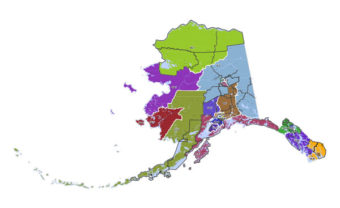
In a couple of ways, the redistricting process is sort of like solving a Rubik’s Cube: It can be really frustrating, and every time you try to fix a part, you run the risk of messing up something else.

From the perspective of the Alaska Democratic Party, the map used for the last election was:

McKinnon: Outrageous.

But the newest version?

McKinnon: Is just bad.

Joe McKinnon is the party’s attorney. He says that while the redistricting board’s newest map solves some constitutional problems, it creates a few others. That’s why the party — along with Katie Hurley and Warren Keogh — filed a lawsuit against the board on Tuesday. There’s already another group based in Fairbanks that’s suing the board for different reasons concerning the Senate pairings of certain districts, and it’s possible this new lawsuit could be rolled in with that one.

McKinnon says his clients have a handful of concerns with the new map. They think the board, which is mostly made up of Republicans, took extra voters from the conservative Mat-Su region to make other seats more secure for their party.

“The Mat-Su has exactly enough population for five seats, and yet the board only put four seats within the borough and then split the other population, putting part in with Valdez and then part in with Anchorage.”

McKinnon says the way the lines were drawn in the Kenai Peninsula and Fairbanks are similarly problematic. He also says the state’s rural districts should have been better drawn to match Native corporation boundaries.

Now, McKinnon wants the courts to say the redistricting board has had enough chances to produce a constitutional map.

“The remedy we want is for the court to draw the final map, to appoint a master.”

Michael White is the redistricting board’s attorney, and he thinks the lawsuit is being brought more for political reasons than constitutional ones.

“I guess if I’m a betting man, I would say what they’re trying to do is blow up the plan with anything they possibly can in the hopes that they would get a master appointed, and that would somehow benefit the Democrats.”

White says he was surprised that the Democrats filed their own suit against the redistricting board, and that he doesn’t think their case has any merit. When it comes to the Mat-Su region, he says the decision to take some population from that area was necessary to pad surrounding districts that didn’t have enough voters.

“It isn’t just a simple matter of ‘Let’s draw this in isolation.’ There’s a ripple effect that you have whenever you move a single person — you start moving several hundred people.”

White adds that he doesn’t see basis for a complaint about rural districts. The map the redistricting board adopted was partially based on a plan offered by Calista, an Alaska Native corporation.

“If they don’t match Alaska Native lines, how come there is not a single Alaska Native interest that is making a challenge?”

The redistricting board is arguing that all legal challenges against the redistricting board be dismissed.

The courts are hearing the lawsuits on an expedited basis in an effort to finalize the state’s political boundaries before the 2014 election. It’s been three years since the redistricting process first started.

This story has been updated to include comment from the redistricting board.

Redistricting Board adopts final plan

In a half-hour meeting on a Sunday afternoon, the Alaska Redistricting Board unanimously agreed on a new electoral map.
The process of drawing the state’s political boundaries has been going on for nearly three years. Along the way, board members described it as a struggle, Democrats characterized it as gerrymandering by a Republican-dominated group, and the courts deemed it unconstitutional.

Board member Bob Brodie expressed relief at the idea the prospect of Sunday’s meeting being the board’s last.

“It wasn’t an easy job in the beginning, and it wasn’t any easier later.”

The new plan is partially based on a proposal from the Native corporation Calista, and there are some major changes from the temporary map used in the 2012 election. It gets rid of a controversial district that mixed some Fairbanks area residents with rural Alaska; it removes Petersburg from Juneau’s Senate district; and it reconnects the Aleutian chain. All of those issues had been raised as constitutional concerns, and board attorney Michael White said at the meeting that the new map addresses those legal claims.

The map also opens up a Senate seat in the Mat-Su area by placing Eagle River Republicans Anna Fairclough and Fred Dyson in the same district, and it creates a new House seat in the Interior by putting North Pole Republicans Doug Isaacson and Tammie Wilson in the same political boundaries.

During Sunday’s meeting, board members complimented each other on finalizing a new map, and they discussed the challenges of complying with both the Alaska Constitution and the federal Voting Rights Act. The act, which is meant to protect the influence of minority populations, was partially struck down by the Supreme Court last month. Board member Jim Holm spoke critically of giving special treatment to Native voters.

“I find it to be disconcerting that we so many times try to allow people to have extra voting rights versus people who are just plain Alaskans. I’ve been here 67 years, and I’m an Alaskan. I may not be an Alaska Native, but I’m a native Alaskan.”

The map will now be submitted to the courts for approval as part of an ongoing lawsuit.

Sealaska sells off share in plastics venture

The Sealaska building in Juneau.
Sealaska’s headquarters building in Juneau. (Photo by Heather Bryant/KTOO)

Southeast’s regional Native corporation is out of the plastics business.

Sealaska sold its share of factories in Alabama, Iowa and Guadalajara, Mexico, on Monday.
Nypro Incorporated bought out Sealaska’s share of their Nypro Kánaak partnership. The purchase price was not revealed.

President and CEO Chris McNeil Jr. says it’s part of a larger effort to narrow investments.

“This particular operation has had a spotty performance over the years. But now all three operations have been profitable. When you have a company that has increasing profitability, that’s generally the time to sell if you have the opportunity to sell,” he says.

Nypro was recently purchased by Jabil, a huge multinational corporation with 60 plants in 33 countries. McNeil says that was also a factor in the sale.

He says a few tribal members interned at Nypro. But the factories were too far away to benefit most shareholders.

Sealaska’s board and management are considering new areas of investment in Alaska and the Pacific Northwest, where most of its 22,000 shareholders live.

“We’re also looking for something that is more constant with our Native values, including the concept of sustainability,” he says.

Sealaska sold its global logistics subsidiary earlier this year, giving the same reasons.

McNeil says the corporation has not chosen a company or industry to replace the plastics business.

He says the sale will not have a large financial impact on shareholder dividends.

“This will become less gross revenues. But of course the revenue and income from the sale itself earns income during the time we’re holding money for reinvestment,” he says.

Sealaska’s plastics venture began in the late 1990s with a subsidiary called TriQuest Precision Plastics, which had a plant in Vancouver, Washington.

Changes in the market led the factory to close. Sealaska then combined assets with Nypro to form the partnership. It made bleach containers, filtered water bottles and other products.


Where will SE election boundaries end up?


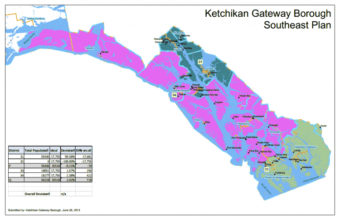
The Ketchikan Gateway Borough redistricting plan for Southeast does not specify how Juneau’s two districts will be split up.

The Alaska Redistricting Board has come up with seven new maps of its own. Four more were submitted by the Ketchikan Gateway Borough, the Calista regional Native corporation and two other groups. (Link to the maps and related documents.)

But the redistricting maps posted online are small or compressed. So, it’s hard to even tell where some communities end up.

“I don’t think anybody really knows what’s going on with redistricting,” said Skagway Mayor Stan Selmer.

Like many Southeast leaders, he’s considering the implications of another round of election-boundary changes.

“I’m a little bit disappointed that this has this much of a life,” he said.

The northern Lynn Canal community used to be linked to Haines, its nearby neighbor, and quite a few other small Southeast towns.

The current redistricting plan, undergoing a court-ordered review, puts Skagway in with downtown Juneau, Petersburg, Gustavus and Tenakee Springs.

New maps keep Selmer’s town linked to the capital city and its Lynn Canal neighbors.

“I know that geography really is the major component of tying Haines, Skagway and Juneau together,” Selmer said.

Most of the new redistricting maps match other Southeast communities with their neighbors, rather than long, narrow strings of towns.

For example, plans link all of southern Southeast together.

Dan Bockhorst is borough manager of Ketchikan, which submitted its own set of regional boundaries.

“The plan that was presented would encompass all of the Ketchikan Gateway Borough and areas with which Ketchikan has strong social, cultural, economic, geographic and transportation connections and similarities,” Bockhorst said.

Some of the 11 proposed maps shuffle communities and boundaries in the middle of the region.

A number, including Ketchikan’s, put Wrangell back in a district with Sitka and Petersburg. That’s what Petersburg wants, rather the current district with Juneau.

All these changes make it hard for some residents to know who their legislators are – and vice versa.

“I’ll just go with the flow, whatever it is. It’s just very frustrating when you get yanked around,” said Wrangell Representative Peggy Wilson.

She lost Sitka and Petersburg from her district for the 2012 elections. And she gained much-larger Ketchikan.

“The thing is, I know that district so well because I’ve had it for so long. And it’s been a challenge for me to get to learn all new people,” Wilson said.

Election districts have to have pretty much the same number of residents.

So when Southeast Alaska didn’t grow – and other parts of the state did – redistricting cost the region two of its eight legislative seats.

That forced small towns in with larger communities, some against their will.

Merrill Sanford is mayor of Juneau, which has about half the region’s residents and two of its four remaining election districts.

“It just seems like no matter how you cut it, we end up having to have some of the other littler communities around us, one way or the other, in our district. And of course that scares and worries them and I don’t blame them,” Sanford said.

A public hearing on the plans is set for noon to 4 p.m., July 2nd, in Juneau. Others are set for June 28th in Anchorage and July 1st in Fairbanks. Testimony will be taken in person and via teleconference.

Incumbents win another term on the Sealaska board

Sealaska shareholders have re-elected four incumbents to their regional Native corporation’s board of directors.

Richard Rinehart Jr., Jodi Mitchell, Jackie Johnson Pata and Patrick Anderson were the top vote-getters.

Results were announced Saturday at Sealaska’s annual meeting in Hoonah.

The board chose Alysha Guthrie as youth adviser for the next year.

The incumbents were challenged by 10 independent candidates, many critical of the corporation’s board and managers.

Mick Beasley, Myrna Gardner and Ralph Wolfe were the top independent vote-getters.

Sealaska says about 120 shareholders and guests attended the meeting in Hoonah. Another approximately 280 households viewed a webcast.

Board members chose Albert Kookesh and Rosita Worl to continue chairing and vice-chairing the panel. Top managers were also retained, including President and CEO Chris E. McNeil Jr.

Sealaska has about 22,000 tribal member shareholders.

2013 Annual Meeting Election Results (in shares cast)

Richard Rinehart Jr. – 601,423

Jodi Mitchell – 601,255

Jackie Johnson Pata – 600,927

Patrick Anderson – 600,487

Mick Beasley – 432,960

Myrna Gardner – 331,986

Ralph Wolfe – 245,620

Frank Jack III – 170,633

Angela Michaud – 118,294

Ernestine Hayes – 103,533

Will Micklin – 100,250

Richard Jack Strong – 95,982

Edward Sarabia Jr – 84,966

Bonnie Jo Borchick – 28,144

Update: Sealaska lands bill passes Senate committee

Sen. Lisa Murkowski speaks in Sitka earlier this year.

Alaska Senator Lisa Murkowski’s version of the Sealaska lands bill has passed out of its only committee of referral.

That’s a major step toward a Senate floor vote.

But there’s no guarantee it will move any further in Congress. Its best chance is as part of a package of lands legislation. Read details of the bill.

Murkowski told the Senate Energy and Natural Resources Committee today that it’s the result of years of negotiations.

“And I recognize it has created tensions within our communities. But we have worked aggressively and tirelessly with all of the stakeholders, not just Sealaska and their shareholders,” she says.

The bill is co-sponsored by Alaska Senator Mark Begich. A similar measure by Alaska Representative Don Young passed out of the House Natural Resources Committee earlier this month.

The Southeast Alaska Conservation Council has endorsed the legislation as a reasonable compromise.

But other critics – including environmentalsportsmen’s and small-community groups – continue to oppose the bill. They say Sealaska wants to trade marginal acreage it can already claim for the most valuable timberlands in the Tongass National Forest.

Andi Burgess is rainforest program director for the Alaska Wilderness League. Her group is particularly concerned about an area on the south end of Prince of Wales Island.

“One of the most productive salmon streams in the Tongass is in Keete Inlet. It’s an area identified by Audubon and Trout Unlimited scientists as being one of the most high-value watersheds,” Burgess says.

The bill would allow the regional Native corporation to choose about 68,000 acres of timberlands from within the Tongass.

Around another 1,600 acres would be transferred for renewable energy and ecotourism development or preservation as cemetery and historic sites.

The total, a little more than 70,000 acres, is less than the 85,000 Sealaska has said it’s entitled to.

Murkowski points to acreage that would gain new protections under the bill.

“It will help the Sealaska region’s timber industry grow, while at the same time we’re working to protect more than 150,000 acres of habitat for fisheries and wildlife,” she says.

Juneau-based Sealaska has about 22,000 shareholders. More than half live outside Southeast, but have family ties to the area.

Point Baker resident Don Hernandez issued this statement in response to the legislative action:

“There is a lot of heartache out here right now. We find it hard to believe that a Senate committee would support a bill that so unfairly benefits a special interest. Murkowski and Begich are touting all the ‘compromises’ that were made, but the only thing that was compromised was their duty to look out for the public interest over the special interest of Sealaska Corp. The bottom line, after all the deal making, is that some of the best forestland on the the Tongass will be clearcut and will never be the same, and no amount of conservation protections written into the bill will change that. One of those watersheds is near and dear to our communities and it will be a tremendous loss if this bill were to pass the full Senate.”

Site notifications
Update notification options
Subscribe to notifications