Alaska Native Corporations

Second bill proposes smaller Sealaska land transfer

A second measure transferring Tongass National Forest land to Sealaska is before Congress on Thursday.

It’s stopgap legislation turning 3,600 acres over to the Southeast-based regional Native corporation. Two parcels are proposed, one on the Cleveland Peninsula and the other at Election Creek on Prince of Wales Island.
A much larger bill before Congress would transfer about 70,000 acres.

Sealaska CEO Chris McNeil says it’s needed to keep logging operations going.

“Obviously we’d like the more systemic bill, but it’s important for us to be able to recognize that we have important timing and operational considerations to achieve. And that’s why there’s the second bill, which is really a subset of the first,” McNeil says.

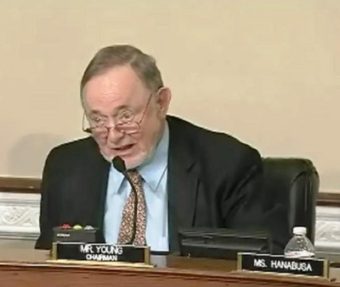
Both measures are sponsored by Alaska Congressman Don Young.

They and four others will go before the House Committee on Natural Resources’ Subcommittee on Indian and Alaska Native Affairs at 10 a.m. Thursday, Alaska time.

Similar legislation is before the Senate.

The House version of the larger measure includes more of what Sealaska asked for. The Senate bill shows more changes resulting from negotiations with environmental groups, small communities, tour operators and other critics.

Young’s measures are House Bill 740 and House Resolution 1306. The main Senate bill, sponsored by Lisa Murkowski and Mark Begich, is Senate Bill 340.

Sealaska reports higher profits

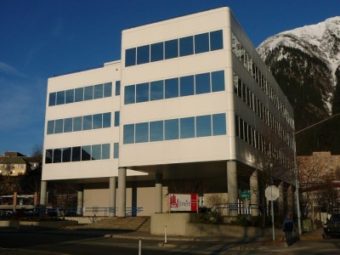
Sealaska Plaza, the corporation's Juneau headquarters. Officials announced the December distribution, the largest in three years.
Sealaska Plaza is the corporation’s Juneau headquarters. Officials just released the regional Native corporation’s 2012 report.

Sealaska is making more money.

Southeast Alaska’s regional Native corporation says it brought in almost $312 million during 2012.

That’s close to 20 percent more than the previous year — and the largest amount from the past five years.

The numbers are for total income, also called gross revenues.

Sealaska’s profits, or net revenue, are $11.3 million for 2012.

That’s 40 percent more than 2011. But it’s lower than the previous two years.

The numbers are in Sealaska’s 2012 annual report, which was released Friday. The Juneau-based corporation has about 21,000 shareholders. Corporate officials were not immediately available for comment.

Link to a copy of the annual report.

More than half Sealaska’s 2012 gross revenues were in the service sector, including environmental contracting and security.

About a quarter came from manufacturing, mainly plastics factories in the Lower 48 and Mexico.

A little less than a fifth of the overall earnings came from natural resources, including timber and gravel operations. The rest was from investments.

The manufacturing, service and investments had higher profits than the previous year. But natural resource profits dropped. We’ll take a closer look at some of those business sectors in a future report.

Read the corporation’s press release describing its annual report and future goals.

Sealaska, UAS official sentenced in DUI case

A Sealaska board member and University of Alaska Southeast official who was arrested for driving while under the influence has been ordered to serve three-days in jail.

Joseph Galen Nelson, 42, changed his plea in Juneau District Court on Tuesday after reaching an agreement with prosecutors.

“To the charge of driving under the influence, how do you plead?” asked Judge Keith Levy.

“Guilty,” answered Nelson by telephone. His attorney said Nelson was in Yakutat on Tuesday.

Nelson was ordered to report to Lemon Creek Correctional Center by 8 p.m. Wednesday, May 8th to begin serving his sentence. (An on-line database of offenders currently incarcerated by the Alaska Department of Corrections indicate that Nelson’s release is scheduled for Saturday, May 11th.)

Nelson’s drivers license is revoked for 90-days and he must have an ignition interlock device installed on his vehicle for six months after he starts driving again. He must pay a $1500 dollar fine before he completes probation in eighteen months. He must also enroll in the Juneau Alcohol Safety Action Program (JASAP) and follow through with the program’s assessment, treatment, and aftercare.

For a misdemeanor charge of driving under the influence, Nelson faced a maximum of a year in jail and $10,000 fine. But, as a first-time offender, he was sentenced to a mandatory minimum of 33-days in jail with 30-days suspended, and a $3000 fine with $1500 suspended.

Before the plea agreement, the case had been scheduled for trial on May 21st.

Nelson was pulled over near 12th Street and Glacier Highway in downtown Juneau at about 2 o’clock in the morning of February 9th. The officer said he witnessed Nelson’s black Toyota FJ Cruiser swerving, accelerating quickly, and speeding. Nelson allegedly had watery eyes and said he had three drinks. The officer said that Nelson failed field sobriety tests and that he registered a .091 blood alcohol content. That’s over the legal limit of .08 for intoxication.

Defense attorney Kevin Higgins said his client has already contacted JASAP and just wants to put the incident behind him.

Mr. Nelson was down at the Viking bar that night after the vigil for the young woman from Kake. He was drinking at the Viking. On his way out, a fight broke out (and) he went back to his vehicle. His vehicle was about 200-yards from his house when he got pulled over. From the beginning, he hasn’t really wanted to challenge this.”

Higgins said he noted some discrepancies between the police report and video footage of the field sobriety test. But he said Nelson has no desire to prolong the case.

Prosecutors did not make any comments and Nelson did not say anything aside from answering routine questions asked by Judge Levy.

Nelson has been a member of the board of directors of Sealaska Native corporation since 2003. He also serves as a trustee for the Sealaska Heritage Institute and as chairperson of the Yak-tatKwaan village corporation. Nelson is currently employed as Vice Chancellor of Enrollment Management and Student Affairs at UAS in Juneau.

Search underway for lost Sealaska canoe

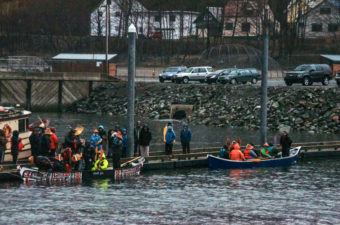
The two canoes prepare to leave Juneau on April 24.
The two canoes prepare to leave Juneau on April 24. (Photo by Kelli Burkinshaw)

Several canoe groups are paddling down the Inside Passage to Wrangell for the Shakes Island Rededication event this week.

Two canoes traveling from Juneau hit bad weather and rough water on Saturday. One canoe was lost.

Both canoes left Juneau on April 24th. They were each accompanied by a support boat.

The Raven canoe belongs to the One People Canoe Society and has paddlers from several Southeast communities and Washington state.

The second canoe is from the Sealaska native corporation and has a Yakutat-based crew.

The crews hit bad weather and high seas in Seymour Canal on Saturday.

Both decided to put the paddlers on the support boats and tow the canoes.

Alicia Chilton is on the board of the One People Canoe Society. She’s also a paddler on the Raven Canoe.

“When we went to turn, the line slacked in, and all the water from the back of the canoe rolled forward. And that’s when she just went down and the line broke. And we watched her drift away from us,” said Chilton.

One of the canoes prepares to depart Juneau on April 24.
One of the canoes prepares to depart Juneau on April 24. (Photo by Kelli Burkinshaw)

Both the Raven canoe and the Sealaska canoe snapped their tow lines and were washed away.

The lost Raven Canoe was spotted on a rocky shore where it had beached itself. It was retrieved safely at about 2pm on Saturday.

The Sealaska canoe was found about two hours later.

The plan was to tow both canoes to Kake, where they could be inspected for damage, repaired if necessary, and sent back on their journey.

The Raven canoe made it. The Sealaska canoe did not.

During the recovery, it broke free of its tow line for a second time.

As of this afternoon, a search and recovery effort is in full swing. A Juneau-based plane for the Alaska Department of Fish and Game was sent out. A second plane from Petersburg Fisheries was also dispatched.

There was a possible sighting of the Sealaska canoe this morning.

Wrangell Cooperative Association staff member Renee Claggett is helping coordinate efforts in the water.

She made contact with crewmember Jay Dodge of the Silver Bay Seafoods tender Lady Kate this afternoon.

“Okay the report is from the pilot that it was upside down and actually went up during a high tide. And it’s falling tides now so it’s probably safe. If anybody as the boats are moving in for the Seymour herring fishery, if they could just keep an eye out for it. So if you could just put the word out on the fishing fleet there as they come in. And if it does get into trouble, maybe somebody could grab it and let us know,” said Claggett to Dodge.

The Sealaska canoe’s life vests were also possibly spotted in the area known as the Rock Garden in Seymour Canal.

Meanwhile, the Raven canoe and its crew arrived in Kake late Sunday afternoon.

The Sealaska crew made it to Kake as well.

And, Chilton said, everyone is coming together to make the best of a harrowing experience.

“What’s happening now is that the Juneau and Yakutat crewmembers—we’ve got a total of 18—will be rotating through the Raven canoe. So Juneau and Yakutat are combining into one now,” said Chilton.

The Raven canoe is expected to arrive in Wrangell waters on Wednesday.

The Raven canoe is set to leave Kake for Petersburg Tuesday morning. It had to delay its planned departure this morning due to inclement weather.

Congress looking at Sealaska Lands Bill

The latest Sealaska land conveyance bill had its first public showing in Congress on Thursday.

The public lands panel of the Senate Energy and Natural Resources Committee heard from two federal agencies about transferring 70,000 acres of the Tongass National Forest to the Sealaska Corporation.

While the bill’s supporters are optimistic it will pass, there are still a couple of major hurdles.

Every regional corporation formed by the Alaska Native Claims Settlement Act is entitled to land. Sealaska is the lone corporation yet to finalize its land transfer.

The corporation is entitled to about seventy thousand more acres.  Problem is, it’s been difficult finding agreement on where the remaining land should come from.

“Nearly every acre, I would venture that every acre of the 16.9 million acre Tongass, is precious to someone,” Senator Lisa Murkowski said.

She says there have been more than 175 revisions to the land transfer bill since it was first introduced more than five years ago. The bill would amendment ANCSA.

Murkowski, who spent part of her childhood in Ketchikan, calls this version the most fair to all involved.

Not everyone will be satisfied. Some environmental groups worry this legislation would set a precedent that would allow other Native corporations to choose new land.

Sealaska selected its acreage, but it wants to pick different sites with more valuable timber prospects. Officials also say they dropped some selections because they were too environmentally sensitive.

Jim Pena is the associate deputy chief of the National Forest System.

“We believe the circumstances around this bill are unique, and no such precedent would be created,” Pena said.

And as Pena said this, a satisfied Murkowski nodded in agreement.

“We went around and contacted all the Native corporation heads, gained assurance that they understood the unique situation that Sealaska faces, and that they do not consider this some kind of precedent,” Pena said.

So that issue should be cut and dry. But it’s not.

Sitting at the table next Pena was Jamie Connell, from the Bureau of Land Management. Both the BLM and Forest Service have stake in the Tongass.

“We can’t give an absolute on some of the issues that were brought up; an absolute that another corporation wouldn’t come in and ask for similar treatment,” Connell said.

Even though Connell hedges, BLM is closer to certainty than it’s been before.

There’s still one major issue though. What kind of trees Sealaska will be able to cut.

The Forest Service worries that the land conveyance will affect the transition from old-growth harvest to new growth.

Murkowski styles the transition as a lifeline to the struggling timber industry.

“These existing timber businesses need some time. They need sufficient timber. And they need economic certainty in order to survive and to have any chance of this transition succeeding,” Murkowski said.

She says she’s willing to compromise on the issue. The Forest Service says the transition is a 10-15 year process. But most new growth is far more decades away from being ready to harvest.

Some conservationists welcomed the changes to this version, such as Joe Mehrkens.

“There are improvements,” Mehrkens said. “The first versions were absolute wish lists for Sealaska.”

Mehrkens, a retired Forest Service employee, sits on the board of the Greater Southeast Alaska Conservation Community.

He says this plan saves prime land on Prince of Wales Island, but it’s still too degrading to the environment to support.

Chris McNeil is the president of Sealaska. He says the company met with every interested stakeholder.

Nine small communities on or near Prince of Wales Island oppose the transfer. McNeil dismisses them saying most of Southeast supports the transfer.

“Naturally you can’t have 100 percent of the constituency in favor of it. They’ve taken a position. But we’ve worked all the parties nonetheless,” he said.

McNeil says he’s optimistic this version can pass because it’s been tweaked to try and meet everyone’s needs.

The previous version stalled in the Senate last year. A similar measure passed the House, but went no further.

There is one indication a public lands bill could move this Congress: Senate Majority Leader Harry Reid testified before the committee. He needs Senate action on a Nevada lands bill.

And Reid controls the legislative calendar of the chamber.

Sealaska legislation going before Senate panel

The revised Sealaska land bill will have its first Senate hearing on Thursday.

The chamber’s Energy and Natural Resources Committee’s Subcommittee on Public Lands will take up the measure.

Alaska Sens. Lisa Murkowski and Mark Begich are co-sponsors. A separate but similar bill sponsored by Congressman Don Young is in the House.

What’s called the Southeast Alaska Native Land Conveyance Act would transfer about 70,000 acres of the Tongass National Forest to the regional Native corporation.

Supporters say it’s a much-negotiated compromise completing Sealaska’s land selections.

“The current bills under consideration by Congress would fulfill a promise made to Alaska Natives and the public while resolving the discrepancies between 1970s priorities and today’s issues,” Sealaska President and CEO Chris McNeil Jr. said in a press release.

Opponents say it gives away valuable timber stands and threatens environmentally sensitive areas within the Tongass.

“Although some of the boundaries have changed, the percentage of old-growth forest proposed for harvest remains unacceptably high,” wrote Jerry Burnett, president of the Juneau-based outdoors group Territorial Sportsmen, in a letter to Oregon Sen. Ron Wyden, ranking Democrat on the committee.

The Sealaska bill is one of 20 public-lands measures listed for the hearing at 10:30 a.m. Thursday, Alaska time.

Other bills on the agenda address boundaries for Utah Indian reservations and a New Mexico national forest. Still others concern grazing rights and wilderness designations in other states.

Hear an earlier report on the measure.

Hear a report on reaction to the bill.

Site notifications
Update notification options
Subscribe to notifications