Alaska Native Corporations

Kookesh to step down as Sealaska board chair

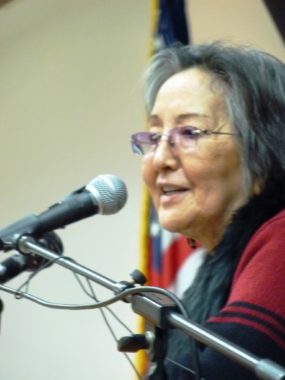
Albert Kookesh. Photo by Ed Schoenfeld/Coastalaska.
Albert Kookesh is stepping down as chairman of the board of directors for Sealaska, the regional Native Corporation for Southeast Alaska.

The company also announced the deadline to apply for its president and CEO position, as Chris McNeil prepares to retire.

Kookesh, a former state lawmaker from Angoon, has been Sealaska chairman for 14 years. He plans to remain on the board, but says he wants to cut back on work and commitments.

Kookesh suffered a heart attack last March. In a message posted to Sealaska’s website Tuesday, he said he’s back to 100 percent, but the incident put a scare in him and his family.

“I want to be here to see my grandchildren grow up,” Kookesh said in the statement.

He said he was honored to have served longer than any other board chair in Sealaska history, and wants to continue to use his relationships in the Native and non-Native communities for the benefit of Sealaska and its shareholders.

Kookesh also decided not to run for reelection as co-chair of the Alaska Federation of Natives last year, another position he had held for 14 years.

McNeil announced his planned retirement in October after 12 years at the helm. At the time he said he hoped to have a successor named by March and that the actual transition would be made at the corporation’s annual meeting in June.

Sealaska is accepting applications for its next president and CEO through February 28th. The company’s board of directors has hired San Francisco-based recruiting firm Egon Zehnder to help with the search.

According to another statement on Sealaska’s website, the successful candidate will be a company shareholder and reside in Juneau, where Sealaska is headquartered. McNeil lives in Washington state and works in corporate offices in Bellevue.

Sealaska Heritage Institute plans art auction fundraiser for Soboleff Center

Soboleff Center December 2013 construction update
The steel framework for Sealaska Heritage Institute’s Walter Soboleff Center went up in Juneau this week. Photo by Casey Kelly/KTOO.

Construction workers this week began erecting the steel frame for Sealaska Heritage Institute’s Walter Soboleff Center in downtown Juneau.

The 29,000 square foot facility is scheduled for completion in January 2015.

SHI has raised about $17.5 million of the $20 million project cost. The nonprofit is planning a major fundraiser early next year to get closer to the overall goal.

Project manager and Sealaska Heritage Institute Chief Operating Officer Lee Kadinger says construction is moving quickly.

“Not too many $20 million facilities are built in a year and half, two year time frame. But we’re doing what we can to try and make that happen,” says Kadinger. “The foundation has been poured, it’s done. Now the steel is going up. By mid-January you are going to see the overall structure, the framework in all of its glory, showing the size of the facility.”

The facility is being named for the late Dr. Walter Soboleff, a Tlingit spiritual leader and educator who passed away in 2011. It will house Sealaska Heritage offices, as well as education, arts and language programs. It also will allow the

Lee Kadinger
Lee Kadinger. Photo by Casey Kelly/KTOO.

institute to bring all of its artifacts under one roof, where now many objects are stored at off-site locations.

“Our archives and our ethnographic collections, we really have some of the world’s most amazing treasures, hidden and tucked away,” Kadinger says.

He says SHI has received contributions for the project from more than 680 individuals, businesses, government agencies, and other nonprofits, including the State of Alaska, the City and Borough of Juneau, and the Rasmussen Foundation.

With less than $2.5 million still to raise, the heritage institute is planning an art auction fundraiser in February. Media and Publications Specialist Christy Eriksen says they’re calling it the Tináa Art Auction. The Tináa is an hourglass shaped symbol used in Southeast Native art that signifies wealth and trade.

“It’s a symbol that we wanted to use in our auction, because what often happened is when you would give it to somebody, it would be worth more than the actual value of the piece,” Eriksen says. “So we wanted to kind of think about that sense of reciprocity we have with the community and the community has with us, and the idea of creating something, having something with more valuable than the actual physical thing.”

Eriksen says several highly regarded Southeast Native artists are donating pieces to the auction, including Preston Singletary, David Boxley, and Delores Churchill. The auction will be held February 1st at Juneau’s Centennial Hall.

Eriksen and Kadinger spoke Thursday to the Juneau Chamber of Commerce.

Juneau Assembly approves Law Department’s move to Sealaska Plaza

Municipal Way Building sign-2
Moving the CBJ Law Department to Sealaska Plaza is expected to allow the city to move the Human Resources staff out of the basement of the Municipal Way Building. Photo by Casey Kelly/KTOO.

The City and Borough of Juneau’s Law Department will move into the Sealaska Plaza building around the first of the year.

The Juneau Assembly on Monday voted 5-3 to approve the move, which will give the law department more space to accommodate additional staff. The city’s in-house legal team is expanding as it takes on more responsibilities for the Juneau School District and Bartlett Regional Hospital.

Some Assembly members wanted to remodel the department’s current office space in the Municipal Way building. That would have saved the city about $6,000 this year compared to the cost of moving.

Assemblyman Jesse Kiehl also argued there would be long-term savings – about $68,000 per year – in the amount of rent the city pays if the Law Department stays at Municipal Way.

“I look at the cost estimates,” Kiehl said. “Even if they are below market – the ongoing expense estimates from the increased lease space – and I have a difficult time supporting adding that to the budget.”

CBJ Lands Manager Greg Chaney said a tentative lease negotiated for Sealaska Plaza would be about 20 percent below market rate.

Assemblyman Randy Wanamaker said moving the Law Department was the right thing to do, because it will allow the city’s Human Resources staff to move out of the basement of the Municipal Way Building.

Juneau City Attorney Amy Mead
City Attorney Amy Mead. Photo by Casey Kelly/KTOO.

“[Human Resources] needs to get out of the basement and if they can move into the Law Department space, those rates are 20 percent below market rates, and it’s available now,” said Wanamaker. “I think we need to take advantage of this. We are adding staff to the Law Department, and we’ve taken on additional responsibilities that we have to fulfill.”

Kiehl and Assemblymen Loren Jones and Jerry Nankervis voted against the move. Wanamaker voted for it, along with Assembly members Mary Becker, Kate Troll, and Karen Crane, as well as Mayor Merrill Sanford.

Assemblyman Carlton Smith recused himself due to a conflict of interest. Smith is a commercial realtor, whose clients include Sealaska Plaza.

Measure creating HR and Risk Management Department delayed

The Juneau Assembly wants more time to consider an ordinance that would create a separate Human Resources and Risk Management Department in the city.

Right now Human Resources is a division within the CBJ Administration. The City Manager’s office has proposed making it a department, since the staff now deals with hiring and personnel issues for the city-owned Bartlett Regional Hospital.

Wanamaker said he needed to hear more before he said yes to the change.

“I understand that there’s an increase in responsibilities,” Wanamaker said. “But I don’t see how we have enough information to fully understand how this affects Bartlett and the need for a city HR department.”

At Wanamaker’s request the Assembly voted unanimously to refer the measure to the Finance Committee for further discussion.

The Bartlett board of directors, which is appointed by the Assembly, supports the city taking on hospital human resources issues. The hospital’s former HR Director Norma Adams resigned in September, one of three members of the Bartlett senior leadership team to resign or announce plans to step down in recent months.

Sealaska dividends total close to $12 million

Sealaska Plaza building
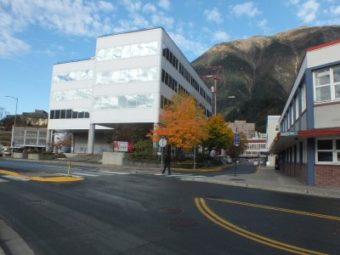
Sealaska Plaza, left, in Juneau is home to the regional Native corporation’s headquarters. Winter dividends will be sent out or deposited starting Dec. 6. (Casey Kelly/KTOO)

Most Sealaska shareholders will get a $713 check or direct deposit in about two weeks.

This year’s winter distribution to stockholders totals $11.7 million. The Juneau-headquartered regional Native corporation has nearly 22,000 tribal members. Most live in Alaska or the Pacific Northwest.

Sealaska Board Chair Albert Kookesh says the twice-a-year distributions strengthen regional communities.

“Since inception, Sealaska has paid more than a half billion dollars total to shareholders and village corporations,” he says.

The majority of stockholders own 100 shares. Payments differ due to status.

Those also enrolled in an urban Native corporation, such as Juneau’s Goldbelt Inc., receive $713. So are those only enrolled in Sealaska.

Shareholders also enrolled in a village corporation, such as Prince of Wales Island’s Klawock Heenya, will get $71.

The difference is income from a pool of regional Native corporations’ natural-resource earnings.

Sealaska pays that directly to urban shareholders, as part of their dividends. But it pays the resource revenues to village corporations, which decide whether to pass them on to shareholders.

Descendents of original shareholders also only get $71 per 100 shares.

And elders in any category receive an extra $71.

Sealaska will mail or direct-deposit dividends beginning December 6th.

Some shareholders say the dividends are too small. They point to the fact that only about 10 percent of the payments come from Sealaska operations and investments.

“Let us not fight of the tiny piece of pie Sealaska chooses to distribute; let us work together to elect a board interested in growing the pie,” says critic Brad Fluetsch on a shareholders Facebook page.


Sealaska CEO lobbies Obama on subsistance, 8(a) contracts

President Barack Obama meets with a group of tribal leaders in the White House, Nov. 12, 2013. Sealaska CEO Chris McNeil Jr. represented Alaska. (Official White House Photo by Pete Souza)

A Southeast Native corporation CEO was one of a dozen Native leaders who met with President Obama as part of last week’s White House Tribal Nations Conference.

Chris McNeil Jr. is president and chief executive officer for Sealaska, the regional Native corporation for Southeast.

He and 11 tribal leaders from around the country met with the president to talk about creating jobs and sustainable economic development. Interior Secretary Sally Jewell and other administration staffers also attended.

McNeil, the only Alaska representative, says he told Obama that federal subsistence rules are not working as they should.

“Alaska Natives are not able to participate fully in the preference as it stands today and the regulations really need a revamping,” he says.

Sealaska CEO Chris McNeil

McNeil says traditional hunting, fishing and gathering are part of Alaska’s economy and rule changes could help them grow. He told officials subsistence is also an important part of the state’s food security.

Sealaska’s CEO says he also pushed for changes in what’s called the 8(a) program. Alaska Native corporations use it to win federal contracts without competing against other businesses. They can also partner with non-Native companies.

It’s been controversial, with calls to rein it in or shut it down. McNeil says it’s an important part of Alaska’s economy, and employs Natives and non-Natives.

“In our view, the administration can still reformulate its regulatory emphasis to be able to make that program work much better within existing law,” he says.

He says Obama asked well-informed questions. But most of the time was taken by Native leaders proposing economic development plans. (Read what else McNeil told the president.)

While McNeil represented Juneau-headquartered Sealaska, he lives in Washington state. He plans to retire in 2014 after about a dozen years heading the corporation.

The meeting with the president came before the larger White House Tribal Nations Conference.

Sealaska board member Jacqueline Johnson Pata

Sealaska Board Member Jacqueline Johnson Pata, also executive director of the National Congress of American Indians, says it continued the same theme.

“The focus of this meeting was really about jobs and the economy and how he, through an administrative lens, can strengthen the ability of tribes to be more successful in that conversation,” she says.

She says the Obama administration turned out in force to meet with delegates from Indian Country, including Alaska.

“We had 12 secretaries, which is the most secretaries ever, listening directly to the tribes. And I think that this really shows this administration is really dedicated to try to resolve some of these issues.. And you could tell that by the depth of their knowledge around the particular issues, whether they be Alaska Native or the Lower-48 tribes,” she says.

Pata says they discussed infrastructure needs, trust asset tax issues and strengthening education, among other topics.

Sealaska CEO announces retirement

Chris McNeil Jr., President and CEO of Sealaska Corporation, has announced his retirement. Photo courtesy Sealaska.

Sealaska president Chris McNeil Jr. says he is leaving the regional Alaska Native corporation in a financially strong position.

The 65-year-old McNeil announced his retirement Friday after 12 years as chief executive officer.

He is a former Sealaska board member. He was selected as CEO in 2001 after serving as corporate secretary, and executive vice president and general counsel.

McNeil has seen major changes since then, including the enrollment of tribal descendants.  When ANCSA was first enacted it allowed for enrollment only in 1971.  The board and shareholders voted to open enrollment to descendants in 2007.

“We’ve moved from about 16-thousand tribal member shareholders to about 22-thousand,” McNeil says. ” That was a very important change that has occurred through time and was certainly a commitment that everyone made to the future of tribal members.” 

He’s also seen radical changes in the Southeast Alaska timber industry.

Gone are the days of large timber sales and swaths of clear cuts as well as the international pulp mills.  Sealaska Timber Corporation, headquartered in Ketchikan, is now the largest timber producer in Southeast. McNeil says Sealaska is changing its forest management.

“Sealaska fully intends to develop a model of sustainability not only in the broader sense of the word but also in the sense of sustainable harvests.  That is a very important change,” he says.

Tribal employment in the company has steadily grown, McNeil says, and it continues to be a goal throughout the divisions.  That requires training.

“As a corporation, we need to continue to encourage people to acquire those kinds of skill sets and experiences that are necessary to participate in the kinds of enterprises that Sealaska and other Native corporations have in this day and age,” he says.

In a message to shareholders, McNeil says the corporation has a solid business plan and is financially strong.

Audited 2012 records put shareholders’ equity at $256-million, compared to $103-million in 2001.  At $88-million, the corporation’s permanent fund is more than twice what it was then.  The Investment and Growth Fund did not exist in 2001; McNeil says it is now nearly $60-million.

Recruiting a new CEO has already begun. The Sealaska Board of Directors has selected an independent search firm to help in the process.

“I can assure tribal member shareholders that this will be a very open recruitment process for a tribal member shareholder who will be the next CEO of Sealaska Corporation,” McNeil says.

McNeil expects the new CEO to be hired by March.  The actual transition will occur at next year’s annual meeting on June 28th.

While McNeil lives in Washington state and works in corporate offices in Bellevue, the next president and CEO will be based at corporate headquarters in Juneau.


NOTE:  This story was updated after a KTOO interview with Chris McNeil.


Site notifications
Update notification options
Subscribe to notifications