Alaska Native Corporations

Theft case dropped against former Sealaska executive

Bob Loescher
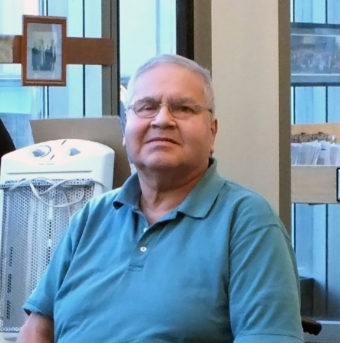
Former Sealaska CEO Bob Loescher arrives for his arraignment on theft charges in May 2014. (File photo by Matt Miller/KTOO)

An embezzlement case against former Sealaska Corp. executive Robert ‘Bob’ Loescher has been dropped after suggestions that prosecutors botched their presentation to the grand jury.

Loescher, 67, was accused of taking $21,515 in funds managed by the Alaska Native Brotherhood and Alaska Native Sisterhood Grand Camp. The funds were part of the Alaska Subsistence Defense Fund and Alaska Traditional Foods Security Council, two nonprofits devoted to the protection of subsistence rights in Southeast Alaska. Loescher was managing the groups when the money allegedly was taken between April and October 2012.

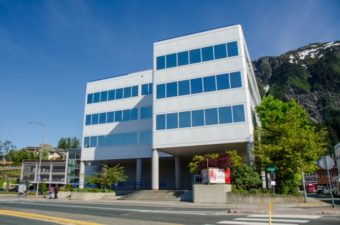
He answered the charges last December and in May, appearing at the Dimond Court Building in a wheelchair.

Loescher’s attorney, Julie Willoughby, called for dismissal of the indictment in a 21-page motion filed in August. Willoughby wrote that the case stemmed from a “fundamentally flawed grand jury proceeding” that included a questionable and misleading presentation by the prosecutor in the case, identified in court documents as Assistant District Attorney Angie Kemp.

Willoughby referred to what she calls “rambling” and largely “irrelevant” testimony by Sasha Soboleff, vice president of the Alaska Native Brotherhood Grand Camp. Soboleff was a key witness before the grand jury, but Willoughby wrote that he did not sit on the board of either subsistence nonprofit and did not understand their relationship to ANB/ANS. She also pointed to Soboleff’s testimony before the grand jury in which he described Loescher as saying he had done “no wrong,” but Soboleff’s comments were erroneously transcribed so that Loescher seemed to admit that he had “done wrong.”

She wrote that Loescher was not bound by the bylaws of the Grand Camp, which may have restricted compensation and reimbursements to himself. She noted that neither Grand Camp treasurer James Llanos or Soboleff appeared to know whether the Alaska Subsistence Defense Fund and Alaska Traditional Foods Security Council successfully obtained nonprofit 501 (c) (3) status. Llanos did not know if Loescher had board approval for drawing funds from the groups’ bank accounts. Bylaws that would specifically prohibit Loescher’s compensation and reimbursement of expenses from the ATFSC were never properly enacted. Such bylaws for the ASDF were never even presented as evidence by Kemp.

In addition, Willoughby noted there was missing exculpatory evidence in the form of invoices and cleared checks suggesting Loescher reimbursed himself or others for legitimate expenses related to the funds, and it was done routinely without formal approval of both groups’ boardmembers.

On Oct. 3, Attorney General Michael Geraghty signed off on a single page order dismissing two charges of felony theft against Loescher based on information from the grand jury investigation and a follow up investigation by Juneau Police.

A December trial has been cancelled, and the case is closed.

Loescher worked for Sealaska, the regional Native corporation for Southeast, for more than 22 years, rising to the position of chief executive officer before he left in 2001.

Sealaska subsidiary closes Kake office, lays off 3

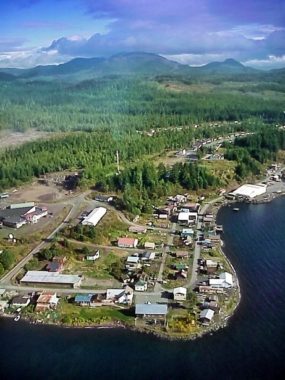
Kake, in central Southeast Alaska, lost three jobs when Sealaska subsidiary Managed Business Solutions closed its satellite office last month. (Courtesy Alaska Community Database)
Kake, in central Southeast Alaska, lost three jobs when Sealaska subsidiary Managed Business Solutions closed its satellite office last month. (Photo courtesy Alaska Community Database)

A Sealaska subsidiary has closed its office in Kake.

Anthony Mallott, CEO of the Southeast regional Native corporation, says Colorado-based Managed Business Solutions lost a large contract.

Anthony Mallott was named the new Sealaska CEO on Tuesday. He takes over June 28th from Chris McNeil Jr. (Sealaska Photo)
Sealaska CEO Anthony Mallott (Photo courtesy Sealaska)

“It led to significant cost-reduction throughout the MBS system, specifically almost a 40 percent reduction in [the] employee count. Unfortunately, that led to additional employment loss, specifically within the Kake office,” he says.

He would not say who the contract was with. Corporate documents list Microsoft and Hewlett Packard as major clients.

Mallott says the company had about 200 staffers.

It’s in the information technology business, including software development.

(Read the press release about the closure.)

The Kake office only employed three people, who worked on marketing, administrative support and project documentation. That’s still a significant number for the central Southeast Alaska village, which has a population of about 550 and high unemployment.

Mallott says the office was, in part, an experiment to see if one of Sealaska’s Lower 48 companies could employ villagers. 

“We’re always looking for our operating subsidiaries to think about how they can move into Southeast Alaska,” he says.

“This was an instance where we tried it, the economics did not work and with MBS looking to reduce fixed costs, this was part of that cost reduction.”

Mallott says Managed Business Solutions is still a viable business. He says it has government clients and is working to find more.

A Sealaska construction subsidiary lost about $26 million last year when it badly underestimated the cost of two projects.

That, and other losses, limited the size of shareholders’ dividends.

Mallott says the contract loss is a very different situation.

“We made a very concerted effort to make sure that we contained the financial effect of that contract loss as quickly as possible. And [we] feel very comfortable that it’s not going to have a significant effect on our financials,” he says.

Sealaska has about 22,000 shareholders with tribal connections to Southeast Alaska, though more than half live elsewhere.

Yupiit Nation members talk tribal sovereignty

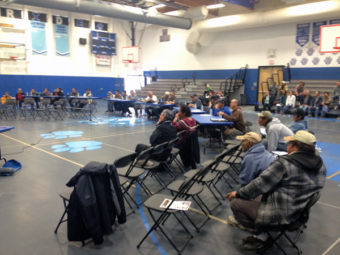
Yupiit Nation member meet in Akiachak in August. (Photo by Ben Matheson, KYUK)

Terms like tribal sovereignty, Native Rights, and co-management, are all open to interpretation. One of the most vocal groups in the Y-K Delta, Yupiit Nation, recently met to hash out their vision of future governance in the region. Members have a spectrum of views about what tribal sovereignty really means.
A few dozen people gathered in the Akiachak School Gym last month for two days of Yupiit Nation discussions at their annual meeting. A similar set of topics comes up at every meeting: subsistence, co-management, local law enforcement; the most basic idea of governance and what role local tribes, who are members of Yupiit Nation, want to play. Ivan M. Ivan is the Tribal President in Akiak.

“We’re not trying to become a government that runs villages. The villages have their power. By themselves to control their own destiny but collectively together I believe they can help each other,” said Ivan.

There is however a long-standing discussion about forming a regional tribal government. Yupiit Nation Chief, Mike Williams, said after the meeting that vision includes a legislative, executive, and judicial branch. He says the current governmental structure holds tribes back.

“There’s 56 individual federally recognized tribes in our area and the respect is there. But if 56 unite together I think we can begin to deal with these issues that are not good and help us manage our way of live as we have for thousands of years,” said Williams.

Williams calls Yupiit Nation a consortium of federally recognized tribes. Formed in 1978 with 19 tribes, Williams says there are now 12 tribes with active members. The core of the group, however, is centered in Akiak, Akiachak, Tuluksak, and Kwethluk.

Critics say the outspoken group doesn’t represent the majority of Y-K Delta tribal members. Still, the group pushes for a shift of the power to tribes in rural Alaska.

Phillip Peter Senior is Akiachak’s Native Community President. He says his ancestors controlled their own destiny and today there are too many laws and regulations. Still, he wants tribes to be partners with existing governments.

“The vision is to help ourselves. And work with our federal and state governments We’re not trying to take away the power from the government and state. All we want to do is work with them,” said Peter.

Moses Owen from Akiak takes a harder line for the Yupiit Nation.

“You know it’s getting tougher for us to survive, with the laws, the regulations, we have have to get back to where we were before. No laws, no rules, just our way of life, we want to practice that,” said Owen.

Yupiit Nation Chief Mike Williams says the group held off on elections, which were scheduled for their meeting on August 22nd and 23rd. He says they’ll likely take place at an upcoming meeting.

And Yupiit Nation isn’t the only group talking about building new tribal government structures. For example, the Y-K Delta Regional Committee, a group facilitated by Calista, the regional Native Corporation, is also drafting a constitution for a possible future tribal government.

Sealaska planning significant investments in Southeast

Anthony Mallott took over as CEO of Sealaska Corp. in June. (Photo by Casey Kelly/KTOO)

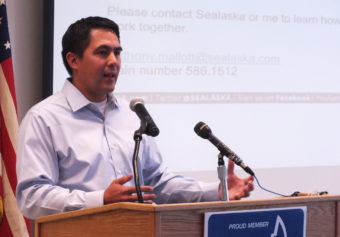
New Sealaska CEO Anthony Mallott says part of the Juneau-based regional Native corporation’s strategy for reversing recent losses will be to do business closer to home.

“Very likely within six months you’ll see significant investments by Sealaska in Southeast, or within industries that are heavily represented in Southeast Alaska,” Mallott told the Juneau Chamber of Commerce on Thursday.

He said Sealaska wants to provide economic opportunities and jobs for its nearly 22,000 shareholders. Most live in Southeast and the Pacific Northwest.

The corporation has sold some of its business interests in areas like Florida, Mexico and Alabama. Mallott says it now has a $100 million investment fund and a $65 million fund for acquisitions.

“So what we’ve done to transition is to load up effectively dry powder,” he said. “And bring on some people that know how to do mergers and acquisitions, and know what we want to look like as a corporation five, 10 years from now, and start making those acquisitions.”

While jobs for shareholders will be important, Mallott says the number one priority will be to invest in profitable enterprises. In 2013, Sealaska businesses lost about $57 million. That shrunk to $35 million due to revenue from investments and natural resource earnings shared by all Native corporations.

Mallott believes Congress is poised to pass legislation completing Sealaska’s land entitlement under the Alaska Native Claims Settlement Act. The long-awaited measure would transfer up to 80,000 acres of the Tongass National Forest to the corporation, providing a boon to Sealaska’s timber businesses.

“It’s been a long wait,” Mallott said. “We’re patient, we know that it’s owed to us and we’ll get there. But it is having some significant effects on our timber harvest and potentially the timber industry in Southeast.”

Mallott took over as CEO at Sealaska’s annual meeting in June. He’d previously served as treasurer and chief investment officer. He replaced longtime CEO Chris McNeil Jr., who retired. Mallott is the son of Democratic gubernatorial candidate and former Sealaska board member Byron Mallott.

New Sealaska leaders promise growth, changes

New Sealaska CEO Anthony Mallott addresses shareholders June 28 at the regional Native corporation's annual meeting near the SeaTac Airport. (Photo Courtesy Sealaska)
New Sealaska CEO Anthony Mallott addresses shareholders June 28 at the regional Native corporation’s annual meeting near the SeaTac Airport. (Photo courtesy Sealaska)

Sealaska’s new board chairman and CEO say the regional Native corporation is gearing up for growth.

They’re following a direction set by their predecessors. But they promise some changes.

Sealaska has been losing money.

The corporation’s businesses lost a total of $57 million last year. Investments, profitable ventures and resource earnings from other Native corporations shrunk that to $35 million.

Officials say the losses should be over.

“Overall, it’s going to be operational profit,” says Anthony Mallott, Sealaska’s new president and CEO.

He’s the one overseeing all business operations and responding to direction from the corporation’s board. The former Sealaska treasurer and chief investment officer replaces Chris McNeil Jr., who just retired.

Mallott says the first half of this year is looking good.

“Of course, it’s purely a forecast. We still have significant financial investment assets, so a significant market fall could take us off that forecast. But right now the forecast is for profits,” Mallott says.

He says that will boost dividends. But Sealaska’s about 21,600 shareholders won’t see the increase until next year.

The Juneau-headquartered corporation still has debts. And Mallott says it’s a significant amount.

Sealaska Board Chairman Joe Nelson
Sealaska Board Chairman Joe Nelson poses at corporate headquarters in Juneau. Nelson was chosen as the new chairman following Sealaska’s annual meeting June 28 near Seattle. (Photo by Ed Schoenfeld/CoastAlaska News)

“We have $18 million in long-term debt outstanding, indicated as short-term because the maturity on that is this year. But all indications are that we’re going to renew that,” Mallott says.

That means the debt will be paid off later. But if it came due now, Mallott says the corporation could handle it.

Sealaska’s other new leader is Board Chairman Joe Nelson, who takes over the post from Albert Kookesh. Nelson has been on the panel since 2003 and has chaired its finance committee.

He wants the corporation to share more information.

“The priority on transparency for me is within our own ranks as employees. Because to be moving in the same direction, we all need to know which direction we’re pointed towards,” Nelson says.

Critics, including independent candidates in the recent board election, say shareholders have been denied basic information about business decisions, successes and losses.

The current practice is to release an annual report several months into the next fiscal year. That document groups operations by categories, such as natural resources, instead of showing how specific companies are faring.

Nelson says not all information will be released. But he expects some improvement.

“Maybe a better word is more frequent communications, just about where we’re at and not having to wait for the annual report to learn the news. Because by the time the annual report comes out, those financials are six months old,” he says.

One of Sealaska’s recovery plan priorities is to buy a new business. It’s sold off its profitable plastics partnership and a smaller company last year to help fund the acquisition.

Nelson says the corporation continues to look for something closer to home.

“We need to invest in areas that we care about. We need to invest in areas that we need to be passionate about and we want to be the best in,” he says.

“We’ve looked at the sustainable food industry. We’ve looked pretty in-depth into the fisheries landscape to see where we could fit,” adds CEO Mallott.

He says Sealaska could have up to $50 million to invest.

“We’ve looked into Southeast-based businesses that tie into any of the current natural resource-based business we have. And we’ve also looked into government contracting,” he says.

Some shareholders have tried to make Sealaska drop, or at least limit, the use of discretionary voting.

It’s a system that gives the board more power at election time. Opponents say it prevents change at the top. And they’ve put resolutions on the corporate ballot to force the issue.

Board chairman Nelson expects discretionary voting to continue.

“I’ve got no doubt that we’re going to look at it. But the shareholders have spoken, over and over again. And changes in the policy, what the shareholders are saying is … the current system is working,” he says.

Nelson and Mallott say they’ll continue pursing federal legislation opening up more Tongass National Forest land to logging. What’s been called the Sealaska Lands Bill has been stalled for years.

They’ll also continue Haa Aaní, a subsidiary investing in Southeast Alaska economic development. Some critics called for it to shut down until the corporation resumes profitable operations.

Soboleff wins Sealaska board seat, Nelson becomes chairman

New Sealaska board member Ross Soboleff. (Courtesy 4 Shareholders for Sealaska)

The Sealaska regional Native corporation has a new board member and a new board chairman.

Shareholders elected Juneau businessman Ross Soboleff to an open seat.

They also re-elected incumbents Rosita Worl, Sidney Edenshaw and Ed Thomas. A resolution limiting discretionary voting failed.

Joseph Nelson was named by the board as chairman. He replaces Albert Kookesh, who remains on the panel but stepped down from the post.

Results were announced at the end of the corporation’s annual meeting at the DoubleTree Hotel near the Seattle-Tacoma airport. About 6,000 of Sealaska’s 21,600 shareholders live in the Pacific Northwest.

New board member Soboleff was part of an independent slate called 4 Shareholders for Sealaska. Fellow members Carlton Smith, Margaret Nelson and Karen Taug were not elected.

Though he was the only one to win, Soboleff says the slate’s message was powerful.

“Most of the board members I’ve spoken to know shareholders are interested in very positive changes in the company. They and me are in the leadership and we have to figure it out together,” he says.

The slate, and most of the six other independent candidates, criticized the board for allowing corporate operations to run into the red by about $57 million last year.

“I would say central to what we came forward with was a turnaround plan for the company,” Soboleff says.

The slate’s Smith was enthusiastic about the results, even if he and two other members lost.

“It’s a powerful victory for shareholders today and it’s a change that’s been wanting to be implemented,” Smith says. “What we’ve got is the beginnings of a brand new board.”

He says the slate cast all its discretionary votes for Soboleff to make sure one member won.

Sealaska’s new CEO, Anthony Mallott, also says the results are a turning point.

“If today’s meeting isn’t proof of change, I don’t know what is,” he said in a press release. “We’ve heard from many people about what is expected of Sealaska, and the great news is that these are the things we’re already working on.”

It’s unusual for Sealaska to have an open board seat. Retiring members usually resign before an election and the board appoints a replacement who then runs as an incumbent.

This year, board member Byron Mallott announced he would not seek re-election so he could pursue his Democratic run for governor. But he completed his term rather than resigning. That guaranteed someone new would fill the seat.

A resolution changing discretionary voting to weaken the board’s hold on ballot counts failed.

Board candidate Mick Beasley, who authored the measure, says he’s frustrated, but would likely try again. He said he may also pursue a term-limits measure, as he has done before.

He was not optimistic about the election’s results.

“I see very little change,” he says.

In all, 13 candidates ran for four board seats this year.

Longtime incumbent Thomas was the top vote-getter, followed by incumbents Edenshaw and Worl. Challenger Soboleff won the fourth seat with the next-highest count.

The board runner-ups, in order of votes received, were Beasley, Myrna Gardner, Ralph Wolfe, Smith, Nelson, Taug, Michelle McConkey, Will Micklin and Edward Sarabia Jr.

The voting share counts are below. Each shareholder casts a vote per share and most own at least 100 shares.

• Edward Thomas 677,440
• Sidney Edenshaw 674,874
• Rosita Worl 674,447
• Ross Soboleff 508,216
• Michael Beasley 472,611
• Myrna Gardner 390,509
• Ralph Wolfe 244,425
• Carlton Smith 206,829
• Margaret Nelson 156,551
• Karen Taug 151,966
• Michelle McConkey 137,691
• Will Micklin 112,261
• Edward Sarabia Jr. 102,166

Site notifications
Update notification options
Subscribe to notifications