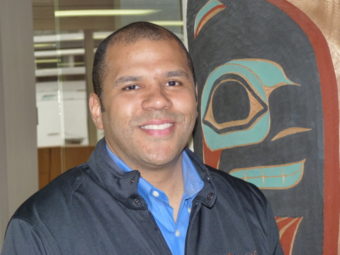
Russell Dick left his job as president of Sealaska’s Haa Aaní to become CEO of Alaskan Dream Cruises. (Ed Schoenfeld, CoastAlaska News)
A former Sealaska executive is the new head of a Sitka-based, small cruise line.
Russell Dick left his job as president and CEO of Haa Aaní in September. The Sealaska subsidiary promotes regional business development.
Dick is now CEO of Alaskan Dream Cruises, a four-year-old company offering tours to Southeast ports not visited by larger lines.
He takes over as the company makes plans to add a fourth ship:
“The Chichagof Dream, which we expect to have in Sitka within the next couple weeks and do some refurbishment of that vessel and have it into the itinerary rotation in 2016,” he says.
Alaskan Dream Cruises is owned by the same Sitka family that operates the Allen Marine boat-building company. It also owns Allen Marine Tours, which offers wildlife-watching and sight-seeing day cruises.
With Dick gone, Sealaska has named Ed Davis as interim director of Haa Aaní. He’s served as its operations manager.
Alaskan Dream Cruises is a small line, operating three ships with a total of about 150 beds on board. Dick says the new ship will boost that number by 30 percent.
“I expect that we’ll be exploring a number of different ports. And Icy Strait Point, of course, should be one of them, given the infrastructure that’s established out there,” he says. “It has nothing to do with my connection to it as much as it does with guest satisfaction and experience, and giving them the full breadth of experience they can get in Southeast Alaska.”
The Allen family also recently purchased the Windham Bay Lodge about 65 miles southeast of Juneau. Dick says it will become a destination for Alaskan Dream Cruises.
Also, Alaskan Dream Cruises recently named Peter Butz as operations manager. He’s been an executive at Lindblad Expeditions, which also offers small-ship tours in Southeast.
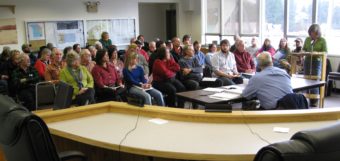
A Senate staffer listens to testimony from Petersburg residents in 2010. (KFSK file photo)
Legislation transferring tens of thousands of acres of the Tongass National Forest to the regional Native corporation Sealaska will supply timber and other economic development opportunities for the corporation. The bill also will set up new conservation areas in Southeast and transfer traditional historic sites and migration routes. The version of the legislation that’s been attached to a defense bill has undergone revisions during a multi-year process.
Sealaska Corporation has been trying for years to finalize its land selection under the Alaska Native Claims Settlement Act. The regional native corporation has sought to select its remaining land entitlement from acreage outside of the withdrawal areas specified in the 1971 law. It’s Senator Lisa Murkowski’s version of the bill to do that that’s moving in Congress. Murkowski held listening sessions in many communities in Southeast during the past few years.
Murkowski spokesman Robert Dillon said it’s not the same measure introduced by Congressman Don Young. “This bill’s markedly changed from the house version,” Dillon said. “Much reduced, attempts to lessen the impact of the logging and to address local community concerns as well as concerns of the fishing community and the conservation community and the recreation community and others.”
Revisions included removal of some of the proposed logging parcels and economic development or “futures” sites. The remaining futures sites that could be used for energy sources or eco-tourism are near Yakutat, Kake and Hydaburg. There are also logging lands included on Kuiu, Prince of Wales, Tuxekan and Kosciusko islands along with the Cleveland Penninsula north of Ketchikan.
The corporation says it needs the transfer to maintain its logging operations and says the bill moves timber selections away from community watersheds and fish habitat to forestland that is predominately on the road system.
The bill also includes language addressing the Tongass National Forest’s transition to logging second growth trees. At a press conference in Juneau last month, U.S. Agriculture Department’s undersecretary for natural resources and the environment Robert Bonnie thought the forest could move forward with the transition even with the passage of the bill.
“One of the things in there would relax, provide more flexibility around CMAI, this issue that I raised earlier, that would allow the forest service to get into young growth stands earlier,” Bonnie said. “Rather than having to wait until they’re 90 years old, it could potentially get in substantially earlier than that and that could help speed up the transition.”
CMAI or culmination of mean annual increment is a forest term dealing with the peak rate of growth for a tree or stand of trees.
The bill also puts more than 150,000 acres of Tongass land into a non-development category, one step below a wilderness designation. Those new conservation areas would be on southwest Kupreanof Island, northern and central Prince of Wales, on central Kuiu Island, two areas of Kosciusko Island and on Sukkwan Island near Prince of Wales.
It also would transfer up to 490 acres of land the corporation would identify as historical sites or traditional cemetery lands around the region. And it transfers three traditional migration routes to the corporation. One is near Yakutat and Dry Bay. Another cuts across Kuiu Island at the Bay of Pillars, and a third runs across Kupreanof Island in between Duncan Canal and Portage Bay not far from Kake. Access to those routes would remain open to the public and the corporation.
Jaeleen Araujo, VP general counsel and corporate secretary for the Native corporation, said Sealaska is pleased the lands legislation is moving in Congress. “We’re just pretty hopeful that maybe this long journey that we’ve been on can finally come to an end and that we can move onto other priorities here at Sealaska,” Araujo said. “But this has been a long effort and we’re excited to just see some additional action on this important piece of legislation to Sealaska.”
Even with the changes to the bill, it’s been controversial in Southeast. A number of small communities asked Murkowski to pull it. Don Hernandez of Point Baker on northern Prince of Wales Island was disappointed to hear the bill could be passing.
“This is not how that bill should be heard in Congress. We were led to believe through this process that if lands bills were packaged in some kind of an omnibus lands package that non-controversial bills would not be included in such a package and the Sealaska bill remains very controversial to a good number of interest groups in Southeast Alaska and I think this is a broken promise from our Congressional delegation.”
Some conservation groups have opposed the bill because it would mean logging old growth trees. Bruce Baker is a board member of the Greater Southeast Alaska Conservation Community and says the corporation has already clear cut scores of thousands of acres of centuries-old trees on what was formerly national forest land. “We don’t think it’s a very good deal for fellow Americans because the entitlement acres that Sealaska is willing to forego are worth less than what they would gain from this legislation,” Baker said. “And that’s true both from a timber value standpoint as well as a wildlife habitat value.”
Sealaska is entitled to 85,000 acres under ANSCA but is accepting about 15,000 acres less in the exchange.
The bill preserves public access on the transferred lands for subsistence hunting and fishing and non-commercial recreation use. Guiding and outfitting operations that have permits to use the forest service land would eventually lose those permits but could come up with a new use agreement with the corporation
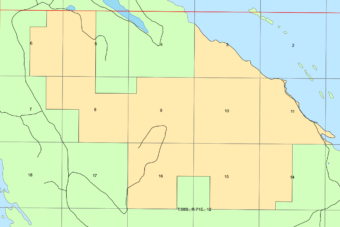
4,595 acres of land on Kuiu Island is designated as an economic development region as part of the Sealaska Land Bill. (Screenshot courtesy Senate Energy Committee)
Sealaska Corporation would get land within the Tongass National Forest in a bill that’s moving quickly in the final days of Congress. The long-awaited Sealaska bill is one piece of a Public Lands package that’s been added to a must-pass defense bill.
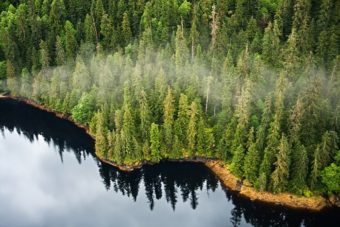
It would turn over about 70,000 acres of the Tongass National Forest to Sealaska, the regional Native corporation of Southeast Alaska, mostly for logging and development.
Sealaska has been pressing Congress for such a bill for years, to complete its land selections under the Alaska Native Claims Settlement Act. Jaeleen Araujo, Sealaska general counsel, is pleased but cautious.
“Well, we haven’t had activity on our bill since they both passed through the committees of the House and the Senate,” she said. “They’ve been waiting for well over a year, probably a year and a half, since we’ve had any action on them. So for us we’re just happy to have some movement.”
Nationally, the bill moves 110,000 acres out of federal control, enables a controversial copper mine in Arizona and expands a BLM program to streamline drilling permits. Outside of Alaska, it also establishes more than 200,000 acres of wilderness and designates new national parks.
Sen. Lisa Murkowski says it’s the culmination of weeks of negotiations. Leaders of both parties, in the House and Senate, have approved the deal. If it passes, it will be the most extensive public lands legislation to become law in years.
Murkowski spokesman Robert Dillon says the package has widespread support in Congress because it includes a variety of measures that appeal to different lawmakers.
“It’s a large, comprehensive package. But it really strikes a good balance between conservation — there’s wilderness bills in here, there’s new parks — and economic opportunity and development,” he said.
The collection of land bills came together just this week, but Dillon says all of the elements have been thoroughly discussed in public.
“Sealaska especially. Sealaska had seven years of public process,” he said.
The land conveyance, he said, will serve as a bridge as the industry lessens its reliance on old-growth harvest.
“The Sealaska bill will help keep the timber industry alive while the Forest Service moves over to a second-growth strategy. It will give the timber mills in Alaska enough timber for the future to get through,” he said.
Among its other Alaska provisions, the bill would sell an old DEW Line radar station within the National Petroleum Reserve-Alaska to Olgoonik, the village corporation of Wainwright. It also clears federal interests in three municipal lots in downtown Anchorage. In Nome, it turns over an Air Force tank farm at the port to the city government. In the defense portion of the bill, lawmakers affirmed the process the Air Force used when it selected Eielson Air Force Base to house the first F-35A squadrons, indicating Congress won’t block the decision. It also authorizes $40 million to improve and expand the missile defense system at Fort Greely and blocks a potentially competing missile site on the East Coast.
The Sealaska transfer is one of the high-profile items in the land bill, and it divides environmental groups. While the bill conveys 70,000 acres on Prince of Wales and other islands, it also conserves more than 150,000 acres in eight areas of the Tongass for salmon habitat and wildlife. The Alaska Wilderness League sees that as significant. But Athan Manuel, who has been fighting the Sealaska bill on behalf of the Sierra Club, says it’s little consolation.
“Even though the bill did get a little bit better, the fact that it privatizes part of the Tongass National Forest is a deal-breaker for the Sierra Club,” he said.
Manuel, though, says he sees no opportunity to stop the bill now.
“This is a very historic win for Sen. Murkowski, a very audacious win for her. The fact that Sealaska is going to be able to operate outside the boundaries of ANCSA is a pretty good plume in their hat,” he said.
The Alaska Native Claims Settlement Act promised acreage to Alaska Native corporations, and Sen. Murkowski says her bill fulfills that commitment to the shareholders of Sealaska. In what could be taken as a sign of its balance, the bill is opposed by both the Sierra Club and the Competitive Enterprise Institute, which complains it would lock up federal land in Western states. The House is expected to pass the bill tomorrow and then it moves to the Senate. Republican Sens. Tom Coburn and Ted Cruz have already objected to the public land bills hitching a ride on the defense bill.
“A bill that defines the needs of our nation’s defense is hardly the proper place to trample on private property rights,” Coburn wrote in a letter to Republican leaders.
Joe Viechnicki, of member station KFSK, contributed to this story from Petersburg.
Part of the Tongass National Forest. (Photo Courtesy U.S. Department of Agriculture)
A long-awaited land selection agreement for Sealaska Corporation is among a package of public land bills that are now slated to move quickly through Congress. A deal to attach the package to the must-pass defense bill was announced late last night.
The bill would turn over about 70,000 acres of the Tongass National Forest to Sealaska, the regional Native corporation of Southeast Alaska, for logging and development.
Nationally, the bill moves 110,000 acres out of national control, enables a controversial copper mine in Arizona and expands a Bureau of Land Management program to streamline drilling permits. Outside of Alaska, it also establishes more than 200,000 acres of wilderness and designates new national parks.
Sen. Lisa Murkowski called it a balanced package that will increase economic opportunities in Western states. Leaders of both parties, in the House and Senate, have approved the deal. If it passes, it will be the most extensive public lands legislation to become law in at least five years.
The bill would sell an old DEW Line radar station to Olgoonik Corporation, the village corporation of Wainwright. The parcel is about 1,500 acres inside the National Petroleum Reserve-Alaska. The bill says the corporation must pay market value for the acreage. It also clears federal interests in three municipal lots in downtown Anchorage and, further north, turns over an Air Force tank farm to the city of Nome. In the defense portion of the bill, lawmakers affirm the process the Air Force used when it selected Eielson Air Force Base to house the first F-35A squadrons.
A new regional tribal government, new taxes, and a constitutional convention will be considered when the Calista-facilitated Regional Committee meets Monday in Anchorage.
The delegates will look at major changes to how the YK Delta is governed through four main resolutions under discussion. The first option being considered would strengthen the role of the Association of Village Council Presidents. Amendments include changing the name to the “Association of Sovereign Yupiit Villages,” providing for direct election of the President, and modifying the charter to allow the President to take executive action to carry out directives from the board.
The next option is to create a new borough government under Alaska state law, with the goal of strengthening the region’s political voice.
The third option is a constitutional convention to establish a regional tribal government with the intention of assessing taxes currently being paid by regional and village corporations to the United States and State Governments.
Willie Kasayulie is Chairman of the Calista board of Directors, as well as the Regional Committee and its steering committee.
“I think the strongest of the three options would be a regional tribal government format. In that concept we basically create a two-house system, similar to the state and federal legislative structure. One side of the house would include tribal representation and tribal governments, the other house would be the house of organizations,” said Kasayulie.
A draft 12-page constitution lays out a regional tribal government, complete with three branches of government, power for law enforcement, and fish and game management. The resolution looks at capturing income taxes from native corporations and assessing taxes on regional lands and businesses.
The Regional Committee formed this February after the Calista board of directors voted to create the group to study problems with current legislation affecting Alaska Native people, tribal government, and corporations, and come up with a strategic plan. A 16-person steering committee has met several times since the spring. Calista’s website says more than 50 tribes have registered for the second full meeting in Anchorage.
Several regional organizations have passed resolutions opposing the Regional Committee and regional tribal governments, including the Bethel Native Corporation and Bethel’s tribe, ONC among others.
The Association of Village Council Presidents provided a list of 16 groups opposing an earlier AVCP resolution in support of a regional tribal government, or the Calista Regional Committee process. Myron Naneng is AVCP President.
“That has come up before but it has been rejected by tribal governments in the villages because they want to ensure they have their local tribal power. This happened 1986 and 2000. We’re kind of perplexed by the fact that Calista wants to move in this direction,” said Naneng.
A final option calls for no changes in governance and would terminate the regional committee. The meeting agenda includes a vote on whether to pursue any of the governance options.
The Regional Committee meets at the Egan Center in Anchorage Monday. Calista’s board approved 200-thousand dollars to run the committee process. Several corporate sponsors made it possible to fly in delegates to Anchorage for the meeting.
KYUK requested to broadcast the proceedings for both of this year’s full meetings, but Calista declined. When KYUK requested that a reporter attend the meeting, a spokesperson said the meeting was closed to the public and to the media. It’s open to shareholders and descendants, space permitting.
Resolutions and draft constitution are posted on Calista’s webpage.
Sealaska Plaza is the regional Native corporation’s Juneau headquarters. Officials say winter dividends will be paid around Dec. 5. (Heather Bryant/KTOO)
Sealaska’s winter shareholders’ dividends will again include no operational profits.
That reflects last year’s multi-million-dollar deficit. Last spring’s distribution also included no such profits.
December’s payments were approved by the Southeast regional Native corporation’s board of directors today.
They range from about $980 to $80 per tribal member. Officials say they’ll be paid around Dec. 5.
Most eligible Tlingit, Haida and Tsimshian shareholders will get about $900. That’s the amount for those belonging to an urban Native corporation, such as Juneau’s Goldbelt.
Those holding stock in village corporations, such as Kake Tribal or Huna Totem, will get about $80 each. Descendants of original shareholders will see an equal amount.
The difference between the two totals is sent to village corporations. Some pass it on, while others invest it or pay debts.
In addition, eligible elders will receive about $80 more.
The numbers are based on 100 shares of stock. Some tribal members have more or less, due to inheritance, gifting and other factors.
The winter dividends reflect earnings from Sealaska’s investments and its share of a statewide natural-resource-profits pool.
Corporate officials were not immediately available for comment.
In a press release, Board President Joe Nelson said he’s not satisfied with dividends without corporate earnings.
He said Sealaska is in better shape than it was in 2013, when net losses totaled $35 million. Three-quarters of that came from a construction subsidiary, which badly underestimated two federal projects in Hawaii.
Sealaska is looking for a private company to buy in hopes of regaining profitability. That’s an ongoing process.
Here’s the payment details, according to Sealaska:
Type of Stock
Per Share
$ Amount Per 100 Shares
Non-Elder and Urban and At-Large Shareholders
$8.99
$899
Elder Urban and At-Large Shareholders
$9.78
$978
Non-Elder Village and Leftout Shareholders
$0.79
$79
Elder Village and Leftout Shareholder
$1.58
$158
Descendant Shareholders
$0.79
$79
Close
Update notification options
Subscribe to notifications
Subscribe
Get notifications about news related to the topics you care about. You can unsubscribe anytime.