Alaska Native Corporations

10 run for 5 Sealaska Corp. board seats

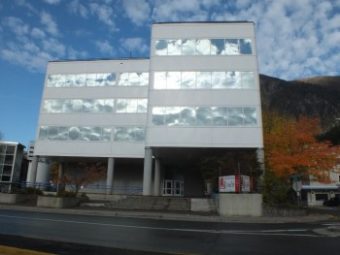
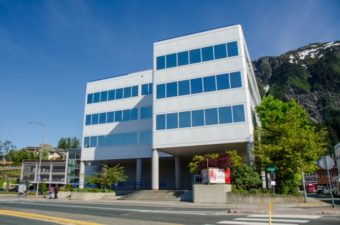
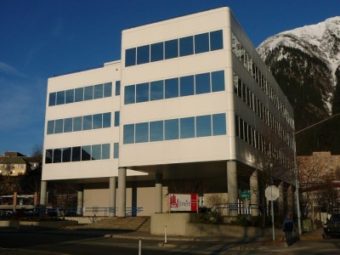
Sealaska Plaza, the corporation's Juneau headquarters. Officials announced the December distribution, the largest in three years.
Sealaska Plaza is the location of the regional Native corporation’s Juneau headquarters.  Shareholders are casting ballots to fill five board of directors seats.  (File photo/KTOO)

Five independent candidates are challenging five incumbents for seats on Sealaska’s board of directors. The election is quieter than last year’s, but not without controversy.
Sealaska’s board reorganized after last year’s election under a new president, Juneau’s Joe Nelson. A new CEO, Anthony Mallott, took the helm around the same time, and some other top officials have been replaced.

But there’s still plenty of conflict over the Southeast regional Native corporation’s practices. That includes five straight years of business losses.

The incumbents say the corporation is healthy. And they express confidence shared by Mallott, who says Sealaska is headed in the right direction.

“That’s financial progress. That’s strong operational platforms. That’s comfort that we can create increasing benefit for our shareholders,” he said in a recent interview.

Two incumbent board candidates live in Juneau. Nelson is a University of Alaska Southeast official. Barbara Cadiente-Nelson is a grants administrator and tribal government treasurer.

Former state senator and longtime board chairman Albert Kookesh of Angoon is another incumbent. So are former state representative and fisherman Bill Thomas of Haines and attorney Tate London of Bothell, Washington.

Most of the challengers are critical of the corporation’s programs and business operations.

Sealaska reported losses of more than $50 million in 2013. It recently announced a significant boost in earnings for 2014, but it still lost about $9.5 million.

Two of the five independent candidates are from Juneau. Karen Taug is a controller and former board chairwoman of an urban Native corporation. Brad Fluetsch  is an investment adviser and former Alaska Native Brotherhood Grand Camp president.

Ray Austin of Albuquerque, New Mexico, who works in information technology, is also running as an independent candidate. So are social service program manager Catherine Edwards of Woodland Hills, California, and Yakutat Tlingit Tribe office manager Ralph Wolfe, a former Sealaska youth board member.

In addition to the incumbents, several of the challengers have run before.

One not on this year’s ballot is Mick Beasley, the independent with the highest vote count in last year’s election. He says three times is enough.

“You don’t want to get toxic. You want people to believe what they say. So to go and ask people repeatedly and repeatedly, I just don’t think that’s proper,” he said.

Also missing this year is an opposition slate.

A group called 4 Shareholders for Sealaska organized a well-funded challenge last year that put member Ross Soboleff on the board.

Carton Smith, a Juneau real estate company owner, was one of the four. He may run again in the future, but not this year.

“My concern last year was that the corporation was reeling for the losses posted in the 2013 financials. And now there’s new management, so let’s see what they can do,” he said.

Taug is the only member of that group running this year.

Many of Sealaska’s approximately 22,000 shareholders have already cast their proxy ballots. Results will be announced at Sealaska’s annual meeting, June 27 in Juneau.

Critics question Sealaska finances

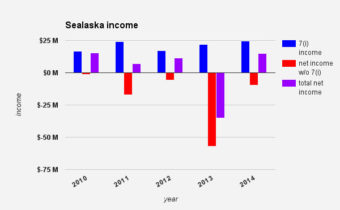
Figures from Sealaska annual reports show no real profits during the past five years. Pooled natural-resource earnings from other regional Native corporations kept all but 2013 out of the red. (Graphic by Jennifer Canfield/KTOO)
Figures from Sealaska annual reports show no real profits during the past five years. Pooled natural-resource earnings from other regional Native corporations, known as 7(i), balanced all but 2013’s budgets. (Graphic by Jennifer Canfield/KTOO)

Could Sealaska make more money, pay higher dividends and make better use of its land? Yes, say some shareholders critical of the Southeast regional Native corporation’s management.
Sealaska’s recently released 2014 financial report shows significant improvement.

The corporation, with about 22,000 shareholders, came back from a $50 million-plus loss the previous year. And it streamlined operations, laying off 150 of its 400 employees. Managers say it’s a significant improvement.

But Carlton Smith, a former board of directors member, says it’s not as good as it seems.

“From a shareholder perspective, I think calling 2014 a turnaround year is a bit of a stretch,” he says.

Smith is a commercial real estate business-owner who ran for the board last year as part of an opposition slate.

He and others point to the fact that Sealaska’s investments and businesses have lost money for each of the past five years.

Financial reports show a profit for all but 2013. But that’s only when other Native corporations’ natural resource earning – which are shared – get added in.

“The central issue here for at least a decade has been the need to replace timber income,” he says.

Sealaska used to make most of its money from logging. But it cut the best trees on much of its property. It’s getting going this year on new timberland, transferred from the Tongass National Forest by Congressional action.

Smith says no one should expect to reach past profit levels.

“We knew volume was going away. We knew that the markets were changing substantially. So the real issue here is, in a more compressed time frame, trying to replace timber income, which as a single strategy, it’s just not going to happen,” he says.

Sealaska managers know that, so they’re looking for new investments. They’re focusing on natural foods, especially seafood, as well as data analytics.

Smith has his doubts.

“A long-standing truism for a successful business is to do what you know. And if those two areas of new investment are contemplated, in my opinion, we need to have expertise in our existing management team to make sure that we’re going to grow it and grow it right,” he says.

He says he doesn’t think Sealaska has that expertise.

“Sealaska took a big hit last year. They took another hit this year. And nothing in this report demonstrates any changes,” says Brad Fluetsch, an investment advisor who runs a shareholders’ Facebook page critical of management. He’s also one of five independent candidates challenging the same number of incumbents for seats on Sealaska’s board of directors.

He says the corporation has fallen far behind a common gauge of financial success.

“What really concerns me is the dramatic drop in investment earnings. The S&P 500 did almost 14 percent last year and Sealaska did barely 4 [percent],” he says.

Fluetsch says, despite cutting 150 jobs, Sealaska still spends too much on its top personnel.

“They paid almost a million dollars or a little over a million dollars in severance bonuses or termination fees. It just demonstrates this board of directors does not value shareholder money,” he says.

“I see that they’ve cut a lot of staff. Other than that, I don’t see any change,” says Mick Beasley, an artist and former board candidate who’s pushed for term limits and other corporate reforms.

Beasley’s all for resource development. But he says Sealaska could do more than log its lands.

“They could have some housing projects on Sealaska land. I look for boat ramps. I like the idea about agriculture, berry farms,” he says.

The corporation is helping develop berry-picking operations in two villages. But managers say it won’t be a significant enterprise.

“As usual, I think the elephant in the room is this discretionary voting,” he says.

Beasley is among those pushing for an end to that practice. It allows shareholders to turn their ballot decisions over to the board.

That favors incumbents and makes it hard for critics – such as Beasley, Fluetsch and Smith – to win elections.

Sealaska points out that it’s a voluntary practice, and one chosen by at least a quarter of shareholders every year.

Sealaska earnings up, but losses continue

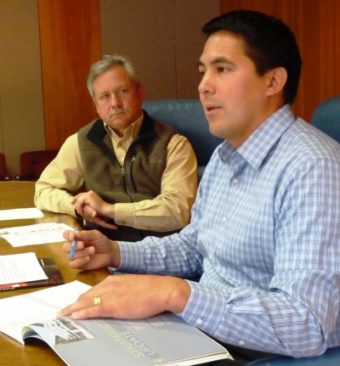
Sealaska CEO Anthony Mallott, right, discusses the regional Native corporation's earnings and losses as Chief Financial Officer Doug Morris looks on. (Photo by Ed Schoenfeld/CoastAlaska News)
Sealaska CEO Anthony Mallott, right, discusses the regional Native corporation’s earnings and losses during a Friday press conference as Chief Financial Officer Doug Morris looks on. (Photo by Ed Schoenfeld/CoastAlaska News)

The regional Native corporation for Southeast Alaska upped its income by $50 million in 2014. Officials at Juneau-headquartered Sealaska say it’s the start of a multi-year recovery.

But critics point to figures showing it’s still losing money.
2013 was a dark year for the 22,000-shareholder corporation.

Its construction company badly underestimated two federal projects, losing more than $25 million. Problems with other businesses more than doubled that amount.

The corporation’s 2014 annual report, which was just released, paints a much brighter picture. It says profits totaled almost $15 million, with growth coming from its service sector.

Sealaska CEO Anthony Mallott says it’s the start of a significant recovery.

“We believe 2014 was a great turnaround that created a stable platform to lead to the progress that we need for the corporation,” he says.

But right now, it’s not looking that bright.

Sealaska still lost money last year. The profit only comes when funds for a shared pool of regional Native corporationsnatural resource earnings is included.

Without that money, from a northwest Alaska mine and North Slope oil development, Sealaska is $9.5 million in the red. Official numbers are lower, because some corporate expenses aren’t counted as losses.

sealaska-annual-report-2015-graph

The result is the smallest amount of business and investment income going to shareholder dividends in about a dozen years.

CEO Mallott says that will change.

“Stable, increasing dividends is what we want to build toward. 2013 will be a drag for a few more years, for sure,” he says.

Sealaska expects growth in its timber subsidiary, which had almost closed down.

Congress last year passed a controversial lands bill turning over 70,000 acres of the Tongass National Forest. Sealaska Timber Corp. is logging its first parcels from that package now, on the Cleveland Peninsula and Prince of Wales Island.

Chief Financial Officer Doug Morris says the timber subsidiary is cleaning up and closing some older logging sites.

“There’s a lot of infrastructure they’re going to put in place, new roads and buying more gear, getting ready for this new life, that they’re going to have going forward, It’ll be profitable but not at the levels we want to see as we go forward,” he says.

Sealaska is in looking to make some significant new investments. It sold off its profitable plastics partnership and a smaller company to help fund new acquisitions closer to home.

Mallott says it’s reviewed at least 100 businesses so far. One area is natural foods.

“We’re looking very closely at the seafood industry. And, of course, the seafood industry can have connections to Alaska and Southeast for sure,” he says.

Officials are also looking at data analytics.

He says the corporation also made internal cuts. It reduced its workforce of 400 by more than a third. And it paid no management bonuses.

Morris says the board of directors also made cuts, including a costly health-care credit.

“They eliminated that as well as put a cap on what their fees can be for the year. So now, they can only make up to their cap, which is below what some of the fees had been over prior years,” he says.

Critics says executives – especially those who retired – were overpaid, an undeserving reward for what they call poor management.

Mallott took over as CEO last June, replacing Chris McNeil Jr., who stepped down. The board reorganized about the same time with a new chairman, Joe Nelson of Juneau.

Five incumbent board members are up for re-election this year. They’re being challenged by an equal number of independents.

Sealaska dividends between $129 and $887

Sealaska Plaza, the corporation's Juneau headquarters. Officials announced the December distribution, the largest in three years.
Sealaska Plaza is the corporation’s Juneau headquarters. Officials 0n April 3 announced the spring distribution to shareholders. (KTOO file photo)

Alaska’s largest regional Native corporation will distribute $12.9 million this month.

Sealaska’s 21,600 shareholders will each get between $129 and $887, depending on their status.

The majority of the payout comes from a shared pool of regional Native corporations’ natural resource earnings. Other funds come from a savings account and corporate operations.

Most eligible Tlingit, Haida and Tsimshian shareholders will get $758. That’s the amount for those belonging to an urban Native corporation, such as Juneau’s Goldbelt.

Those holding stock in village corporations, such as Kake Tribal or Huna Totem, will get $129 each. Descendants of original Sealaska shareholders will see an equal amount.

The difference between the two totals is sent to village corporations. Some pass it on, while others invest it or pay debts.

Eligible elders will receive an additional $129.

The amounts are based on ownership of 100 shares of stock. Some shareholders have more or less, due to inheritance or gifting.

The Sealaska Board of Directors approved the distribution at an April 3 meeting. Payments will be made around April 13. Sealaska is headquartered in Juneau.

A second 2015 distribution is expected around December.

Each spring dividend includes $50 from corporate earnings. The past two payouts have not, due to operational losses.

President and CEO Anthony Mallott says Sealaska continues to recover from the 2013 financial loss.

“We are confident that the significant improvement in financial performance will lead to greater progress, as we remain disciplined and follow our strategic plan toward financial stability,” he said in a press release.

Distribution and Stock Type (from Sealaska)

Type of Stock

Non-Elder Urban and At-Large Shareholders
Elder Urban and At-Large Shareholders
Non-Elder Village and Leftout Shareholders
Elder Village and Leftout Shareholder
Descendant Shareholders

Per Share

$7.58
$8.87
$1.29
$2.58
$1.29

$ Amount Per 100 Shares

$758
$887
$129
$258
$129

New Tongass chief from Southwest U.S.

Earl Stewart will become the top official at the Tongass national Forest in May. (Courtesy USFS)
Earl Stewart will become the top official at the Tongass National Forest in May. (Courtesy USFS)

Southeast Alaska’s Tongass National Forest has a new top official.

Earl Stewart will take over as forest supervisor beginning in May. He will replace Forrest Cole, who is retiring after more than 40 years with the Forest Service.

Stewart is based in Flagstaff, Arizona, where he’s in charge of the Coconino National Forest. He’s never been to the Tongass.

He says he looks forward to overseeing America’s largest national forest, while understanding it attracts frequent attention.

“For me it’s that one opportunity to engage at a level that is far higher than what I’ve had … in the past, to develop new relationships and to expand horizons,” Stewart says.

Stewart’s future boss, Alaska Regional Forester Beth Pendleton, says he’ll be a good fit.

“He brings a wide range of experience and leadership to this position and has a great understanding of the unique relationships that communities have with their national forests, which will suit Alaskans well,” she says.

Stewart’s earlier posts were in Montana, Alabama and Washington, D.C. He began his Forest Service career in 1991, after working as a biologist for Oklahoma’s Department of Wildlife Conservation.

He says he knows the Tongass is different – and that he has a lot to learn.

“I’m going to approach it from a very eyes-wide-open manner, to seek to understand and interpret. And then try to assist in a much more collaborative way than what my experience has been in other situations,” Stewart says.

Stewart says he’s overseen timber harvests, including second-growth, and forest restoration projects.

He will take over Tongass operations as the agency maps out a transition from old-growth to young-growth logging.

It also faces ongoing legal challenges to its timber sales. And it’s adjusting to Sealaska’s takeover of 70,000 acres, including prime timberlands.

Two environmental organizations quickly welcomed Stewart to the Tongass.

“We are encouraged by Stewart’s background as a biologist and his experience leading collaborative restoration projects in other regions of the country that are well suited to meeting the unique needs of southeast Alaska,” says Mark Kaelke, Trout Unlimited’s Southeast Alaska project director.

The executive director of the Southeast Alaska Conservation Council invited Stewart to join her for a fishing trip in Petersburg.

“We look forward to introducing him to our unique way of life in Southeast Alaska and working with him to chart a prosperous and resilient future for our communities,” says Malena Marvin.


Sealaska, BLM celebrate land transfer

Sealaska Building
Sealaska headquarters in Juneau. (Photo by Casey Kelly/KTOO)

Sealaska has taken possession of 70,000 acres that used to be part of the Tongass National Forest.

With photographers snapping pictures, and a roomful of corporate and federal officials looking on, Sealaska President and CEO Anthony Mallott and Bud Cribley from the Bureau of Land Management signed papers transferring title to the Tongass timber lands to the corporation at a ceremony Friday at corporation headquarters in Juneau.

Late last year, Congress passed legislation allowing Sealaska to complete its land entitlement under the 1971 Alaska Native Claims Settlement Act. That ended a decade-plus effort by Sealaska to choose parcels outside the original Native land claims boundaries established by ANCSA.

But Mallott says the process began long before Sealaska’s lands bill was introduced.

“You can take this all the way back to the Tlingit and Haida and Tsimshian leaders who started the (Alaska Native Brotherhood) in the early 1900s,” he says. “You can go to the ‘60s and ‘70s when the original leaders that led ANCSA were being pushed by their communities, by their tribal members for a land settlement.”

Anthony Mallot, Sealaska
Sealaska President and CEO Anthony Mallott. (Photo by Casey Kelly/KTOO)

Cribley, BLM’s Alaska Director, says it’s historic anytime a regional Native corporation can complete its land entitlement.

“This is very important,” Cribley says. “It’s not only important for the Bureau of Land Management as far as being able to move forward with our obligations under the Alaska Native Claims Settlement Act… But it’s just important from a historic standpoint of the significance of that act, and what it is doing for Sealaska and giving certainty for their future.”

Sealaska came close to shutting down timber operations in recent years, as the corporation logged most of its previously conveyed land. The transfer gives Sealaska access to new timber stands and other economic development sites. Company officials have said they may start logging the first of those new parcels this year.

But Sealaska board chair Joe Nelson says the corporation wants to treat the land with respect.

“The land is embedded in who we are,” Nelson said. “And you go to any indigenous people around the world, that makes us unique in the world, our connection to the land.”

Still, the land transfer remains controversial. It’s been opposed by environmentalists, hunting and fishing groups, as well as some communities near Sealaska’s new lands.

During the ceremony, former board chairman Albert Kookesh echoed Nelson’s comments about the importance of the land to Native people. Kookesh told the story of a man from his home village of Angoon, who used an ancient fish weir as proof that Native people will be good stewards of the land.

“If we can take care of that land for 10,000 years and have that fish stream still produce, the deer still be around, the trees still be there, then you have to give us credit for that land that we own, that we’re going to be taking care of it. That we’re going to sustain it. And it’s going to be there for another 10,000 years,” Kookesh said.

The Bureau of Land Management plans to prioritize which of Sealaska’s new parcels get surveyed and patented first to allow the company access to more valuable land sooner than later. It could take about five years to survey and patent all the tracts and another three years to complete the paperwork. But Friday’s signing ceremony officially transferred title to the land.

The legislation finalizing the corporation’s land entitlement also allows Sealaska to select up to 76 cemetery and historic sites in the Tongass, totaling no more than 490 acres. No word on when that process will be complete.

Site notifications
Update notification options
Subscribe to notifications