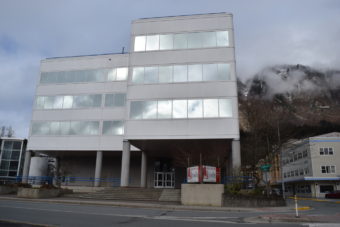
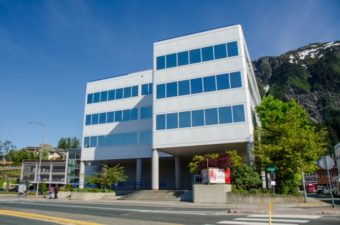
Sealaska Corp.’s headquarters are in Juneau. The regional Native corporation completes its land-selection process Friday. (Casey Kelly/KTOO)
Sealaska Corp. gets its new land on Friday.
The federal Bureau of Land Management will sign paperwork that day turning over 70,000 acres of the Tongass National Forest to the corporation.
The agency’s Ramona Chinn says the land must still be surveyed and patented. But as of Friday, it’s Sealaska’s.
“It’s a milestone for the land-transfer program. Sealaska is one of 12 regions and this would finalize their entitlement,” Chinn says.
Federal legislation passed late last year turned the land over to the Juneau-based regional Native corporation. Sealaska gave up the right to select other lands in Southeast, under terms of 1971’s Alaska Native Claims Settlement Act.
The Bureau of Land Management’s Erika Reed says Sealaska prioritized which of the new parcels it wants first.
“We are going to be able to, we think, depending on the budget, survey the first two priorities this year. But assuming we maintain a stable budget, it will probably take us about five years to survey all 18 parcels,” she says.
The full process will take about eight years.
About 3,400 acres of old-growth forest on the Cleveland Peninsula and Prince of Wales Island’s North Election Creek are at the top of the list.
Sealaska has said logging could begin this year, but it’s not a firm decision. The parcels are near other corporation land with logging infrastructure.
Sealaska can also take over up to 76 tracts of cemetery and other historic sites in the Tongass totaling no more than 490 acres.
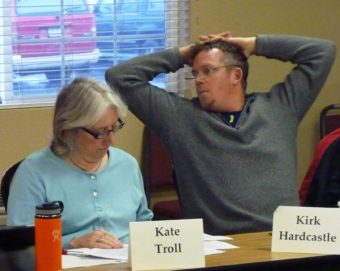
The Forest Service’s Jason Anderson, left, talks with fisherman Kirk Hardcastle, right, while Juneau Assemblymember Kate Troll reviews a report during the Tongass Advisory Committee meeting Feb. 17 in Juneau. (Ed Schoenfeld/CoastAlaska News)
A new forecast says current plans for logging younger Tongass trees will not provide enough wood to maintain the region’s timber industry. But a more aggressive approach might.
Meanwhile, critics continue pushing the Forest Service to focus more on fishing, recreation and tourism during the most recent Tongass Advisory Committee meeting, held in Juneau.
Secretary of Agriculture Tom Vilsack, who oversees the Forest Service, gave Tongass officials a mandate about a year and a half ago.
He told them to develop a plan to move from logging old-growth to second-growth trees over the next 10 to 15 years.
“The current plan does not get you there,” says Wade Zammit, an industry representative on the Tongass Advisory Committee, which is developing recommendations for the young-growth transition.
Zammit and committee environmental representative Keith Rush recently ran numbers on a couple scenarios.
The Nature Conservancy’s Keith Rush discusses a second-growth timber analysis Feb. 17 during the Tongass Advisory Committee meeting in Juneau. (Ed Schoenfeld/CoastAlaska News)
“The models show that in 15 years, if you’re very aggressive on all of the young growth stands, that perhaps enough volume would be available to maintain the current industry,” Rush says.
He says aggressive, in part, means more logging near beaches.
He and Zammit say their analysis shows that could significantly increase the amount of available timber. Part of the secretary’s mandate is to maintain what’s left of the region’s industry.
That’s not what some people want to hear about.
“You guys are talking about relaxing standards and guidelines on beach buffers. … It’s craziness,” says Eric Grundberg, a commercial fisherman in Petersburg.
“And the whole thing is to support an unsustainable export timber industry. I think the time is now to stop old-growth logging and start being realistic about what really drives this region,” he says.
Rush and Zammit’s analysis shows too much weight is being put on pre-commercial thinning, which is supposed to speed growth by reducing competition.
But industry representative Eric Nichols, owner of Ketchikan’s Alcan Forest Products, says it makes no economic sense.
“The people that grow timber professionally for the timber growth, they don’t commercially thin anymore. It ended up costing way more to do it for the bang they got out of it,” he says.
Tree farms thin from an early age, which makes an impact.
But Rush, a conservation forester with The Nature Conservancy in Juneau, says it’s different in the Tongass.
“They’re not going to be growing in a timber stand long enough to recoup the lost volume, so you’re not going to see much of a timber payback,” he says.
The options analyzed included logging in clusters, rather than clearcuts. Different approaches to protecting streams and rivers were also discussed.
Zammit, former Sealaska Timber Corp. president living in Washington state, says the timing was different, but the scenarios worked.
“All of the other options, all the aggressive and the modified and the hybrids, they get you to some place in the 16-20 [year] time frame that pretty much mimics long-range, sustained-yield numbers. It gets you there. The current plan does not get you there,” he says.
A separate analysis, from Oregon consultant Mater Limited, says enough commercially valuable second-growth timber is available now to speed the transition from old-growth logging. Committee members discussed that and other reports reaching different conclusions at their January meeting.
Public testimony to the Tongass Advisory Committee was mostly critical of its direction, especially continued logging of old-growth timber.
Mark Kaelke, Trout Unlimited’s Southeast project director, talked about 77 watersheds needing additional salmon habitat protections.
“I’m guessing some of you would say that taking these watersheds out of the timber pool would amount to yet another lockup of federal lands. But from the way we see it, what it would do is to help lock in the $2 billion of economic contribution this region realizes from fisheries and tourism each year,” he says.
The Southeast Conference, which backs old-growth logging, sees it differently.
Executive Director Shelly Wright says the conversation should include jobs and small communities trying to hang on.
“I don’t think anybody sitting in this room has illusions that we’re going to go back to the glory days of the timber industry. And I don’t think anybody sitting in this room feels like we’re going to go back and mow down all of the old growth in the Tongass either,” she says.
The next Tongass committee meeting is tentatively set for March 25-27.
Sealaska Vice President and General Counsel Jaeleen Araujo, front right, describes Tongass land being transferred to the regional Native corporation under terms of recently-passed legislation. (Ed Schoenfeld/CoastAlaska News)
Sealaska says it will begin logging its new lands later this year.
Federal legislation passed in December turned over 70,000 acres of the Tongass National Forest to Southeast Alaska’s regional Native corporation.
The first two parcels to be cut will be on north Election Creek, on Prince of Wales Island, and the Cleveland Peninsula, north of Ketchikan.
They add up to about 3,400 acres of old-growth forest near land Sealaska’s already logged.
“And those are smaller, but they’re adjacent to some existing operations. So those will probably be the two areas that would see activity first,” says Sealaska General Counsel Jaeleen Araujo, who discussed the plans at the recent Tongass Advisory Committee meeting in Juneau.
The 15-member panel is helping craft the Tongass’ transition from old- to young-growth logging.
Almost all of Sealaska’s Tongass acreage is timber land, split into nine sites, most on or near Prince of Wales Island.
Older forests make up more than half that acreage. About a third is growing back from previous cuts under Forest Service management.
“I was not of the opinion that legislation was going to go forward,” says Forrest Cole, the Tongass National Forest’s top official.
Jason Anderson of the Forest Service and fisheries business owner Kirk Hardcastle listen to a presentation during a Tongass Advisory Committee meeting at Juneau’s Aspen Hotel. (Ed Schoenfeld/CoastAlaska News)
While the Forest Service agreed to the legislation, its passage altered timber sale plans, including on an island off Prince of Wales’ west coast.
“So we basically started a fairly large project on Kosciusko (Island). And now that Sealaska’s happened, we’re going to have to take some of that project out and see if we can pick it up elsewhere on the island,” he says.
Cole says the sale should be planned out by mid-summer. It’s near the community of Edna Bay, which opposed Sealaska’s takeover of the forest lands. A large state timber sale is also planned there.
Araujo says the corporation’s new Kosciusko land, plus additional acreage on nearby Tuxecan Island, contain the largest stands of its new, second-growth timber.
Once the legislation takes full effect, Sealaska will become the state’s largest timber company, by far.
Araujo says it understands its role in the regional economy is changing.
“Obviously, we do provide a benefit to our shareholders, but we also benefit a lot of local businesses where we operate. And a number of contractors do depend on us,” she says.
Southeast Alaska’s timber industry lobbied for the land transfers.
Alcan Forest Products owner Eric Nichols, a Tongass Advisory Committee member, says Sealaska logging will help preserve existing markets.
“It also helps support the infrastructure that’s out there in non-logging: float planes, barges, scaling companies. So all these people now have a little bit better degree of certainty. And hopefully we’ll quit losing so much of our infrastructure that helps support the forest industry here in Southeast,” Nichols says.
“Anytime our public lands are taken out of public hands, it’s a cause for concern for everybody across the country,” says Andrew Thoms, executive director of the Sitka Conservation Society and another advisory committee member.
He hopes Sealaska will sell its timber to regional mills. Now, it’s stripped of branches and sold as logs, mostly overseas.
“The old-growth resource that we have on the Tongass is limited. And it’s a shame when we see it exported overseas in the round without any processing or manufacturing in the region. And once that old-growth resource is gone, it’s gone,” he says.
Sealaska cites a study showing its log-preparation work provides jobs to about as many people as processing in mills.
But Araujo says it will look harder at in-state sales, forest restoration and other issues that come with taking over 70,000 acres of the Tongass.
“Our board wants to better understand mitigation, wants to better understand domestic processing, wants to better understand how we can maybe become our own contractor. There’s just a lot of things that we’re looking at now that this has happened,” she says.
Almost 98 percent of the acreage being transferred is timberland. About 1.5 percent is for other economic development, including energy production. The remainder includes about 75 cemetery and historic sites.
More responses to the Tongass transition are available online:
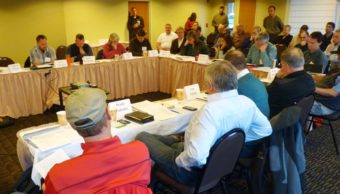
Tongass Advisory Committee members discuss timber transition issues while audience members watch during a Jan. 20 meeting at Juneau’s Aspen Hotel. (Ed Schoenfeld/CoastAlaska News)
Members of the Tongass Advisory Committee are unhappy with U.S. Forest Service efforts to speed up their work.
The 15-person panel is meeting in Juneau this week to help plan a transition from old-growth to young- or second-growth timber harvests.
The committee’s charter calls for two years of work, which began in 2014. But members have been asked to provide at least partial recommendations by early March. That would likely be done at its Feb. 18-20 meeting in Petersburg.
Timber industry representative Wade Zammit says that’s not long enough.
“Given the amount of time invested by this group and the risks we’re taking in some of the discussions we’re having made me feel we’re going to push ourselves into a bad decision,” he says.
Tongass Advisory Committee industry representative Wade Zammit discusses forest transition issues during a Jan. 20 meeting at Juneau’s Aspen Hotel (Ed Schoenfeld/CoastAlaska News)
Zammit is the former president of Sealaska Corp.’s timber business.
In an interview before the meeting, the Forest Service’s Jason Anderson said the panel has the full amount of time to do its work. But he said it’s also been asked to develop recommendations for a larger Tongass management plan revision with an earlier deadline. And the committee accepted that challenge.
“There’s some delicate balancing between the two processes to make sure that the agency is poised to receive their recommendations in a timely way and be responsive to it and also for the committee to stay focused on the charter and achieve their objectives,” he said.
Zammit drafted a letter to U.S. Department of Agriculture Secretary Tom Vilsack arguing against the earlier deadline. Vilsack oversees the Forest Service and told the agency to make the transition from old- to young-growth logging.
Other advisory committee members expressed general support for Zammit’s approach at the Juneau meeting. The letter is a document signed by individuals, not the group as a whole.
Zammit says the committee’s work is too important to compress.
“If we start time-driving some of these very critical discussions, we’re likely to put ourselves in corners and not come up with a good solution. And our goal with this group is to come up with a solution that has been eluding the Tongass for 40 years,” he said.
The panel is deliberating a number of recommendations during the Juneau meeting.
Native art expert and teacher Steve Brown created the formline on the glass awnings encircling the Walter Soboleff Center. (Photo by Lisa Phu/KTOO)
Sealaska Heritage Institute begins moving into the new Walter Soboleff Center. (Photo by Lisa Phu/KTOO)
A clan house in the middle of the Walter Soboleff Center will feature art by David A. Boxley and Preston Singletary. (Photo by Lisa Phu/KTOO)
Tlingit carver Wayne Price textured the clan house cedar with an adze. (Photo by Lisa Phu/KTOO)
Tony Harding moves boxes out of the current Sealaska Heritage Institute office on the third floor at One Sealaska Plaza. Sealaska Corp. is looking for a tenant to fill the space. (Photo by Lisa Phu/KTOO)
A view of the first floor. (Photo by Lisa Phu/KTOO)
The Walter Soboleff Center is not open to the public yet. The grand opening is May 15. (Photo by Lisa Phu/KTOO)
The Sealaska Heritage store will be located on the first floor of the building. (Photo by Lisa Phu/KTOO)
Sealaska Heritage Institute started moving into its new home in the yet-to-be-opened Walter Soboleff Center this week.
“Next door will be our new home,” Kadinger says from his current office at One Sealaska Plaza. “So every time you hear we’re having a Native Lecture Series, it’ll be at Sealaska Heritage. Every time you hear that we’re having weaving classes, it’ll be at Sealaska Heritage. Everything that we do isn’t going to be scattered around in different places or classrooms or meeting rooms; it’ll be at Sealaska Heritage.”
The building will have space for art exhibits, demonstrations and education. The main collections vault will be in the basement, the retail shop on the first floor, Sealaska Heritage offices on the second and office rental space on the third.
In the very center of the building, visible as soon as you enter, is a traditional clan house.
“If we want to have lectures in there, if we want to have presentation in there, if we want to have smaller performances in there – it’s really a flexible space. It’s a multiuse space and it’s an educational space,” Kadinger says.
The clan house front will be carved and painted by Tsimshian artist David A. Boxley. The inside will feature a carved glass house screen and two house posts depicting Eagle and Raven warriors made by Tlingit glass artist Preston Singletary.
Other permanent art work includes 40-foot panels by Haida artist Robert Davidson that will go on the building’s cedar-clad exterior.
Formline design expert Steve Brown created the glass sidewalk awnings that are already installed.
Having raised around $20 million for the construction of the Walter Soboleff Center, Sealaska Heritage continues to fundraise for added artwork and exhibits. Kadinger says more than a thousand individuals, businesses and organizations have already donated.
Sealaska Plaza is the regional Native corporation’s Juneau headquarters. (Heather Bryant/KTOO)
A bill transferring about 70,000 acres of the Tongass National Forest to Sealaska has passed Congress.
The measure is attached to the National Defense Authorization Act, which is on its way to the President’s desk after a Senate vote.
The legislation completes the Southeast regional Native corporation’s land selections, promised by the 1971 Alaska Native Claims Settlement Act.
Sealaska could have chosen other lands earlier. But this bill gives it access to more valuable timber stands, economic development locations and heritage sites.
Sen. Lisa Murkowski, who authored the measure, says it will help more than Sealaska.
“You also have the aspect of the economic benefit that is conveyed when these lands, that were in federal hands, are now transferred for an opportunity for increased recreation, tourism and also for economic interests such as timber harvests,” she says.
Critics have called the bill a giveaway that will damage fish and wildlife habitat. It’s been strongly opposed by environmentalists, sportsmen’s groups and communities near potential logging sites.
“Sealaska Inc. and Southeast Alaska’s other ANCSA corporations have already picked over those areas, taking the best timbered areas,” says the Greater Southeast Alaska Conservation Community in a statement posted online. “Now, Sealaska wants to cast off the rest, for more of the best elsewhere.”
The corporation has come close to shutting down its timber division in recent years, as it’s run through forests on earlier land selections.
“This is a monumental step to achieve our strategic plan of growth and profitability while maintaining important cultural priorities,” said Sealaska President and CEO Anthony Mallott, in a press release.
Murkowski, interviewed after the vote, says she hopes the bill will help turn around the industry.
“I hope it’s not too little too late. It has been a long, long time in coming. If you haven’t had an opportunity to visit with anyone in Southeast lately, it’s pretty skimpy down there,” she says.
Rep. Don Young sponsored the bill’s original version. Sen. Mark Begich co-sponsored Murkowski’s legislation.
Close
Update notification options
Subscribe to notifications
Subscribe
Get notifications about news related to the topics you care about. You can unsubscribe anytime.