Alaska Native Corporations

Sealaska dividends funded by other Native corporations

Sealaska's distribution to its 22,000 shareholders ranges from $1,182 to $131 each. (Graphic courtesy Sealaska)
Sealaska’s December distribution to its 22,000 shareholders ranges from $1,182 to $131 each. (Graphic courtesy Sealaska)

Sealaska will distribute $17.5 million in dividends to its 22,000 shareholders on Dec. 3.

More than 60 percent will receive $1,051. Most of the rest will get around $131.

The difference is a payout from a statewide pool of other regional Native corporations’ resource earnings. Urban shareholders get it directly, but village and new shareholders don’t.

Sealaska CEO Anthony Mallott, right, discusses the regional Native corporation's earnings and losses as Chief Financial Officer Doug Morris looks on. (Photo by Ed Schoenfeld/CoastAlaska News)
Sealaska CEO Anthony Mallott, right, discusses the regional Native corporation’s finances earlier this year. (Photo by Ed Schoenfeld/CoastAlaska News)

The dividends are mostly funded by other regional Native corporations’ resource earnings, though officials at the Juneau-based corporation said that will change. Sealaska CEO Anthony Mallott said the pool, known as 7(i), is expected to shrink.

“The 7(i) income we receive is very tied to commodity pricing. And the two main commodity prices that affect the 7(i) we see is oil prices and zinc prices. And both of them have been pretty significantly hit in this recent commodity price decline,” Mallott said

About 8 percent of the larger dividends come from Sealaska’s permanent fund. Around 5 percent comes from operations, which sounds like the corporation’s own earnings. But at this point, Mallott said most of that money also comes from the resource earnings pool.

Sealaska has been trying to bounce back from a $57 million operational loss since 2013.

The recovery plan is to buy a controlling interest in one or several seafood, government services or other businesses with growth potential.

“Putting our investment capital to work is going to be one of the only significant solutions to deal with any decline in 7(i). We understand that pressure, but we still want to keep to a process where we are comfortable that we’re making the right decision,” he said.

Mallott said Sealaska continues researching potential purchases. He said it’s negotiating with about a half-dozen companies, though he didn’t say what they are.

The Sealaska shareholders getting larger, $1,051 dividends are also enrolled in an urban Native corporation, such as Juneau’s Goldbelt. They get the 7(i) part of their payment directly.

Those also enrolled in village corporations, such as Saxman’s Cape Fox, may or may not. The money is sent to the village corporations, which decide whether it should be distributed to shareholders.

Shareholder descendants receive the smaller, $131 amount, as do those called “leftouts.” Registered elders receive an additional $131.

Totals are based on an average ownership of 100 shares. Some shareholders have more or less – or a mix of share types – due to inheritance and gifting.

Victory for Sealaska Heritage underscores weakness in the law

Federal investigators have found that the country’s oldest theological college broke the law regarding its Native art. Andover Newton Theological School planned to sell off 80 pieces in its collection, including a sacred Tlingit halibut hook. Now some tribal leaders are wondering if repatriation laws should be tougher.

Rosita Worl has been fighting against the school’s Native art liquidation since June. She’s the president of Sealaska Heritage Institute and also served on the Native American Graves Protection and Repatriation Act (NAGPRA) review committee.

Worl said the feds’ decision was bittersweet. It reaffirms the private college is subject to the law because it receives federal student loans.

“We were happy that the federal government did find that they were obligated to comply with NAGPRA, but I was also saddened that we had to spend all of that time and effort to force them to comply with NAGPRA,” Worl said.

Back in July, the school’s president Martin Copenhaver claimed that the items in the collection weren’t sacred. Turns out, that’s wrong. David Katzeek, a Tlingit tribal member, identified the halibut hook as a sacred object that was used in religious ceremonies.

Copenhaver couldn’t be reached for comment, but the college has 45 days to contest the decision.

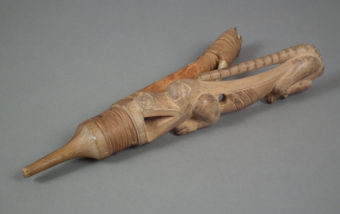
This Tlingit halibut hook with a wolf spirit was slated for auction. (Photo courtesy of Karen Kramer/Peabody Essex Museum)
This Tlingit halibut hook, Gooch Kuyéik Náxw, was slated for auction. (Photo courtesy of Karen Kramer/Peabody Essex Museum)

“To the best of my knowledge, we haven’t received any request for informal discussion and there has been no request for hearing at this time,” said David Tarler.

Tarler works at the NAGPRA office in Washington D.C. He said the college has reached out for “technical assistance,” but it should have filed a summary of its Native art years ago, which allows the tribes to see what’s in the collection.

Andover Newton might not be the only institution skipping this step. Worl says the process can lead to oversights.

“There’s no real teeth to the law,” she said. “If I didn’t file my income tax, you could be certain I would be hearing from the federal government and there would be immediate action to comply with the law. In the case of NAGPRA, we don’t have similar kinds of requirements.”

Because of this, the Alaska Federation of Natives recently passed a resolution. A group will work on proposing amendments to NAGPRA. They’ve already reached out to the congressional delegation.

Worl says the changes are necessary. Repatriation can be a long and costly endeavor for the tribes.

“In one case, I would say that we expended over a hundred thousand dollars in just direct expenses. With lawyers, other anthropologists compiling evidence,” she said.

And she says the NAGPRA laws are more than 20 years old.

“When museums and scientists were less sympathetic to Native American beliefs.”

Worl thinks there’s been a cultural shift. Recently, the Northern Light United Church sent a letter to Andover Newton Theological asking the school to return the sacred items. And with the advancements, she says the law should adapt, too.

“I do believe that we have a younger group of scientists and museum professionals with a greater understanding of Native American beliefs. I’ve seen this happen all around the country,” she said.

Worl hopes this case will encourage other schools and museums to step forward with their Native collections.

She says there are more legal hoops, but the Tlingit halibut hook is one step closer to coming home.

Workshops at Elders and Youth Conference aim to connect, educate

Xeetli.eesh Lyle James, a group leader for the Woosh.ji.een dancers in Juneau, teaches a small crowd of young people during a break out session at the Elders and Youth Conference in Anchorage. (Photo by Jennifer Canfield/KTOO)

IndiGenius  — a play on the word indigenous — is an offering of afternoon workshops every year at the First Alaskans Institute’s Elders and Youth Conference.

“We have storytelling, we have drum making, we have weaving, and in some cases you’ll have elders teaching youth and in other cases youth teaching elders,” said Emily Tyrell, sustainability director for the First Alaskans Institute. “It’s this transference of knowledge whether it’s elders to youth or youth to elders.”

Two years ago, The CIRI Foundation helped FAI acquire more funding for the workshops. Conference participants had asked in previous years for more opportunities to connect and learn through art, and so that’s what the extra funding went to.

Tyrell said it’s important for the youth to embrace their culture’s strengths.

“Oftentimes we hear this message that our people are overloaded with these terrible statistics: high suicide rates, domestic violence,” she said. “Yes, those statistics are true, but there is also a message that we bring forward through our work that we are a beautiful vibrant people and we’ve been on these lands for the last 10,000 years.”

The CIRI Foundation's President and CEO Susan Anderson (right) and Program Officer Nadia Sethi. (Photo by Jennifer Canfield/KTOO)
The CIRI Foundation’s President and CEO Susan Anderson (right) and Program Officer Nadia Sethi. (Photo by Jennifer Canfield/KTOO)

Susan Anderson, president and CEO of The CIRI Foundation, said the idea is that traditional arts give elders and youth the chance to talk about current issues and concerns in the context of an activity their ancestors also took part in.

“It’s about helping people know who they are culturally and through heritage as well as helping them to then succeed in their educational path,” Anderson said.

One of the first agreements attendees at the annual Elders and Youth Conference make is to participate. “In every chair, a leader,” is a mantra repeated throughout by institute staff. Attending IndiGenius workshops is a step toward fulfilling the mantra.

The agreement means a number of things: It calls on participants to actively engage with others and to listen carefully, to speak respectfully and to be open to learning. It guides participants through a series of discussions and activities aimed at fostering communication between the generations and instilling confidence in the younger ones.

There are dozens of workshops to choose from and participation is not limited to Alaska Natives or just elders and youth. Tyrell says the general public is encouraged and welcome to join the conference, which goes until Wednesday morning.

Theology school calls off Native art sale amid investigation

This Tlingit halibut hook with a wolf spirit was slated for auction. (Photo courtesy of Karen Kramer/Peabody Essex Museum)

A Massachusetts college that planned to liquidate its Native art collection has called it off. The pieces are from 52 tribes, including Tlingit and Haida items that might be sacred. Now the country’s oldest theology school could get dinged with penalties as feds investigate.

Over the summer, the Andover Newton Theological School, or ANTS, quietly decided it would sell 80 pieces of Native art from their collection. But their plans didn’t stay quiet for long. The museum that’s housed the collection since the 1940s alerted hundreds of tribal leaders.

Sealaska Heritage Institute was one of the organizations contacted because the school intended to auction off a Tlingit halibut hook, an item that SHI President Rosita Worl says is sacred.

“The halibut hook has spiritual dimensions to it and in this particular case, we have a halibut hook with a wolf,” she said.

Worl believes the school also has a Southeast shamanic doll. If a college or museum receives federal funds, then federal law dictates that certain items in their collection are subject to repatriation.

So, how did Andover Newton wind up with such a vast collection of Alaska Native, Native American and Hawaiian art?

“It was through their own missionaries going out into the field and collecting objects. Like, I tell the story over and over again … they collected our sins,” Worl said.

What those missionaries considered “sins” could fetch the college a million dollars now if the legality of the sale hadn’t come into question.

Peabody Essex Museum President Dan Monroe says the school was confused from the jump. It didn’t file an inventory or summary providing tribes with information. And the college assumed the museum could cherry-pick what was subject to the law, but only tribes have say in that.

“No other party can make those identifications,” Monroe said.

Even so, the school claims that information came from Peabody Essex. Monroe lets out a big laugh before responding.

“OK. Number one: we could never tell them what objects in their collection are subject to NAGPRA. … Because we have no standing in the law and we perfectly well understand that,” Monroe said.

NAGPRA is the Native American Graves Protection and Repatriation Act.

In 2009, Monroe says the Onondaga Nation asked the school to give back a wampum belt. The school denied the request. As a private college, it thought it wasn’t subject to the law. But here’s the problem with that: some students pay their tuition with Stafford loans, which are funded by the government.

This tunic was repatriated from a museum in 2007. Although it's of Southeast origin, the tribe is unknown. (Photo by Elizabeth Jenkins/KTOO)
This tunic was repatriated from a museum in 2007. Although it’s of Southeast origin, the tribe is unknown. (Photo by Elizabeth Jenkins/KTOO)

“If the institution receives federal financial assistance, whether directly or indirectly, that would be receipt of federal funds,” said David Tarler.

Tarler works at the NAGPRA office in Washington, D.C. He said the school is being investigated, and in this case penalties can range from $5,000 for each failure to comply up to about $21,000, or .25 percent of the school’s annual budget — whichever is less. Then there are aggravating circumstances, like previously denying a tribe’s claim.

Monroe says he’s still not sure if the college gets it.

“On the plus side, they’ve made the commitment not to sell objects; they’ve made a commitment to comply with  NAGPRA and those are admirable and very positive decisions on their part,” he said. “Regardless of the means of how they arrived at them.”

Martin Copenhaver, the school’s president, said he was too busy to comment but forwarded a letter that said “we will proceed to repatriate artifacts … if feasible and appropriate ways can be found to do so.”  

“I mean, that sent up a red flag to me,” Worl said. “When I read that, ‘if feasible and appropriate.’ What does that mean? It should be if it complies with the law. Who makes that determination? If it’s feasible?”

Aside from the law, she says there’s a larger underlying issue the school doesn’t seem to understand about the collection.

“They keep referring to them as artifacts and they’re not artifacts. They’re at.oow. They’re living things to us; they’re spiritual things to us,” Worl said.

Andover Newton Theological School did recently reach out to the Onondaga about the wampum belt, Worl said. But Southeast tribes are still waiting.

Clarification: we’ve reworded details about how the school may be fined.

How to voice a story at 60 mph, 300 feet off the ground

For the first time last month, Hoonah hosted an 8.3-mile footrace called J’eet’s Challenge. The course begins near sea level, runs through town and then up a mountain to the finish line.

The race winners lit mountaintop signal fires, echoing events from a Tlingit story. From there, runners hopped into harnesses and ziplined back down to Icy Strait Point, which is Huna Totem Corp.’s salmon cannery turned tourist attraction.

The winner's of the 2015 J'eet's Challenge race in Hoonah light signal fires near the finish line, Aug. 29, 2015. (Photo courtesy Icy Strait Point)
The winner’s of the 2015 J’eet’s Challenge race in Hoonah light signal fires near the finish line. (Photo courtesy Icy Strait Point)

The run and zipline ride were part of Icy Strait Point’s annual neighbor’s day event, a package daytrip out of Juneau that I took part in.

“One, two, three, enjoy the ride, bye-bye.”

That, followed by the clanging of mechanical metal gates swinging away where I just had my feet propped was the last thing I heard before the whoosh of speed and air drowned out most sound.

I was ziplining — and attempting to voice a story — on one of six parallel lines running down a mountain in Hoonah. They’re among the longest continuous spans of zipline in the world, taking riders 1,300 vertical feet down over about a mile of galvanized steel. Cruising down at about 60 mph, the ride back to sea level is over in about 90 seconds.

The view from the Icy Strait Point ZipRider. (Photo by Jeremy Hsieh/KTOO)
The view from the Icy Strait Point ZipRider. (Video still by Jeremy Hsieh/KTOO)

What does voicing a story at 60 mph, 300 feet off the ground look like? Find out in this video.

In 2014, about 13,000 people rode the Icy Strait Point ZipRider, generating an estimated $1.6 million in revenue. That’s according to Terra-Nova LLC of Utah, which built it in 2007.

Until 2014, it was the longest zipline in the world. That’s when another Terra-Nova-built zipline opened that’s a mile and half long in Mexico’s Copper Canyon.

A Icy Strait Point sign still claims the zipline to be the longest in the world. (Photo by Jeremy Hsieh/KTOO)
An Icy Strait Point sign still claims the zipline is the longest in the world. (Photo by Jeremy Hsieh/KTOO)

Nowadays, there’s still some Icy Strait Point advertising and signage around calling it the “longest” zipline in the world, but it’s being phased out and replaced with the world’s “largest” zipline.

Tyler Hickman, vice president of operations at Icy Strait Point, explained the distinction.

“We have six cables that are side by side. And each cable is 5,330 feet, each. So each cable is over a mile long. … The one claim that is absolute is we have the most rideable cable in the world. Six miles of cable, nobody even comes close to that.”

Hickman was one of 89 runners to take J’eet’s Challenge. He says 187 people rode over from Juneau for neighbor’s day, their biggest turnout ever.

The runners just before starting the inaugural J'eet's Challenge race at Icy Strait Point. (Photo courtesy Icy Strait Point</a?)
The runners just before starting the inaugural J’eet’s Challenge race at Icy Strait Point.
(Photo courtesy Icy Strait Point)

Hickman says he’s probably zipped down more than 100 times, and every time is still awesome.

At the end of my first ride, a series of springs on the line cushion the abrupt impact. Metal twangs, my harnessed legs swing up toward the sky for a moment, then gravity reclaims them.

As I hop out of my harness and put my feet back on terra firma, the other riders and I cheer in a flurry of satisfaction.

The end of the Icy Strait Point ZipRider. (Photo by Jeremy Hsieh/KTOO)
The end of the line. (Video still by Jeremy Hsieh/KTOO)

As the final dock pilings are drilled, a Hoonah controversy is put to rest

The location of the new dock at Icy Strait Point. (Photo by Elizabeth Jenkins/KTOO)

The final pilings for a new cruise ship dock are being driven at a Hoonah tourist attraction, marking an end to the nearly decade-long saga that divided the community. The publicly financed dock is being built where it serves a local Native corporation’s interests, only indirectly benefiting residents — although many are also shareholders.

On the grounds, tourists wander in and out of a historic salmon cannery turned museum. They skim the treetops on more than a mile of zipline and bask in front of a crackling wood fire that an employee keeps going.

Tyler Hickman is the vice president of Icy Strait Point, owned by the Huna Totem Corp. He says it’s important to maintain the cannery’s off-beat charm.

“It just starts feeling fake when you overdo something,” he says. “We try to make sure that everything we do is authentic.”

A tender boat picks up passengers to be brought back to ship. (Photo by Elizabeth Jenkins/KTOO)
Tender boats drop off passengers from the ship. (Photo by Elizabeth Jenkins/KTOO)

Part of that is making sure visitors feel comfortable when they arrive and leave. About 150,000 cruise ship passengers travel to Hoonah each year. To get to Icy Strait Point, they have to schlep over on a small tender boat. There’s no place for the big ships to dock.

Hickman points to 60 people on a cruise ship waiting for a tender to transport them to shore. In the future, he says, those passengers will be able to grab their raincoat and wander off the boat on their own.

From there, they could walk through second-growth forest. Not everyone is as enchanted with the location of what Hickman estimates is a $22 million dock, paid for primarily by a grant from the state.

Ken Skaflestad is a shareholder in the Native corporation. He says before the cruise ships started arriving back in 2004, the village felt like a different place. Its population was around 750.

“I remember a day when somebody might wear their pajamas down to pick up the newspaper or groceries on a Saturday morning. If a cruise ship’s in town, that’s changed now,” he says.

An employee in uniform answers tourists questions about halibut being wheeled around the boardwalk. (Photo by Elizabeth Jenkins/KTOO)
An employee in uniform answers tourists questions about a real halibut carted around the boardwalk. (Photo by Elizabeth Jenkins/KTOO)

A mile past Icy Strait Point’s traffic gate is the city of Hoonah. Tourists shuttle through for bear watching tours and to ride the zipline.

Back in the mid-2000s, the city proposed a multi-use dock located closer to the city center.

“This commercial dock that was going to help with barging, that was going to help with freighting, was going to be a place for fishing boats to tie up to,” he says.

Cruise ships weren’t the main focus, but Skaflestad says the conversation shifted after the success of Icy Strait Point as a tourist destination. A public-private partnership was created. The state put in $14 million to build the dock; the corporation put in $8 million. Although the inclusion of cruise ships was decided, the location of the dock wasn’t.

Skaflestad says the Icy Strait Point developers disagreed with where the community wanted the dock, which was about 800 feet toward town from their existing facility.

The city selected Shaman Point. He says the argument became not only about where it should be, but also what: a multipurpose dock close to downtown or a cruise ship dock on private land.

“I can say that I was one … that adamantly took opposition to that whole initiative.”

And the town, he says, was split down the middle.

“I refer to it as World War III. It was horrible,” he says.

A Royal Caribbean executive sent a letter to the city stating that if the dock was built at Shaman Point, cruise lines might not moor there. Skaflestad says the cruise ship passenger experience outweighed the community’s interests in the dock.

“The opinion of the customer’s experience was touted to far outweigh the community’s need to all of the other uses other than a cruise ship dock,” Skaflestad says.

(Photo by Elizabeth Jenkins/KTOO)
Tourists explore the grounds of Icy Strait Point. (Photo by Elizabeth Jenkins/KTOO)

Eventually, the city council turned over. A new mayor was elected and it was decided the dock would be built at Icy Strait Point. Skaflestad says he never did agree with how everything went down. But when he became mayor in 2014, he wanted to make the best of it.

“I had to really work to be open minded about this and listen to the other points of view. The other opinions were that right now the important thing is the development of this industry and that those other uses are really relatively small uses. They’re not going to be big booms to our economy or anything,” he says. “Truthfully, this dock, it’s primarily income that’s  going to come through the cruise ships.”

As the final pilings go in, Tyler Hickman says there’s no need to discuss what happened in the past.

“To me, it’s about today. When you go and walk around the corner, it’s being installed where it is and it’s in the right place,” Hickman says. “The experience the cruise ship guest is going to have is going to be the best in the world.”

The new dock could attract more cruise lines such as Disney, which would mean more visitors to Icy Strait Point and Hoonah.

Skaflestad says he’s trying to be welcoming. He leads the bear watching tours when they get overbooked. He says before, the locals just wanted the tourists to pass right through.

“This metamorphosis has happened and the town is saying ‘I can make a buck here,’ ‘Hey, I’m finding a little niche over here,’ or ‘I’m just going to sit here like I used to sit and watch the birds on the beach and now I’m going to watch tourists,'” Skaflestad says. “There’s this significant change that the presence of these visitors has brought to Hoonah.”

The dock is expected to be completed in October just as Icy Strait Point closes for the season.

Site notifications
Update notification options
Subscribe to notifications