Alaska Native Corporations

Congress OKs Coast Guard bill to transfer lands

Congress has approved a Coast Guard bill that includes several land transfers Alaska’s congressional delegation has pursued for years.

One of them is at Point Spencer, to advance the possible construction of an Arctic deepwater port near Nome. Bering Straits Native Corp. hopes to develop the port, in partnership with the state of Alaska.

The bill cleared the U.S. House earlier this week.

It also includes a land handover in Tok, to allow the Tanana Chiefs Conference to continue running a counseling center, and transfers federal property to village corporations in the Pribilofs.

The legislation continues the effort to acquire a new icebreaker. An amendment co-sponsored by Sen. Dan Sullivan authorizes another $14 million toward the billion-dollar project.

The bill now goes to the president for signature.

Nunavik Inuit mourn the passing of Juneau mayor Greg Fisk

Recently deceased Juneau mayor Greg Fisk was a senior negotiator on the James Bay and Northern Quebec Agreement, an agreement analogous to the Alaska Native Claims Settlement Act. Makivik Corp. just released a documentary on the signing of the agreement, which featured interviews with Fisk. (File image courtesy of Nunatsiaq News)

Makivik Corp. is mourning the death of one of the negotiators of the James Bay and Northern Quebec Agreement.

Greg Fisk, an Alaskan consultant and politician, died at his home in Juneau, Alaska this week. He was 70 years old.

“I’m in shock,” said Senator Charlie Watt, who first met Fisk in the early 1970s.

“When I met Greg more than 40 years ago I saw a person who was motivated and not a submissive person,” Watt said. “He’s definitely in the history books of the Inuit of Nunavik.”
As president of Makivik’s predecessor, the Northern Quebec Inuit Association, Watt hired Fisk during a trip to Alaska to study the Alaska Native Claims Settlement Act in the early 1970s.

Fisk’s experience with the land claim as a consultant for Arctic fisheries made him a natural fit for the NQIA at the negotiating table.

Fisk’s death comes just weeks after the 40th anniversary of the signing of the JBNQA, and the release of Makivik-produced documentary on the land claim process.

Fisk actually flew to Montreal last summer to be interviewed in the film Napagunnaqullusi, which was recently premiered in Kuujjuaq and Montreal.

“Many of our youth are just learning about the trail blazers who negotiated our land claims agreement in 1975,” said Makivik president Jobie Tukkiapik in a Dec. 2 release.

“To hear one of the negotiators has died during this time is unexpected and we want his family in Alaska to know his legacy in Canada will live on.”

Fisk had only just been elected to serve as mayor of Juneau, when he was discovered dead in his home Nov. 30. His cause of death has yet to be determined.

Republished with permission from Nunatsiaq Online, a news service based in Iqaluit, Nunavut
Read Original Article – Published December 02, 2015 – 1:15 pm
Nunavik Inuit mourn the passing of a land claim negotiator

Nome Native corporation sells mining equipment, reclaims land

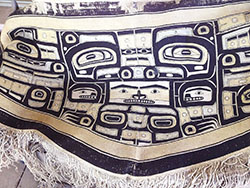
Muskox grazing on the reclaimed land of Rock Creek Mine. (Photo courtesy of Bering Straits Native Corporation)

It’s been a long and unproductive road for the Rock Creek Mine. But now that it’s being liquidated, money will finally flow into the pockets of its current owner, Bering Straits Native Corporation.
The mine was originally owned by Canadian mining company NovaGold and operated by its subsidiary, Alaska Gold. It opened briefly in 2008 before shutting its doors just months later. In the two years of preproduction and the two months of actual production, the mine went more than $20 million over budget, lost two of its workers in a construction-related accident, and violated the Clean Water Act, resulting in over $800,000 in federal fines.

There was a glimmer of hope that the mine’s doors would reopen when Bering Straits bought it from NovaGold in 2012. CEO Gail Schubert told KNOM in an interview at the time of the purchase that they planned to bring the mine back into production, albeit on a much smaller scale.

“Economic development opportunities are few and far between in rural Alaska and given the fact that this mine site has already been developed that NovaGold put several hundred million dollars into developing this site we just really felt that it was a good opportunity and kind of our responsibility to look closely at it to see whether it couldn’t be made operational,” Schubert said.

At the time, Schubert hoped the mine could be an economic engine for the region.

“You know we want to be able to provide some jobs and other opportunities to our shareholders and descendants and other folks that live in the region,” she said.

But what they hoped would be a source of revenue for locals, turned out instead to be a continuation of cleanup and reclamation. Now, it seems that along with ridding the land of toxins, Bering Straits will also be clearing out the facility’s interior. A news release published by another Canadian mining company, Almaden Minerals, revealed that it was entering into an agreement with Bering Strait to purchase much of the mine’s equipment.

Almaden will pay Bering Straits $6.5 million for the equipment over the next 30 months. Jerald Brown, Bering Straits’ vice president of Nome operations, has been working on the sale for a little over a year and says the initial investment in the failed mine turned out to be quite profitable.

“We’ve actually recovered 100 percent of the purchase price to date without including the proceeds from selling this equipment so it actually was a very good investment decision that Gail Schubert worked on a negotiated,” Brown said.

Along with the profitability of the purchase, Brown is optimistic that the land will eventually give back to Nome though this time in a different way.

“The land will be reclaimed, in fact, it already has been, and it will go back to being an area where people can go berry-picking and look at the muskox and everything they were doing before the mine was there,” Brown said.

The mine’s used equipment will be shipped south, where it will be put to work at a gold mine in Mexico.

Chilkat robe returning to Southeast

Sealaska Heritage Institute has acquired a Chilkat robe that was to be auctioned off on eBay on Wednesday. After the seller learned the robe was a sacred item, he allowed SHI to purchase it at the reserve price of $14,500. There were already multiple bids.

The Chilkat robe is a Raven design and measures just over five feet wide. (Photo by
The Chilkat robe is a Raven design and measures just over five feet wide. (Photo by George Blucker)

Typically, these objects can fetch upwards of $30,000.

The seller, George Blucker, bought the robe at an Illinois flea market 25 years ago. He thought it was a fake, but that seller told him it was purchased at an estate sale and had been brought back sometime after the Yukon gold rush.

The clan of origin is unknown. The robe is a Raven design and appears to be funerary object.

In a statement, Blucker said when he learned the robe had “religious significance” and a “spiritual presence,” he knew it needed to return home.

SHI expects the robe to arrive in Juneau later next week.

Tlingit leader Robert ‘Bob’ Loescher dies at 68

Former Sealaska CEO and longtime Native rights activist Robert “Bob” Loescher has died at the age of 68.

Robert 'Bob' Loescher speakers during a meeting in June of 2011. The former Sealaska CEO dies at the age of 68. (Photo by Ed Schoenfeld/CoastAlaska News)
Bob Loescher speaks during a Juneau meeting in June of 2011. The former Sealaska CEO has died at the age of 68. (Photo by Ed Schoenfeld/CoastAlaska News)

Loescher worked for the Southeast Alaska regional Native corporation for about 25 years. He became Sealaska’s CEO in 1997, a job he held until 2001.

“Bob’s mentoring nature and passion for Native land ownership and management had a profound impact on Alaska’s natural resources. He supported state policy that was guided by science and research,” Sealaska CEO Anthony Mallott said in a press release.

Loescher served on the Juneau Assembly in the early 1970s.

He also held leadership roles in the Central Council of Tlingit and Haida Indian Tribes of Alaska.

Council President Richard Peterson said Loescher ran the organization’s housing and electrical authorities.

“He put himself forward and worked for our people and we owe a great debt of gratitude for anybody who’s doing that and Bob did it in a very impactful way,” Peterson said.

Loescher, who died Nov. 11, recently served as a tribal judge. He was recognized as the central council’s tribal citizen of the year in 2012.

He was often described as a strong spokesman for Native subsistence rights.

In a 2009 speech, Loescher called for the state to stop citing indigenous people harvesting traditional foods. He pointed to what he called unreasonable limits on subsistence-caught salmon.

“What we have is a disproportionate allocation between the commercial fisheries and the traditional and customary hunting-fishing-gathering access to our resources, which we’ve used for thousands of years. That is not right,” he said.

The sometimes controversial Tlingit leader spent many years working with the Alaska Native Brotherhood, including heading up its Subsistence Defense Fund and Traditional Foods Security Council.

But other ANB officials alleged he illegally took about $21,000 from the groups. That led to a 2013 indictment on two charges of felony theft.

He challenged those charges, which were dropped last year.

Tlingit and Haida’s Peterson said he saw Loescher’s passion as a child growing up in the Prince of Wales Island village of Kasaan.

“One thing I got to know about Bob is when he was involved, he was really involved and he put a lot of effort into those initiatives, whether it was subsistence or others,” he said.

Loescher also worked as a consultant and lobbyist. .

A Tlingit-Haida Central Council biography says Loescher is of the Eagle Moiety, Chookeneidi Clan, the people of Glacier Bay and Hoonah. His Tlingit name is Kahtushtu’.

Editor’s note: This report was updated with additional information Nov. 17, 2015.

Conservation interests fear prized yellow cedar may face extinction

yellow cedar
Yellow cedar in Southeast Alaska. (Photo by Paul E. Hennon/U.S. Forest Service via Bugwood.org )

In some areas, yellow cedar trees stand white and empty of needles against a background of green hemlock. The places appear skeleton-like, bare trees standing with limbs exposed, said Paul Hennon, a research forest pathologist with the U.S. Forest Service.

He said in some of its range, 75 percent of mature trees have died.

“Yellow cedar for me is by far and away the nicest wood to cut lines in and shape in,” said Donald Gregory.

Gregory is Tlingit Raven Beaver from Angoon, but was raised in Juneau. He began carving at a young age, inspired by other local artists.

Gregory carves almost exclusively with yellow cedar. Its wood is strong, yet easy to carve, and the tree has natural anti-fungal properties that inhibit decay. It is one of the few local woods that can withstand the elements over time and avoid rot outdoors.

These are the reasons that yellow cedar is valuable in the market.

Research suggests that yellow cedar could live up to 3,500 years. The tree grows slowly and can survive in nutrient-poor soils.  Bears gnaw on yellow cedar bark and deer shelter within the tree for warmth in winter.

In a 2012 paper published in the journal BioScience, researchers identified climate change as a culprit of yellow cedar deaths. A warmer climate has reduced snow cover and created areas with poor soil drainage. With no blanket of snow for protection, roots freeze, causing immense injury to the base of the tree system.  

This has killed swaths of trees prematurely.

Ecologist Lauren Oakes, a researcher at Stanford University, found that yellow cedar has a more difficult time regenerating in areas that have experienced die-off. She said that even in areas with healthy yellow cedar trees, it is often outcompeted by more vigorous species like western hemlock.

Conservation interests have petitioned to protect yellow cedar under the Endangered Species Act. The petition, citing two scientific journals, described yellow cedar’s decline as “the most severe forest die-off ever recorded in North America.” It claims the species will likely be extinct in the next hundred years without protection.

The U.S. Fish & Wildlife Service is reviewing the petition.

Sealaska Corp. has urged against the ESA listing.

ESA petitioners claim logging companies target yellow cedar, but Sealaska said it doesn’t.

While some scientists worry for yellow cedar’s survival, others are confident in the tree’s resilience. Brian Kleinhenz, a corporate forester with Sealaska, said the tree is thriving in parts of its range, despite mortalities  documented elsewhere.

“I’ve seen a lot of, especially in young forests, yellow cedar regeneration,” Kleinhenz said.  “I’m observing yellow cedar being more successful as we move north in Southeast Alaska, and then as you move up the slope, so as you move up to higher elevations, I’m finding a lot more yellow cedar seedlings coming in.”

Yellow cedar branch
A young yellow cedar branch. (Video still by David Purdy/KTOO)

Sealaska Timber Corp. owns land, manages it and clear cuts across Southeast. Kleinhenz said that yellow cedar is the most reliably valuable wood from the region. He said that yellow cedar wood sells at a high price in Asian markets.

Sealaska sold 28 million board-feet of wood from Southeast in 2014, but would not specify how much of it was yellow cedar or what the wood was worth.

Kleinhenz said he is worried that if yellow cedar is protected under the ESA, Native cultural connections with the tree will fade.

Alaska Natives in Southeast highly regard yellow cedar. The Tlingit and Haida transform it into totems, paddles and weave its bark into blankets. It has medicinal and spiritual importance to the tribes.

Native carver Donald Gregory said his favorite pieces to carve are wooden halibut hooks.

Halibut hook by Donald Gregory
A halibut hook made by Donald Gregory. (Photo courtesy of Donald Gregory)

Gregory said the Tlingit have harvested the tree for a very long time, even before saws. His people believe that all living things have a spirit, including yellow cedar.

“When they harvest the wood from the tree they do a ceremony and they thank the tree for the offerings of the wood. It’s just proper to do that,” Gregory said.

Gregory said the price of yellow cedar has gone up, but he has had no problem getting the wood. He thinks that 20 years from now the wood will be more scarce.

Gregory said that culture and carvers will adapt.

A decision on the yellow cedar listing is expected in 2017, according to the U.S. Fish & Wildlife Service. The listing would forbid taking yellow cedar from federal land, but not private land.

Other ramifications of protecting yellow cedar are undefined, but could affect harvests of other tree species such as spruce, hemlock, alder and red cedar if declared “critical habitat.” Fish & Wildlife defines critical habitat on a case-by-case basis.

Meanwhile, the Tongass Advisory Committee and U.S. Forest Service are creating a plan to transition out of logging old growth timber to only second growth.

Site notifications
Update notification options
Subscribe to notifications