Fisheries

Southeast Alaska not ready for a hatchery-only king fishery, study finds

""
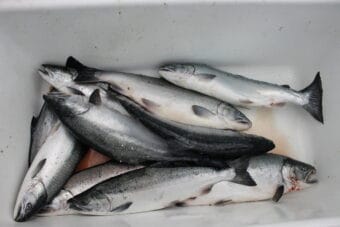
King salmon landed in the commercial troll fishery in the summer of 2019. (Photo courtesy of Matt Lichtenstein)

Should Southeast Alaska have a hatchery-only king salmon sports fishery? Researchers recently tried to answer that question as a possible solution to a declining number of wild kings.

Chinook or king salmon are the largest and most valuable salmon species. They’re sought-after by sport, commercial, and subsistence fishermen alike. But in recent decades, their harvest has become more restricted as populations plummet. A recent study considered if a new Southeast fishery could help – one that allows sport fishermen to keep only hatchery king salmon and release wild ones.

“And an important question there is could this actually be done within the current management context? And is this something that is desirable for folks in Alaska?” asked Anne Beaudreau, who led the study, which took about a year.

Beaudreau is an associate professor with the University of Washington’s School of Marine and Environmental Affairs. The study was initiated and funded by the Alaska delegation of the Pacific Salmon Commission. Members asked the Alaska Department of Fish and Game to explore the possibility of a hatchery-based sports fishery, and the state then contracted with the university.

As part of the study, Beaudreau helped run several public meetings throughout Southeast. Dozens of people participated.

“We heard a lot of concern brought up at these meetings,” she said.

In theory, a hatchery-only fishery – or what’s called a ‘mark selective fishery’ – could provide more sport fishing opportunities. All types of fishing for wild kings are highly restricted because of a treaty that the U.S. has with Canada. It sets harvest limits to make sure that both countries get kings every year. And hatchery king salmon don’t count toward the U.S. treaty allocation.

But the study found that a lot would have to be in place for such a fishery to work. For starters, not all hatchery king salmon in the region are marked. Marked kings have their adipose fin removed, making them easily identifiable. In fact, even a few wild kings in Southeast are also marked that swim to spawn in transboundary rivers leading into Canada. So, in order for a hatchery-only fishery to work, there would have to be buy-in from all the region’s hatcheries. But Beaudreau said some just aren’t set up for marking all of their fish right now.

“The more fish you mark, the more successful you can be in actually implementing a mark-selected fishery,” she said. “It would also require hatcheries to support the idea of mass marking for a mark-selected fishery. And that’s not the case presently.”

Southeast residents also worried about other ramifications – like how such a hatchery sport fishery might affect commercial fisheries. And charter boats concentrating their efforts near hatcheries that locals rely on. And how the management of it might divert resources away from other issues like habitat and bycatch.

Beaudreau said a major concern that arose from the study was incidentally killing wild kings while targeting the hatchery fish. It’s estimated that 16% of catch and release sport-caught king salmon in Southeast die.

“One thing that has risen to the top over and over again, especially in conversations with community members, is these concerns about incidental mortality, the mortality of those unmarked fish that are released,” Beaudreau said.

Also, Southeast’s king salmon fishing is complicated because there is a mix of fish swimming towards many different destinations. Some wild kings are heading to Alaska spawning grounds and others are here temporarily until they return to spawn in British Columbia or the Lower 48. And some are hatchery-produced, returning to where they were released. The fish’s origin varies and depends on the time and location.

Ketchikan sport fisherman Russell Thomas questioned the study’s lack of data on the rate of encountering wild versus hatchery kings.

“It just seems to me like without that information, how do you ever really evaluate what the feasibility is?” he asked at one of the public meetings.

Beaudreau admitted that the study was a high-level overview of the region. Researchers didn’t drill down on how a sport fishery like this could work in specific areas.

Staff from the state’s Sports Fish Division agreed. They said there are too many unknowns right now to start a new fishery in Southeast. Patrick Fowler, a regional fisheries management coordinator, addressed Russell’s concerns.

“I would just say at this time, the Department doesn’t intend to advance a particular proposal,” he said.

But Fowler added that if residents wanted to pursue a local fishery the state department could help gather data for that specific area for a future proposal.

Here is a summary of the study and online meetings.

Feds pinch Southeast Alaska skippers for illegally transporting crab

Commercial Tanner crab in Petersburg, Alaska in 2023. (Photo by Andy Wright)

Three men are charged in federal court for illegally transporting Alaska crab to sell in Washington. The U.S. Attorney’s office in Alaska says Kyle Potter and Justin Welch caught crab in Southeast Alaska this spring and moved them to Seattle at the direction of Potter’s dad, Corey.

The federal indictment says Corey Potter owns the two fishing vessels involved, which were run by his son, Kyle, and Welch. One of the boats is the 97-foot Arctic Dawn, which has been docked in Petersburg this spring but is registered to a Kodiak residence.

The two captains participated in the Southeast Tanner and golden king crab fisheries in February and March, harvesting over 7,000 pounds. Corey Potter allegedly directed the two captains to transport the crab to Seattle to fetch a higher price. By the time they arrived, a lot of the king crab was already dead and about 4,000 pounds of Tanner had to be thrown out because of bitter crab syndrome. Bitter crab is a common parasite and is sorted out at Alaska ports when fishermen sell their catch. It causes the crab to taste bad but isn’t harmful.

The federal indictment says Kyle Potter and Welch never recorded their harvests at an Alaskan port, which is required by state law. And they took the undocumented crab through Canadian and Washington waters, which is against a federal law called the Lacey Act.

Corey Potter is being charged in federal court with two counts of unlawfully transporting fish or wildlife. Kyle Potter and Justin Welch are being charged with one count each of the same thing. Their first court appearance is set for May 2 before U.S. Magistrate Judge Matthew M. Scoble in U.S. District Court in Anchorage.

In February, Justin Welch was fined $1,000 in Petersburg court for using king crab pots that don’t allow smaller crabs to escape. He was put on probation for one year. Back in 2016, Corey Potter and his family, including Kyle, were rescued from their 74-foot tender boat “The Ambition” when it sank near False Pass in the Aleutian Islands.

Attorneys for the men are not listed in the federal indictment. The U.S. Attorney’s office would not make further comments.

Report portrays mixed picture of Alaska’s huge seafood industry

Low clouds hang over Kodiak’s St. Paul Harbor on Oct. 3, 2022. Kodiak is a hub for commercial fishing, an industry with an economic impact in Alaska of $6 billion a year in 2021 and 2022, according to a new report commissioned by the Alaska Seafood Marketing Institute. (Photo by Yereth Rosen/Alaska Beacon)

The Alaska seafood industry remains an economic juggernaut, but it is under strain from forces outside of the state’s control, according to a new report commissioned by the state’s seafood marketing agency.

The report from the McKinley Research Group, titled The Economic Value of Alaska’s Seafood Industry, is the latest in a periodic series commissioned by the Alaska Seafood Marketing Institute.

The total economic value of the Alaska seafood industry in 2021 and 2022 was $6 billion, slightly more than the $5.6 billion tallied in 2019, the last full year prior to the COVID-19 pandemic, according to the new report and the previous version published in 2022.

Along with that good news, the McKinley Research Group’s report contains a warning about the industry’s economic future.

A price collapse in 2023 bodes ill for the industry, the report said. While the dollar and employment totals did not use 2023 data, the report included specific information about one of the main fisheries affected.

For sockeye salmon, prices paid to fishers delivering their catches were, on average, less than half of what they were paid in 2022, the report said. That price — called the ex-vessel price — averaged 65 cents last year. It was the lowest nominal price since 2004 “and among the lowest prices on record when adjusted for inflation,” the report said.

The reasons for the price collapses were multiple, the report said.

Because of inflation, consumer demand dropped, notably in the United States, where it fell below pre-pandemic levels. A strong dollar and weak yen made Alaska seafood prices less competitive in Japan, a key market, the report said. There was a large amount of 2022 harvested fish leftover as inventory, making wholesalers and retailers less inclined to buy fish in 2023, the report said. And the global supply of key species like pink salmon and pollock increased dramatically, notably from Russia but also in Alaska, the report said.

The report contains some mixed statistics on markets.

Alaska supplied 60% of U.S.-produced seafood, based on the 2021 and 2022 data, and if it were an independent nation, it would rank No. 9 as a global supplier of wild seafood, the report said. Yet Alaska provided only 1.8% of the global supply, on average, during those years.

While Alaska’s wild salmon and crab are considered premium products, fish from Alaska accounted for only 9% of the world salmon market and 9% of the world crab market, the report said. Competition from farmed salmon and wild Russian salmon dominates that market, according to the report. Much of the world market for crab is claimed by king crab from Russia – the world’s top king crab producer – and snow crab from Canada. The global crab market was affected by Alaska harvest closures, the report noted. Those closures were triggered by stock crashes in the Bering Sea.

For Alaska seafood in total, the U.S. domestic market was the top consumer destination, accounting for about $2 billion worth of product annually, the report said. The second-biggest market as of 2021 and 2022 was Japan, which took in $650 million worth of Alaska seafood annually, the report said.

Salmon accounted for 40% of the value of commercially harvested seafood, while pollock was the top-quantity fish, accounting for 59% of the harvested volume in 2021 and 2022, the report said.

Alaska halibut is advertised at Ivar’s Pier 54 Fish Bar in Seattle on Oct. 24, 2023. The U.S. domestic market is the top destination for Alaska seafood. But U.S. demand for seafood dropped in 2023. (Photo by Yereth Rosen/Alaska Beacon)

The seafood industry, between harvesters, processors and managers, accounted for 48,000 jobs on average in 2021 and 2022, equivalent to 29,100 full-time positions, the report said. That is a reduction from the 62,200 total jobs in 2019, the equivalent of 37,400 full-time positions.

The industry’s economic performance varied by region.

Total employment in all regions of the state was down from 2019 levels, the new report said, but one region was particularly hard-hit: the Arctic-Yukon-Kuskokwim region, where Western Alaska salmon runs have been faltering and some harvests have closed.

In 2021 and 2021, there were 1,100 people employed in commercial fisheries across that wide swath of Alaska, working the equivalent of 300 full-time jobs, the report said. In 2019, there were 3,100 people working in commercial fishing in that region, amounting to an equivalent of 1,300 full-time jobs, the previous report said.

Jeremy Woodrow, ASMI’s executive director, emphasized the positive signs in this year’s report.

“The brand of Alaska Seafood is cherished among consumers. The variety and superior quality of products Alaska has to offer is unmatched. Research shows that consumers strongly prefer wild seafood to farmed, they want to add more sustainable seafood to their routines, and they place a high value on the health benefits of seafood,” Woodrow said in a statement. “Alaska has the most passionate fleet behind this industry and we will weather this storm together and come out stronger on the other side.”

To address the looming problems, the Alaska Legislature is calling for a special task force to be created and, by Jan. 21, 2025, produce recommendations for action.

The task force concept is detailed in a measure, Senate Concurrent Resolution 10. It passed the Senate without opposition on April 19, and on Thursday, it cleared its first House committee, the House Special Committee on Fisheries, also without opposition.

At that committee hearing, a representative of a region of the state heavily dependent on commercial fisheries expressed strong support for the task force plan.

Ernie Weiss, natural resources director for Aleutians East Borough, testified from Anchorage about the hardships the residents there are enduring.

“Fisheries and communities in our region are in an unprecedented crisis. Fishermen are losing markets, in some cases not being paid for last year’s catch, and processing plants (are) closing or for sale,” he said.

He mentioned the closure of the seafood plant in the fishing community of King Cove.

“The current plant closing is devastating for this community, a community known for its resilience. But this is stretching the bounds of what is possible for the people of King Cove,” he said.

It is the first closure of the King Cove plant in more than a century of operation other than a closure made necessary by a 1976 fire that destroyed the facility, Weiss said. At that time, local fishers made do by for a while by delivering their fish elsewhere, and the King Cove plant was rebuilt relatively quickly, he said. This time, the outcome is uncertain.

This story originally appeared in the Alaska Beacon and is republished here with permission.

King Cove braces for salmon season with no seafood processor amid historic price slump

King Cove in August 2023. (Theo Greenly/KUCB)

The city of King Cove is worried about the future after its seafood processor announced earlier this month that it will cease operations. The plant, formerly owned by Peter Pan Seafood Company, is the economic engine of the community on the Alaska Peninsula.

A new owner will take over the processing plant, but it’s unclear when the facility will reopen. Kirsten Dobroth is the Alaska reporter for Undercurrent News, which is a commercial fishing and seafood industry trade magazine. She’s been reporting on what this means just ahead of salmon season.

Listen:

The following transcript has been lightly edited for clarity.

Ava White: Why is this plant closing- at least for now?

Kirsten Dobroth: The seafood industry has been struggling with this historic slump in wholesale and dockside prices. Back in December, Trident Seafoods announced it would sell four of its shoreside processing plants in Alaska because of this market situation. At the time that was kind of a bombshell that got a lot of attention outside the industry.

And within a few weeks of that announcement Peter Pan Seafood Company also said it would temporarily close its facility in King Cove for winter. That’s noteworthy for a number of reasons – it’s the company’s biggest plant, it processes a number of species year round. But at the time Peter Pan said it would reopen for the summer salmon season.

Ava White: And it sounds like now that’s not happening.

Kirsten Dobroth: Right. It was pretty widely reported as time went on that Peter Pan was in some serious financial trouble. And then fast forward to just a few weeks ago – it comes out that Silver Bay Seafoods, which is also a major processor in the state, will take over all four of Peter Pan’s plants as part of this major restructuring plan that’s still being finalized. Silver Bay says in the announcement that it will operate all the Peter Pan plants for the summer – except for King Cove.

Meanwhile, Peter Pan really wasn’t saying anything about what it planned to do with King Cove. But there were some signs that things weren’t looking good – for instance, some fishermen I spoke with were already signing on with other buyers for summer.

And then about two weeks ago the company posted on Facebook that the plant would stay closed and encouraged people to apply to Silver Bay for work. And since then Silver Bay has also confirmed that – at least for now – it doesn’t have plans to open the facility.

Ava White: Okay, so a lot has happened. Why is this Peter Pan news such a big deal in this whole picture?

Kirsten Dobroth: There are a few things that are notable about this announcement between Silver Bay and Peter Pan. One is that it’s a major deal between two of the state’s biggest and more recognizable shoreside processors – and one is effectively ending operations altogether less than two months before the start of salmon season, which is the peak time for most processors and fishermen.

Another noteworthy point to the Peter Pan side of this – the current owners only bought the company back in 2021. One of the financial backers of that sale was McKinley Capital Management, which was using money from the Permanent Fund Corporation’s in-state investment program at the time. I don’t know what the implications of that are. But I think when you look at how quickly this company is halting operations – it’s really indicative of how quickly things have changed for one of the state’s biggest industries.

Ava White: Okay, so let’s go back to King Cove, what does this mean for that community?

Kirsten Dobroth: The implications for the city of King Cove are huge. I’ve talked to city officials there pretty frequently since early this year and this is a big financial hit for them. More than half King Cove’s general fund budget comes from fishing landing taxes. And I think the ambiguous timeline for reopening has people there worried.

Some hurdles to reopening quickly, though, are deferred maintenance at the facility that need to be addressed. Silver Bay has also said it’s prioritizing absorbing as much of Peter Pan’s fleet as possible, including up in Bristol Bay, where Silver Bay will now operate two processing plants because of this Peter Pan deal. So, that will likely eat up some of the company’s more immediate expenses.

But keeping King Cove closed will have a regional impact, too. Fishermen outside of that local fleet have historically delivered to the King Cove plant depending on the species and price at any given point. So, I think there’s a lot of people that are anxiously awaiting word on when things will be back up and running.

University of Alaska gets $20M to study effects of climate change on fishing and harvesting in the Gulf of Alaska

People fish off North Douglas in July 2023. (Clarise Larson/KTOO)

A new University of Alaska research project will look at how human-caused climate change affects fishing, farming and harvesting in the Gulf of Alaska to build resilience for communities that rely on the ocean.

$20 million dollars of funding from the National Science Foundation will support the work of 23 researchers at all three University of Alaska campuses in Fairbanks, Juneau and Anchorage.

Jason Fellman of the Alaska Coastal Rainforest Center is one of the principal investigators on the Interface of Change project. He says warming from the burning of fossil fuels is changing the weather across Southeast Alaska, bringing more extreme rainfall and less winter snow.

It’s also rapidly accelerating glacial melt, which creates a steady trickle of freshwater, sediment and nutrients. 

“What’s running off the landscape potentially ends up in the nearshore marine,” Fellman said. “So these connections — land ocean connections — could be changing quite rapidly.”

Understanding those changing connections is important because the Gulf of Alaska supports vital commercial and subsistence harvests. 

The five-year project will examine important marine foods like red seaweeds, kelp, oysters, clams, mussels and salmon to see how they might be responding to the changing environment.

It will also focus on questions about mariculture. The industry is booming in Alaska, but it’s still young. 

“There’s still a lot to learn about this type of farming in the Gulf of Alaska,” Fellman said. “Maybe glacial runoff is driving places that are more suitable, or less, to growing seaweeds or kelps or something like that. Those are the types of questions we don’t know.”

Davin Holen, a coastal community resilience specialist with Alaska Sea Grant and one of the project’s five principal investigators, says the research will support the harvesting of traditional foods, too.

The goal is to create tools that people can use to adapt the timing and location of their subsistence harvests to keep up with a changing climate. There will also be projects focused on diversifying which species are gathered, and reconnecting younger generations to traditional foods.

“You can kind of build resilience, so that when the environment impacts one species, you still have lots of other species and the knowledge of how to harvest all those other species as part of your toolkit,” Holen said.

The researchers will work closely with industry partners, local science centers, and tribes in Juneau, Haines, Klukwan, Seldovia, Halibut Cove, Homer, Cordova and Valdez. 

Research efforts will kick off this summer.

Peter Pan Seafoods announces it will cease operations

Fishing vessels in King Cove (Theo Greenly/KUCB)

Peter Pan Seafood Co., the state-backed processing company that has faced dire financial troubles recently, announced Friday it was ceasing operations.

“We’re saddened to share that Peter Pan Seafoods will be halting operations at its processing plants, leading to the discontinuation of both summer and winter production cycles for the foreseeable future,” the company said in a Facebook post Friday night.

The company has faced mounting troubles, including legal claims from fishermen of back-owed payments for unpaid seafood deliveries.

Silver Bay Seafoods recently announced it would acquire Peter Pan’s Valdez facility, as well as operate Peter Pan’s facilities in Dillingham and Port Moller during the 2024 salmon season. It never specified, however, if the King Cove plant would be included.

“This is so sad because I (worked up in King Cove) from ‘96 through last summer,” one commenter posted. “I have good memories from King Cove and the plant, have my kids in the school for a few years.”

King Cove, a community of around 800 residents, relies on the processing facility as its main economic engine. The city already faced hardship when Peter Pan opted last minute not to open for winter’s “A” season, forcing local fishing boats to scramble for new facilities where they could deliver their catch.

“Thanks for waiting until the last possible minute before you told the community of King Cove,” another person commented. “Wouldn’t even tell the fishing fleet of King Cove face to face what was happening, we all have to find out on Facebook.”

Peter Pan said current or former employees can seek processing jobs at Silver Bay Seafoods, but did not specify which facilities would be hiring.

Site notifications
Update notification options
Subscribe to notifications