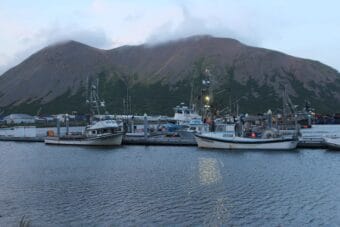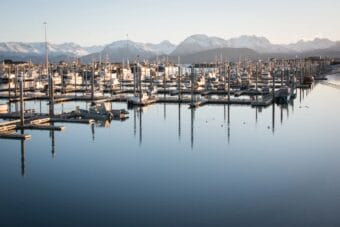
The Trident Seafoods processing plant in Petersburg. (Hannah Flor/KFSK)
Trident Seafoods, one of the largest seafood processing companies in the country, will finalize sales for three of the four plants it listed for sale late last year. According to Friday press release, the Ketchikan, Petersburg and False Pass plants all have buyers.
The seafood processing giant put four of its Alaska plants up for sale in December 2023, citing the need to reduce costs in a harsh global market for United States seafood.
Trident did not name who will buy the plants. A company spokesperson declined comment saying that both Trident and the buyers are bound by non-disclosure agreements.
It’s currently unclear what impact the sale will have on Trident’s fleet, employees, or the local communities. Trident’s vice president of Alaska operations, Jeff Welbourn, said in the Friday announcement that the company is trying to move as quickly as possible on the sale to minimize impacts on the upcoming salmon season.
Welbourn added that the deals are “simple, straightforward transactions” and expects the buyer to communicate with its fleets in the coming weeks.
Fishing boats line a dock at Kodiak’s St. Paul Harbor on Oct. 3. A variety of winches are seen on the boats’ equipment. Entanglements in winches and the cables attached to them can cause serious injuries, but there are ways to reduce onboard risks, a new CDC study says. (Photo by Yereth Rosen/Alaska Beacon)
Russian fish flooding global markets and other economic forces beyond the state’s border have created dire conditions for Alaska’s seafood industry.
Now key legislators are seeking to establish a task force to come up with some responses to the low prices, lost market share, lost jobs and lost income being suffered by fishers, fishing companies and fishing-related communities.
“Alaska’s seafood industry is in a tailspin from facing unprecedented challenges,” said the measure’s sponsor statement issued by the committee’s co-chairs: Sen. Bert Stedman, R-Sitka; Sen. Lyman Hoffman, D-Bethel; and Sen. Donny Olson, D-Golovin. The measure is also being promoted by Senate President Gary Stevens, R-Kodiak.
The industry’s troubles caused a loss to Alaska’s economy of more than $2 billion in 2023, the sponsor statement says.
The resolution got its first hearing on Thursday in the committee that introduced it.
The Joint Legislative Seafood Industry Task Force task force idea is modeled after one created 20 years ago to help the then-struggling Alaska salmon industry, Tim Lamkin, a Stevens staff member working on the subject, told the finance committee.
Then, Alaska salmon fishers and sellers were facing low prices and a shrunken global market share caused by booming production of cheap farmed salmon. That 15-member task force needed two years to complete its work, Lamkin said.
In contrast, the Joint Legislative Seafood Industry Task Force would consist of seven members and would present its findings and recommendations to the legislature in less than a year, by Jan. 21, 2025, according to the resolution wording.
However, the measure is still a work in progress, with the size and makeup of the task force among the details to be worked out during the rest of the session, Lamkin told the committee.
Testifying in favor were the chief executive of OBI, one of Alaska’s major seafood processing companies; the president of the Pacific Seafood Processors Association; the executive director of the Alaska Seafood Marketing Institute, a state-owned corporation funded in part by the industry; the head of United Fishermen of Alaska, a large trade association of commercial fishers; the head of the Commercial Fisheries Entry Commission; and the mayor of the Kodiak Island Borough.
That mayor, Scott Arndt, said industry woes have caused severe strain in his region. He mentioned the pending closure or sale of Trident Seafood plants, which have been economic pillars in the region, and a looming 12.5% increase in Kodiak Electric Association rates – the first increase in 30 years – that is needed, in part, because of reduced sales to seafood processors.
“We have stress in all species, along with all markets for seafood prices. In my 60 years as a resident of Kodiak, I have never seen it this bad. It is scary for a lot of families,” he said.
UFA Executive Director Tracy Welch, who said her association in February voted unanimously in support of such a task force, ran through a list of industry troubles.
“Alaska’s seafood industry is facing unprecedented challenges in every area of the state and across every fishery. Alaskan fishermen, processors, processing workers, support businesses, communities are confronted with low prices, plant closures, lost markets and foregone fishing opportunities,” she said.
The more than $2 billion in losses in 2023 affect communities and state government as well as the private sector, she noted.
“I cannot sum up the situation more succinctly than by saying the Alaska seafood industry is in crisis,” she said.
Russia is the source of a significant amount of trouble for the industry, said ASMI Executive Director Jeremy Woodrow.
He cited a dramatic example. While Alaska’s 2023 pink salmon harvest of nearly 200,000 metric tons was large, Russia harvested over three times that much, he said. And while sales of Russian fish are banned in the United States, Alaska still competes with Russian fish in the global marketplace, he said.
Global inflation is another challenge, causing demand for seafood to slide, he said, while high interest rates are squeezing harvesters and processors.
“There is no silver bullet to solve the challenges we face, and this situation certainly will not turn around overnight,” Woodrow said.
John Hanrahan, OBI’s chief executive, identified some potential state actions that could provide some relief. He suggested increased funding for ASMI to broaden markets, loan guarantees to help offset the impact of high interest rates, and purchases of Alaska seafood for state food-assistance programs – similar to the recently announced U.S. Department of Agriculture commitment to buy large quantities of salmon and pollock for federal nutrition and school lunch programs.
The salmon task force work of the early 2000s resulted in some legislation and policy changes. In general, industry and state efforts at that time started to focus on differentiating Alaska wild salmon as a premium product. Within a decade, that focus on higher quality, more niche marketing and new markets was showing some success, according to a 2012 analysis by Gunnar Knapp of the University of Alaska Anchorage’s Institute for Social and Economic Research.
Mauka Grunenberg looks at live oysters for sale on Aug. 29, 2022, at Sagaya City Market in Anchorage. The oysters came from a farm in Juneau. Oysters, blue mussels and sugar, bull and ribbon kelp are the main products of an Alaska mariculture industry that has expanded greatly in recent years. (Yereth Rosen/Alaska Beacon)
While Alaska’s mariculture industry is small by global standards, production of farmed shellfish and seaweed in the state has increased substantially in recent years, according to a new status report released Friday by the National Oceanic and Atmospheric Administration.
Applications for Alaska mariculture permits averaged about six a year from 2014 to 2018 but increased to about 14 a year from 2019 to 2023, said the State of Alaska Aquaculture report, issued by the NOAA Fisheries.
Oysters have been a pillar of Alaska mariculture for many years, and sales of Alaska oysters grew from about 4.5 million in 2000 to about 7 million in 2022, according to the report.
Growth in seaweed harvest is shown in this graph from NOAA Fisheries’ State of Alaska Aquaculture Report issued on Feb. 23, 2024. (Graph provided by NOAA Fisheries’ Alaska Region Aquaculture Program)
The other main mariculture products in Alaska are blue mussels and sugar, ribbon and bull kelp, the report said. In all, 42 invertebrate and seaweed species have been permitted for farming in Alaska, though finfish farming is illegal in the state, the report said.
Seaweed production has grown dramatically in Alaska. It went from almost nothing in 2017 to nearly 900,000 pounds in 2022, the report said.
The global seaweed market is worth close to $10 billion, according to a recent analysis. Production is overwhelmingly dominated by China and other Asian countries, and farmed seaweed is being used for various industrial and pharmaceutical purposes as well as for food, according to a World Bank analysis.
Within the United States, Maine is the leading producer of seaweed, with more than 1 million pounds of product in 2023 and more than 40 active seaweed farming sites in 2023, according to a recent report issued jointly by Sea Grant programs in multiple coastal states. But Alaska’s industry has grown sufficiently to bring the state to second place by 2023, with over 875,000 pounds produced from 30 active sites last year, according to the Sea Grant report.
Tostadas with topped with kelp and kelp salsa are arrayed on a platter on Feb. 17, 2023, at a reception capping a three-day mariculture conference in Juneau. The tostadas were prepared by Juneau chef Maylin Chavez. The conference was hosted by Alaska Sea Grant and explored the opportunities and challenges of mariculture in Alaska, including seaweed farming. (Photo by Yereth Rosen/Alaska Beacon)
The new NOAA Fisheries report notes that several initiatives have been launched in recent years to expand the industry in Alaska. The Alaska Mariculture Task Force, formed in 2016, established a goal of developing a $100 million industry by 2020. In subsequent years, Alaska mariculture programs were granted federal funds to stimulate development of the industry. An important event occurred in 2022 when the Alaska Mariculture Cluster was awarded $49 million made available through infrastructure legislation pushed by the Biden administration. The cluster was formed by the Southeast Conference, a regional economic development organization.
NOAA and the state are in the process of identifying more areas suitable for mariculture through an Aquaculture Opportunity Areas program announced last year.
Pollock are transferred from a fishing boat into a processing plant in Dutch Harbor, in the Aleutian Islands, in January 2019. (Photo by Berett Wilber)
Right about now, millions of walleye pollock are gathering in the Shelikof Strait, near Kodiak Island. They mass there every year towards the end of winter to prepare for spawning.
And soon, scientists will follow them to do their annual winter trawl survey.
“It’s timed to be there and survey the pollock just prior to the peak of spawning,” said fisheries biologist Lauren Rogers, with the National Oceanic and Atmospheric Administration. “So that timing of when pollock are going to be migrating to the spawning grounds or away from the spawning grounds is then going to be particularly important for that survey.”
But the timing of pollock spawning is becoming more unreliable, as human-caused climate change warms the ocean. That means the scientific surveys that are used for fisheries management could become unreliable too.
Between 2017 and 2019, surveys done by the Alaska Fisheries Science Center across the Gulf of Alaska produced wildly different estimates of pollock biomass. Summer surveys across the feeding grounds showed near-record lows, while the winter survey in Shelikof Strait showed record highs.
To understand the mismatch, Rogers and her collaborators worked backwards using surveys of larval pollock.
“We have the offspring’s information and then we can go back to what the parents must have been doing in order to put them in the world when they were put in the world,” Rogers said.
Rogers’ previous research on pollock showed that spawning can occur earlier when ocean temperatures are warmer. And according to a new paper, published this month, earlier spawning times account for much of the discrepancy in the Shelikof Strait survey.
In 2017 and in 2019, peak pollock spawning happened more than 2 weeks earlier than the long-term average. That was likely shaped, in part, by marine heat waves that hit the Gulf around that time. The new paper offers a tool that can be used to account for changes in spawning timing when building stock assessments.
But Rogers says spawning time isn’t the only thing fisheries surveys need to pay attention to — warming oceans may be changing fish in all kinds of ways. Recent studies in the Bering Sea, for instance, showed that as sea ice melts, populations of pollack are moving further north, out of the typical survey areas.
But Rogers says fisheries managers can try to adjust for these changes.
“If we have an understanding of the links between changes in the climate and changes in spawn timing, or migration timing, or distribution shifts or growth rates, then we can start to use that information when we’re interpreting our biomass estimates or when we’re doing our stock assessments,” Rogers said.
It’s not just a simple matter of doing the Shelikof survey earlier or moving the Bering Sea surveys north. Rogers said there are logistical challenges that come with doing that, and climate-driven changes will be unpredictable from year to year.
“We need to be monitoring to track changes as they’re happening,” Rogers said. “Planning for a continual shift is not going to allow us to respond as proactively as we need to.”
So to keep up, she says fisheries managers need to consider the latest climate science. It’s the only way to follow the fish in a rapidly changing ocean.
Metlakatla Mayor Albert Smith exits the courtroom at the Robert Boochever U.S. Courthouse in Juneau, Alaska after oral arguments in a fishing rights case on Feb. 15, 2024. (Eric Stone/Alaska Public Media)
Attorneys presented oral arguments in a long-running dispute over fishing rights on Alaska’s only Native reservation on Thursday. Metlakatla Indian Community sued Gov. Mike Dunleavy and his administration in 2020, claiming the state’s fishing permit system infringes on rights guaranteed to the tribe by Congress.
Lawyers for the tribe argue that Metlakatla fishermen should not be required to purchase limited-entry permits to fish in waters near Ketchikan and Prince of Wales Island. The tribe argues that the 1891 federal law that created Metlakatla’s reservation implicitly guarantees tribal members the right to fish outside its boundaries.
The state disagrees, arguing that allowing members to fish off-reservation without state permits would hamper efforts to manage fisheries sustainably.
The Ninth Circuit Court of Appeals sided with Metlakatla and revived the case last year after it was dismissed in 2021, sending it back to district court. The appeals court tasked the lower court with determining the scope of the tribe’s right to fish outside the reservation’s boundaries. The Biden administration joined the case with a friend-of-the-court brief, siding with Metlakatla.
On Thursday, attorneys for the state argued in a Juneau federal courthouse that the Ninth Circuit’s decision required Metlakatla to prove that they had a history of fishing in the southern panhandle.
Metlakatla’s attorneys told the judge, Sharon Gleason, that the state was attempting to relitigate an issue settled by the appeals court. A U.S. Department of Justice attorney said the federal government believed that Congress had indeed granted the tribe off-reservation fishing rights. Metlakatla’s attorney said that if the case proceeded to trial, he was prepared to present evidence of Metlakatla fishermen fishing in those areas.
In a statement, Alaska Assistant Attorney General Laura Wolff said the case involves many tough issues, adding that Gleason appears to understand the nuances. Metlakatla mayor Albert Smith said shortly after the hearing that he was pleased to see the case moving forward. A DOJ spokesperson declined to comment, citing the ongoing litigation.
The Trident Seafoods processing plant in Petersburg. (Hannah Flor/KFSK)
Three major seafood processors in Alaska have announced plans to sell off their plants or temporarily close for the upcoming fishing seasons. Trident, Peter Pan Seafood Company and most recently OBI Seafoods – just last month – have all cited turbulent market conditions for their decisions.
Kirsten Dobroth is the Alaska reporter for Undercurrent News, which is a commercial fishing and seafood industry trade magazine. She’s been following this market downturn.
The following transcript has been lightly edited for clarity.
Ava White: Kirsten, it seems like one company closing a plant would be pretty drastic, let alone three. How bad are things right now, and can you give us an overview of what’s happening?
Kirsten Dobroth: Yeah, I think a lot of people would say bad is an understatement and historic is a more appropriate description of the market situation. There was a lot of attention this summer on low base prices paid out to fishermen for salmon. But prices for pollock products also crashed last year, so that’s the state’s two biggest species by volume and value. Since then, this market collapse has spread to pretty much every species. Black cod, for instance, is typically one of the more lucrative dollar per pound fish caught in Alaska, and prices were so low at the end of last year that processors weren’t even buying it. And I should clarify, by “prices” I’m referring to both the dockside price paid to fishermen and the wholesale price paid to processors – so, no one is really safe here, both sides are hurting.
Ava White: It seems like this is pretty all encompassing. Why is this happening?
Kirsten Dobroth: That’s a good question and there’s a plethora of answers – most of them come down to global market conditions. Inflation and the pandemic fundamentally changed consumer spending habits – and at the same time, made it more expensive for fishermen and processors to operate. Trade conditions have also changed with China, and a strong U.S. dollar has made it harder to sell Alaska seafood products in places like Japan, which is traditionally a big buyer. The amount of Russian seafood products in the market has gotten a lot of attention. High interest rates have also hit processors particularly hard. And then there’s just a lot of supply out there, so basic supply and demand – you have these tough market conditions and a lot of product sitting in cold storage that’s getting harder to sell.
Ava White: Now processing facilities are closing or being sold. What happens to these communities that are losing plants or have large fishing fleets?
Kirsten Dobroth: Well, I think in the short term they’ll be looking at how to keep people working. In Kodiak, where I live, Trident’s plant – which the company has said it will sell – employs hundreds of people, many of them live here year round. And then boats that sell to Trident, where do they bring fish – especially if other companies are also struggling financially? Peter Pan Seafood Company announced last month that its plant in King Cove won’t open for winter, and city officials there told me they’re expecting a hit to fish landing taxes which make up more than half their general fund budget. But I think it’s also really important to zoom out on this – Alaska’s seafood industry employs tens of thousands of people that collectively earned more than a billion and a half dollars back in 2022 when times were good. Another $160 million went to taxes and fees that year. This isn’t just an issue for Kodiak and King Cove – this is a statewide problem.
Ava White: Is there any financial relief coming their way?
Kirsten Dobroth: That’s yet to be seen. About three quarters of the Alaska State Legislature sent a letter to the US Department of Agriculture last month asking for more support and more purchases of Alaskan seafood. The USDA purchased a little more than $200 million worth of Alaska seafood products last year, so that’s provided a boost while things have been bad. But what else they can do and any additional support in the state budget is unclear at this point. It’s worth pointing out that Gov. Dunleavy’s state of the state address didn’t include any mention of fisheries except for Pebble Mine and an allusion to “wild harvest.”
Ava White: So, I guess looking forward the big question is are there signs that the fishing industry will rebound anytime soon?
Kirsten Dobroth: I think that’s what everyone is asking. I’ve talked to a number of sources on the processing side of things who think we haven’t hit rock bottom. I’ve talked to fishermen who go out for seasons that either just started up or start up soon and they’re looking at another year of really depressing dockside prices. President Biden just signed an executive order that effectively stops Russian seafood products from getting into the US, and there’s been some optimism in the industry particularly in Alaska about that. But unfortunately I don’t think anyone can say where we go from here.
Close
Update notification options
Subscribe to notifications
Subscribe
Get notifications about news related to the topics you care about. You can unsubscribe anytime.