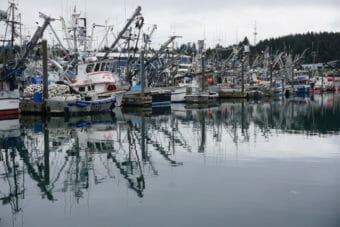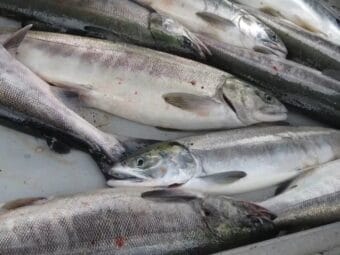
Commercial fishing vessels docked in the St. Paul Harbor in Kodiak; Feb. 6, 2023 (Brian Venua/KMXT)
Russia will no longer be able to sell seafood to U.S. markets after processing products through other countries, according to an executive order President Joe Biden signed earlier Friday to close a loophole.
Alaska lawmakers, especially those in fishing communities like Kodiak and Homer, heralded the news.
“I’m glad it seems to be resolved here,” state Senate President Gary Stevens said. “It just really has an impact on everyone in Kodiak, both the processors, and the fishermen, and the workers and the plants and all that. It’ll make up a level field that we can all fairly deal with.”
Fisheries have been struggling this year, and marketing executives and processors alike have blamed Russia for flooding markets with its seafood as a major reason for low prices offered to Alaska fishermen.
The initial ban on Russian seafood was enacted after the country invaded Ukraine. While Russian seafood processors have been unable to directly export products to the United States since then, they have gotten around the ban by having fish processed or “significantly modified” in other countries like China.
U.S. Senator Dan Sullivan said he’d been working on closing the loophole since the initial ban on Russian seafood.
“It’s a long overdue win for Alaskan fishermen, American fishermen, for sustainable and environmentally sound fisheries, and the numerous coastal communities in Alaska that support our fishing fleet,” Sullivan said.
Closing the loophole will open a huge market for domestic seafood producers to fill demand and hopes it will help raise prices for Alaska fishermen, Sullivan said.
“We have plenty of fish in Alaska that can source any of these products that you’d need,” he said.
Sullivan also touted Alaska’s standards for environmental protection and labor reputation when compared to its Russian and Chinese counterparts.
Starting Friday, Sullivan said, no new contracts can be signed to import Russian seafood from other countries. Any existing contracts must also be fulfilled or surrendered within the next 60 days, he said.
A pod of killer whales swims in waters off Southeast Alaska’s Chicagof Island in July of 2023. A new federal report describes the 37 killer whale entanglements that were documented in Alaska waters from 1991 to 2022. (Photo by Meghan Chamberlain/U.S. Forest Service)
Over the last three decades, 37 killer whales were entangled in fishing gear in Alaska, which resulted in 25 deaths, according to a new report issued by the National Oceanic and Atmospheric Administration.
The report from NOAA Fisheries covers documented cases from 1991 to 2022. It does not include this year’s unusually high number of cases, in which 10 killer whales were found ensnared in fishing gear — mostly bottom-trawl gear — with nine of them found dead. Those events sparked a special examination by the agency.
The cases documented from 1991 to 2022 involved a variety of fishing gear. Trawl gear caused 20 of the entanglements, longline gear caused 10 of them and assorted other gear was implicated in other cases.
Killer whales are known to follow vessels to feed on the fish caught by net, hook, pot or trap, sometimes at their peril. Some die from asphyxiation because they become pinned in place underwater, and even if they escape alive, some wind up with serious injuries that could result in death later, the report said.
But there are gear modifications and devices that have the potential for reducing harm to the whales, the report notes. Barrier ropes that prevent whales from swimming into nets, sleeves that cover hooked fish being pulled up on longline gear, acoustic instruments that ward off whales and other devices should be further studied to see if they can effectively reduce the toll on killer whales, the report said.
Not all of the 37 reported entanglements over the three-decade period involved fishing or marine gear of any kind.
In two of the reported cases, the whales were determined to have been enmeshed in strings of kelp. Those determinations were based on analysis of photographs – demonstrating the importance of collecting photo evidence, the report said.
Killer whales and other whales are known to interact with kelp and have been observed playing with it. There is also evidence that rubbing against kelp sooths whales’ skin. It is likely that there were many more kelp entanglement cases than the two that were documented, the report said.
The affinity for kelp is a signal of a potential future problem as kelp and seaweed farming proliferates, the report noted. “Killer whales have the potential to interact with kelp farms’ anthropogenic material as well as crops,” it said.
Alaska killer whales are classified by stock and by prey type. Resident whales are fish-eaters, while transient whales hunt marine mammals. Multiple stocks are found in Alaska waters.
NOAA Fisheries estimates that there are 1,920 animals in the Eastern North Pacific Alaska Resident stock, which swims in the Gulf of Alaska and Bering Sea, and 587 in the Eastern North Pacific, Gulf of Alaska, Aleutians Island and Bering Sea transient stock. Past analysis by NOAA Fisheries has found that the Eastern North Pacific Alaska Resident stock can withstand losses of 19 animals a year, while the smaller transient stock can endure losses averaging 5.9 animals per year.
An OBI Seafoods processing plant in Petersburg in 2019. (Photo by Joe Viechnicki/KFSK)
Six Seven, an upscale restaurant located in Seattle’s historic Edgewater Hotel, serves Northwest cuisine with a focus on fresh seafood. The eatery sources some of that product from Alaska’s fisheries, which provide more than half of the country’s wild-caught seafood according to the Alaska Seafood Marketing Institute.
The restaurant is open seven days a week, but the hotel’s general manager, Ian McClendon, said that he has noticed that other fine dining spots are operating for fewer hours.
“I would say several high-end restaurants that used to be open seven days a week down here at the waterfront are not open full time,” he said.
As restaurants reopened to in-person dining after pandemic closures, they struggled with staffing shortages. According to the National Restaurant Association, at the start of this year, 80% of restaurant operators reported they had a hard time filling open positions.
McClendon said Six Seven has kept staff due to their union contracts. But the Bureau of Labor Statistics reports that leisure and hospitality job openings are near 20-year highs.
And one seafood processing executive said all those openings are hurting their bottom line. Mark Palmer is the CEO of OBI Seafoods, which operates 10 processing plants throughout Alaska.
In a November meeting hosted by the United Fishermen of Alaska, Palmer said that restaurants are operating with a smaller wait staff, selling fewer dishes for higher prices.
“Some of them have identified a new business model that doesn’t move more pounds of product. They move less, and it’s just as profitable,” he said.
That new model means they’re buying fewer fish from processors like OBI.
Last year, a presentation from DataEssential for the Alaska Seafood Marketing Institute showed that Alaska seafood had a much higher median price point in fine dining institutions than the overall seafood average — $33.00 per dish compared to $19.95.
Palmer said that many processors have traditionally depended on their sales to fine dining restaurants like Six Seven to turn a profit.
“We rely on fine dining. We rely on white tablecloths. And that’s where we really can drive margin and that’s where a lot of premiums are paid,” Palmer said.
University of Alaska Anchorage emeritus professor of economics Gunnar Knapp has studied fisheries for decades. He said restaurants have adapted to having fewer workers by catering to this smaller clientele.
He said grocery and fish markets are also changing what and how much they buy to adjust to having fewer workers.
“Similarly, on the retail side, they’re trying to do less that involves labor, and this can affect the mix of products they want to buy and have to stock and so on,” Knapp said.
These changes, Knapp said, come as many processors are contending with a shifting international market, including a shrinking amount of frozen salmon sold to Asia. Knapp said processors are paying to hold large quantities of some products.
“The longer that they have to hold those fish, the higher their storage costs, but also the higher their interest costs from borrowing,” he said.
Knapp said that in the future, retailers are likely to return to buying larger quantities of available fish like sockeye salmon.
“Eventually, some stores will say, ‘Hey, we can sell more,’ and ‘All those other stores are keeping their prices high. We’ll buy a sockeye salmon, and offer consumers this cheaper price that the other stores aren’t passing along,’” he said. “Then the other stores have to price match, and then prices get into adjustment.”
Restaurant job openings have started to come down from last year’s peak. But a return to more normal labor levels may not be the whole picture.
At the Edgewater Hotel, McClendon said that even with a full restaurant, staff are buying less from Alaska because of continuing supply line constraints and occasional lack of availability for catches like crab. He said that the restaurant, which is part of a larger hotel network, tries to buy in bulk from vendors. Now Six Seven has to source from more groups.
“Pre-pandemic, we had a pretty strict routine. Coming out of [the] pandemic, we’ve never had this many seafood vendors,” he said. “So we’re having to find more people. It’s harder for us to find products than it used to be before the pandemic.”
Some processors have called for legislative change to help address challenges the industry is facing, including liquidity issues. That change could include involving the U.S. Department of Agriculture or providing low-interest financing solutions. For now, processors and their clients will have to continue to grapple with the challenges of labor shortages and a fluctuating market.
Pollock at a processing plant in Dutch Harbor. (Photo by Berett Wilber)
The total amount of pollock allowed to be scooped up by trawlers in the Bering Sea will stay the same in 2024. In its Dec. 9 meeting in Anchorage, the North Pacific Fishery Management Council moved to keep the total allowable catch for pollock at its current level of 1.3 million metric tons, a move that has generated criticism from conservationists, tribes, and the trawling industry alike.
Alaska’s pollock fishery is responsible for the vast majority of salmon bycatch in the region. And amid alarming declines in returns of multiple species of salmon to Western Alaska rivers, the pollock trawl fishery has faced increasing criticism for its perceived role driving the crisis. But federal fisheries managers and the trawling industry pushed back, asserting that the claims are unfounded.
Trade organizations representing the trawl industry said during testimony at the council meeting that the decision to hold the pollock quota steady is misguided.
Stephanie Madsen, executive director of the At-Sea Processors Association, told the council the move could lead to missed opportunities to harvest increased numbers of mature pollock in the Bering Sea.
“We can’t bank them like some fish species. They will age out of the system and they will be not available to the fishery,” Madsen said.
Madsen also told the council that the industry request for a modest increase to the pollock quota, which was ultimately denied, was already a compromise.
“I would just remind you that the Russian fishery in the Sea of Okhotsk and the Western Bering Sea take more pollock than our Eastern Bering Sea pollock,” Madsen said. “So a 20,000 metric ton increase in the Eastern Bering Sea is likely to have very little impact on a global situation.”
Communities hit hard
On the other side of the debate, tribes and conservation groups representing communities reeling from salmon crashes in Western Alaska have called for reining in the pollock fishery.
“We consider the salmon that do return to our rivers are survivors of climate change, which they experience in both their freshwater and marine stages,” said Kuskokwim River Inter-Tribal Fish Commission Programs Manager Terese Vicente. The commission is one of the groups pushing for increased tribal co-management of resources in Western Alaska.
“We ought to protect every one of them to be precautionary, to be protective with the factors we can control because they’re so vulnerable to climate-driven ecosystem changes,” Vicente said.
Dozens of tribes impacted by salmon crashes have made calls for a greater voice at the federal management table, including advocating for Alaska Native representation on the 11-member North Pacific council.
Council member Jon Kurland noted that requests from the Association of Village Council Presidents and Tanana Chiefs Conference to meet with the council ahead of the meeting hadn’t panned out.
“We have been making a lot of efforts to improve our process for tribal consultation and to try to ensure that when tribes and tribal consortia and so forth are interested in talking to us that we do that before the council takes final action,” Kurland said. “We made a number of attempts to reach out, and unfortunately were not able to make those connections.”
Both organizations are suing suing the federal government over the way the Alaska pollock fishery is managed.
Council member Anne Vanderhoeven, who introduced the motion to hold the 2024 pollock quota the same as this year, pushed back against the notion that the fishery is a significant driver of salmon crashes.
“We have heard calls and public comment to reduce the pollock TAC [total allowable catch], and recognition of the current salmon crisis in Western Alaska rivers, and the devastating impacts that crisis has on subsistence users and Alaska Native cultures,” Vanderhoeven said. “But the best scientific information available does not support the assertion that relatively small adjustments to the pollock TAC will measurably or significantly increase salmon escapement to Western Alaska.”
The pollock quota for 2024 is set, but for 2025 the quota has yet to be determined.
The council’s next meeting is scheduled for Feb. 5 to Feb. 12 in Seattle, where it plans to discuss potentially refining the environmental impact statement guiding management decisions.
FILE – This Oct. 24, 2006 file photo shows file photo shows the Ice Harbor dam on the Snake River in Pasco, Wash. (Jackie Johnston/AP)
BOISE, Idaho — The White House has reached what it says is an historic agreement over the restoration of salmon in the Pacific Northwest, a deal that could end for now a decades long legal battle with tribes.
Facing lawsuits, the Biden administration has agreed to put some $300 million toward salmon restoration projects in the Northwest, including upgrades to existing hatcheries that have helped keep the fish populations viable in some parts of the Columbia River basin.
The deal also includes a five year stay on litigation and a pledge to develop more tribally run hydropower projects and study alternatives for farmers and recreators should Congress move to breach four large dams on the Snake River, a Columbia tributary, which tribes say have long been the biggest impediment for the fish.
“Many of the Snake River runs are on the brink of extinction. Extinction cannot be an option,” says Corrine Sams, chair of the wildlife committee of the Confederated Tribes of the Umatilla Indian Reservation.
The agreement stops short of calling for the actual breaching of those four dams along the Lower Snake in Washington state. Biden administration officials insisted to reporters in a call Thursday that the president has no plans to act on the dams by executive order, rather they said it’s a decision that lies solely with Congress.
A conservation bill introduced by Idaho Republican Congressman Mike Simpson to authorize the breaching of the dams has been stalled for more than a year, amid stiff opposition from Northwest wheat farmers and utility groups.
When the details of Thursday’s salmon deal were leaked last month, those groups claimed it was done in secret and breaching the dams could devastate the region’s clean power and wheat farming economies that rely on a river barge system built around the dams.
“The agreement announced by the Biden Administration commits the U.S. Government to spending hundreds of millions of dollars that will ultimately end up being paid by electricity consumers in communities throughout the West,” said Heather Stebbings, interim executive director of Northwest RiverPartners in a statement.
Copyright 2023 NPR. To see more, visit https://www.npr.org.
The Trident Seafoods processing plant in Petersburg. (Hannah Flor/KFSK)
Trident Seafoods, one of the biggest seafood processors in the country, announced Tuesday that it’s selling a third of its Alaska plants. Four of Trident’s processing plants in Alaska are now for sale – in Kodiak, Ketchikan, Petersburg, and False Pass.
The company also announced a significantly scaled-back winter season for its year-round plant in Kodiak. The historic Diamond NN Cannery in South Naknek and the company’s support facilities in Chignik will either be retired or sold as well, according to a company statement.
Multiple fishers contacted by KMXT said the move was a huge surprise.
Trident spokesperson Alexis Telfer, declined to comment, saying they’re focusing on their employees and fishing fleets at this time.
There’s a storm of issues in seafood markets right now – processors have offered fishers some of the lowest prices for their harvest in years, sparking standdowns and protests across the state. The Alaska Seafood Marketing Institute’s conference in November pointed to declining demand for seafood, huge harvests, and foreign competition as some of the key problems.
In a press release, Trident blamed similar reasons for its move to sell and claimed the plants for sale in Southeast Alaska and on the Alaska Peninsula better aligned with other operators’ strategies for the state. The seafood processor also announced it would delay building a processing plant in Unalaska earlier this year.
The company’s cost-cutting efforts also include laying off about a tenth of its corporate staff.
Close
Update notification options
Subscribe to notifications
Subscribe
Get notifications about news related to the topics you care about. You can unsubscribe anytime.