Fisheries

Sitka workshop discusses the future of invasive crabs in Alaska

Twenty green crabs laid out in rows on a table, with a bucket full of green crabs next to them
European green crabs collected from Metlakatla’s Tamgas Harbor this week. The crabs were trapped in shrimp pots. (Photo courtesy of Dustin Winter)

Tammy Davis is the invasive species program coordinator for the Alaska Department of Fish & Game. During the Alaska Invasive Species Partnership workshop in Sitka on Thursday, she was teaching a roomful of people how to identify invasive green crabs – which, surprisingly, are not always green.

“They can be brown, they can be orangish, reddish, yellowish,” Davis continues. “They’re four inches — an adult is four inches across the back of the carapace.”

European green crabs first reached the Pacific coast in 1989, but it wasn’t until 2022 that they showed up in Alaska. Davis remembers the moment she learned that green crabs had been found in Metlakatla last summer.

“And I think we were all really close to tears, because we should have known they were coming,” Davis said. “But we didn’t think they would come this soon, I guess.”

Genelle Winter is the Climate & Energy Grant Coordinator for Metlakatla Indian Community.  While Metlakatla is the only place in Alaska where green crabs have been positively identified, Winter said it’s likely that they’ve already spread.

“The numbers that we’re finding them in — we’re pretty sure that there are other places, we just haven’t found them yet,” Winter said. “And with that, right now, we’re just under 3000 crabs total that have been caught since discovering them in 2022.”

She said that aggressive trapping in Metlakatla, combined with early detection, has made it easier to reduce their spread.

“The first thing that was found was the first shell,” Winter said. “And that triggered that response to really start intensifying our trapping and then modifying how and where to make sure that we were really actually putting the traps where the crab were. And now those guys, they have it dialed in something fierce.”

These crabs tend to decimate eelgrass beds, which are critical habitat for juvenile salmon and other critters. They are also voracious eaters of clams and other small crabs. They reproduce quickly, and can survive in a wide range of environments.

Davis said communities like Sitka should be on the lookout.

“It seems so frightening and negative to say it’s inevitable, but based on ocean currents, it’s likely,” Davis said. “We don’t actually have good oceanographic information about currents in the Alexander Archipelago, so some of our Southeast communities may be slightly more protected if currents tend to go out along the coast. Unfortunately, that puts Sitka more likely.”

Davis said that Alaskans can help by learning how to identify green crabs and looking out for them on beach walks. While collecting some invasive species requires a permit, Alaska beachcombers can collect potential green crabs for the purposes of reporting – but they should keep the crab in a container and report the find immediately. You can report invasive species online through the Alaska Department of Fish & Game website or by calling the invasive species hotline at 1-877-INVASIV.

Western Alaska salmon crisis affects physical and mental health, residents say

Strips of salmon are seen hanging in a smokehouse on the Kuskokwim River on July 19, 2017. Salmon has been a mainstay of diets in the region, providing high-quality protein that helps residents avoid numerous physical ailments, the head of the region’s tribal health provider testified on Friday. Lack of salmon therefore has negative health consequences, he said. (Photo provided by U.S. Fish and Wildlife Service)

The salmon crisis in the Yukon and Kuskokwim rivers is harming more than local economies, food security and culture, according to people in the region. It is also harming human health.

That was a message emphasized on Friday at a field hearing held by U.S. Sen. Lisa Murkowski, R-Alaska, in Bethel, the regional hub for the Yukon-Kuskokwim Delta. Field hearings, held outside of Washington, D.C., are often located in sites directly affected by specific issues.

Murkowski said she convened the Senate Committee on Indian Affairs hearing in Bethel so that Alaskans there could explain the impact of the salmon collapses to people outside the region and outside the state who might not grasp its severity.

“Part of my job is to convey the urgency here,” she said at the start of the five-hour hearing.

Among those testifying was Dan Winkelman, president of the Yukon-Kuskokwim Health Corp., the tribal organization that is the region’s main health provider. Friday’s event was held at the organization’s Bethel headquarters.

Lack of salmon, Winkelman said, “is not just negatively affecting our culture and well-being but our good health,” he said.

He ticked off the numerous well-known nutritional benefits of salmon. It is a complete, high-quality protein that builds lean body mass and helps people’s bodies function correctly, he said. It is rich in Omega-3 fatty acid and essential minerals key to heart health, brain health, immune function and control of inflammation, he said. It is a nutrient-dense food that helps people maintain healthy body weights and avoid diet-related health problems, he said.

For these and other reasons, the U.S. Department of Agriculture has recommended that people eat at least two servings a week of fish like salmon, Winkelman said. In the past, with widespread daily consumption of salmon, residents of the region easily met that recommendation, he said.

“However, when fish is not available, meals are supplemented with store-bought, highly processed foods that contain added sugars, salts, and saturated fats, and often less protein,” he said. “Diets become more energy dense instead of nutrient dense, which can lead to an increase in unhealthy weight gain and increased rates of chronic disease development. Often, I have providers tell me that his has become a problem or the last decade or so in the in the Y-K region.”

Migrating salmon are seen in late 2011 in the waters of Western Alaska’s Togiak National Wildlife Refuge. (Photo provided by U.S. Fish and Wildlife Service)

In rural areas across the state, wild foods generally provide all the required dietary protein, according to studies by the Alaska Department of Fish and Game. Salmon has been the dominant wild food in many rural regions, and that is especially so in the Yukon-Kuskokwim region, according to state and federal experts.

Additionally, salmon harvesting itself is physical exercise that keeps residents fit, Winkelman said in his testimony.

The scarcity of salmon also affects mental health, said residents testifying at the hearing.

Jonathan Samuelson, executive director of the Kuskokwim River Inter-Tribal Fish Commission, described salmon harvesting as part of a holistic approach to wellness.

“When we’re forced to deviate from our traditional ways of life, it only amplifies our unwellness. Our way of life and our cultural knowledge and the way that we be in the world is our path to wellness, and we know that,” he said.

Kara Dominick of Bethel spoke about how a return to salmon-harvesting traditions helped her recover from a serious opioid addiction.

“The river and the tundra became my peace. In the end, it was what made my life feel whole and meaningful again. I may not have been here today if I didn’t have that connection and access to my culture and subsistence opportunities,” she said in her testimony.

The “deeper connection to our culture and our way of life” is critical to addressing the substance-abuse crisis that is gripping much of the population, Dominick said. But now that avenue of recovery is under threat, she said.

“With the decline in salmon numbers comes further separation from our culture. How is this going to affect our mental health? How much worse will it get? I fear for our people,” she said.

Charles Menadelook, subsistence resources program director for Kawerak Inc., a Nome-based tribal consortium, expressed similar fears.

He talks to his young family members about the importance of subsistence harvesting, he said, his voice faltering with emotion. “I tell them, they need to go fishing. They need to go snow hunting. Because I don’t think it’s going to be around much longer,” he said.

This story originally appeared in the Alaska Beacon and is republished here with permission.

EPA plans to limit or eliminate salmon-killing tire chemical found in preliminary Alaska sampling

The U.S. Environmental Protection Agency will begin the process to limit and possibly eliminate a chemical commonly used in car tires, after scientific studies found that the chemical — commonly known as 6PPD — is fatal to salmon. Coho salmon swim after being released from a hatchery. (National Marine Fisheries Service/Southwest Fisheries Science Center; Salmon Ecology Team photo)

The U.S. Environmental Protection Agency will begin the process to limit and possibly eliminate a chemical commonly used in car tires, after scientific studies found that the chemical — commonly known as 6PPD — is fatal to salmon.

The EPA announced its regulatory plans Thursday, answering a petition from three Native Tribes in the Pacific Northwest. The states of Washington, Oregon, Vermont, Rhode Island and Connecticut also supported the petition.

It likely will take years for the EPA’s rulemaking process to take effect; the agency’s first step will be to require tire manufacturers to share their unpublished health and safety studies, but that’s not expected before the end of 2024.

A University of Washington study, funded by the EPA and published in late December 2020, conclusively linked 6PPD to mass die-offs of coho salmon in urban waterways around Seattle.

Followup studies by the National Marine Fisheries Service and the U.S. Geological Survey, among others, have repeatedly confirmed the results.

The 6PPD chemical is used by all major tire manufacturers to reduce degradation and cracking. Tires deposit small amounts of rubber on the road with each revolution, and those deposits contain 6PPD, which then washes into neighboring waterways with snow and rain.

Limited testing has been done in Alaska, home to the nation’s largest salmon runs, but preliminary sampling in Anchorage in 2021 found levels of 6PPD that are lethal to coho salmon.

Alaska seafood harvesting jobs decline as fish crashes, pandemic and other factors take toll

Fishing boats line the docks in Kodiak’s St. Paul Harbor on Oct. 2, 2022. Fish-harvesting employment has been declining since 2015, with multiple factors at play, according to an Alaska Department of Labor and Workforce Development analysis. (Photo by Yereth Rosen/Alaska Beacon)

Alaska fish-harvesting employment declined in 2022, a continuing yearslong slide caused by a variety of factors, according to an analysis by the state Department of Labor and Workforce Development.

Employment for people harvesting seafood dropped by about a quarter from 2015 to 2022, according to the analysis, published in the November issue of Alaska Economic Trends, the department’s monthly research magazine.

The industry lost ground compared to other sectors of the Alaska economy, the analysis found. Seafood harvesting accounted for 7.3% of Alaska jobs in July of 2021, but only 5.7% of Alaska jobs were in seafood harvesting in the following July. Fishery work is highly seasonal, and July is the peak month for it.

That one-year change showed how fish-harvesting employment continued to dwindle even while other Alaska sectors, notably tourism, were recovering from the COVID-19 pandemic, said Joshua Warren, the state economist who wrote the Trends article.

“They’re going down a little bit, while other industries were popping back up,” he said. “If there was going to be a snapback from COVID, it should have been this year, in the 2022 season, and we didn’t really see it.”

While Warren’s article focused on harvesting specifically, he noted that the lagging recovery from the pandemic extended more broadly in the Alaska seafood industry. Fish harvesting and fish processing, in combination, accounted for over 10% of Alaska’s July employment in 2022, but that was down from over 13% in July of 2021, he said.

In all, seafood harvesting jobs averaged 6,331 per month in 2022, down from 8,501 in 2015, the recent peak year, Warren’s analysis found. In the peak month of July, the 2022 employment total was 20,231, compared to the July 2015 total of 24,594.

Multiple factors have contributed to the employment-loss trend, Warren said.

Since 2015, there has been a decrease in the number of active permit holders, which means there are fewer captains working and fewer crew members being employed, he said.

The COVID-19 pandemic accelerated the longer-term decline in fish-harvesting jobs. From 2019 to 2022, Alaska fishery employment declined by 17.3%, according to Warren’s analysis. Companies operating in Alaska waters during the pandemic reduced crew sizes for health reasons, but more importantly, some of the vessels that stopped operating in Alaska during the pandemic had yet to return to the state by 2022, the analysis found.

Fishery disasters also disrupted employment.

Shellfish harvesting has suffered the steepest job losses, largely resulting from closures of key Bering Sea crab fisheries deemed necessary because of poor stocks. Those closures reversed what had been a trend of job growth for shellfish harvesting, even during the pandemic.

Crashes of salmon runs in the Yukon and Kuskokwim rivers largely wiped out fish-harvesting employment in Western Alaska’s Yukon-Kuskokwim Delta, the analysis said. There were over 1,000 salmon-harvesting jobs in the region in August 2018; four years later, that number was zero, the report said.

There are some categories bucking the downward trend, Warren’s analysis found. Salmon-harvesting employment in the Bristol Bay region is back up to its pre-pandemic level, he found. Bristol Bay’s strong salmon returns have contrasted with weak returns in other regions, he noted.

Future prospects for fish-harvesting employment are unclear, but there are continued negative signs, Warren said. The closure of the Bering Sea snow crab fishery was just extended for another year, his article noted. And while the Bristol Bay red king crab harvest reopened in mid-October after two years of closure, the allowable catch is very limited, making this season’s fishery small.

Additionally, a flood of Russian fish into world markets has driven down prices this year for a variety of Alaska’s fish species, a situation expected to continue, Warren’s analysis said.

Industry experts have noted the influence of Russian supplies on prices for Alaska fish, including pollock, the top-volume seafood harvest in the state and the nation. In the case of salmon, Russian supplies are combining with supplies from huge harvests in Alaska to depress prices, according to industry experts.

With little movement on salmon bycatch, Alaska advocates look to Biden administration for executive action

Crew members adjust the net as it releases fish aboard the Northern Hawk factory trawler on Aug. 5, 2023 in the Bering Sea. (Loren Holmes/Anchorage Daily News)

Amid catastrophic shortfalls in salmon harvests in some of Alaska’s rural, Indigenous communities, advocates have pleaded for a crackdown on unintentional catch of those same salmon by the trawl vessels that harvest billions of pounds of whitefish in the Bering Sea.

But the politically appointed regional council that manages Bering Sea fisheries has largely resisted those requests.

So instead, advocates are now taking another approach. They’re pushing the Biden administration for a workaround: a rewrite of the federal guidelines that tell the regional council, and its counterparts across the country, how to manage all the fisheries under their supervision.

The idea has broad support from conservation groups, Alaska Native tribes, small-boat fishermen and Alaska Democratic U.S. Rep. Mary Peltola, who made her opposition to the unintentional salmon harvests, known as “bycatch,” a key plank in her recent congressional campaigns.

But the Biden administration, after asking for feedback earlier this year on possible revisions to the guidelines, has not yet committed to taking action. And any such efforts face opposition from politically connected fishing businesses and industry groups that say tougher bycatch rules and limits could cut into their profits or even shut down entire fishing fleets.

“There’s a lot of question in my mind about whether they’re going to really follow through,” said Peltola, referring to the Biden administration. “There are so many things that the administration could do…that they haven’t done.”

Council inaction amid crisis

The new debate comes after several years in which salmon have returned to Western Alaska’s Yukon and Kuskokwim rivers in numbers far below usual, forcing outright closures of fisheries or strict limits.

Residents of dozens of Indigenous communities along those rivers depend on salmon to feed their families and generate cash income in a region where groceries are expensive and well-paying jobs can be hard to find.

Families would once catch hundreds of salmon every summer and fall. The absence of fish, in recent years, has posed what some tribal leaders describe as an existential crisis.

Scientists say that warming ocean waters, more than bycatch in Bering Sea fisheries, are driving the declines.

But advocacy groups and Western Alaska leaders have nonetheless aggressively pushed the North Pacific Fishery Management Council to set stricter bycatch limits, arguing that it’s unjust for corporate-owned vessels to accidentally catch thousands of salmon when subsistence harvesters face fishing bans.

The North Pacific council — most of whose voting members were chosen by Alaska Republican Gov. Mike Dunleavy — has not agreed to the requested caps on the trawl vessels. For now, it’s chosen to study such proposals.

That’s prompted advocates’ more recent push for executive action from the Biden administration.

The effort centers on provisions of the Magnuson-Stevens Act — the landmark federal law passed in 1976 that still sets out the framework for America’s federally managed fisheries.

The act contains 10 “national standards” that the North Pacific council and its other regional counterparts must follow as they draft management plans for each fishery. To help the councils, the law also called for the executive branch, through the National Marine Fisheries Service, to publish guidelines with more detail about each of the different standards.

The guidelines aren’t technically law. But judges can still look to them when deciding fisheries-related lawsuits because of what’s known as “deference” — the idea that agency interpretations of laws should carry significant weight in court.

Climate change, environmental justice goals prompt review

Earlier this year, the fisheries service, known as NMFS, published a formal notice saying it was considering revisions to the guidelines for three of the 10 national standards, including the one that applies to bycatch. The two other guidelines under review apply to allocation — the division of fish harvests between different groups of harvesters — and impacts to communities.

NMFS officials say they’re doing the review in part because it’s been more than a decade since some of the guidelines were last updated. They also say they want to make sure that the language is aligned with overarching Biden administration directives to incorporate climate change planning, environmental justice and equity goals into federal policy.

“Those issues are very real for our fishermen across the country,” Kelly Denit, the director of NMFS’ Office of Sustainable Fisheries, said in an interview. “There is a general interest in making sure that we’re looking at our system as a whole and trying to think about how we adjust and adapt to changing climates in particular.”

The notice, which asked the public for feedback and ideas about possible revisions to the guidelines, generated a tidal wave of responses.

Some 400 formal comments came in from individuals, fishing industry interests and coalitions, tribal advocacy organizations, state government agencies and conservation groups.

The responses from fishing businesses and groups involved in the harvest of Bering Sea whitefish — and the bycatch of salmon — largely argued against any changes.

Seattle-based United Catcher Boats, which represents dozens of whitefish trawlers, said in its four-page letter that the Biden administration is considering “skirting Congress to advance partisan goals” — an idea that it called “deeply concerning.”

Another industry trade group, Seafood Harvesters of America, said it supports the intent behind the Biden administration’s idea. But it urged “extreme caution” and suggested that the Biden administration is contemplating changes to broad, national fisheries policy to address what’s really a narrow problem.

“We are aware of the growing calls for better bycatch management in certain regions,” the group’s leaders wrote. “However, we strongly urge NMFS to resist the urge to make significant changes to fundamental management principles and guidelines to appease one specific region or sector.”

Other stakeholders opposing guideline revisions include Dunleavy’s administration and the North Pacific Fishery Management Council itself — which, like many others, criticized NMFS for ignoring requests to extend its four-month comment period until after the summer fishing season.

Peltola blasts “status quo”

Alaska’s two Republican U.S. senators, Lisa Murkowski and Dan Sullivan, both requested an extension but didn’t submit substantive feedback in response to NMFS’ formal call for comments.

A spokesman for Murkowski declined to comment, while a spokeswoman for Sullivan, Amanda Coyne, said the senator is “closely following” the process.

Given the importance of the guidelines, “it is critical that any revisions be carefully thought through and done intentionally in an effort to avoid unintended consequences,” Coyne added.

Peltola submitted her own five-page comment letter saying that “the status quo is failing most Alaskans, and NMFS needs to ensure the National Standards reflect the ocean’s changing conditions and decreased productivity.”

“The North Pacific Fishery Management Council has a moat around it. It is not interested in listening to citizens,” Peltola said in the interview.

Dozens of other Alaska commenters said they want NMFS to follow through with revisions, including Anchorage-based Native Peoples Action. The group’s letter included more than 200 co-signers and said inaction on the guidelines would result in “cultural genocide.”

“We understand that fisheries management is complex and there are multifacets to the decline in returns,” the group’s letter said. “However, it is critical to address the compounding issues of bycatch and its impacts to communities across Alaska. Policy should prioritize equity for Indigenous fishing communities.”

Others endorsing revisions include a small-boat cruise line, The Boat Co.; an array of tribal governments ranging from Southeast Alaska to a Bering Sea island; small-boat fishing groups; and conservation organizations like Oceana and SalmonState.

NMFS is now reviewing the hundreds of comments it received and has not yet decided its next steps, said Denit. If the agency decides to move forward, it aims to propose its revised guidelines in the spring, she added — a step that would kick off more public comment and participation.

“We recognize the national standard guidelines are important to all our regional fishery management councils. And we also understand that changes to those guidelines can cause potentially significant complications to our fishery management system,” Denit said. “If we do decide to pursue any changes, we will be doing it in a very thoughtful and engaging way.”

This piece was originally published in Northern Journal, a newsletter published by Nathaniel Herz. Subscribe here.

Conservation group plans to sue federal government over deaths of orcas in trawl nets

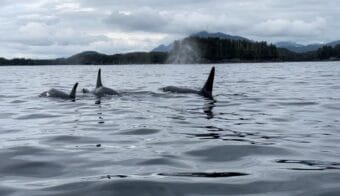
Orcas spotted in the Bering Sea in August 2023. (Courtesy Dustin Unignax̂ Newman)

The Center for Biological Diversity is preparing to sue the federal government for allegedly failing to protect killer whales from trawlers in the Bering Sea.

The trawl fleet in the Bering Sea and Aleutian Islands has come under fire in recent weeks. The backlash follows a report from the National Oceanic and Atmospheric Administration that said 10 orcas were hauled up in trawl nets over the last year, nine of which died.

The conservation group said in a Monday statement that NOAA Fisheries must uphold its duty to protect the killer whales, which are protected by the Marine Mammal Protection Act.

The national conservation group said the trawlers are catching lots of non-targeted species, or bycatch, in defiance of conservation laws.

It’s not a new issue for orcas to get caught up in fishing gear, but the recent numbers are a jump up from previous years. The trawl fishery association Groundfish Forum said their boats have reported a recent uptick in orca encounters. Climate change may play a role in the increased sightings, as many ocean species adapt to new conditions.

The conservation group announced they would file a lawsuit if NOAA Fisheries did not adequately address the allegations within 60 days.

Site notifications
Update notification options
Subscribe to notifications