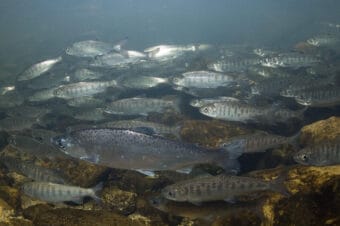
UAF associate professor Peter Westley holding spawning male chum salmon from the Anaktuvuk River in September 2023. (Joe Spencer/Alaska Department of Fish & Game)
University of Alaska Fairbanks associate professor of fisheries Peter Westley is clear that there’s nothing new about salmon straying into Arctic Ocean waters. Westley says the fish have long been occasionally observed and caught, but their numbers appear to be increasing.
“And we were interested in whether the change in the sort of frequency of salmon being encountered…is that a perhaps indicator that the salmon are not only showing up in the ocean but are showing up in rivers and are potentially working to establish populations in a new region.”
Last month, Westley lead a team that aerially surveyed two Colville River tributaries, the Anaktuvuk and the Itkillik, and counted about a one hundred chum salmon equally split between the two Arctic rivers. He says movement of a species farther north is a clear signal of climate change.
“So in the past where those fish might have been sort of hopeful colonists showing up and kind of giving it a go, the conditions are just changing enough that we might be on the cusp of having it be a viable success story for the salmon.”
Elizabeth Lindley, a PhD student working on the project, says that while the development is positive for the salmon, it’s not necessarily good for the region’s people.
“Being Yupik and from Bethel, I was really interested in this question about salmon, which are really important to me, maybe impacting other Indigenous ways of life and ecosystems,” she said.
Lindley helped organize and lead an Arctic salmon workshop last December where she says people shared difference perspectives on the movement of the fish.
“Some community members that were present expressed concern over increasing salmon and not wanting to catch more salmon because it interferes with cultural harvesting practices, but I think it really varies by the person and the community,” she said.
Lindley says the impact of salmon sharing spawning grounds with Arctic char and Dolly Varden is among the unanswered questions.
The UAF team deployed temperature sensors in gravel where the chum salmon were observed spawning to track whether the water remains warm enough for the eggs to survive. The origin of the Arctic chums is unknown, but Westley says analysis of samples gathered from the fish this fall will provide clues.
“Extract DNA and sort of compare that to the genetic structures of known populations,” he said. “You can also use the water signatures, the chemistry of the waters themselves that gets archived in the ear bones, the otoliths.”
Lindley and Westley both emphasize the value of Indigenous knowledge in understanding the history and future of salmon in the Arctic Ocean and North Slope rivers. The UAF lead research group plans to head back to the Anaktuvuk and Itkillik rivers next fall to look for smolt as well as more spawning adults.
Red king crab from the Bristol Bay fishery. (KUCB file photo)
The Alaska Department of Fish and Game has reopened the Bristol Bay red king crab fishery, following a two-year closure.
The department announced Friday morning that the lucrative crab fishery will open Oct. 15, following analysis of survey data by the North Pacific Fishery Management Council.
The fishery closed in 2021 for the first time in more than 25 years due to low abundance. But this season, fishermen will have a total of more than 2.1 million pounds to catch — that includes both Individual Fishing Quota and Community Development Quota. In 2020, the total allowable catch was nearly 2.7 million pounds.
According to fisheries officials, summer trawl survey data shows higher numbers of mature females within the population. And while male and female crab are still at historic lows, the fishery is not at or approaching an “overfished” status.
Fish and Game said that the total estimated amounts of both mature and reproductive females are above thresholds required to open the fishery.
Red kings are the largest commercially harvested crab and are mainly caught in Bristol Bay. According to the National Oceanic and Atmospheric Administration, the Bristol Bay stock is considered the second largest king crab population in the world.
Fish and Game also announced Friday morning that the Bering Sea snow crab fishery will remain closed for a second year. Snow crab — or opilio crab — was declared “overfished” in 2021, and regulators closed the fishery the next year, not long after state surveys showed record highs for snow crab recruitment. The drastic drop came as a surprise to many in the industry. Some theories suggest climate change is to blame.
There will be a western and eastern Bering Sea tanner crab season this year. That will also open on Oct. 15. The state has allotted a total of more than 1.3 million pounds to the western district of tanner crab — or bairdi — and 760,000 pounds to the eastern. The western allotment is up more than 50% from last year’s total allowable catch, while eastern tanner TAC has dropped nearly 35% from last year.
The Bristol Bay red king crab fishery opens Oct. 15 at noon and closes Jan. 15.
A king salmon is displayed outside a fish processor in downtown Petersburg in 2019. (Photo by Angela Denning/CoastAlaska)
Wild king salmon stocks are in decline all over the North Pacific Ocean and Alaska. Outside Alaska, some are trying to conserve the fish by limiting sport fishermen to hatchery-only kings. That’s being studied as a possibility for Southeast Alaska, too, but the idea is receiving a chilly reception so far.
British Columbia, Washington, and Oregon use what’s called mark-selective sport fishing to help conserve wild king salmon or chinook. Anglers can only keep hatchery kings that have their fins clipped, a marking practice done at hatcheries before the juvenile fish are released.
“It’s really about trying to vet another approach,” said Judy Lum, the Alaska Department of Fish and Game’s supervisor for sport fishing in Southeast Alaska. “So it was, ‘Okay, well, they do it down here. Can it work for us? And if it can work for us, in what situations? What conditions? Or can it be broad brush? Or does it have to be very specific?’”
Lum stresses that they are only studying the possibilities. They don’t know if a mark-selective fishery would help or hinder king salmon stocks or whether the benefits outweigh any potential costs.
“We have all these tools in our toolbox, so to speak for management,” said Lum. “And this would be just one additional tool to the toolbox.”
The question originated with the Pacific Salmon Commission. The commission is a regulatory group of U.S. and Canadian governments overseeing the fairness of salmon management in both countries. Alaskans involved with the commission asked the state’s Department of Fish and Game to consider the potential for a mark-selective fishery in Southeast. The department contracted with the University of Washington to do the study using grant money.
But so far, Alaskans haven’t been receptive to the idea. The state has held community engagement meetings in Juneau, Ketchikan, Klawock, and Sitka. And Lum says they’ve heard a lot of concerns.
Derek Anderson attended the meeting in Klawock.
“A lot of people are upset,” he said.
Anderson and his wife own a fishing lodge in Craig on Prince of Wales Island. He says the meeting was standing room only and full of emotion — subsistence, commercial and sport users came together.
“The main voice was no, this is not a good program for Southeast Alaska, in any way, shape, or form,” he said.
Anderson says they’d rather keep things the way they are and fish by harvest limits, which recently has been a few fish per day for residents and two to three fish per season for non-residents. He says targeting just hatchery kings would hurt more fish.
“There’s just not enough hatchery fish in our waters to make that whole thing viable,” Anderson said. “If you’re out there having to fish for hours on end to look for hatchery fish, and you’re turning back wild fish after wild fish after wild fish, a lot of those fish end up dying.”
Fishermen in Sitka felt the same. Roughly three dozen people participated in the community meeting, including 74-year-old Eric Jordan. He is a life-long troller and says everyone was cordial, but no one wanted the program.
“I think there was a lot of skepticism in the audience that this would be a good way to go here,” said Jordan.
Jordan is a self-described conservationist and has participated in fish policy for decades, from local fish advisory councils to the state Board of Fish. He says for the program to work, it would have to address the harm of catch and release.
“In the salt waters of Southeast Alaska, you’re going to need to change the rules to minimize mortality,” he said.
How many kings in Southeast are wild or come from hatcheries varies by location. It’s complicated because most of the kings (63%) originate in non-Alaska areas — both wild and hatchery stocks — and not all hatchery fish are marked.
Lum, with Fish and Game, says incidental bycatch is also a big concern for the state. Starting up a mark-selective sport fishery would be a years-long process that would require a lot of buy-in.
And there isn’t hard data that the program is working elsewhere. Mark-selective fisheries have been ongoing for about 20 years in some locations in Washington. But has it really been successful? The jury is still out, according to Anne Beaudreau. She’s an associate professor at the University of Washington conducting the state’s study.
“There’s so many different variables to that.” she said. ” And it’s actually been a really hard question to answer.”
So she says something like a mark-selective sport fishery may or may not work in Alaska.
“Mark-selective fisheries are not a one-size-fits-all approach,” said Beaudreau. “The way that they have been implemented, and the way that they’ve been managed has been different, depending on where they’ve taken place.”
The study results are expected to be completed by next spring.
Another opportunity for Southeast Alaskans to learn about the study and comment on it is coming up Wednesday, Oct. 4 at 7 p.m.
An American Seafoods Company vessel in the Port of Dutch Harbor in June 2020. (Hope McKenney/KUCB)
The U.S. Environmental Protection Agency has fined one of Alaska’s biggest fishing companies nearly $1 million for Clean Water Act violations.
American Seafoods Company is the world’s largest at-sea processor of Alaska pollock and holds the largest allocation of wild Pacific hake. The company operates a fleet of seven vessels in the North Pacific Ocean and Bering Sea.
The EPA cited the company and the owners of its vessels for hundreds of violations along the Oregon and Washington coasts, including discharging waste in a protected area, failure to monitor discharges and reporting inaccurate information in required annual reports, according to a Thursday statement.
“Discharge of seafood processing waste in prohibited areas and within the 100-meter depth contour of Washington and Oregon exacerbates already existing low-oxygen conditions which negatively impact most fishes, crabs and other marine life,” the EPA said.
An American Seafoods spokesperson said the company was notified of the allegations in March. Since then, he said the company has provided all documentation to the EPA, and that it’s assigned additional staff and updated its processes to ensure reporting is “complete, accurate and timely.”
The EPA found that American Seafoods and the owners of its vessels had noticeably more severe and much higher number of violations than other Oregon and Washington offshore fish processors during a compliance check of the industry. The vessels are the American Dynasty, American Triumph, Northern Eagle, Northern Jaeger and Ocean Rover.
The EPA is requiring American Seafoods to conduct “corporate-wide, systemic improvements” to ensure compliance with its permits, and requires they pay $999,000 in penalties.
“In amassing hundreds of violations from illegal discharges to sloppy and even non-existent record-keeping American Seafoods Company demonstrated a clear disregard for the fragile and valuable resources that sustain its business,” said Ed Kowalski, director of EPA’s Enforcement and Compliance Assurance Division in Seattle. “When issuing a permit, EPA confers to the permit holder the responsibility to protect our nation’s resources. We expect the company-wide, systematic overhaul of its operations will re-focus American Seafoods Company on the true value of its permit, the importance of tracking compliance with the permit, and the resources that permit entrusts it with protecting.”
When asked about the company’s Alaska operations, an EPA spokesperson did not say whether or not the agency is currently bringing any enforcement actions against them.
Orcas spotted in the Bering Sea in August 2023. (Courtesy Of Dustin Unignax̂ Newman)
Federal officials are looking into the deaths of nine orcas that were hauled up by groundfish trawlers in Bering Sea and Aleutian Islands fisheries this year, and conservation groups say more needs to be done to prevent such deaths.
According to NOAA Fisheries, a tenth whale was released alive, but the nine other orcas incidentally caught in trawl nets weren’t so lucky.
“NOAA Fisheries is analyzing collected data to determine the cause of injury or death and determine which stocks these whales belong to through a review of genetic information,” saidJulie Fair, public affairs officer with the federal agency’s Alaska office, reading from a statement published Thursday. She declined to be interviewed, except to read the statement aloud.
Killer whales are protected under the Marine Mammal Protection Act, which requires boat owners or operators to report the deaths and injuries of the mammals during commercial fishing and survey operations.
Fair said NOAA Fisheries monitors bycatch of protected species to determine whether the animals were dead before being caught or were killed or seriously injured by commercial gear.
The vessels involved in these incidents weren’t named, but Fair said the boats involved were all required to carry two federal observers on board.
“Nine, ten killer whales is too many,” said Shari Tarantino, head of the Seattle-based advocacy group Orca Conservancy, which advocates for the endangered Southern Resident killer whale population that roams from California to Southeast Alaska. “And if it’s just this year, something needs to be done in the future to mitigate these atrocities, frankly.”
Chris Woodley, head of the Groundfish Forum — the Seattle-based association that represents Bering Sea trawlers — declined to be interviewed, providing a written statement to KUCB instead. In it, he said that vessels are experimenting with gear modifications that may prevent whales from entering trawl nets, and that the Amendment 80 trawl boats voluntarily stopped fishing on Sept. 9, with more than three months left in the season, because of the orca bycatch.
Fishing boat encounters that harmed or killed orcas in Alaskan waters were rare until recently, according to the statement, first reported by the Anchorage Daily News. NOAA reported just seven killer whale mortalities or serious injuries resulting from fishing gear entanglement between 2014 and 2020.
“In 2023, our captains have reported an increase in the number of killer whales present near our vessels, where they appear to be feeding in front of the nets while fishing,” the statement reads in part. “This new behavior has not been previously documented and marine mammal scientists are not sure why this change has occurred.”
Tarantino said it’s important to protect orcas for future generations.
“We’re not saying stop trawling, even though I think trawling is unbelievably devastating to the ocean animals and the beings that live there,” she said. “But to continue taking this bycatch is just insane. It’s destroying our future, in my opinion. You know, if the ocean goes, we go.”
Biologist Deborah Giles, the science and research director for the Washington-based nonprofit Wild Orca, said she wasn’t surprised when she heard about the nine orca deaths.
“I was glad that [NOAA was] finally recognizing it publicly,” she said. “Of course, my cynical brain wonders how often this is happening when it was not reported — or at least not released publicly. I’m very glad that this is going to be investigated.”
Giles said the industry needs to figure out a safe way to keep animals from interacting with fishing vessels and reduce bycatch of non-targeted species.
“We’d ask NOAA to come up with some new protocols for ensuring that this doesn’t happen again in the future,” she said. “NOAA is responsible for marine mammals, like killer whales, and they’re also responsible for making sure that the fisheries are not jeopardizing non-targeted species. And especially in the trawl industry, bycatch is massive. And it’s unsustainable. Initially, what we need to know is what are they doing about this? What steps are going to be taken to minimize this?”
Activists with the “Stop Factory Trawler Bycatch” campaign planned to hold a protest Thursday outside the annual meeting of Genuine Alaska Pollock Producers at Seattle’s Four Seasons Hotel.
“Nothing I have seen yet clearly states which trawl vessels were involved,” anti-bycatch activist David Bayes said in a text message.
Genuine Alaska Pollock Producers did not immediately respond to a request for information Wednesday afternoon.
In a written statement, NOAA spokesperson Julie Fair said the agency is working quickly to evaluate the orca-harming incidents and will share findings as soon as possible.
Two Eastern North Pacific right whales are seen swimming in the Gulf of Alaska in August of 2021. They were among four right whales spotted just south of Kodiak Island during a survey by scientists with the National Oceanic and Atmospheric Administration. Scientists believe there are only about 30 animals in the population, and sightings are rare. NOAA Fisheries is now considering a revision to its designated areas of critical habitat in waters off Alaska, a response to a petition from environmental groups seeking broader areas of protective zones for the right whales. (Photo provided by NOAA Fisheries)
Some of the world’s rarest whales could get enhanced protection under a plan announced by federal regulators on Tuesday.
The National Oceanic and Atmospheric Administration’s National Marine Fisheries Service said it will reevaluate the habitat designated as critical for the tiny population of right whales that swim in the waters off Alaska.
The move is in response to a petition filed last year by the Center for Biological Diversity and an organization called Save the North Pacific Right Whale. They argued that the areas of critical right whale habitat designated 15 years ago by NOAA Fisheries are far too small to effectively conserve the tiny population.
Scientists believe there are only about 30 animals in what is called the Eastern North Pacific right whale population. The critically endangered population that shares Alaska waters with fishing vessels and cargo ships is distinct from other highly endangered right whale populations in the world, including the few hundred in the Western North Pacific population and the North Atlantic population.
Critical habitat, as defined in the Endangered Species Act, is an area that is considered essential to conservation of a listed population. The act requires that any endangered or threatened listing be followed by a designation of critical habitat, as long as there is enough information available to do so. Within critical habitat, any activities requiring federal permits must be vetted for potential impacts to the listed species.
NOAA Fisheries in 2008 designated critical habitat consisting of 1,175 square miles in the Gulf of Alaska south of Kodiak Island and 35,460 square miles in the southeastern Bering Sea.
The environmental petitioners are seeking a vast expansion, to include a large swath south of the Alaska Peninsula and eastern Aleutian Islands and a larger chunk of the southeastern Bering Sea north of the Aleutians. Included in the groups’ proposed expansion is a heavily trafficked area called Unimak Pass, an important marine transit zone used by ships, marine mammals and fish traveling between the Gulf of Alaska and the Bering Sea through the easternmost section of the Aleutians.
A map shows existing critical habitat for North Pacific right whales in Alaska waters and an expansion proposed by environmental groups in a petition submitted in 2022 to the National Oceanic and Atmospheric Administration’s Fisheries service. The map also shows many of the locations where the rare whales were spotted in recent years. (Map provided by NOAA Fisheries)
NOAA Fisheries has not yet committed to any particular expansion, said Jenna Malek, the agency’s North Pacific right whale recovery coordinator.
“It’s unknown at this time what a revision is going to look like,” Malek said.
In addition to Unimak Pass, other areas the environmental groups are seeking to add as designated critical habitat overlap with areas used for commercial fishing and shipping. Malek said NOAA Fisheries will have to consider possible impacts to those industries as it evaluates options for critical habitat revisions.
Since 2008, there have been visual sightings or acoustic recordings of right whales in areas outside of that designated critical habitat, according to NOAA Fisheries.
In one notable case, an Eastern North Pacific right whale was spotted in 2018 well to the north of existing designated critical habitat in waters off St. Lawrence Island at the southern tip of the Bering Strait, then later in nearby waters off Russia. Another St. Lawrence Island sighting occurred in 2019.
Two North Pacific right whales were spotted in February of 2022 feeding in waters near Unimak Pass, according to NOAA. The most recent sighting was in February, made by people aboard a whale-watching ship off Monterey, California, Malek said. It is unclear whether they migrate and, if so, how they migrate, she said. “We know that they can be popping up pretty much anywhere any time of the year,” she said.
Sightings are rare. “Only a handful of folks have actually seen them,” she said.
While a couple of sightings of juveniles are considered encouraging, there are continued mysteries about the population, Malek said.
“There is a lot more that is unknown than is known about this species, unfortunately,” she said.
The North Pacific right whale population was once feared extinct, the victim of commercial harvests of past centuries. They were considered the “right whales” to hunt because they swim slowly and have such a high blubber content that they floated when killed.
A rare North Pacific right whale is seen swimming in the Gulf of Alaska in August of 2021. The whale, spotted during a scientific survey conducted by the National Oceanic and Atmospheric Administration, is demonstrating the distinctive V-shaped exhale for which right whales are known. (Photo provided by NOAA Fisheries)
Now the major threats cited are, along with climate change, ship strikes and entanglements in fishing gear. Such events have been documented among the North Atlantic right whale population, but so far not among the tiny Eastern North Pacific population swimming off Alaska, Malek said. But given the remoteness of the habitat, incidents are possible, she said. “We don’t have any evidence, but that’s not to say that it’s not happening.”
The groups seeking expanded critical habitat welcomed NOAA Fisheries’ action.
“I’m encouraged that North Pacific right whales may get these badly needed protections,” said Cooper Freeman, the Center for Biological Diversity’s Alaska representative, said in a statement. “There’s no time to waste in helping these whales, who are teetering right on the brink of extinction.”
Kevin Campion, founder of Save the North Pacific Right Whale, said in the statement: “As one of the rarest whales on the planet, North Pacific right whales require a dedicated effort to recover. … We’re grateful to NOAA for recognizing these areas are critical to the whale’s survival.”
However, the Center for Biological Diversity is critical of another federal action in waters used by right whales and other marine species.
The center last week sent a notice of intent to sue the U.S. Department of Transportation’s Maritime Administration over its recent decision to include barge routes in the Gulf of Alaska and Bering, Chukchi and Beaufort seas in the federal marine highway system.
The designation of what is being called the M-11 route through Alaska waters, announced last month by Transportation Secretary Pete Buttigieg, failed to consider impacts of increased ship traffic to endangered and threatened species, including North Pacific right whales, the center’s Sept. 21 notice said.
“There can be no doubt that vessel traffic on the M-11 Route ‘may affect,’ and is ‘likely to adversely affect,’ these listed species. Increasing vessel traffic heightens the likelihood and risk of ship strikes, strandings, and spills of fuel, oil cargo, or chemicals, intensifies vessel noise, and may adversely affect prey abundance,” the notice said.