Fisheries

Marshall’s tribal president speaks on the cultural toll of the Yukon River salmon crash

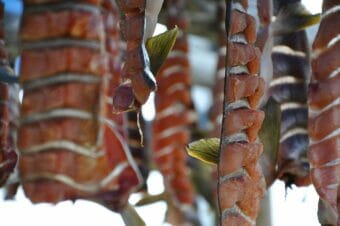
Christian Mulipola reaches for king salmon strips his grandmother, Diane Ishnook, has hung up to dry. Her king salmon were caught far downriver from Koliganek. (Photo by Avery Lill/KDLG)
Christian Mulipola reaches for king salmon strips his grandmother, Diane Ishnook, has hung up to dry. (Avery Lill/KDLG)

Salmon runs on the Yukon River have been dwindling for years. And the loss of commercial and subsistence fishing has hit communities hard. KYUK sat down with Tribal President Nick Andrew Jr. of Marshall on Aug. 9 to talk about what the salmon crash means for people who have relied on the fish since time immemorial.

Andrew has fished for salmon commercially and for subsistence since he was five. He spoke about the emotional and cultural toll that the salmon crisis has taken on his community.

Listen:

This interview has been edited for clarity and length.

Nick Andrew Jr.: My name is Nick Andrew Jr. I am a tribal citizen of Marshall. I am also the tribal president, but what I have to say is not necessarily a statement on behalf of the tribe.

I’m from Marshall, born and raised. I’ve been part of the salmon fishery, the commercial and subsistence, since I was five years old. I helped my family, my grandparents, my uncles, my aunts, my nieces, my cousins, we all worked together in the past. And yes, salmon does define who I am. It does define my ancestors, my family, my relatives, everyone on the river.

Nick Andrew Jr., Native Village of Marshall Tribal President. (Dean Swope/KYUK)

We’ve been in conservation mode for king salmon for about 40 years. And that’s a long time. I’ve seen the years of plenty. I’ve seen the years of scarcity, and it’s a political issue now.

Loss of salmon hit us really hard on the cultural side. There went our connection to the ancestors. We also lost that family connection. Because a lot of people went fishing and processing, they involve the family. And the last four years have been hard, especially the years we were in strict conservation mode. It was felt in the community and the region on the lower Yukon River. We had a sense of helplessness.

Basically, not knowing was the biggest thing. We thought that the salmon were going extinct, that was one of the thoughts. And we also had a sense of despair. We didn’t have salmon, dried salmon, smoked salmon, salmon strips, salmon dry-fish, king salmon, salted fish, and salmon for the freezer, for the winter. That took a big emotional toll on our people.

Our subsistence rights are not negotiable. We only take a small fraction of any of the runs that pass the river. And it’s not too hard to ask that more be done for the salmon. Because if nothing’s done, within 50 years we’re gonna be on the endangered list, probably extinction at the rate things are going. So we just need a voice at the table, especially on the North Pacific Fishery Management Council. Our input is important. Our traditional knowledge is important. And we, the Native peoples along the river on shore, we matter too. That needs to be kept in mind.

Francisco Martínezcuello: How has this year’s run been?

Nick Andrew Jr.: Well, when we look at the run we get information from the Alaska Department of Fish and Game on their Facebook page and the faxes we’re getting to the tribe, and they’re showing lower and lower numbers. That’s very concerning. And on a different note, we were allowed to harvest the summer chum. And that really helped a lot of people. And that put reassurance that hey, we do matter. Hey, we’ll have salmon for the winter, even though it’s not the king salmon we’ve desperately been wanting for years. So that’s where we are.

Francisco Martínezcuello: What about your memories as a kid fishing around here, to give people like me who are complete outsiders an understanding of how things used to be, especially for your people, your family?

Nick Andrew Jr.: Growing up was a different time. We had plenty of fish: king salmon, summer, fall chum, and the silvers. The village would empty. Families went to fish camp during those years. Everyone was happy. The dogs that were needed for our transportation and subsistence activities back in the day were fed, they relied on salmon too. All the bears, the birds, meaning the eagles and falcons, seagulls, they were happy too, and the world was complete then. So, on any given day, dried salmon, salted salmon were eaten three or four times a day.

Nowadays, as the salmon started to dwindle, people had to find other species. But still that left the void, the void meaning a big part of our staple was gone. And it’s still, the puzzle isn’t complete today because we got all these factors, and that affected our culture, our physiological and our mental well-being as well. You know it does weigh heavily on our minds, and our very DNA are in tune with salmon as our diet, our identity, our culture. So as the salmon continue to dwindle, that’s impacting just about everyone in our region and on the lower Yukon River because it was the common denominator that made us whole.

KYUK’s Evan Erickson helped with this story.

Crew member on Alaska factory trawler dies after possible ammonia exposure

The Northern Eagle docked in Unalaska/Dutch Harbor in July 2020. (Hope McKenney/KUCB)

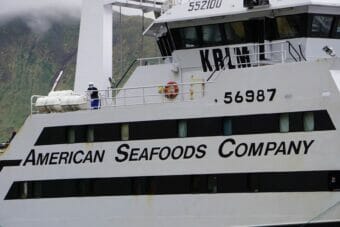
A crew member on an American Seafoods factory trawler died at sea last week, likely from an ammonia leak on board.

U.S. Coast Guard Petty Officer Second Class John Highwater said they received a satellite call from the Northern Eagle at about 4 a.m. Friday.

“One of their crew members was found unresponsive in one of their engineering spaces,” Highwater said. “They believe there was an ammonia leak somewhere in the vessel that caused the person to fall unconscious.”

Jeremy Baum, the Alaska Wildlife Trooper stationed in Unalaska/Dutch Harbor, identified the crew member as First Engineer David Kuma from Ghana, in West Africa.

Forty-three-year-old Kuma was found unresponsive just after 12 a.m. that morning, according to Highwater.

The nearly 350-foot vessel was already en route to Unalaska/Dutch Harbor when they made the call to the Coast Guard. Highwater said it would have taken Coast Guard crew longer to reach the vessel than for the trawler to head to port.

Unalaska’s Fire Chief Ben Knowles said the Northern Eagle reached Unalaska around 5 a.m. the next day — roughly 24 hours after the distress call. From there, the case was turned over to local responders.

“The fire department, along with NOAA, the U.S. Coast Guard Marine Safety Detachment and the Alaska State Troopers boarded the vessel around 6 a.m., once they were all tied up, and began the investigation into the incident,” said Knowles.

He said Kuma was pronounced dead prior to arriving at port. The Unalaska Fire Department assisted troopers with their investigation, provided decontamination and offered grief counseling for the vessel, according to Knowles.

“We were able to hold some listening sessions and just kind of make sure that the crew members were able to have someone to talk to,” he said.

American Seafoods brought Kuma’s family to the island, according to Knowles.

“We are here to offer our services to them,” he said. “And we’re hoping that they can find some healing in this process.”

The Coast Guard, troopers and NOAA Enforcement are investigating the incident.

Kuma’s body was sent off island to the State Medical Examiner’s Office on Tuesday for an autopsy, according to Wildlife Trooper Baum.

American Seafoods declined a request for comment.

New quota system to start for trawl harvests of cod in Bering Sea and Aleutians

A closeup view of a Pacific cod is seen in this undated photo. The commercial catch of Pacific cod is the second-largest groundfish harvest in waters off Alaska. A new system assigning cod quota shares to trawlers in the Bering Sea and Aleutians is set to go into effect in January. (Photo provided by NOAA Fisheries)

Commercial fishermen netting Pacific cod from the Bering Sea and Aleutians region will be working under new individual limits starting next year designed to ease pressure on harvests that regulators concluded were too rushed, too dangerous and too prone to accidentally catch untargeted fish species.

The new system will require fishers who harvest cod by trawl – the net gear that scoops up fish swimming near the bottom of the ocean – to be part of designated cooperatives that will then have assigned quota shares. The fisheries service at the National Oceanic and Atmospheric Administration said it has notified eligible participants and is asking for applications.

The cod-trawling program, to start next January, is the first new fishery quota system started since 2012 in federal waters off Alaska, according to NOAA Fisheries.

The Pacific cod harvest is the second-biggest commercial groundfish catch in the waters off Alaska, after pollock, according to NOAA Fisheries. The 2021 commercial harvest totaled 330.4 million pounds and was worth $86.5 million, according to NOAA Fisheries

Pacific cod is harvested by three gear types: longline, which catches fish with hooks arrayed on lines; pot and jig gear, which traps fish; and trawl nets. In the Gulf of Alaska, pot and jig gear dominate the Pacific cod harvest, while longline gear dominates the harvest in the Bering Sea and trawling is the method most used to harvest Pacific cod in the Aleutians, according to NOAA Fisheries.

A quota system has been in effect for several years for longline harvests of Pacific cod, and the total allowed cod catch is already divvied up among the various categories of harvesters through the North Pacific Fishery Management Council process.

While the system to go into effect in January for trawl-caught cod in the Bering Sea and Aleutians is new, numerous other harvests of fish in federal waters off Alaska have previously been converted from open-access systems to quota systems through a process sometimes referred to as “rationalization.”

A Pacific cod is seen swimming near the ocean floor in Alaska waters in this undated photo. (Photo provided by NOAA Fisheries)

Through rationalization, maximum catches limits are assigned to specific harvesters through quota shares, replacing systems where participants are allowed to catch as much fish as they can until the season’s limit is reached by the full fleet.

The resulting quota systems are referred to by the North Pacific Fishery Management Council as Limited Access Privilege Programs.

The idea of converting Bering Sea and Aleutian trawl harvests of Pacific cod to this type of system started as early as 2019, when the council was contending with a crash of Pacific cod stocks in the Gulf of Alaska. The council in 2021 recommended creation of the new system. The final rule for it was published on Aug. 8.

Managers concluded that numerous conditions warranted the change, said NOAA Fisheries spokesperson Julie Fair.

“This Program would provide incentives to increase the length of the directed fishing season and allow deliveries to be distributed over a longer timeframe, which would benefit both harvesters and processors,” Fair said by email.

Among the conditions prompting the change are a decline in the total allowable Pacific cod catch and an increase in the number of licensed harvesters and associated vessels, along with “the compressed length of the fishery in recent years, the decreased product quality caused by a race for fish in recent years, need to minimize bycatch, and safety concerns,” she said.

Bycatch is the incidental harvest of untargeted species.

The new quota system is applicable only to trawl harvests of Pacific cod in about the first half of the year, the periods referred to as the A and B seasons. The A season runs from Jan. 20 to April 1 and the B season runs from April 1 to June 10.  There is a smaller C season that runs until Nov. 1, but it is not part of the new program.

The new system is supported by trawling industry groups.

The deadline to submit applications for the new quota system is Oct. 10, NOAA Fisheries said.

This story originally appeared in the Alaska Beacon and is republished here with permission.

NOAA outlines sweeping plan to boost the nation’s seafood industry

Commercial fishing vessels docked in the St. Paul Harbor in Kodiak; Feb. 6, 2023 (Brian Venua/KMXT)

The National Oceanic and Atmospheric Administration has released a sweeping five-year plan to prioritize and promote the country’s commercial fishing industry.

NOAA Fisheries announced its National Seafood Strategy on Wednesday. The agency said in a press release that the plan will “outline the direction” of the country’s seafood sector. It’s the first time NOAA has released an overall strategy aimed at addressing industry needs – the agency says it will complement other federal policies that are already in place.

The new plan outlines broad priorities, like investments in sustainability, research and aquaculture, and calls for making the country’s seafood sector more competitive – both within the U.S. and on the global market. It also outlines current challenges to the nation’s seafood industry, like labor shortages and lingering market disruptions caused by the pandemic. Climate change is also identified as a main present – and future – challenge to fishing communities.

The National Seafood Strategy is vague on costs and timelines, and doesn’t provide any regional insights into how the strategy might be implemented in places like Alaska. But it comes as processors are blaming competitive market conditions for lower payouts to fishermen across several of the state’s fisheries, and a string of cuts to catch limits and all-out closures.

NOAA estimates the dockside value of the country’s seafood industry at $6.3 billion – as of 2020, Alaska accounted for 60% of all commercial landings and 31% of the industry’s overall value.

Trooper citations for salmon discards add grist to regional Alaska fishery dispute

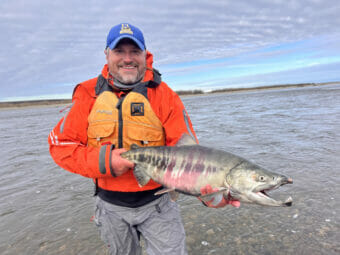
Two chum salmon show the distinctive stripes that emerge after they enter freshwater to spawn. Chum salmon are important to the diets of Indigenous residents of Western Alaska. (Photo provided by NOAA)

For years, residents along the Yukon and Kuskokwim rivers have accused fishers operating in marine waters north of the Alaska Peninsula of intercepting too many river-bound salmon, sometimes in hidden ways.

Now a trooper enforcement campaign by the Alaska State Troopers wildlife division gives some credence to those accusations.

The campaign, carried out in June and July in the region known as Area M, resulted in nine citations issued to captains and crew members for allegedly dumping unwanted salmon overboard, the Alaska State Troopers said in a statement issued Thursday.

The species of discarded salmon was not disclosed, but it was potentially chum salmon bound for the Yukon and Kuskokwim rivers, where there have been devastating chum crashes in recent years.

“I think many people from along the Yukon knew it happened,” Serena Fitka, executive director of the Yukon River Drainage Fisheries Association. “It does occur, and we’re glad it’s finally getting acknowledged.”

Kevin Whitworth, executive director of the Kuskokwim River Inter-Tribal Fish Commission, referred to the practice as “chum chucking.” The fishermen want sockeye, and “they don’t want to keep the chum salmon, so they throw it overboard,” he said.

The trooper citations add to the long-simmering dispute over salmon that travel through the Bering Sea to spawning grounds in the Yukon and Kuskokwim drainages. As chum and chinook salmon returns in the rivers have dwindled and harvests have closed, residents have blamed Area M interception for contributing to those problems. But the Area M commercial fisheries are vigorously defended by Alaska Peninsula and Aleutian residents who depend on them.

Attempts to resolve the disputes reached the Alaska Board of Fisheries last February. The board considered proposals to restrict Area M fishing and ultimately approved rules that the Yukon-Kuskokwim advocates characterized as too weak but that the Aleutians East Borough, the regional government for many communities dependent on Area M harvests, deemed appropriate.

The meeting was emotion-charged, with both Yukon-Kuskokwim fishers and fishers from the Alaska Peninsula and eastern Aleutians testifying about the need to protect their well-being, communities’ stability and cultures.

Scientists believe that the Yukon and Kuskokwim salmon crashes have more to do with climate change impacts in the ocean and possibly in the upriver spawning areas than with bycatch, the term for unintended catches of fish during harvests of other targeted species. However, interceptions could be exacerbating the problem, some say.

In a brief statement Thursday, the Aleutians East Borough criticized the cited salmon discards.

A docking facility is seen in 2009 in Sand Point. The community on the Alaska Peninsula is part of the Aleutians East Borough and is highly dependent on the fish harvests conducted in the region known as Area M. (Photo provided by the Alaska Division of Community and Regional Affairs)

“We absolutely do not condone this type of reckless and illegal behavior. We believe the State of Alaska’s enforcement division will handle this to the harshest extent of the law,” the borough statement said.

Area M is a difficult place to conduct fishery patrols, said Major Aaron Frenzel, deputy director of the Alaska Wildlife Troopers.

Unlike the Bristol Bay or Kodiak fisheries, where vessels can be crowded together and where troopers aboard a patrol vessel can easily see practices and behavior, the Area M harvests are conducted by boats separated by vast distances.

A trooper helicopter proved key to the Area M enforcement effort, he said. But availability of that helicopter and other assets limits any enforcement in the region because wildlife troopers need to patrol other fisheries, Frenzel said. That means some strategic movement of ships, aircraft and people to the places where they are most needed, he said.

“It’s kind of like a chess game,” he said.

The outcome of the citations is yet to be determined. The fishers cited, some of them from Washington state, have court appearances scheduled for later this month in Anchorage. The violation is considered a class A misdemeanor punishable by fines of up to $15,000 and jail terms of up to one year, Frenzel said.

The Board of Fisheries is not expected to hold another Area M-focused meeting for three years, according to the meeting cycle. The next scheduled meetings are focused on Cook Inlet and Kodiak fsh.

Citizens may ask the board to consider subjects outside of the normal cycle. The next deadline to request that consideration is Aug. 14, and requests are to be considered at the board’s scheduled October work session.

Aside from their special Area M operation, wildlife troopers conducted their regular summer patrols in the Bristol Bay fishery, source of approximately half of the world’s harvested sockeye salmon. The Bristol Bay operation involved multiple patrol boats and aircraft, the trooper statement said. Over 400 commercial vessels working in Bristol Bay were boarded, with thousands of fishermen contacted, 150 citations issued and thousands of pounds of salmon seized, the trooper statement said.

Trident Seafoods drops salmon prices due to flooded global markets

The Trident Seafoods processing plant in Petersburg. (Hannah Flor/KFSK)

Trident Seafoods dropped the price for Alaska chum salmon this weekend, from 60 cents to 20 cents per pound for all fisheries. The company also announced a plan to drop pink salmon prices. Trident says Russian pink salmon harvests are affecting demand for all kinds of salmon.

Trident is the largest U.S.-owned fish processor in Alaska, with dozens of processing plants and vessels. It announced the price drop in a letter to fishermen on Saturday, saying that chum salmon markets have collapsed. The company did not elaborate, and did not respond to requests for comment.

But the Alaska Seafood Marketing Institute’s executive director, Jeremy Woodrow, said it’s true — salmon markets are flooded.

“The entire global salmon market is challenged right now,” Woodrow said. “So, I would say it’s not just chum salmon, but it’s chum salmon, pink salmon and really all salmon species.”

He said Alaskan chum salmon also have specific competition from Japan.

“Japan’s Hokkaido chum salmon fishery has returned after several years of being down and so that’s added actually more chum salmon to the market as well,” Woodrow said.

Earlier this summer in Bristol Bay, Trident Seafoods was the first processor to drop sockeye prices, causing fishermen to protest. The other two processors in the area followed with price drops a few days later. In Petersburg, the two main processors are Trident and OBI Seafoods. A representative for OBI declined to comment on the possibility that they would also drop chum prices.

In its letter, Trident said they plan to drop the pink prices once there is a large amount of pinks with pale meat color or what’s called PMC. Salmon meat is paler at the end of a salmon’s life, when nutrients go to producing eggs and sperm sacks. It’s less marketable and lower quality. Salmon with paler meat have mature salmon eggs. Usually, the eggs make up for the pale meat’s lower market price — but according to Woodrow, Russia is having one of its largest pink salmon years on record. He said that makes it hard to compete.

“Russia’s selling their salmon at a much lower price in the global markets,” said Woodrow. “[The] last report I saw, they’re likely going to catch double of what Alaska’s salmon harvest will be.”

Woodrow said that inflation has also had an impact on the global seafood market.

“When consumers have less spending power, they tend to leave seafood out of the shopping cart,” Woodrow said.

But that’s changing. He said, as inflation levels off, consumers are starting to behave differently.

“Consumers are starting to add seafood back to their shopping baskets,” he said. “They’re starting to dine out a little bit more frequently and purchasing seafood while at restaurants.”

Woodrow said that large global salmon harvests will probably at least continue into the fall. But overall, it looks like demand for seafood is increasing. And that could affect seafood prices in the months to come.

Site notifications
Update notification options
Subscribe to notifications