Fisheries

On the Yukon, Alaska and Canada are bound together by salmon – and their collapse

Salmon filets hanging from a drying rack
Yukon river residents are going on four years of severe chum and chinook subsistence harvest restrictions. (Shane Iverson/KYUK)

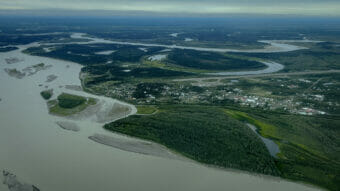
The Yukon River covers a lot of ground on its nearly 2,000 mile journey to the sea. The river’s headwaters are in the mountains of northern British Columbia, just 50 miles from Skagway. From there, the river winds north through the Yukon, crosses the border near Eagle and flows all the way across Interior Alaska until it finally reaches the Bering Sea.

And for as long as anyone can remember, salmon fed everyone along its course.

“For most of our lives, it was king salmon,” said Rhonda Pitka, First Chief of the village of Beaver in the upper Yukon Flats. “That was the majority of our diet, and what we traded and what we processed.”

Pitka remembers busy childhood summers with her family at their fish camp about ten miles outside the village, helping her grandmother catch and process fish.

But today, she can’t continue that tradition with her own family.

Rhonda Pitka, first chief of the Yukon River village of Beaver, speaks at an event in Fort Yukon. (Courtesy Rhonda Pitka)

Since the mid-1990’s, runs of king and chum salmon — the two primary species harvested on the Yukon River — have become more unpredictable. King salmon numbers have seen a long, slow decline, while chum runs have sometimes seemed to bounce back, only to fall again. Now, both species are in a historic collapse.

In the last four years, the numbers of king and chum salmon in the river have dropped so low, state and federal fisheries managers have all but closed subsistence fishing. The causes of the decline aren’t fully understood, but researchers say a parasite targeting kings and warming waters due to human-caused climate change are possible factors. Harvesters also blame salmon bycatch in the Bering Sea commercial pollock fishery and the large commercial chum salmon fishery off the Alaska Peninsula known as “Area M.”

The closures have been devastating for communities along the river, said Pitka, who remembers trading salmon for caribou or muktuk with relatives in Arctic Village and Utqiaġvik back when fish were abundant.

“It’s been a real challenge for families to get enough food for the winter and enough food to share,” Pitka said.

The salmon collapse is changing life on the Yukon — and not just in Alaska.

Communities along the upper Yukon, stretching deep into Canada, have borne the brunt of the salmon collapse, in part because only a fraction of the fish make it that far upriver. Some Canadian First Nations have restricted fishing for decades.

Still, the U.S. and Canada depend upon each other to conserve this vital resource.

Pitka serves on the Yukon River Panel, a body of representatives from both Alaska and Canada that advises fishery managers on both sides of the border. The panel was established by the landmark Yukon River Salmon Agreement, a treaty the U.S. and Canada signed in the early 2000s after more than a decade of negotiations. The treaty aims to ensure a healthy salmon population and access to fishing for communities in both countries.

It’s been a challenge to discuss resource allocation for a river that’s not actually meeting anyone’s subsistence needs, Pitka said.

“Our Canadian counterparts haven’t fished for at least 20 years, if not longer,” Pitka said. “And that’s a tragedy all in itself. It’s been really difficult. It’s been really tense.”

As part of that agreement, Alaska committed to letting a certain number of fish cross into Canada, said John Linderman, the panel’s U.S. co-chair.

“Each country has its own responsibilities under the treaty agreement,” Linderman said. “For Alaska, one of our most important responsibilities is to annually provide to the Canadian border the escapement goal and the Canadian harvest share.”

That means allowing enough fish to make it back to their spawning grounds to ensure a healthy salmon population and, in better years, ensuring an additional number of fish cross the border to allow a fair harvest up and down the river.

Those requirements can sometimes sound like a burden for Alaskans, said Holly Carroll, the Alaska subsistence fisheries manager for the U.S. Fish & Wildlife Service – especially during the last four years, when managers have heavily restricted subsistence fishing. But, she said, that’s the wrong way to look at it.

“People will say, ‘Just let us fish. I don’t take more than I need, my family does not take more than I need.’ And every family will tell you that, and they mean it and they are honest,” Carroll said. “But here’s the problem: when our runs are too small to meet everyone’s needs, we have to close.”

Lately, there aren’t even enough salmon returning to the river to ensure healthy runs in the future. And that means everyone on the river  — Alaskan and Canadian — has had to sacrifice.

The treaty keeps both sides working together to protect their salmon. But that doesn’t mean it’s easy, Pitka said.

She recalled a potlatch after two recent deaths in Stevens Village, near her village of Beaver. It was painful to hold such a gathering without its traditional center.

“It was so hard to see families not have salmon to give out at potlatch,” Pitka said. “There should have been salmon on everybody’s plate. They should have been able to give salmon out to visitors that were leaving.”

“That’s the cultural connection that we’re missing right now,” she said. “The ability to share and to feed our families our cultural foods.”

Reward quadrupled after more than 20 endangered sea lions illegally killed near Cordova

A NOAA Fisheries marine mammal specialist examines a dead Steller sea lion pup found on a beach in the Copper River Delta. (NOAA Fisheries)

More than 20 endangered sea lions have been found dead in the Copper River Delta this summer, many with gunshot wounds. The National Marine Fisheries Service has now quadrupled the reward for information on the illegal killings to $20,000.

Sadie Wright, a biologist with the agency, said the dead animals were found during surveys of the area east of Cordova. This year, she said, it’s an unusually high number.

“We’ve done this for a number of years,” Wright said. “And this year we’ve found a big spike in the number of dead sea lions on the islands there.”

As of June 2, they’d found seven dead sea lions in the area. Since then, at least 15 more have been reported. Wright said by this time in previous years they’d found about three or four.

Steller sea lions are protected under the Marine Mammal Protection Act and the Endangered Species Act. Killing them is illegal — the only exception is for subsistence hunting by Alaska Native people. Wright said the animals found in the Copper River Delta didn’t appear to have been harvested for food or craft.

NOAA Fisheries Sadie Wright uses a metal detector to examine a dead Steller sea lion found on a beach in the Copper River Delta. (NOAA Fisheries)

This isn’t the first time numerous sea lions have been killed in the area. Wright said in 2015, fishermen illegally shot sea lions they saw as a threat to their livelihood. She said it’s still unclear what is behind this year’s spike.

“In this case, I don’t know,” she said. “We’re not sure why people would injure or harm or kill sea lions in the area.”

The endangered sea lion population is already facing challenges like the marine heat wave, and Wright said these killings hurt their chances of recovering.

“A lot of these animals that we’re seeing out there dead are young animals in their prime,” she said. “So it’s sad to see them die when there doesn’t seem to be a good cause for it.”

Wright said people can report harm or harassment of marine mammals to NOAA law enforcement at 1-800-853-1964.

Fish were plentiful, but fishermen scarce for Southeast Alaska’s first summer king opening

The troller Sallie enters Eliason Harbor in Sitka. Only 500 boats fished in the first king opener July 1-12, 2023. It’s possible that legal uncertainty over the future of the fishery played a role in reducing effort. (Berett Wilber/KCAW)

The numbers are in for the first opening in the summer troll fishery for king salmon in Southeast Alaska.

The 12-day season saw more chinook landed than expected, despite fewer boats being on the water.

Southeast trollers brought in about 85,000 king salmon from July 1 to July 12, around 8,000 fish over the target for the first opener of the season.

At first, it might look like enthusiasm played a role, as it was only on June 21 that the U.S. Ninth Circuit Court of Appeals issued a stay that allowed the fishery to occur at all.

But that was not the case. Grant Hagerman manages the troll fishery for the Alaska Department of Fish and Game. He says even fewer trollers participated this summer than in 2022.

“We had roughly 580 participants in the king fishery last year,” he said, “and we’re just over 500 for this opening.”

As recently as 10 years ago, Hagerman says it was more typical to see 800 trollers during the first summer king opener. Having 80 boats drop out in just one year suggests that the Wild Fish Conservancy lawsuit created just enough uncertainty to steer trollers into other fisheries – or even into other lines of work.

“Until just several weeks before the fishery, I think a lot of permit holders maybe had to make other plans,” said Hagerman. “Some of the permit holders from out of state may not have come up. Obviously, fuel is still an issue as well.”

Nevertheless, the fishing was pretty good for the 500 boats that stayed in the game. Hagerman says three days of bad weather during the opener meant for some busy days during good conditions. A lot of the work involved shaking undersize kings, which were below the legal length of 28-inches, and trying to keep hooks free for bigger fish.

Hagerman says trollers tend to pull their gear and move to a different area when they’re catching a lot of “shakers.” The average weight of legal fish was 11 pounds.

“And surprisingly, there are legal fish even under 10 pounds,” said Hagerman. “They’re just kind of long and skinny. There’s a fair amount of those. But I wouldn’t say (average weight) is  alarmingly low compared to recent years, but you know, for the long term, yeah, it’s still down.”

Hagerman says prices were comparable to the long-term average for summer kings – between $5 and $6 per pound. The market forces that created low prices for Alaska’s sockeye fisheries have not been a factor for kings. The delay of chinook fishing in Canada, and the closure of California’s salmon fishery both helped to prop up prices for Southeast kings.

Although the first opener exceeded its target, roughly 24,000 kings remain in the summer troll allocation for kings. Hagerman anticipates that the Department of Fish & Game, after accounting for landings in the sport and commercial net fisheries, will make an announcement regarding a second summer king opening on August 4.

With Alaska’s maritime heritage at risk of being lost, program seeks to preserve it

The Alaska flag flies from the bow of a boat in one of Ketchikan, Alaska’s small-boat harbors on Monday, July 24, 2023. (James Brooks/Alaska Beacon)

With more coastline than all of the other states combined, Alaska has quite the maritime history. And for historians and museum leaders, it’s a challenge to preserve that history. A new federally funded grant program may make their jobs easier, by funding efforts to both preserve artifacts and educate the public.

Come Tuesday, the Alaska Maritime Heritage Preservation Program will be open to applicants for $327,500 aimed at helping retain and support maritime preservation and education projects. That’s the amount the National Park Service awarded to Alaska’s state government to distribute in grants to local programs.

With its 47,300 miles of coastline, the state of Alaska has an intricate relationship with the maritime world, making it a strong candidate for the national grant, according to Katie Ringsmuth, who serves as both the Alaska state historian and deputy state historic preservation officer.

“We really are the maritime north. We’re not just a state coastline. We connect the circumpolar north and the Pacific world. We have the power to tell that story for the rest of the country,” Ringsmuth said. “That would be why I think we made a good argument. The rest of the country needs us in helping them establish that history, that really important history.”


State Historian Katie Ringsmuth stands in her office with photos of Alaska maritime history. (Teigan Akagi/Alaska Beacon)

The State Historic Preservation Office formed a partnership with Alaska State Library, Archives and Museums, which allowed the state to increase the funding from the national grant. According to Ringsmuth, there are two grants to which those interested can apply: one focused on Alaska maritime heritage education and the other on Alaska maritime heritage preservation.

The education grant provides money to those who will share information with the public about maritime history or skills, whether that be through participatory programs, improving maritime exhibit spaces, teaching traditional maritime skills or other techniques.

On the other hand, the historic preservation grant gives money to projects that are documenting archeological history, research, the repair and rehabilitation of important maritime resources, and more.

The grants will provide money to Alaska-residing nonprofits, individuals, academic institutions, tribes, and others.

Museums work at preservation

Museums around the state are considering applying for the funding.

“It’s a great program–one of the few funding programs aimed specifically at preserving maritime history,” said Toby Sullivan, executive director of the Kodiak Maritime Museum.

He noted that Alaska’s long coastline makes it stand out when compared with other states.

“There’s a lot of history associated with that coastline and the oceans offshore from it, from the journeys of the Indigenous people who arrived in Alaska by sea thousands of years ago, to the early European exploration of coastal Alaska, to the modern fishing industry,” Sullivan said. “Preserving and understanding that history helps us to understand who we are in the present moment and gives us the perspective to see our possible place in the world of the future.”

The Kodiak Maritime Museum is just one of the many potential applicants for the program. The museum records oral histories, conducts historical research, surveys historically important waterfront sites and does other things to preserve maritime history, Sullivan said.

The Thelma C, a 1960s seine fishing boat restored by the Kodiak Maritime Museum, is seen on display in July 2021 in Kodiak. (Photo by James Brooks)

When it comes to what the museum plans on citing for its grant applications, Sullivan said that the museum has two projects in mind.

“First, finding a permanent building for the museum, which is the museum’s primary strategic goal, and helping to fund any refurbishment necessary to house the museum in that building. The second funding choice is to do a systematic historic survey and inventory of maritime history sites on Kodiak‘s waterfront,” Sullivan said.

Another potential applicant is the Sitka Maritime Heritage Society. Society Executive Director Keith Nyitray said of the opportunity: “It’s amazing!”

He said there are many different pieces of history that need preservation.

“I think it’s a shame when historic knowledge is lost, and providing that opportunity for younger people to learn about the history and skills and keep them moving forward is really important,” Nyitray said. “And it’s not just about how to fish, but it’s how it was done and why it was done, and those skills transcend time, but those skills are being lost.”

SMHS has done much to preserve Alaska’s maritime history. From boat-building and knot-tying classes to pub talks where historical themes and events are discussed, it’s all done without the walls of a museum. In fact, one of the SMHS’s biggest goals is to restore a boathouse to serve as their museum’s home.

“We’ve just spent hundreds of thousands of dollars into restoring this thing, we may apply for a fire suppression system, a sprinkler system, because what’s the sense in restoring it and then having it all burn down?” Nyitray said.

The Maritime Heritage Preservation Program application period opens on Aug. 1 and closes on Oct. 31.

Ringsmuth said it’s a significant opportunity.

“This is a program that we really hope will help Alaskans preserve not just the places that really matter to them, but their traditions and their lifeways,” Ringsmuth said. “We’re kind of treating this as a pilot program, and success will help leverage future grants. So that is really the intent is to try to create a more sustainable program so that we can continue to support coastal communities and the comprehensive history of Alaska.”

A webinar will be held on Sept. 21 with more information about the grant. For more information, concerning Alaska’s Maritime Heritage Preservation Grant or a link to the webinar, contact State Historian Katie Ringsmuth at katie.ringsmuth@alaska.gov.

This story originally appeared in the Alaska Beacon and is republished here with permission.

Trident’s new processing plant in Unalaska will be the largest in North America

Trident Seafoods is constructing a state-of-the-art facility to process fish in Unalaska. Representatives say they expect to be online in 2027. (Hope McKenny/KUCB)

Trident Seafoods has begun building the first bunkhouses at its to-be processing plant in Unalaska’s Captains Bay, progressing on a timeline the seafood titan says would make it operational by 2027.

The Aleutian Islands and Bering Sea region is home to some of the world’s most productive fishing grounds. It’s where most Alaska pollock comes from, the whitefish found in fish sticks and McDonald’s Filet-O-Fish sandwiches worldwide. And a lot of that fish is processed at the giant Trident Seafoods plant in Akutan.

But aging infrastructure and decades of wear prompted the seafood company to plan a new facility.

“Status quo in Akutan isn’t an option,” said Stefanie Moreland, a spokesperson for the company. “We can’t be operating a plant and making the kinds of changes and improvements that we need to within the facility that we’re running currently in Akutan.”

The company began a feasibility study in 2017 to explore ways to upgrade its Akutan plant. They tested things like building designs and energy efficiencies, but ultimately, representatives from the company said a complete rebuild was the only reasonable option.

Trident began constructing a dock on Captains Bay in Unalaska in spring 2022, after its subsidiary, LFS, acquired a tidelands lease from the City of Unalaska.

“We started in ‘22 [with] rock removal, rock crushing, getting kind of a building site ready,” said Jarred Brand, the site manager for the project. “We built over 1,500 feet of sheet pile dock, and we needed to let that settle for a year.”

Now, they are grading the site, working on a fendering system, and building the first bunkhouse.

While the company didn’t specify the size of the new plant, Brand said it would be at least as large as the Akutan plant, currently the largest processing facility in North America.

“We’re not getting any smaller,” Brand said.

Brand said the new plant will focus on automation, renewable energy, and on 100% protein capture — that is, being so efficient that not a scrap of fish is left to pump out to sea.

“In our industry, there’s a lot of waste that goes out the outfall pipes,” Brand said. “So we’ve been working on this process for quite some time, knowing that the future is 100% capture and putting it into a sellable product.”

Integrating the new plant into the city’s existing infrastructure poses a whole other set of variables.

Unalaska City Manager Bil Homka said considerations like power generation, plumbing and road access all pose serious challenges.

“We have diced this thing like a Rubik’s Cube, except it’s almost like a Rubik’s rectangle, just to kind of make it stranger,” Homka said. “You see all the parts … you twist one here, you twist one there and see how it works.”

The City of Unalaska is the community’s primary electricity provider, but the diesel power station doesn’t produce enough energy to power the new plant.

“Our existing power house only has room for one more generator,” Homka said. “And it’s only a maximum output of [about] four and a half megawatts, so we’d still be short.”

Many seafood processors provide their own energy, often through a combination of diesel and fish oil, but Trident says it wants to avoid power production.

The seafood company is hopeful about another potential energy source in the works: the Makushin Geothermal Project.

The community has been trying to tap nearby Makushin Volcano for geothermal energy since at least the 1980s. After decades of false starts, a contractor is currently working on the project — nothing is guaranteed, but Homka said the timing could dovetail with the new seafood facility.

“Wonderful if it all syncs up timing-wise between when Trident will be online and when geothermal will be ready,” Homka said. “Timing is of an amazing essence.”

The Trident crew is currently building bunkhouses and the geothermal crew is building an access road. Both projects are slated to come online in 2027.

Why sockeye flourish and chinook fail in Alaska’s changing climate

Salmon spread across the deck of a fishing vessel during last summer’s record season in Bristol Bay. (Hope McKenney/KUCB)

University of Washington ecologist Daniel Schindler is at the mouth of a salmon stream at Lake Nerka, in Southwest Alaska. It’s roiling with fish.

“They sort of pile up in balls of thousands of fish for a couple of weeks. I think that’s when they’re doing their final maturation,” he said of the sockeye mob. “They’re jostling with each other and splashing, occasionally jumping.”

Schindler is in his 27th year of field work, studying Bristol Bay sockeye. This year is on par with the sockeye abundance Bristol Bay has seen in the last decade, he said, which is far higher than the historical average.

The unlikely hero of this story of plenty: climate change.

“We tend to think of climate warming is bad news for wild animals,” he said. “But for sockeye, Bristol Bay warming has been good news.”

For other salmon, climate change is a villain.

Chinook — or king — salmon are in terrible decline all over the state, and especially dire on the Yukon River. Meanwhile, sockeye — or reds — are having another banner year in Bristol Bay, and everywhere. Scientists say they don’t know exactly why one salmon species is doing so well while the other is in crisis, but some clues are coming into sharper focus.

One key difference, Schindler said, is what kind of river habit each species needs.

Sockeye use lakes as their nurseries. Since the 1980s the water in those lakes has warmed significantly. The warmth stimulates plankton to reproduce more, and young sockeye eat plankton. Fifty years ago, Schindler said, a lot of sockeye spent two years in Lake Nerka before heading out to sea.

“And now they grow so fast that nearly all of them leave after a single year in freshwater, which is a reflection of the fact that the freshwater systems have become more productive,” he said.

University of Washington professor Daniel Schindler is in his 27th summer of field work in the Bristol Bay
watershed. (University of Washington)

The science is a little murkier about what happens in the ocean, but Schindler said northern parts of the coastal ocean have been especially good for Alaska sockeye. There’s apparently plenty for them to eat. and their predators seem to be elsewhere.

“So the Nushagak, the Igushik, even the Kuskokwim River, which never really had that many sockeye in it — all those populations have really exploded in the last decade,” he said.

The chinook aren’t so lucky. Changes in the ocean and the rivers have not been kind to kings, especially for those from Alaska’s longest river, the Yukon.

“It’s kind of this perfect storm of bad things happening for those particular chinook stocks,” said Katie Howard, a state fisheries scientist.

Her research shows Yukon chinook who spawn during a warm-water year produce fewer juveniles. The water temperatures in the Yukon sometimes get to 68 degrees now.

“When water temperatures get that high, they just kind of shut down,” she said. “They’re a cold-water fish. They can’t really tolerate those temperatures very well.”

Heat stress is just one factor. Big rainfall can wash eggs from the gravel where female chinooks deposit them. There’s a parasite that leaves Yukon chinook riddled with “pus pockets,” Howard said. And there’s evidence that female chinooks may not be getting enough thiamine from their ocean diet, causing developmental problems in their eggs.

All of these things may stem from climate change, and kings are particularly vulnerable.

“Kings tend to spawn in really big rivers. That’s where the big king populations are,” said Erik Shoen, a fisheries biologist at the University of Alaska Fairbanks. The Yukon, for instance, has all kinds of conditions along its 1,982 miles, but every fish that spawns there has to go through the lower river.

“So if that lower main stem is unfavorable,” he said, “or if the Bering Sea just went through a heatwave and they have to make it into the lower main stem with less gas in the tank than they need to swim 1,000 miles plus — they’re in trouble.”

By comparison, the sockeye population of Bristol Bay thrive in the ocean and have multiple shorter rivers to climb, with more cool spots to take refuge in.

The Kuskokwim, like the Yukon, is a big river enduring a multi-year crash of chinook. Chum salmon are also in crisis. But there are more sockeye returning to it than ever before.

Near the peak of the Kuskokwim run “there will be anywhere from 20,000 to 40,000 sockeye salmon passing the sonar in one day,” said Kevin Whitworth, executive director of the Kuskokwim River Inter-Tribal Fish Commission. “That’s a lot of protein.”

His organization is encouraging subsistence fishermen to take up dipnets to scoop up sockeye without hurting Kuskokwim chinook. The giant nets — sometimes 5 feet in diameter — are not a traditional tool for the region.

As part of the campaign, the fish commission posted a video on Facebook featuring testimonials from tribal elders.

“I wasn’t really expecting to get this much from dipping on the Kuskokwim,” said James Nicori, of Kwethluk. “Something new for me. And it works good.”

His brother-in-law, Martin Andrew, also from Kwethluk, said he overcame his skepticism by landing 20 sockeye.

Unfortunately, though, people on rivers like the Kuskokwim can’t just swap one salmon species for another. There still aren’t enough reds returning to replace the missing stocks on the Yukon and Kuskokwim.

And biologists say there never will be. The Kuskokwim and Yukon just don’t have enough suitable sockeye habitat to produce fish equal to the mass of salmon that used to return to them.

But with chinook too few to meet the need, sockeye are too plentiful to ignore.

Site notifications
Update notification options
Subscribe to notifications