Fisheries

‘Too hot’ for salmon: How climate change is contributing to the Yukon salmon collapse

A sample of heart tissue from a Yukon king salmon infected with ichthyophonus sits under a microscope at the Alaska Department of Fish and Game laboratory in Anchorage on Aug. 17, 2023. (Kavitha George/Alaska Public Media)

Scientists know one thing for sure about the collapse of Yukon River king and chum salmon: there’s more than one culprit.

“It’s really hard and probably unrealistic to just point your finger at one thing and say that’s what’s doing it,” said Jayde Ferguson, a fish pathologist with the Alaska Department of Fish and Game.

Researchers have identified many threats facing Yukon king and chum salmon, and those threats pop up at each stage of the salmon life cycle — when salmon hatch in freshwater streams, as they swim down the Yukon to the ocean, where they spend most of their lives and on their arduous journey back upriver to spawn and die.

Scientists think many of these threats are connected to climate change. Ferguson studies one of them, a parasite named ichthyophonus, at the Alaska Department of Fish and Game lab in Anchorage.

Under a microscope, salmon tissue infected with ichthyophonus appears mottled with big white dots, each one a single parasite that will grow, draining the fish’s resources and causing cells to die.

The parasite can’t harm humans, but it does kill fish. As salmon are making their journey upstream, they’re especially vulnerable.

“Their immune system is not as good, their bodies are just breaking down,” Ferguson said. “And so the parasite actually starts replicating then within the fish.”

Many infected fish don’t survive long enough to lay eggs.

“It’s almost like an arms race,” he said. “Can they get to the spawning ground before they die prematurely?”

Often, infected fish look completely normal from the outside, but their flesh will have a spotted or patchy white pattern where the parasite is growing inside. Importantly, infected fish aren’t good to eat.

Researchers saw a big spike in king ichthyophonus levels in the early 2000’s, when around 30% of kings showed detectable levels. Levels dropped off for more than a decade. And then in 2020, the parasite was back. In recent years more than 40% of the Yukon king run has shown detectable levels of ichthyophonus.

Fish pathologist Jayde Ferguson places cell samples on a microscope at the Alaska Department of Fish and Game laboratory in Anchorage on Aug. 17, 2023. (Kavitha George/Alaska Public Media)

It’s unclear what’s driving the spike. Other researchers have found that Yukon king salmon eggs are low in a vitamin called thiamine, which may cause weakened immune systems. Ferguson said warming river water might also play a role.

In fact, the Yukon is warming twice as fast as rivers further south as a result of climate change.

“It’s crazy to be at the northern-range extent of salmon and talking about it being too hot for them,” said Vanessa von Biela, a U.S. Geological Survey ecologist.

Salmon are cold-blooded, meaning they can’t regulate their internal temperature. When the river gets above 65 degrees Fahrenheit, that’s a problem.

When it’s too hot, Von Biela said, the proteins that keep salmon cells functioning normally start to lose their shape. Warm water also makes it harder for their hearts to pump oxygen to their bodies.

“Their whole physiology, their whole body is designed to be in cold water,” she said. “So when that water is warm, they just really hit these limits.”

In a 2020 study, von Biela found that in an average year half of all Yukon kings swimming upriver have heat stress.

And it’s not just the river that’s warming. The ocean is heating up too. Climate change is bringing on more marine heat waves, or periods of severe ocean warming.

Jim Murphy is a NOAA fisheries biologist who has studied salmon at sea for 20 years. He said marine heat waves are disrupting the availability of salmon prey species. It’s not totally clear what’s happening at sea, Murphy said, but when he examines fish, one thing is clear: all salmon — but especially chum — are not getting enough to eat.

“Their stomach contents, the amount of food that they have in their stomach has been declining with warming temperatures,” Murphy said. “They’re likely feeding less in these warm years than in cooler years.”

Scientists say all three of these factors — disease, heat waves, a lack of food — exacerbate each other. A fish that didn’t eat enough is already weaker as it starts its journey up the Yukon. Add a parasite and heat stress, and that fish is a lot less likely to make it to its spawning grounds to reproduce, which means fewer fish next year.

Yukon River fish also have the longest salmon migration paths on Earth, traveling as much as 2,000 miles to get to their spawning grounds.

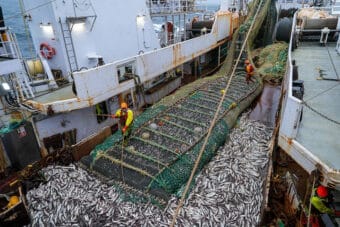
On top of all this, people along the river have another frustration — commercial fishing. Many residents point to Bering Sea pollock trawlers and a commercial salmon fishery along the Aleutians known as “Area M” that they argue are intercepting salmon at sea that would otherwise be bound for the Yukon.

“It kind of pisses me off a little bit thinking about it. Because it’s the double standard,” said Basil Larson, a subsistence fisherman and resident of Russian Mission, on the lower Yukon. He spoke to a weekly Yukon River Drainage Fisheries Association teleconference for river updates this summer.

Larson said it’s infuriating to see commercial fishermen pulling in hundreds of thousands of chum each season while Alaska Native communities like Russian Mission have gone four summers barely able to fish.

“We’ve been getting restricted and restricted and restricted, and it’s not even funny anymore,” he said.

In recent years, Western Alaska fisheries groups and residents of the Yukon and Kuskokwim Rivers have clamored for tighter regulations at sea, like a cap on chum fishing in Area M and stricter chum bycatch limits in the Bering Sea — but so far, regulators haven’t taken much action.

Meanwhile, commercial fishers point to data that show only a small percentage of the Bering Sea bycatch salmon and Area M salmon are headed to Western Alaska rivers.

But Murphy, with NOAA, said even though environmental factors driven by climate change are probably the main culprit for the Yukon collapse, right now, commercial fishing is the one contributor we have control over.

“Most people recognize that [commercial fishing] is not what is causing the collapse of these runs, necessarily. But it is something that can be regulated to mitigate the effects of declining production,” Murphy said.

For now, Yukon River residents are in limbo, waiting to see if fish return. Murphy said it doesn’t look like kings will come back anytime soon. But he said there’s hope for chum.

A 2016-2019 Bering Sea heat wave hit chum salmon particularly hard, but since then, ocean temperatures have subsided and Murphy said, juvenile chum are starting to look healthier.

He said signs are good for a stronger chum run in 2024.

Southeast trollers could top one million cohos in extended season

Coho — or silver salmon — are identifiable by their white gum line. Unlike king salmon, which are regulated by an international treaty with Canada, most coho rear in Alaska’s streams and rivers. ADF&G says escapement targets for coho have been met. (USDA image)

Southeast trollers will have an extra ten days to target coho — or silver salmon — before the summer season officially comes to a close.

The Alaska Department of Fish & Game announced the extension last Friday, pushing the end date for the season from the usual Sept. 20 to Sept. 30.

Last year, the story of summer trolling was a remarkable chum harvest. This year, silvers are in the spotlight.

“You know, this year will be the first year in probably five or six years that the trollers are looking to catch over a million cohos,” said Grant Hagerman, the area troll management biologist for Southeast Alaska. Chum runs are largely produced by hatcheries. And although chum runs were strong, the price of chum collapsed, forcing the fleet to reset, and shift its attention to coho.

“With the in-season collapse of that market, it changed things quite a bit and so effort dropped,” said Hagerman. “And with chinook closed, a lot more effort turned back to coho that we didn’t really have last year. We didn’t reach our chinook allocation, and the coho catch was down from season, because we had a third of the fleet that was fishing hatchery, chum salmon for a third of the summer. So, yeah, very different this year.”

In just the last few weeks, catch rates for coho have been more than double the long-term average – not just for trollers, but for gillnetters, too. And the department is seeing good escapement, as the coho who manage to get by the hooks and the nets are reaching their natal streams in strong numbers.

Hagerman says the price bumped up later in the season, as coho became noticeably larger. Although the final price often isn’t settled by processors until after the season, Hagerman says it’s likely to come in around $1.80 or $2.00.

And while it’s not quite the bonanza of the 2022 chum season, coho fishing can feel like dependable income in an industry that’s inherently volatile.

“I mean, that was something incredible, the $9- or $10-million that was caught over a six- or seven-week period,” said Hagerman of the 2022 chum season. “Without a market for these chum and with chinook salmon closed for the season, it was it was good that these cohos were around.”

Many of the coastal areas along Baranof and Chichagof islands, and the Fairweather Grounds, will be closed during the extended season, due to the high abundance of king salmon. Trollers who want to target that species will only have to wait a couple of weeks: The winter season for chinook opens on Oct. 11.

Four years into the Yukon salmon collapse, an Interior Alaska village wonders if it will ever fish again

An aerial view of Fort Yukon Alaska on Tuesday evening, August 29, 2023. (Matt Faubion/Alaska Public Media)

Without salmon, Gwichyaa Zhee is missing its heart.

“It’s just no good,” said Linda Englishoe, sitting on the sofa in her house not far from the Yukon River. Englishoe is an elder who has lived in the village for her entire life.

There are signs of fall in Englishoe’s house — a pan of apples and cinnamon on the stove, a tray of lowbush cranberries waiting to be processed. Fall usually also means the arrival of chum salmon on their journey upriver, but this year, the run is a fraction of the size it once was.

Without fish, Englishoe said, nothing in the village is the way it’s supposed to be. The smokehouses, normally full of salmon drying for the winter, are empty. Even the smell of town is different.

“It used to smell so good, smelling those fish,” Englishoe said. “Ooh, I used to just sit outside, smelling.”

A picture of the town Fort Yukon.
The town of Fort Yukon on Thursday, August 31, 2023. (Matt Faubion/Alaska Public Media)

Gwichyaa Zhee is the Gwich’in name for Fort Yukon. The village sits on the upper Yukon River 150 miles northeast of Fairbanks. It’s home to less than 500 mostly Gwich’in Athabascan people, many of whom are related and have deep ties to other communities all along the river and into Canada. Small homes, many with large moose antlers mounted above the door and snow machines or four-wheelers in the yard, sit on a sprawling grid of dirt roads and flat tundra. People here are used to sharing food with one another.

Life in Gwichyaa Zhee revolves around the Yukon River, which is wide and braided where it passes by town. Its silty waters barely make a sound winding through scalloped islands and sandbars. This river used to be full of fish and busy with families traveling back and forth from fish camp, Englishoe said.

“Everyone would visit each other along the river,” She remembered.

Now, the riverfront is quiet, except for a few hunters heading out to try for moose.

A boat next to a river with a sunset.
The Yukon river on Tuesday, August 29, 2023. (Matt Faubion/Alaska Public Media)

Englishoe is one of the 15,000 people living along the Yukon River who are feeling the effects of the salmon collapse, from the Bering Sea to the river’s headwaters in Canada.

The river’s once-strong king salmon run has been on a long, slow decline since the 1990s. Chum salmon runs have also been unpredictable. But in the last four years, both species’ runs abruptly crashed.

Researchers are still unsure exactly what is driving the collapse. Scientists say climate change probably plays a big role, raising the temperature of river water and potentially affecting the availability of prey species at sea. Many people along the river also blame bycatch from the Bering Sea trawler fleet and commercial salmon fishing along the Aleutian chain.

This year, the king salmon run was less than a fifth of its normal size. This summer, for the fourth year in a row, fisheries managers closed almost all king and chum fishing along the Yukon River in Alaska to try to ensure as many fish as possible make it to their spawning grounds.

That means, in Gwichyaa Zhee, there’s no salmon to eat, and no salmon to put away for the winter.

A man in a plaid jacket stands in the road.
Michael Peter outside his home in Fort Yukon morning. September 1, 2023. (Matt Faubion/Alaska Public Media)

Michael Peter worries about young people — his kids — losing a part of their identity.

Peter is second chief of Gwichyaa Zhee. He grew up learning to cut fish from his grandmother. Summers at fish camp connected him to his community, the river and his family from a young age. But now, he said, instead of spending the summer working together on the river, people are at home.

“A lot of our young people are kind of lost, because of not having our traditional foods and showing them our traditional values, and teaching them, going to fish camp,” Peter said.

For him, fish camp served as a “spiritual awakening,” Peter said. He worries younger generations are missing out on their opportunity to carry on the tradition.

The salmon collapse has also made daily life harder. Without fish, people have to rethink what they eat. Many families are hunting more, Peter said, but fueling up a boat to hunt for moose or shoot geese can cost $9 per gallon. Grocery shopping at the local AC store costs three times what it would in Anchorage.

Year-round work is limited in Gwichyaa Zhee, and Peter said, without fish it’s hard to make ends meet.

“A lot of people are migrating to the city,” he said.

For people in Gwichyaa Zhee, the salmon collapse is just one of a cascade of outside threats.

Recent floods destroyed fish camps up and down the river. Floods like that could become more common, as climate change drives more unpredictable spring river breakups and extreme weather. Peter also worries that oil development like the Willow project and proposed mining in the Brooks Range will threaten caribou herds his community relies on for subsistence. These projects do have support from some communities and Alaska Native leaders, even as Peter and others see them as threats.

“It seems like we’re being attacked all at one time, without any consideration for our future — our kids, our land, our animals, our air, our water, our climate,” Peter said. “The earth can only sustain so much.”

Peter and other residents want Alaska Native people to have more control over how the river and other resources are managed. Currently the U.S. Fish and Wildlife Service and Alaska Department of Fish & Game set limits on subsistence fishing when the runs don’t meet the escapement goals and quotas set out in a decades-old treaty with Canada.

Peter represents the Yukon Flats in the Yukon River Intertribal Fish Commission executive council which develops recommendations for fishery management. He and other Yukon residents are pushing to establish tribal co-management rights for Yukon River salmon. They’re looking at the Kuskokwim River where 33 federally-recognized tribes work in partnership with state and federal agencies to make management decisions, as a model.

“We shouldn’t have to struggle to survive, but we’re survivors, and we’re resilient,” Peter said. “We’ve been here, we’re not going nowhere, and this has always been our home. And who are the better managers of the land than the people themselves?”

Hatchery strays could increase the risk of salmon suffocation in streams across Southeast Alaska

Chum salmon migration. (USFWS/Togiak National Wildlife Refuge)

In 2013, researcher Chris Sergeant was doing some routine water quality monitoring in Sitka’s Indian River when he noticed something strange on the oxygen monitor.

“It was getting close to zero — really, really low,” Sergeant said. “And there were fish dying off. Juvenile coho and cutthroat trout. And a high percentage of the adult salmon were hatchery strays.” 

The stream was choked, filled with too many fish that couldn’t get enough oxygen. Salmon die-offs like that have been documented for at least a century, but their causes have not been well-understood. Now, a new study by Sergeant and his research team suggests that a booming population of hatchery-raised salmon in Southeast Alaska could put pressure on thousands of miles of salmon streams that are already vulnerable due to climate change.

 “We have too many salmon breathing too much oxygen,” Sergeant said. “It’s an unnaturally high population.”

The water in rivers and streams has dissolved oxygen in it, which salmon and other fish breathe through their gills. When those fish can’t get enough oxygen, it’s known as hypoxia. They can suffocate. Or, in less extreme cases, low oxygen can slow salmon down on their strenuous trip upstream. 

“They may not make those spawning grounds in time or have enough time to spawn,” Sergeant said. “So there’s a lot of really subtle effects in addition to just massive die-offs.”

Scientists have long-warned that hatchery salmon can compete with wild fish for resources, including oxygen. And for more than half a century, hatchery production across Alaska has boomed, especially for pink and chum salmon. 

Those populations are supposed to return to their hatchery when they spawn, but they commonly stray into wild streams. According to the study’s authors, that could put wild salmon — including more desirable species like chinook, coho and sockeye — at a higher risk of smothering. 

The study maps more than 10,000 miles of wild salmon habitat in Southeast Alaska that are close to hatchery release sites, creating the potential for overcrowded streams.

And salmon’s risk of hypoxia is made worse by human-caused climate change. Rising water temperatures across the region have been linked to salmon die-offs in recent years, and warm water holds less oxygen. 

When hot temperatures are accompanied by drought, salmon streams are even more primed for hypoxia. That’s because an ideal salmon habitat is rough and fast-flowing. That kind of water is oxygen rich. 

“The more the water tumbles and foams, like a rapid, the more opportunity it has to exchange with the atmosphere,” Sergeant said. “That tumbling motion of the water is basically injecting oxygen.”

Climate change is expected to bring more precipitation to Southeast Alaska overall, but the region still faces a growing risk of drought. Extreme rainstorms are likely to be punctuated by longer dry periods, especially in summer. And declining snowpack in the mountains could also cause drought.

According to Ryan Bellmore, a US Forest Service researcher who co-authored the study, snowpack is like a bank account for the watershed. 

“And we’re more likely to go into the red,” Bellmore said. 

Water is saved in the high mountains in the winter and then melts gradually throughout spring and summer, feeding the rivers and streams. Without it, salmon streams could dry up and slow down in the summer heat, which could lead to low oxygen levels. 

And as climate change puts pressure on Southeast Alaskan watersheds, cramped conditions may continue to strangle wild salmon.

From schooner to salmon tender, the Aleutian Express sails on 100 years of history

The Aleutian Express in Chignik after the 2015 salmon season. (Courtesy of John Clutter)

This summer, an unusual looking salmon tender is anchored in the Naknek-Kvichak District. The Aleutian Express is a historic, three–masted schooner that came sailing up from Washington State for the Bristol Bay sockeye season. With three masts and filled sails, this iconic vessel has been instrumental in many chapters of Alaskan history.

Owner John Clutter first laid eyes on the boat in Chignik waters in 1993. He’s captained the vessel across Alaska and the Pacific Northwest for the last eighteen years, and he says it’s become recognizable in many ports and across many generations.

So this guy was standing there looking up to the boat.” Clutter said. “He had a son with him about 10 years old, and he pointed up to the boat. He said, ‘That’s the coolest boat in Alaska. My dad told me that and his dad told him that.’”

The Aleutian Express was originally built in 1912 as a fire boat for the city of Portland, Oregon. There, the vessel started out under a different name: the David Campbell, in honor of the City’s late fire chief.

The keel was actually probably laid right about the time of the Titanic sinking,” he said. “And it was commissioned a year before that. But they actually started building in 1912 and it was fully operational then for the City of Portland sometime in late May that it actually got underway as a fireboat.”

Clutter says in 1912, the boat’s history started off with a bang.

The first operation, I guess they couldn’t get the boat out of gear and they crashed into the bridge. And I think that dent is still in the bow,” Clutter said.

A postcard depicting the original vessel, then named the David Campbell. (Courtesy of John Clutter)

Over the last hundred years, the ship has had many different names and lived many different lives. It’s been a fur trading boat in the Aleutian Islands, an oil tanker in WWII, a tow boat on the Columbia River, and a crabbing boat in the Bering Sea. Most recently, Clutter has captained the Aleutian Express as a salmon tender in Bristol Bay.

Since 2004, Clutter has retrofitted the 125 foot historic boat to bear resemblance to the ship’s rigging in the 1920s.

The boat, it had a couple of douglas fir masts where they cut them off to give them more of a tow boat look. And so it did have masts on it up until the early 1970s. And then I just decided to put the masts back but I made these out of galvanized pilings,” he said.

He says on long voyages, he’ll set a jib sail in addition to using the engines.

That jib alone would move the boat at three knots, just one big jib dragging the props. So it’s actually pretty efficient,” Clutter said. “And now that I have a mizzen boom built, I do believe it’ll make five to seven knots under the right conditions.”

He says sails not only help with speed, but cut down significantly on fuel use and carbon emissions. On one voyage from Alaska to Washington, Clutter calculated just how much.

I crossed the Gulf, took it down to Port Orchard, Washington and made it in a week and I pretty much ran on one of the engines and sails. And I figured I’d saved about 1500 gallons of fuel on that one week run,” he said.

Clutter says the challenges of owning and operating a historic vessel are extensive, but with his restorations, he hopes the Aleutian Express will be a working boat for generations to come.

It’s a great sea boat, I mean, this is an incredibly smooth ride. They just don’t build it like this anymore,” Clutter said. “I kind of see myself as a curator. With the work I’ve done in the last 18 years on this boat. It’s good for another 50.”

This season, the Aleutian Express is anchored at the Y on the Naknek River, working as a tender bringing loads of sockeye salmon from the water to Naknek’s docks. So keep your eyes peeled on the water this summer, for a 3-masted schooner coming around a bluff—a living piece of Alaskan history.

A salmon glut has sent prices plunging, and economists don’t know when they’ll recover

Before the salmon season, harbors like this one in Dillingham were filled with boats and crews anticipating another large season. (Brian Venua/KMXT)

Kodiak fisherman Mike Friccero has fished for salmon for over four decades. He said he was expecting a low price for Bristol Bay salmon this summer, but didn’t think rumors were true about how low it would drop.

“Our processor gave us a letter, a narrative before the season started, saying that pricing conditions weren’t great but that they were going to go after it with all the resources that they utilized last year as far as tendering and logistics and resources in general,” he said. “And they asked if we would do the same.”

It’s been a tough year for commercial salmon fishermen. Three years of huge returns in Bristol Bay created a surplus of sockeye in the market. Towards the end of the season, processors announced a base price of just 50 cents per pound – the lowest price in decades, when adjusted for inflation.

Fishermen can get bonuses for better quality, but Friccero said even with the boost, he was better off gearing up to fish for other species like halibut.

“If you’re catching 5,000 pounds and you’re thinking 80 cents, then your crew’s share might be $400,” he said. “Well that’s worth doing for folks, but once it drops into the lower figures, if you have crew that have talent, they’ve got other things they want to get over to.”

Friccero said he usually leaves shortly after the peak anyway, but he wasn’t the only one packing up before August.

The Bristol Bay base price for sockeye was one of the lowest prices for Alaskan salmon in recent history. Since then, Trident has dropped their price for chum down to just 20 cents per pound in response to massive harvests in Russia and announced they will stop buying salmon from most communities in Alaska, starting Sept. 1.

Fishermen across the state are wondering how long the low salmon prices will last. Some are even considering selling their boats.

Gunnar Knapp is an economist who specializes in the state’s fisheries. He said for the sake of both fishermen and processors, he hopes that this is just a one-year blip instead of the beginning of a long term pattern.

“To get the lowest price you’ve ever gotten while you’re working just as hard as you ever did, and other expenses like fuel have gone up – it puts fishermen in a really tough position,” Knapp said. “I think processors would also say that they’re in a really tough position and their companies are on the line.”

Knapp was visiting family in Maryland when he saw in retail stores that wild caught seafood is now selling for the same price as farmed fish. He said he’s not surprised but still disappointed knowing the amount of work processors and fishermen do to produce high quality products.

“I was in a local Costco yesterday, and I saw in that Costco, farmed Atlantic filets from Chile and farmed Atalntic filets from Norway and wild Alaska sockeye all selling for $10.99 a pound,” he said.

The Alaska Seafood Marketing Institute is funded by the State Legislature to stir demand for Alaskan products. Greg Smith, the institute’s communications director, said there just isn’t enough demand to keep up with the glut of fish.

“There’s difficult issues in the global marketplace – inflation, increased cost of living, shipping costs, the Russian invasion of Ukraine, so there are just significant challenges,” he said.

Fishermen started the season with some processors still holding frozen product from last year’s harvest.

The seafood marketing institute received an extra $5 million in funding this year to better compete in global markets. But even with extra funding, staff are unsure if their short-term efforts like retail displays and working with food writers will help much. Smith said one of the institute’s bigger projects is investing in new markets across the globe.

“We’re focusing on emerging markets, Latin America, parts of Africa, we’re doing some things in Israel but it is just really trying to build off the strength of the brand,” Smith said.

Smith said they’ve had some success with retail and restaurants, and even worked with the U.S. Department of Agriculture to include salmon in purchases for school lunches and food banks. Alaska’s senators also brought the ranking member of the Senate Agriculture committee to Kodiak to make the case that fishermen should be included in the upcoming farm bill.

Friccero said with lower salmon prices, he’s able to keep a decent paycheck but will have to be wary of his budget for next year. He said he hopes market conditions improve over the winter.

The low prices this year has pushed several fishermen to call for better transparency from processors. Friccero said a guaranteed minimum price would be the best possible starting point to build more trust.

“Looking for transparency, anything would improve it right – because there’s almost none,” he said. “That doesn’t necessarily mean that we’re being mistreated in any way, it’s just very hard to have a conversation with no information.”

Regardless, Friccero said he’ll be back to fish more next year.

Site notifications
Update notification options
Subscribe to notifications