Fisheries

Alaska leaders petition the US Supreme Court for reversal of EPA ban on Pebble Mine

Sockeye salmon swim in the Kijik River in Lake Clark National Park in 2010. The Dunleavy administration on Wednesday asked the U.S. Supreme Court to overturn an Environmental Protection Agency decision that bars permitting of the controvsial Pebble Mine, a project that opponents say would degrade Bristol Bay habitat used by the wold’s largest sockeye salmon runs. (Photo provided by National Park Service)

The Dunleavy administration on Wednesday asked the U.S. Supreme Court to overturn the Environmental Protection Agency’s decision to block the controversial Pebble copper and gold mine.

The administration filed what is known as a “bill of complaint” with the nation’s highest court that argues that the federal agency’s use of the Clean Water Act to preclude Pebble development violates the state’s right to use its natural resources. The document details the state’s complaint and also seeks permission to argue the case in full to the nation’s highest court.

Appealing directly to the Supreme Court while bypassing all lower courts is an unusual step, but it is warranted “given the extraordinary decision being challenged,” Alaska Attorney General Treg Taylor said in a statement released by the state Department of Law.

“If EPA can rely on undefined terms and subjective standards instead of sound science to bypass the regular State and federal permitting processes here, it can do it anywhere, from large mining projects such as this, down to a family building their dream home. It’s an indefensible and unprecedented power grab that the U.S. Supreme Court should find unlawful,” Taylor said in the statement.

Gov. Mike Dunleavy, in the statement, echoed arguments made in the brief assert the EPA action effectively confiscates state property and clashes with the Alaska constitution’s mandates.

“Our constitution is clear: Alaska is responsible for utilizing, developing, and conserving all of the State’s natural resources for the maximum benefit of its people,” Dunleavy said in the statement. “Bureaucrats in Washington D.C. are exercising unbridled and unlawful power to choke off any further discussion on this important decision affecting so many Alaskans.”

The EPA on Jan. 30 announced its decision to invoke a little-used provision of the Clean Water Act to prohibit development of the Pebble Mine or any similar metals mine in the area. That announcement capped a process that ran for over a decade, starting with requests made in 2010 by Native organizations for the federal agency to use the Clean Water Act to prevent permitting of the mine. The law’s Section 404(c) authorizes the EPA to prohibit a project that would cause dredge or fill having an “unacceptable adverse impact” on municipal water supplies, fisheries, wildlife or recreational areas.

The Bristol Bay community of Dillingham is viewed from the air in 2004. Dillingham is a commercial fishing center where opposition to the Pebble Mine has been strong. (Photo provided by the Alaska Division of Community and Regional Affairs)

During the Obama administration, the EPA put together a Bristol Bay watershed assessment that was completed in 2014. Through the regulatory process, the Obama administration’s EPA proposed a Section 404(c) prohibition on Pebble or a similar mine in the watershed, citing what it concluded would be irreparable losses to salmon habitat important to both people and wildlife. That process was delayed by litigation and suspended by the succeeding Trump administration before being revived by the Biden administration.

The 91-page brief filed by the state on Wednesday describes the EPA decision as depriving the state of economic value – specifically, the mining potential of the land in question. The Pebble deposit contains copper, gold and other minerals.

“Due to its remoteness and lack of infrastructure and development, the only economically productive use for the land is mining. But by making it impossible for the State to utilize the land’s mineral resources, the EPA has effectively confiscated the land and created a de facto national park contrary to federal prohibition,” the document says.

But to mine opponents, the territory eyed for Pebble is valuable for its role supporting the Bristol Bay ecosystem, home to the world’s biggest sockeye salmon runs and the base for important commercial and subsistence fish harvests.

The proposal to build the huge open-pit mine has stirred opposition for many years from fishing, environmental and Native organizations, including the regional Bristol Bay Native Corp. Polling conducted by the Bristol Bay Native Corp., has shown consistent statewide opposition to the mine since 2012 and even stronger opposition within the region.

On Wednesday, representatives of the groups that have fought against the mine – and celebrated the EPA’s decision earlier this year — said they were surprised and disappointed by the state’s appeal to the Supreme Court.

“Today’s legal filing from the Governor is a slap in the face to Bristol Bay. Contrary to his false narrative, it was our Tribes, Alaska’s First People, who requested this action because politicians like Governor Dunleavy slammed the door in our face and put the interests of a Canadian Mining company above our rural villages and our world class salmon fishery,” Alannah Hurley, executive director of the United Tribes of Bristol Bay, said in a statement.

Hurley said the EPA action “is grounded in sound science” and predicted that the Dunleavy administration’s attempt will fail. “The Governor is once again ignoring the will of Alaskans and legal process by filing an action directly in the Supreme Court. Nevertheless, our Tribes will continue to defend EPA’s Clean Water Act protections for our region. We will use every tool at our disposal to protect our waters, our salmon, and our people,” she said.

A sticker expressing opposition to the Pebble Mine is seen on a coffee shop window in Kodiak on Oct. 3, 2023. Opposition to the mine has been widespread in Alaska’s fishing communities for several years. (Photo by Yereth Rosen/Alaska Beacon)

Nelli Williams, Alaska director of Trout Unlimited, also released a statement.

“The Governor is ignoring Alaskans and science with this lawsuit. And even more appalling, he is using public funds to prop up out-of-state mining executives at the expense of Alaska’s salmon and all the people who rely on them. It’s anti-Alaskan,” she said.

Carole Holley, Alaska regional managing attorney for Earthjustice, said that the effort “goes against the wishes of most Alaskans.” She added: “It’s a highly unusual legal move, and also a highly unpopular one.”

But Northern Dynasty Minerals Ltd., the Vancouver-based company that owns the Pebble Limited Partnership, applauded the administration’s move and pledged to assist in the legal effort.

“The Bill of Complaint filed by Alaska is a welcome development in the long Pebble saga,” Ron Thiessen, the company’s president and chief executive officer, said in a statement. “Northern Dynasty strongly, and I mean very strongly, supports all of the arguments set forth by the State and we congratulate the State for bringing these claims directly to the U.S. Supreme Court. Northern Dynasty intends to prepare and file with the Supreme Court appropriate briefs to support the State’s case.”

The state action comes as the Bristol Bay commercial salmon season is nearing completion. As of Wednesday, 38.6 million salmon, almost all which is sockeye, had been harvested by commercial fishers this summer, according to preliminary figures from the Alaska Department of Fish and Game.

This year’s harvest so far is well short of the more than 60 million salmon harvested last year from a record Bristol Bay sockeye run of 79 million fish, but it is above the recent 20-year average, according to Department of Fish and Game data. Bristol Bay sockeye runs have been particularly strong in recent years, according to the department.

The Supreme Court will not be in session until October.

Two humpback whales freed after entanglements near Juneau

Humpback whales Juneauite on the left and Herbert, the entangled calf, on the right (Photo courtesy of NOAA Fisheries/Suzie Teerlink, NMFS Permit #24359)

Whale experts with NOAA Fisheries have successfully freed two humpback whales, including a well-known calf called “Herbert” that became entangled in fishing gear near Juneau last week.

Herbert’s was the third reported humpback whale entanglement in the area this month. 

Sadie Wright is the coordinator for NOAA’s large whale entanglement response program. She said her team had fielded more entanglement reports than usual for July.

“We’re definitely above average this year for large whale entanglements in Alaska, and in the Southeast,” she said.

Herbert’s entanglement in a recreational crab pot line was reported by a researcher at Auke Bay Laboratories early last week. 

A NOAA team member makes cuts to the fishing line to free Herbert, a humpback calf. (Photo courtesy of NOAA Fisheries/David Gann, NMFS Permit # 24359)

A local whale watching company shuttled NOAA biologists out to Herbert and his mother, Juneauite, while the whales fed near Favorite Reef. The biologists were able to cut loose most of the fishing gear from their boat. Drone footage later confirmed that the calf shook off what was left.

Juneauite is often seen outside of Juneau. This was the second entanglement for one of her calves, following a similar incident in 2016.

Wright also confirmed that another resident humpback whale, nicknamed Manu, was able to free himself after an entanglement in crab pot gear around Fritz Cove earlier this month. The response team tracked the gear using a satellite tag.

“All of the gear that he was entangled in is accounted for,” Wright said. “But we’re interested to see if he has injuries or if he is able to forage properly.” 

The team is asking for recreational boaters, whale watch tour managers and researchers to keep an eye out for Manu around Frederick Sound.

A third, unidentified whale that was entangled in a gill net earlier this month has not been spotted since.

Entanglement in fishing gear can be life-threatening for whales. Heavy, floating gear can cause exhaustion and limit feeding. The risk of entanglement is higher for free floating lines. 

Wright said fishermen can reduce the risk of entanglement by using weighted lines and removing fishing gear when it’s not in use.

Sitka’s seafood donation network connects abundance with scarcity in Western Alaska

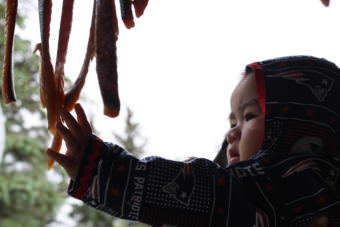
Jenny Bennis and her family donated sockeye from their setnet in Bristol Bay to help other families on the Yukon and Chignik rivers where salmon populations have crashed. (ALFA photo)

A seafood donation program that began in Sitka during the pandemic is still growing. Now called the Seafood Distribution Network, the program is supplying sockeye to families on the Yukon and Chignik rivers, whose traditional salmon runs have crashed.

The market shift in seafood during the COVID pandemic created a problem for the industry: Unlike many other sectors, the supply — the fish — was still there. How to connect those fish with people when traditional markets vanished?

For Linda Behnken, director of the Alaska Longline Fishermen’s Association, it was about connecting the dots.

“So we worked with the local processors here to figure out what fish was stranded by markets being closed, by restaurants being closed, the supply chain disruptions,” Behnken said. “We raised money, bought fish from fishermen that was stranded product, and then started distributing it to people in town that told us they were in need. So it was really ‘You let us know if you need seafood, we’ll provide it.’”

And that’s how the association’s Seafood Donation Program got started in 2020. Basically, a processor-to-doorstep delivery service for people who were having trouble getting by. It didn’t take long for word about the program to get out.

“And then we started hearing from people outside Sitka that there was a need and people really wanted seafood,” Behnken continued. “So we did a distribution with Sealaska, for example, that reached every community in Southeast Alaska. And we did distributions in the Lower 48 to Tribes along the Columbia River, to Anchorage military families, to communities in Western Alaska. Where we heard there was need, we found partners to work with to make that happen.”

Behnken credits Sitka-based processors Seafood Producers’ Coop, Sitka Sound Seafoods, and Northline Seafoods, along with tribes and tribal organizations across the state for helping make the connections that kept the program going.

On paper, it sounds like an impossible undertaking — delivering 645,000 seafood meals across the Pacific Northwest and Alaska, but Behnken says it conformed to basic Alaskan values.

“Alaska is a big state, but we’re also a small state and communities really care about other communities,” she said. “And we have a lot of relatives in different parts of the state, and that there is clear reason for us to share between those areas that have a lot and those areas of scarcity, but the infrastructure isn’t really there. So that’s what we’re working on developing is that infrastructure in Alaska so Alaskans can benefit from Alaska’s fish,

A grant from the Alaska Community Foundation got the Seafood Donation Program rolling; a regional food systems grant from the U.S. Department of Agriculture helped ramp it up. But just the energy of regular Alaskans is helping fuel things now. In a pilot project in Dillingham this June, the Alaska Longline Fishermen’s Association organized a drive to collect subsistence sockeye for communities affected by the crash in chinook and chum stocks.

Natalie Sattler is the program manager for the association.

“We worked with a lot of community members and locals in Dillingham and the Bristol Bay area to help us collect seafood and it was all subsistence donations,” Sattler said. “And within one week, we were able to collect 5,000 pounds of sockeye and folks rallied support, they went down to their setnet sites – kids, families, everyone just you picking fish and donating it and getting it ready to ship out.”

This year, the sockeye will be going to communities on the Yukon and Chignik rivers. And besides providing food, Behnken says the fish are intended to keep food traditions alive.

“What we’ve heard from people in these communities that aren’t able to harvest fish themselves right now because of scarcity is that they really wanted round fish because being able to process that fish as a family – and as a community – is really culturally important,” Behnken said.

The pandemic and the salmon crash have been a one-two punch for many communities in Western Alaska. In a news release, Rep. Mary Peltola said programs like the Seafood Distribution Network were a critical part of the rebound. “Low salmon abundance is an issue that needs to be addressed at every level, from the federal government down to individual communities, and efforts like this are an important piece of that larger goal,” Peltola said.

Bristol Bay fishermen protest low base price, lack of transparency from processors

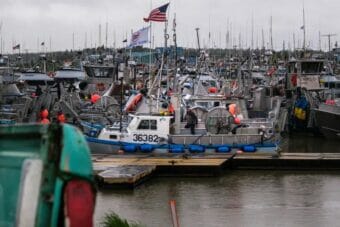
Fishing crews anchored at the Naknek River mouth in protest on July 20, 2023. (Photo by Jack Darrell/KDLG)

By 9 a.m. Thursday, over 100 boats were anchored in the Naknek River entrance, some after a night of fishing the Naknek-Kvichak. Ivan Basargin of the fishing vessel Top Notch was one of them. He was there to join the demonstration against this year’s low price.

Basargin has fished in Bristol Bay since the late 1980s and builds fishing boats in the offseason. Standing in the wheelhouse of a boat he built, he said this year’s low-price hit hard.

“I’m going to pay my workers. I’m going to pay my bills. As far as living expenses, I haven’t decided yet. This fifty cents that I get, when I get home, it’s going to be a wash. I’m not going to have any money in the bank saved,” he said.

Organizers of the protest are calling on processors to reconsider and improve the base price this season from fifty cents per pound — less than half of last year’s price.

Without change, many fishermen say it’s unsustainable for the industry, and some say they will go home in debt. Basargin said he was out on the water protesting because he feared accepting this year’s low base price will set a precedent.

“If they know we can fish for fifty cents, we’re going to get paid thirty cents next year,” he said. “That will happen if we don’t do anything. Like today — this is a peaceful protest. We’re not trying to block people or anything. We’re just trying to show the world that we’re hurting, and we need some help.”

Basargin said processors claim they are struggling financially, too, but he hasn’t seen evidence of this struggle.

“After a record fish catch last year, processors are complaining they are losing a lot of money. I see processors expanding. I see them buying other companies out,” he said. “If you look at the scenario, it kind of seems like they are putting a burden on us. They’re adding up their profits and expanding operations.”

Trident Seafoods was the first to post that base price on Sunday, with some handling incentives: fifteen cents for refrigerated seawater and ice, and for the drift fleet five cents for floating and ten cents for bleeding. North Pacific Seafoods announced the same a few days later, along with Peter Pan Seafoods, who is also offering a twenty cent bonus for “late season” fishing beyond July 18.

Protest organizers also called for processors to resume posting a base price ahead of the season. In recent years, Peter Pan Seafoods posted a price in mid-June, which was welcomed by fishermen. This year, processors did not release a price in Bristol Bay before fishing started. Fran Kaul, a longtime captain, says with prior knowledge of the low price, fishermen may have planned differently.

“It’s very interesting that the price came out pretty much at the very end of the season. They had all our fish, right? The fish had been caught. And then Trident posts fifty cents a pound,” she said.

Cheyne Blough has been fishing in Alaska for 35 years. He fishes for Trident and helped organize this protest, prompted by Trident’s price announcement letter to the fleet. His children crew on his boat in the summers, but he has discouraged them from buying into the fishery.

 A Bristol Bay fishermen radio group protest processors in the Naknek River
A Bristol Bay radio group protest processors in the Naknek River on July 20, 2023. (Photo by Jack Darrell/KDLG)

“The last thing you want is your children to get strapped to hundreds of thousands of dollars worth of debt, and then have the rug pulled out from under them,” he said. “And that’s what’s going on. I didn’t think it would happen quite this way, quite this fast.”

Adjusted for inflation, this year’s base price is the lowest recorded price in nearly 40 years, since 1984. Without adjustment for inflation, this year’s price is still the third lowest — the lowest was in 2001.

But Blough says he’s seen the quality of the fish sold to processors improve over that time. That’s due to fishermen’s investment in equipment and labor, according to Blough, but it’s not reflected in prices offered by the processors.

“We’ve been asked to make expensive capital improvements — a regular RSW (refrigerated seawater) system, we hire an extra deckhand so we can bleed the fish. They have quality control people on every tender going ‘your fish is good, your fish is bad, you need to do better,’” he said.

Blough says fishermen bear the cost of these improvements, but don’t benefit from the resulting revenue.

“And what do we get in return? We get half the price. And in my opinion, the processors need to do better. I cannot believe I’ve been fishing for 35 years, and I’m fishing for less base price than I did when I was in my teenage years,” he said.

Kelly Stier on the F/V Honey Badger says processors are taking advantage of fishermen, knowing they have few choices for buyers in the region.

“We’re out here, and the processors know that. They have us, and it does take a lot of infrastructure and they do have expenses on their side of things, but I think they’ve taken advantage of us because they know they have us backed into a corner,” he said.

Anna Mounsey is a new skipper on the fishing vessel Syren. She says younger members of the fleet, like herself, are questioning if this industry is worth buying into.

“As a new fisherman, new skipper, trying to make it in this fishery just starting out, the unsustainability with overhead and the price fluctuations, (we’re) just seeing if it’s even worth it,” she said. “With how much it fluctuates, not being able to count on making boat payments and all the other expenses that come with just starting out, being young. Watching this graying fleet leave, what hope do us young fisherman have with the vulnerability of this market?”

KDLG made repeated email and phone call requests for comment with the largest processors — Trident Seafoods, OBI Seafoods, North Pacific Seafoods, Silver Bay Seafoods and Peter Pan Seafoods — but did not receive a reply.

Some fishing crews heard the news about prices and ended their season. Others continued fishing, in an otherwise strong season with harvests over 36 million fish to date.

Vessels in the Naknek River entrance. (Photo by Jack Darrell/KDLG)

What climate change and extreme temperatures could mean for Bristol Bay salmon

Salmon spread across the deck of a fishing vessel during last summer’s record season in Bristol Bay. (Hope McKenney/KUCB)

Bristol Bay sockeye populations are booming, but what is the tipping point?

This summer is a colder, rainier and buggier season in Bristol Bay, and across Alaska. Meanwhile, last week the world faced four straight days of the hottest temperatures on record, marking Earth’s extreme warming.

The biggest challenge of climate change for Bristol Bay salmon isn’t necessarily warming temperatures right now. Bill Templin, the Alaska Department of Fish and Game’s chief salmon fisheries scientist, says it’s variability.

“You know, climate change isn’t just directional. It’s not just that things are warming, it’s also that there’s greater variability in the systems,” he said.

Templin believes these cold, wet, stormy summers are a product of climate change too.

“There can be a wider swing of hot and cold or dryness, drought, flooding, excessive water in the systems,” Templin said. “That variability makes it hard for an organism to adapt to the changes which can lead to reduced productivity from systems that are otherwise healthy, with healthy habitats and low fishing pressures.”

What does that mean for salmon?

There’s some good news. Starting in freshwater, where salmon return to spawn and remain the first year of life, Bristol Bay’s deep lakes provide a natural buffer to temperature changes.

“So it seems like the lakes are really this big buffering mechanism,” said fisheries ecologist and researcher Daniel Schindler with the University of Washington’s Alaska Salmon Program. That’s critical for the salmon’s success.

Freshwater lakes are deep and stratified, meaning temperatures of the water are warmer at the surface going down to cooler at the bottom. Salmon can dive deep and escape warmer surface temperatures. According to Schindler, that means they can return to spawn earlier if ocean temperatures are too warm, like the birth ward at the hospital.

“That allows them to adjust when they migrate in from the ocean, and basically chill out until it’s time to spawn, which is much later in the season for fish that spawn in warm sites within watersheds,” he said.

In other words, the lakes and rivers above Bristol Bay can withstand a bit of temperature change. Salmon can’t regulate their own heat but they are very good at adjusting their depth to find the most comfortable water temperature.

Bristol Bay’s spawning grounds are also seeing a boom in what sockeye are eating – zooplankton.

Schindler believes it may be the “Goldilocks zone” of favorable conditions for sockeye right now. He said the things that salmon eat love that warmer top layer of lakes in Bristol Bay. That means more food for juvenile sockeye, which means salmon leaving for the ocean as big, well-fed fish, which means relatively high survival rates on average.

“So if we look where this might be going over the next 20 years, I think it’s safe to say that the lakes probably are not going to get any colder. Our best estimate is that the productivity of the lakes will continue to increase. This probably won’t translate into any differences in runtime, that’s really most likely affected by conditions they encounter at sea, not conditions they encounter in the lakes,” Schindler said.

That buffer for spawning salmon can only go so far though. What happens when climate change alters water temperature past that “Goldilocks zone?” Schindler suggested we should expect to see changes in the behavior of sockeye.

“Over the long term, with more climate change and more adaptation, we might see changes in spawn and run timing,” he said.

There’s a sci-fi movie trope where someone goes back in time and accidentally does something miniscule that alters the course of space-time in an unforeseeable way. In a way, the cascading and unpredictable effects of climate change in southwest Alaska could be like that. Our ecosystems are unimaginably complex and researchers don’t know what will happen when one factor is tweaked. A snow cap can prematurely melt miles away and flood the watershed, a lake can get a little warmer and suddenly entire industries have to adapt.

For the Bristol Bay sockeye fishery estimated at more than $2 billion, that butterfly effect of climate change could have massive impacts for fishermen and the communities dependent on the fishery.

Templin said most likely, those climate change effects could be seen in the open ocean where sockeye spend most of their life.

“So, we would expect water temperatures in the ocean to have a bigger effect on their size, their survival, and the age that they return,” Templin explains, “because the ocean is a very productive place, and they do most of their growing there. So we would expect temperatures in the ocean to potentially have a bigger effect than freshwater temperatures.”

Of course, there is no open-and-shut case. Templin referenced recent research from the University of Alaska which shows that different species of salmon are associated with different temperatures and locations at sea. This may provide part of the reason why some salmon species are booming while others, like chinook, are under threat. As sockeye are pushed to the top of that climate bubble, other species that respond less favorably to warmer sea surface temperatures begin to tip over the edge.

But what is that tipping point for Bristol Bay sockeye?

Templin believes we have to go back to the lakes to understand what a tipping point may look like.

“Tipping points have been seen in other systems, maybe not the way that we often think of them. But kind of a point where – not a point of no return, so to speak – but where systems flip into a new mode.”

Templin used this example: “You notice how the top foot or two of water is a lot warmer? And when you dive down and get into some really cold water? That stratification of the lake water can be disturbed by a lot. When they get a big windy event and it mixes the water, that changes the way the ecosystem acts. So there’s a tipping point in many lakes. There’s a time during the year when enough of the sun and the wind has stirred it up enough that that stratification breaks down. And the water column becomes more uniform in its temperature.”

When that buffering system in the lakes breaks down, Templin said, so does the ecosystem. Glacial melt, cold water inputs, algae, silt, these are all factors that could contribute to a potential tipping point, the straw that breaks stratifications back.

Templin assured it’s not all doom and gloom yet, the tipping point won’t be tomorrow. Bristol Bay rivers are short and cold and the lakes are hardy.

“But the lakes do provide a lot of buffer. They form kind of these cold water reservoirs, as well as the ability for lots of fish to to survive, thrive and grow juvenile salmon within these lakes,” he said.

When asked if Fish and Game is keeping an eye on climate change and the future volatility of Bristol Bay watersheds, Templin said the department is more focused on management.

“The department is not necessarily a research organization like a university. Our responsibility is to manage and to manage for the benefit of the people in the state and the sustainability of the systems. So most of our research has to do with improving management and understanding the species.”

Alaska fisheries managers are tasked with managing the fast-paced, dynamic Bristol Bay runs each year, and that will also mean adapting to climate changes in the future. The only thing we know for sure is that tomorrow, for better or worse, whether a fisher or a fish, Bristol Bay industries and ecosystems must adapt together.

Forest Service identifies nearly 700 Tongass stream crossings that could block migrating fish

An old culvert built for past logging projects obstructed Logjam Creek on Prince of Wales Island. (Photo courtesy of USFS)

Nearly 700 sites along Tongass National Forest streams could obstruct fish from migrating. That’s according to a new report from the U.S. Forest Service. But there is a plan to deal with the old roads and culverts causing the problems.

Back in the 50s and 60s, timber was harvested throughout Southeast Alaska without plans for how all the construction — like roads, culverts, and bridges — would affect fish habitats as they deteriorate in the years to come. And that deterioration has proved to be a big problem for fish.

“Fish migrate, so we need to ensure that they have that opportunity,” said Sheila Jacobson, fisheries program manager for the U.S. Forest Service.

Jacobson is leading a new project that seeks to restore all 700 of the crossings on the Tongass that aren’t up to federal standards. She says migrating fish — including salmon, steelhead, and trout — swim into human-caused barriers left over from those days of heavy logging.

“This project really is aimed at restoring fish passage across roads and motorized trails, which are fragmenting fish habitat across the entire forest,” Jacobson said.

The federal agency has been documenting these stream crossings since the early 1990s. The Forest Service has tried to restore them one by one as funding allows. Now, they’ve compiled all of them into one project, the Tongass National Forest Fish Passage Restoration, which can be added to as more crossings are identified.

Jacobson says it should make for a more streamlined process.

“It sets us up well for being able to capitalize on some of the new funding streams that have been coming up in the past year or so,” she said. “And then partners are able to help us with grant opportunities as well. So, we are definitely being able to get more project funding for this particular issue.”

This culvert on Logjam Creek on Prince of Wales Island has been restored to improve fish passage. (Photo courtesy of USFS)

The Forest Service isn’t the only one restoring streams on the Tongass. The agency has several partnerships, including the Hoonah Native Forest Partnership. Ian Johnson runs the environmental department for the Hoonah Indian Association. For the past five years, they’ve run programs that have local workers restoring watersheds in the area. Hoonah is on the northeast side of Chichagof Island.

Johnson says streams there have been affected by past logging.

“When fish are passing through a culvert, if there’s a meter perch or something on the backside, people can see that,” Johnson said.

Johnson says around six years ago, the tribe surveyed the community about environmental issues, and stream restoration was ranked number one. He says some community members had worked for the logging industry in the past.

“There were a lot of folks here who were a part of the logging and, you know, experienced the logging,” Johnson said. “And those that had concern at the time about the effect of logging right up to the stream.”

Now, workers with Hoonah Native Forest Partnership fix culverts and bridges and reintroduce wood into watersheds that lost that natural process through logging. Johnson says healthy streams are important — especially for communities that rely on the land around them.

“Hoonah as a community relies on subsistence resources, to meet many of its needs, especially around protein,” Johnson said. “and needs to have a landscape that can provide those resources.”

The Forest Service wants to grow partnerships like the one with Hoonah. Fixing 700 stream crossings is a lot. It’s a plan that spans nearly the whole Southeast region, except for Prince of Wales Island. That island has 2,000 miles of mostly logging roads and has its own restoration plan.

Many of the bad logging practices started changing in 1976 with the passage of the National Forest Management Act. It regulated the timber industry, limiting the size of clear cuts and how far away from streams they could be.

Site notifications
Update notification options
Subscribe to notifications