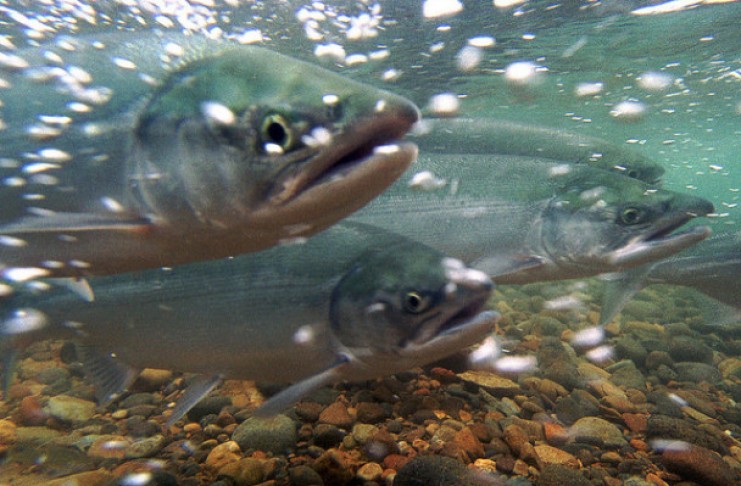
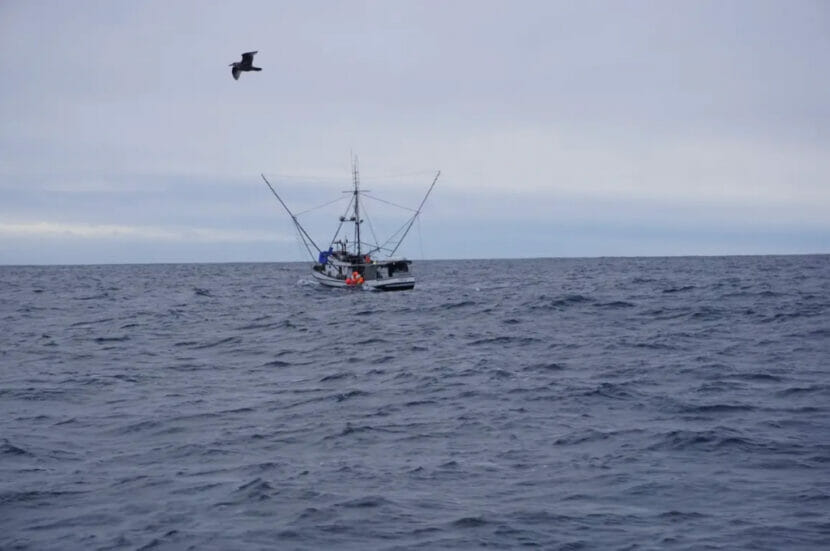
Chum salmon migration. (USFWS/Togiak National Wildlife Refuge)
Among the projects Gov. Mike Dunleavy vetoed from the state budget on Monday was salmon research to help determine the causes of the chinook and chum crisis in western Alaska.
Dunleavy vetoed $513,000 for research on the origins of salmon caught by accident in the Bering Sea pollock fishery, as well as the origin of salmon intercepted by fishermen off the Alaska Peninsula in what’s known as “Area M.” Dunleavy vetoed the project last year, too.
“You never know what’s going to come of these budgets. But this is quite a disappointment, again,” said Karen Gillis, program director of the Bering Sea Fishermen’s Association. The association was to receive the money and pass it on to a partnership of federal and university scientists.
The veto documentation said the funding was cut to save money. Dunleavy spokesman Jeff Turner added that the Alaska Department of Fish and Game did not believe the study would meet its objectives and that $100,000 would have gone to the University of Washington for overhead.
The research results would have policy implications, and could fuel the fury already burning in communities on the Yukon and Kuskokwim rivers. For the fourth season in a row, subsistence salmon fishermen in the region are shut down or severely restricted. Chinook and chum are returning to those rivers in numbers so low that there’s barely enough to meet escapement targets for spawning. Meanwhile, thousands of chinook and chum are caught every season in the Bering Sea and Area M fisheries.
Prior research has shown that only a portion of that salmon bycatch was destined for western Alaska rivers, with many of the fish originating from Asia. Gillis said more research is needed to aid management decisions.
“The genetic work that’s been done to date lump the Norton Sound, Yukon, Kuskokwim and Bristol Bay stocks into something called ‘coastal western Alaska,’” she said. “And so what this work does is studies from otoliths of adult salmon to determine their geographic location or their birthplace, basically.”
Otoliths, or ear bones, of salmon bear the chemical fingerprint of the freshwater the fish has swum through, allowing scientists to determine not just which side of the Pacific the fish originated, but which river system.
Gillis said last year’s veto halted the project, but there may be another source for the funding.
The governor’s office referred questions about the veto to the Department of Fish & Game, which did not respond in time to be included in this story.
A troller plies the waters of Sitka Sound earlier this year. (Photo by Max Graham)
A federal appeals panel issued a last-second ruling Wednesday that will allow this summer’s Southeast Alaska troll chinook salmon fishery to open as scheduled July 1 — reversing a lower court ruling that would have kept the $85 million industry off the water.
“It’s a major victory,” Alaska Fish and Game Commissioner Doug Vincent-Lang said in a brief phone interview Wednesday. “We can go fishing.”
The panel, in a five-page ruling, said that the entities defending the fishery — the Alaska Trollers Association, the state of Alaska and the National Marine Fisheries Service — met the legal standard required to grant what’s known as a “stay” of the lower court ruling.
The decision, the panel said, was based on the likelihood that those entities could show that “the certain and substantial impacts” of closing the harvest on the Alaska salmon fishing industry outweigh the “speculative environmental threats” posed by allowing the fishery to take place.
The Washington-based environmental group that sued in an effort to shut down the harvest, the Wild Fish Conservancy, argued that allowing the fishery to continue would harm a population of 73 endangered orca whales that live off the coast of Oregon, Washington and British Columbia.
The Southern Resident orcas depend on chinook salmon for most of their diet.
This article was originally published in Northern Journal, a newsletter from journalist Nathaniel Herz. Subscribe at this link.
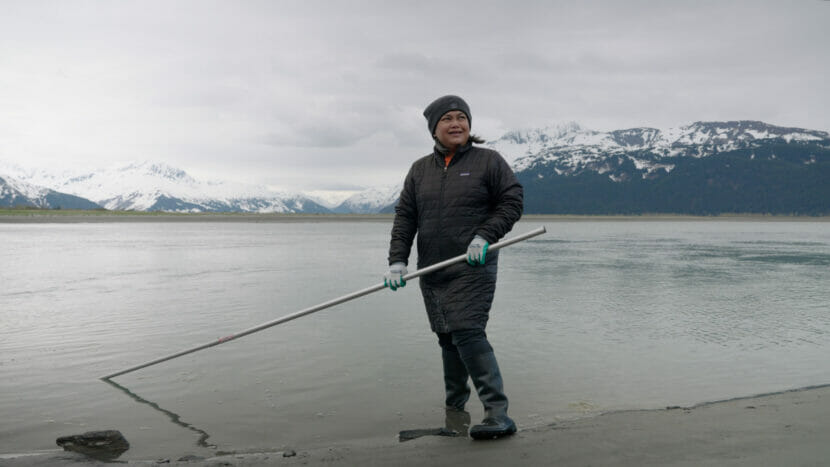
Ratdawan Haywood was the lone hooligan fisher in the Twentymile River area on the last day of May, trying her luck after being able to fill her five-gallon bucket several times the week prior. (Young Kim)
On the last day of May, Ratdawan Haywood tried her luck at the mouth of Twentymile River near Portage. She dipped her net into the grayish brown river, where it disappeared for a few moments before it emerged empty. Her blue Lowe’s bucket sat on the shoreside near her, empty as well.
“It’s slow this year,” she said. “People say last year was pretty good and this year is not as good. I heard people are catching them in Seward, but I don’t know where to go.”
Haywood had better luck the week prior, and was able to fill her bucket a couple of times.
Every year, dozens of Anchorage residents like Haywood venture to the southernmost edge of Anchorage’s municipal boundary to the mouth of Twentymile River, in hopes of filling their freezers and fryers with the slender, small silvery fish. For a brief season — the beginning of April to the end of May in salt water and June 15 in freshwater — they can scoop hooligan fish out of the water with long nets. The hooligans’ arrival is the kick off to the long-awaited summer season for many families who turn the fishing trip and the subsequent fresh fish fry into celebratory events that center on family, friends and the sharing of food.
“I think the move is to take what you think you can eat, and then share with everyone else, because it seems like everyone has a use for it,” said Randy Guintu who grew up in Anchorage and fished often with his family.
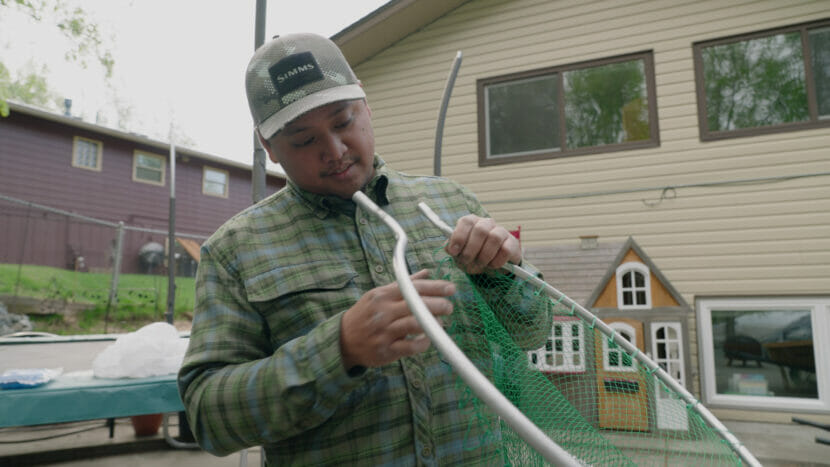
Randy Guintu removes the old net from his dip net frame. He remembers growing up and going to Seward, Willow or Twentymile and hooligan being one of the first fish that young children are able to catch for themselves. (Young Kim)
Haywood also spent a lot of time fishing with her family. She said she took her children to catch hooligan every year, and would fry and bake the little fish for her family to eat. But then her children grew up, and her recent trip to the river was her first in about a decade. She wanted to get out of the house, she said, and still likes to fry the hooligan, but she’s been more experimental with the fish she caught the week before — trying them in Thai soups like tom yum.
“It was last week, I actually told my mom I wanted to make tom yum soup,” she said. “Sometimes people think the fish is small and the meat is squishy so some people don’t like them because it’s a lot of oil.”
Hooligan, also known as ooligan, smelt, candlefish and eulachon, are extremely oily – up to 20% of the fish is fat. The small fish is considered to be a keystone species for the West Coast. A multitude of marine and land animals rely on hooligan for food in the spring months, and the fish is prized by Indigenous people in the Northwest for its oil, medicinal and food values. Before the gold rush, trails like the famous Chilkoot Trail were used by Indigenous people to trade ooligan oil. These trails were sometimes called “grease trails.”
Ooligan oil is a staple in Ruthie Constantine’s home. She moved to Anchorage in 2009 from Metlakatla, a Tsimshian community near Ketchikan in Southeast Alaska. She grew up eating hooligan and its oil — which is made by fermenting large batches of the fish before rendering the oil into different grades. Constantine said they get ooligan grease from Canada, where her tribe is originally from.
Despite growing up eating hooligan, Constantine only tried fishing for it when she first moved to Anchorage.
“It was a different experience to see and try,” she said. “My husband’s aunt took us out and wanted us to try. After that we were hooked.”
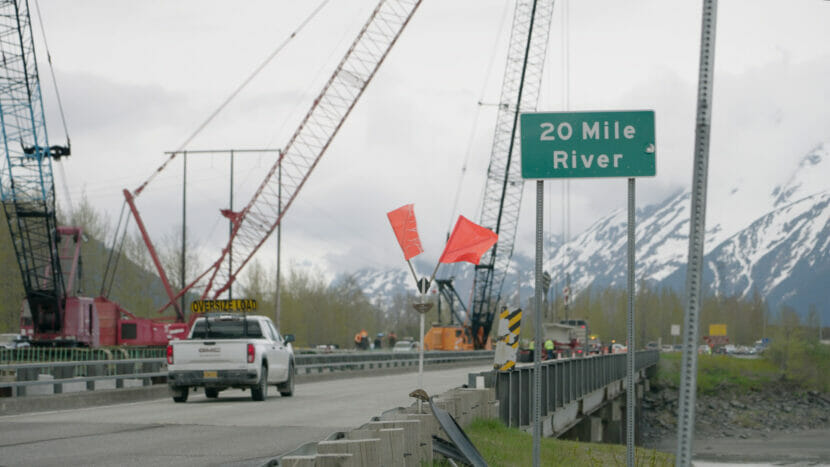
Road construction takes place near the bridge by Twentymile River, a popular destination for hooligan fishing in May. (Young Kim)
Constantine and her family often fish for friends and family who live back home in Metlakatla. When they visit, they bring two 50-pound freezer boxes on the plane with them. Then, starting with her grandma’s house, they go around the community with gallon bags full of fish for whoever wants or needs them.
“To bring them home feels – I don’t know how to describe it – it’s like a piece of joy just being able to share something that everyone loves to have at home,” she said. “It’s nice to provide for them and be able to give, and to be able to share with everybody.”
Constantine, as well as her friend’s and family back home, like to fry the fish whole with flour and seasoning or smoke them using traditional methods her grandmother taught them.
“Depending on who we’re having our Native food dinners with, sometimes the older people like a small bit added to their berries,” she said.
Guintu and his family also grew up frying the hooligan fish whole. Guintu works in the survey field and has commercial fished in Cook Inlet.
“I feel like hooligan is one of the first fishes young children are able to fish for,” he said. “I kind of remember growing up and being dragged down to Seward, and we would go to Willow or Twentymile. It’s kind of something that I’ve done for my family, being like one of the only adult children from my generation that actually likes to go out and fish.”
He tries to go annually with his family and friends, but hasn’t been able to go the last few years. But, family friends have made sure he doesn’t go without hooligan to eat – which they all typically like floured, seasoned and fried fresh and whole.
When he does fish, Guintu said, he likes to share his catch with his aunts or grandma. Their method is to take the biggest sized hooligan, butterfly and marinate it in garlic, soy sauce, brown sugar, vinegar, MSG, Sprite or Coke and liquid smoke, before baking them at a low temperature to create a smoked effect. Then, they’d fry the fish.
“It’s like a potato chip,” he said. “You just eat everything, it’s crunchy. But that takes a lot of time. The move was to bring them to grandma’s house because she made them the best. I think that’s probably pretty typical with most Filipino families. There’s a party, just fry and go really.”
He said the flesh of the fish is white, delicate and oily and not “super fishy” in taste. Most recipes from any culture calling for milkfish or mackerel could easily translate to using hooligan, he said.
“I feel like there’s a lot of cultures that have really made it popular, and really have a good way of preparing them,” he said. “Usually it’s a lot of ethnic cultures like the Hmong or the Hawaiians or the Koreans. I’m really intrigued to see what the Greeks or some of the other Europeans are doing with them. I think it’s a pretty cool resource to have.”
Like Haywood, whose bucket was empty Wednesday afternoon, Guintu said he’s been “kind of concerned about some of the returns” he’s seen.
“It just used to be – when we were kids, we went down to Nash Road and we’d be like five years old, you’d bring a spaghetti strainer and you can scoop them out of the creek,” he said, referencing Seward.
Whether it’s fishing or hunting, Guintu said, he likes providing for his family and others.
“I felt like it was something we did traditionally and I wanted to keep that tradition strong with the next generation,” he said. “I think it’s a pretty important personal use and subsistence fishery for all Alaskan residents.”
Catching the fish has become a tradition for many. For Haywood, who came to the river to try her luck after a decade hiatus from the fishery, it’s a tradition she’s picking back up.
“From now on, I’m going to try and come out every year and catch it for the season,” she said.
This reporting is supported in part by a grant from the Alaska Humanities Forum and the National Endowment for the Humanities, a federal agency. Any views, findings, conclusions or recommendations expressed in this report do not necessarily represent those of the National Endowment for the Humanities.”
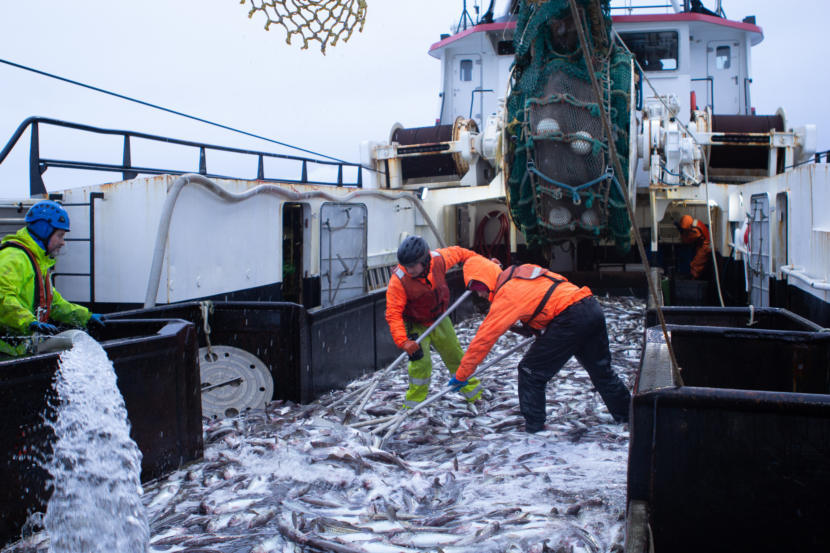
U.S. pollock fishermen on the deck of the Commodore. The American pollock industry is among those that object to importing Russian-caught fish through China. (Photo by Nathaniel Herz/Alaska’s Energy Desk)
President Joe Biden signed an import ban on Russian seafood last year, but fish valued at several hundred millions of dollars are able to evade the ban by diverting to another another country before arriving on American shores.
“There has been a huge loophole where the Russians have been now sending their fish — it’s pollock, it’s salmon, a little bit less crab — to other countries for reprocessing, primarily China,” U.S. Sen. Dan Sullivan told reporters Thursday.
The ban was intended to ensure Americans aren’t indirectly financing Russia’s war on Ukraine through their purchases. The problem is that the United States doesn’t require that seafood imports be traced to their country of origin.
Last year, the U.S. imported more than $300 million worth of salmon and pollock from China. Some of it was caught in the U.S. and sent to China for processing but a majority is likely to be from Russia, according to an International Trade Commission report.
Sullivan said he’s talking to officials in the Biden administration about closing the loophole and is also sponsoring legislation, as he did last year.
“Bottom line, what this does is it bans all Russian origin fish, wherever it goes to be reprocessed. Again, primarily, China,” Sullivan said. “We think this is a really big deal for our country, to nail the Russians as they’re trying to evade sanctions after the brutal invasion of Ukraine.”
Environmental groups and the American pollock industry are among those calling for the loophole to be closed. But U.S. companies that process and sell imported fish oppose bans that decimate their supply.
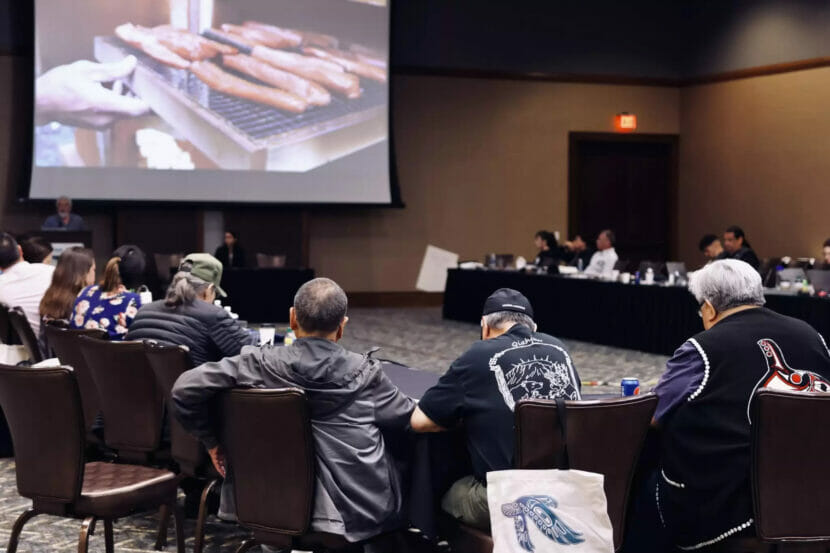
Delegates participate at the 4th Annual Indigenous Leaders Summit in Lummi Nation, Washington last week. (Photo courtesy of SEITC)
Tribes in Southeast Alaska and across the border in Canada have declared an emergency for salmon facing environmental risks. Leaders with the Southeast Alaska Indigenous Transboundary Commission made the announcement at the 4th Annual Indigenous Leaders Summit in Washington last week. The transboundary commission represents 15 Tsimshian, Lingít, and Haida Nations.
They say that Pacific salmon are facing habitat loss and degradation of critical waterways on both sides of the border.
Guy Archibald is the commission’s executive director.
“We’re seeing declining salmon stocks across the board, especially king salmon or chinook,” said Archibald, “and we’ve come to the conclusion that there’s no time to waste.”
At the summit, participants talked about what they experienced at home.
“Our people no longer have salmon running in our streams. Salmon only live in our stories,” said Violet Gatensby, a youth representative from Carcross, Yukon.
Archibald says the commission wants two specific things to come from the salmon emergency declaration. They hope to unify tribes in Alaska and Washington along with First Nations in Canada to strengthen their message. And they want recognition for the traditional territories of Southeast Alaska tribes that run across the border. Archibald says the lands are now in British Columbia and are subject to several large mines – some operating and some that are being proposed.
“Canada has to recognize, you know, those traditional boundaries and give Alaska tribes a real seat at the table on how these mines are developed,” he said.
Archibald gave the example of the Unuk watershed east of Ketchikan, which has several mining projects – like the Brucejack goldmine, the proposed KSM goldmine, and the Eskay Creek Revitalization Project, which is an old gold mine looking to reopen.
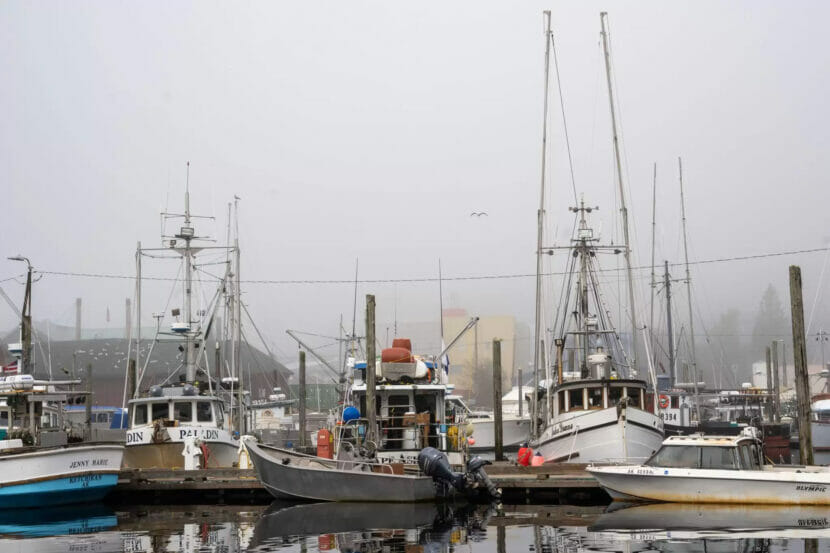
Trollers wait in Ketchikan’s Thomas Basin on Oct. 8, 2022. (Eric Stone/KRBD)
The National Marine Fisheries Service hasn’t ruled out the possibility of opening the summer troll season for king salmon in Southeast Alaska, despite a federal judge’s recent ruling to the contrary.
The service’s Alaska regional administrator, Jon Kurland, told a roomful of trollers during a June 7 meeting in Sitka that the agency was working hard to correct the problems identified in the federal lawsuit. The Wild Fish Conservancy in Washington state sued to stop the Southeast Alaska troll season, seeking to protect endangered Southern Resident killer whales’ food sources.
If successful, Southeast trollers might be able to harvest king salmon this summer – if not on the traditional date of July 1, then possibly in August.
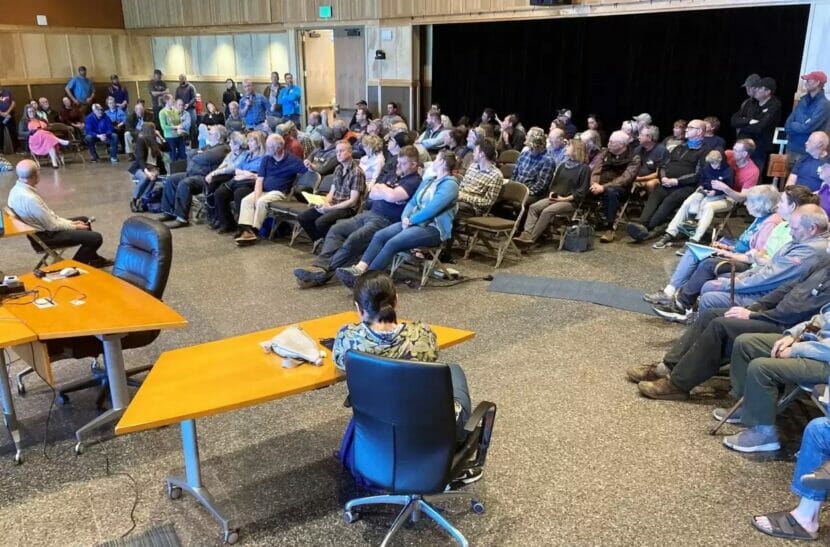
To get a feel for the impact of the Wild Fish Conservancy lawsuit on Southeast trollers, try sitting in a room filled with them: Grizzled oldsters, seasoned men and women hardened by life on the ocean, well-known fisheries advocates, young families, and a baby or two.
Kurland says that despite his lengthy title at the National Marine Fisheries Service, an arm of the National Oceanic and Atmospheric Administration, he is a neighbor and he gets it.
“So first off, I know that there’s been just a huge amount of concern about the implications of this suit and the potential for the troll fishery not to be able to open,” Kurland told the room. “I live in Juneau, I have a sense of how important this fishery is for Southeast Alaska for a lot of small businesses, a lot of families, a lot of communities. It’s a big deal.”
The Wild Fish Conservancy sued the National Marine Fisheries Service in 2020, arguing that the service had violated the Endangered Species Act by failing to fully account for the impact of Southeast trolling on Southern Resident whales.
The Conservancy won, and a judge ordered Southeast Alaska king salmon trolling shut down until the problem could be remedied. And it’s just commercial trolling for chinook in Southeast Alaska – no other commercial or sport fishery anywhere from Alaska to California is affected.
Listen to the full audio of Jon Kurland’s update to trollers, Wednesday, June 7 2023, in Sitka.
It’s a baffling strategy, and Kurland is as surprised as anyone that the suit got this far.
“We were all sort of incredulous that this suit is focusing on Southeast Alaska fisheries, when there are a lot bigger threats that Southern Resident killer whales are facing then what’s happening in these fisheries,” Kurland said. “The Southeast Alaska fisheries are a really small contributor to the challenges that Southern Resident killer whales face in their recovery. But anyway, it is what it is.”
Kurland explained the nuts and bolts of the lawsuit, which were already known to many in the standing-room only crowd in Sitka’s Harrigan Centennial Hall: How it stemmed from a 2019 biological opinion prepared by the National Marine Fisheries Service, and the associated incidental take statement required to conduct a fishery that could affect an endangered species.
NOAA Fisheries Alaska Region administrator Jon Kurland (left) speaks to Southeast Alaska trollers during a June 7, 2023 meeting of the North Pacific Fisheries Management Council in Sitka. (Robert Woolsey/KCAW)
He then took questions – some tough questions. Deborah Lyons, the Alaska Trollers Association’s representative to the Pacific Salmon Treaty, wondered how the National Marine Fisheries Service could be outflanked by a nonprofit conservation organization on a question of environmental policy.
“So when I look at what happened in Washington, NMFS, who are the experts on fisheries, issued an opinion that said: The Southeast fishery – yes – take some threatened salmon and take some salmon that are prey of an endangered whale,” Lyons said. “But in the opinion of the National Marine Fisheries Service, it was not a significant threat to any of those species. And yet (the Wild Fish Conservancy) was allowed to appeal to a judge and provide hand-selected bits of data that the judge found more compelling than the opinion of the agency – the federal agency – that’s supposed to render these decisions. Now, how does that happen?”
Kurland responded that the Endangered Species Act has a provision that allows any citizen to bring suit, and that’s what the Conservancy did.
Although the National Marine Fisheries Service has appealed to the U.S. Ninth Circuit Court of Appeals and asked for a decision in June, it’s unlikely that the court would act so fast.
Instead, Kurland – without giving away too much legal strategy – said the National Marine Fisheries Service had one trump card it could play.
“So the agency has the authority under the Endangered Species Act to issue a new biological opinion and a new incidental take statement,” Kurland said. “It could be reviewed by the court, the court doesn’t need to approve it upfront. But it’s certainly possible that the plaintiffs will take issue with whatever we put out, and will ask the court to review it. But there is no no implicit requirement or explicit requirement for the court to approve it before it takes effect.”
This prompted troller Robert Bateman to drill down.
“It’s my understanding that once the (incidental take statement) and the new (biological opinion) has been written, and correct me if I’m wrong, you can basically put that in effect straight away?” Bateman asked. “Now, if that didn’t happen before July 1, could we maybe go fishing in August still?”
“So your question is, if we are not able to get the new ITS coverage in place by July 1, but we get it in later, could there be an opening later in the season?” Kurland paraphrased. “Yes.”
Kurland was joined at the meeting by an attorney from the U.S. Department of Justice, which is representing the fisheries service. Kurland explained that the the DOJ steps in anytime someone sues the government.
“I get sued all the time,” Kurland said.
Close
Update notification options
Subscribe to notifications
Subscribe
Get notifications about news related to the topics you care about. You can unsubscribe anytime.