Fisheries

Pebble Mine company to pay shareholders who claim they were duped

Spawning Bristol Bay sockeye salmon, with their distinctive red bodies and green heads, swim in the waters of Lake Clark National Park and Preserve in 2003. Potential effects on Bristol Bay’s bountiful salmon runs have been at the heart of opposition to the Pebble Mine, and the Environmental Protection Agency in January invoked a rarely used provision of the Clean Water Act to bar Pebble’s permitting. Some investors in 2020 sued parent company Northern Dynasty Minerals Ltd., claiming that corporate leaders misled them about the project and its environmental effects. The parties have reached a settlement totaling nearly $6.4 million. (Photo by D. Young/National Park Service)

The company behind the controversial Pebble Mine in Southwest Alaska has agreed to pay nearly $6.4 million to a group of shareholders who claim they were misled by corporate leaders.

Vancouver-based Northern Dynasty Minerals Ltd. reached the settlement with the named plaintiffs, according to documents filed last week in the U.S. District Court for the Eastern District of New York.

The settlement is the product of two lawsuits, later consolidated, alleging that Northern Dynasty and the Pebble Limited Partnership had defrauded investors through false and misleading statements. Northern Dynasty is the sole owner of the Pebble Limited Partnership.

The court filings name only a few individual investors, but the lawsuit has become a class-action claim with “likely hundreds, if not thousands of potential Settlement Class Members” to share in the payment, said the settlement memorandum filed on Wednesday. If the court approves the agreement and certifies the class, others who owned Northern Dynasty securities between Dec. 21, 2017 and Nov. 25, 2020 could be eligible for payment from the settlement total, according to the memorandum.

At issue were revelations in recorded conversations released in 2020 that became known as the Pebble Tapes. In those conversations, which were recorded by an environmental organization working undercover, Northern Dynasty Chief Executive Officer Ron Thiessen and Tom Collier, then the Pebble Limited Partnership CEO, described a strategy of getting a relatively small mine plan through the permitting process and following up with a massive expansion. Additionally, the two men touted political connections that they said would ease permitting.

“When the truth emerged through a series of corrective disclosures and materializations of risks that the Pebble Project would not receive a permit, Northern Dynasty’s stock went into a tailspin, wiping out hundreds of millions of dollars in market capitalization and injuring hundreds of thousands of investors,” said the amended complaint filed in 2021 in the consolidated case.

The mine, targeting copper primarily, appears to be administratively blocked; the Environmental Protection Agency in January invoked a rarely used Clean Water Act provision that precludes permitting of the Pebble Mine or any similar mine in the specific sites targeted for development.

EPA said the Pebble Mine would have “unacceptable adverse effects” on salmon habitat in the Bristol Bay region, site of the world’s largest sockeye salmon runs, and the people and ecosystem dependent on that habitat.

A sticker expressing opposition to the Pebble Mine is seen on a coffee shop window in Kodiak on Oct. 3, 2023. Opposition to the mine has been widespread in Alaska’s fishing communities for several years. (Photo by Yereth Rosen/Alaska Beacon)

Northern Dynasty, however, continues to pursue the Pebble project and is gathering information to present to the U.S. Army Corp of Engineers to support issuance of a critical permit to develop that wetlands area. The Corps denied Pebble’s permit in 2020, but in April its reviewing officers ordered a reconsideration of that decision.

In a statement sent to the Alaska Beacon on Monday, a Northern Dynasty official said the company disclosed some information about the settlement in recent financial reports and that the settlement “does not contain any admission of liability.”

“To the contrary, Northern Dynasty firmly believes that the notion of a ‘secret mine plan’ is baseless and the company denies any wrongdoing alleged by the plaintiffs. The Company is confident that it would have prevailed at trial on the merits, when the full context and facts underlying the permitting process would show the allegations to be without merit. Nonetheless, this settlement brings to an end what would have been a costly and protracted legal process, with the settlement amount representing a fraction of the expected costs of litigation to bring this case to verdict,” said the statement, from Mike Westerlund, vice president of investor relations.

Since the total is within the company’s insurance policy limits, Northern Dynasty “does not anticipate corporate funds will be used to fund the settlement,” the statement said.

According to its financial report for the first quarter of 2023, Northern Dynasty has CA$139.5 million in total assets, of which CA$127.2 million was in the company’s mineral property, plant and equipment.

The Bristol Bay Defense Fund, a coalition of community, nonprofit, Indigenous and business organizations opposed to the Pebble Mine, said the settlement “demonstrates yet again how untrustworthy Northern Dynasty Minerals is and always will be.”

“Not only did they mislead investors, they lied to the people of Bristol Bay, and since they aren’t using any corporate funds for this settlement, the Biden administration should order them to remediate the parts of the watershed they damaged and left behind polluted for the community to clean up,” the Bristol Bay Defense Fund statement said.

The Bristol Bay Defense Fund and similar organizations are calling for watershed protections that go beyond the EPA’s action. “Our elected officials must recognize the duplicity of Northern Dynasty and the recklessness of their project, and pass watershed-wide protections to protect all of Bristol Bay, our salmon and our way of life, forever,” the statement said.

This story originally appeared in the Alaska Beacon and is republished here with permission.

Want to help Alaska biologists log migratory fish? There’s an app for that

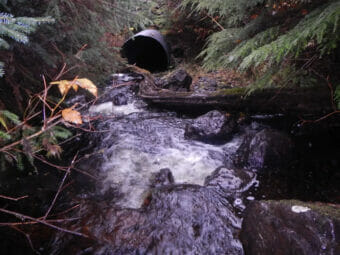
U.S. Forest Service fish biologist, Eric Castro, along with his dog, Redden, checks a minnow trap in a tiny stream in Petersburg’s Sandy Beach Park. (Photo by Angela Denning/CoastAlaska)

A warming climate has scientists wanting to know, more than ever, what’s living in Alaska’s rivers and streams — specifically, what species live in the anadromous freshwater streams where migratory fish return from saltwater to spawn. Biologists and others are hoping that a new phone app will encourage Alaskans to help map these fish habitats.

Alaska has over 46,000 miles of shoreline—more than the rest of the country combined. Sandy Beach in Petersburg is one tiny sliver of it. It’s a popular park with a playground and shelters for picnics. A creek cuts a shallow channel across the sand into Frederick Sound. In late summer, it fills with pink salmon heading in to spawn.

Away from the beach and a few steps into the park’s tree line, there is a tiny tributary of the creek. That’s where I meet Eric Castro, a fish biologist with the U.S. Forest Service.

“This is an uncharted stream as far as the Forest Service has on our records,” Castro said.

Castro is here to use the new Fish Map App to catalog what’s in the water. The app supplies a form that anyone can fill out to nominate fish they find. If approved, the fish will be added to the Alaska Anadromous Waters Catalog. This tiny stream is not recognized in the federal database at all. The state’s catalog lists it, but not all the species living here.

Castro wants to add cutthroat trout to the state’s list because he’s seen them here before. So, he’s set up a few minnow traps.

“I figure we can try this out and see what we get,” he said.

The Alaska Department of Fish and Game has categorized over 21,000 anadromous waterways since the 60s. The listing for Southeast Alaska is nearly 600 pages.

“It’s a massive data set,” said Joe Giefer, who manages the state’s Anadromous Waters Catalog.

Although the catalog includes all major systems in the state, Giefer says there is no way to cover all of the smaller streams. He hopes the phone app will get others to document fish they see in streams while out in the field too.

“There’s a lot of water in Alaska,” Giefer said. “There’s a lot of remote areas.”

Giefer says the catalog data is used by local, state, and federal agencies and provides protections from possible development projects. So the more data that’s added to the catalog, the better.

Minnow traps like Castro’s take permits. But Giefer says documenting adult fish would be very useful too, like those found spawning.

“There’s probably spawning, good spawning habitat all over the place,” Giefer said. “But nobody’s physically there, nobody’s physically [seen] salmon spawning, just because of the remote nature of a lot of these water bodies.”

That’s where local knowledge can help, says Aaron Poe with the Alaska Conservation Foundation. He coordinates the phone app, which is supported by a large partnership of federal, state, tribal, and nonprofit groups. They started testing the app last year and hope to get more users involved.

“Local folks really do know best where the anadromous fish are,” Poe said. “So whether that’s Indigenous knowledge that dates back for millennia, or whether that’s local knowledge from families that grew up in a region or some combination of both, those folks really know where the fish are.”

Poe says there is increased interest in what fish are where, because of climate change.

“Essentially, we’re having some of these anadromous fish, whether they’re salmon or white fish, or other species that are starting to move into other areas of the state,” he said.

The Aleut Community of Saint Paul Island, created the Fish Map App through its Indigenous Sentinels Network, which runs about a dozen apps.

Hannah-Marie Garcia, with the Saint Paul tribe, says they wanted to provide a useful tool to document ecosystem shifts. Saint Paul is 300 miles offshore in the Bering Sea. So, they also wanted to make sure it was usable in remote areas. Garcia says the app doesn’t require Internet.

“If they don’t have Wi Fi or cell signal, it just stays on the device,” said Garcia, “until they then can come to a place — maybe they’re back in town or, you know, they’re back from the fishing ground or the back from wherever they were hiking to go find that stream, when they finally have signal they can then upload to the database, after the fact.”

Back at Sandy Beach Park, Castro pulls a minnow trap from a shaded pool underneath a log. Soon two young girls push through the brush along the bank.

“We’ve been spotted!” Castro said.

The girls ask what we’re doing.

Castro told them we’re doing some minnow trapping and look at this.

He transfers two juvenile fish — a cutthroat trout and a coho salmon — into a bucket to the “oohs” and “ahhs” of the small crowd.

“Cool” they said.

“So these fish right here are living in this water in this little teeny stream, Crazy huh?” Castro said.

“Yeah!”

“Did you know that there were fish in the stream?” I asked them.

“NO!”

Later, Castro uses the phone app to fill out a nomination form including all kinds of information—location, weather, and details about the stream and fish. First, the nomination will be checked by Garcia’s Indigenous Sentinels Network before going to the state for confirmation. That can take months. The state updates its catalog once a year.

Last year — the app’s first year — produced 13 nominations. The app advocates hope to receive thousands more in the future. There is an incentive too. For people who take the time to fill out a nomination for a local stream, they’ll receive $100.

Find out more about the fish-mapping app at the program’s website.

Hooper Bay residents weigh in on fishing closures: ‘It’s like taking away food from our table’

(Francisco Martínezcuello/KYUK)

Inside Hooper Bay’s brown tribal council building, nearly 50 people gathered to hear more from state officials on why they decided to close chinook salmon fishing in the coastal area from the Naskanat Peninsula up to Point Romanof. That closure includes Hooper Bay, Scammon Bay, Chevak, Emmonak, Kotlik, Nunam Iqua and Alakanuk.

State biologists said that the closure is intended to protect chinook salmon while they migrate upriver to spawn in Alaska and Canada. But most in the crowd were subsistence fishermen and fishing means survival.

“It’s like taking away food from our table,” said one person who testified.

Alaska Wildlife Trooper Sergeant Walter Blajeski arranged the meeting. He said that he wanted to give the community an opportunity to ask questions they might have on both fishing opportunities and restrictions.

“And, you know, I think the meeting was a success. Our goal was just that: to be available to answer questions and to provide maybe some explanation as to why restrictions were going to be occurring. And I think we accomplished that,” Blajeski said.

Non-salmon fishing will still be permitted during the closures, but with restrictions. Gillnets will be limited to 4-inch or smaller mesh and 60 feet or less in length. These nets must be operated as a setnet and should be set near shore.

Blajeski said that troopers can’t always enforce these regulations; they do it when weather and time permits.

“We don’t often get to the coastal villages. But when we do, we usually go there, you know, for the day. And those types of enforcement patrols are usually conducted, you know, onshore in the village, walking around the village because we just don’t have the resources to get out there,” Blajeski said.

Blajeski warned that anyone caught violating the regulations will be fined up to $500, though there is wiggle room.

“What we’ve seen over the last couple years, for people that don’t have a history of violations, is a about $300 fine. We don’t recommend to the court that we forfeit any fishing gear that would otherwise be legal,” Blajeski said.

Blajeski said that the troopers don’t normally seize the fish either.

“And if we do seize fish, we would donate those fish to qualified charities such as Elders or people in need in the region,” Blajeski said.

Deena Jallen, an Alaska Department of Fish and Game biologist and the Yukon River summer season manager, traveled to Hooper Bay for the meeting. She said that residents asked a lot of questions about commercial fishing in other areas of Alaska that may catch the same fish subsistence users are supposed to avoid.

In her role as the Yukon River summer season manager, she said that she often fields the same questions from all over the region.

“We often get questions and [statements] about Area M and the pollock fleet. We hear that a lot at every meeting that we come to,” Jallen said.

What makes Hooper Bay different from others is that it is a coastal community.

“In previous years, the coastal area has not been closed. They’ve had restrictions to 6-inch mesh, but they’ve typically been left open. They do catch some kings and summer chum as they migrate up along the coast of the Yukon River. So unfortunately, when there’s no harvestable surplus, we do feel the need to close that district as well to hopefully reduce the harvest of king salmon as they travel up along the coast,” Jallen said.

Jallen said that she was happy to see the turnout as well as the level of participation.

“It’s very understandable that people are very frustrated with the salmon and with the management actions in recent years,” Jallen said.

Jallen said that the salmon in Hooper Bay are either bound for the Yukon River, where runs have been very low in recent years, or they could be headed to other streams either along the coast or in other areas of the state.

She also has concerns for king salmon runs across Western Alaska and particularly in the Yukon River area. Jallen said that the region didn’t meet any of the escapement goals for king salmon last year.

“So any king salmon that’s coming back either to the Yukon River or to a nearby spawning stream is likely to have a pretty low abundance this year, and so we’re concerned for all of them. So even if that fish isn’t specifically Yukon-bound, we haven’t really seen anything that says, like, oh, well, this river is doing better or the stream is doing better,” Jallen said.

Fisheries managers said that they could loosen restrictions if the run is stronger than they’re projecting, but right now Jallen said that every district of the Yukon is going to be closed to king salmon fishing. Based on salmon run timing, those closures will work their way up through the entire Yukon area through all the districts and all the tributaries.

“I think just the main takeaway is that we know these management actions are very, very intensively managing subsistence. And we know it’s incredibly frustrating. But we’re only taking these actions because the runs are so low that there’s no fish available for harvestable surplus,” Jallen said.   

The frustration was palpable.

“You know, they wanted to ask questions, but a lot of the community members that were attending, after the meeting thought that, you know, they really didn’t get any answers,” said Native Village of Hooper Bay Tribal Administrator Jan Olson.

Community members said that they need access to their subsistence foods.

“We don’t do any commercial fishing, you know, we don’t even go up to the Yukon or Black River to do any type of commercial fishing. All we do is stick around here and do subsistence fishing,” Olson said.

Olson said that there’s still confusion as to why they are being regulated. They need to fish to survive.

“We’re not in it for the money. We are in it to put fish in our freezers for future use. And, you know, that’s a big part of our diet there. You know, that’s one thing that we missed,” Olson said.

Remnants of Typhoon Merbook, which happened in fall 2022, caused major flooding in Hooper Bay. Families were displaced, homes were lost, people’s stores of salmon and other subsistence foods were destroyed. The community relied on state assistance as well as donations of fish.

“You know, we’re not bad people, you know, we just want to fish and, you know, it’s just, we want the fish that we’re accustomed to,” Olson said.

Olson, along with several other members of the community, said that these restrictions will make winter more challenging as many residents don’t make enough money to buy more groceries.

Salmon are disappearing on the Yukon and Kuskokwim. Here’s what to know about the crisis this summer.

A fisherman pulls a chum out of the Yukon with a Kenai-style dip net. Sometimes nontraditional gear types are permitted to allow for the exclusion of chinook. (Kyle Clayton/KYUK)

People on the Yukon and Kuskokwim rivers are expecting another dismal year for harvesting salmon, the food that used to fill their smokehouses and freezers. It’s a disaster that repeats annually, felt acutely in the region and accepted elsewhere as the new, bad normal.

Here’s a primer on the Y-K Delta salmon crisis and how this year is shaping up.

Which salmon are affected?

Chinook (king) and chum are the major salmon species on the Yukon and Kuskokwim. They’ve been at historically low numbers in both rivers for years. The coho (silver) returns have also dropped.

How long has this been happening?

This will be the fourth year subsistence fishing has been closed or severely restricted on both rivers.

For the past three years, the Yukon hasn’t seen sufficient numbers of chinook even to meet the top priority – allowing enough salmon to escape up the river to spawn. Most escapement goals for Yukon chum and coho weren’t met either.

But the problem goes back farther than that. The Yukon chinook subsistence harvest has been below the level of need since 2008. Chum dropped significantly in 2017 and haven’t bounced back.

On the Kuskokwim, the picture is only slightly better. The chinook crash there was underway by 2009 and continues. Chum have also collapsed to record low numbers. In 2021, the Kuskokwim saw an 84% decline in chum compared to just a few years prior, with only a slight rebound last year. And coho have been sparse for the past three years.

Are people still fishing there? 

The rivers used to support commercial salmon fisheries. On the Yukon, there’s been no commercial chinook fishery since 2007. Commercial chum opportunities have been spotty.

And now subsistence – harvesting for food, rather than money or sport – is severely restricted, too.

Yukon subsistence fishermen haven’t been allowed to target salmon for two years, with only limited numbers coming from test fisheries or in subsistence nets intended to catch fish other than salmon.

On the Kuskokwim, subsistence fishing for chinook has been severely restricted. Last year, for the eighth year in a row, the harvest was less than half of what the state considers adequate to meet the need. State, federal and tribal fishery managers credit residents for sacrificing their historically normal chinook catch to meet escapement goals.

The Kuskokwim chum harvest has also been well below the level of subsistence need for the past three years.

What’s the outlook for this year?

Yukon chinook are projected to come back in numbers too low to meet the escapement target, the number needed for healthy reproduction. That leaves no likelihood for even a subsistence harvest.

The Yukon chum runs are also expected to be poor, although managers may allow some subsistence fishing for summer chum.

Fish managers of the Kuskokwim expect to meet the escapement goal for chinook, allowing for a very limited subsistence harvest. It’s not clear yet whether chum and coho will meet the escapement target.

Why is this happening?

Multiple factors are at play: Warming ocean temperatures, reduced prey supply in the Bering Sea, warm river temperatures, a parasite that plagues Yukon chinook, bycatch – the accidental catch – of salmon by the Bering Sea pollock fleet, and the interception of fish on the Alaska Peninsula fishery known as “Area M.” The last two items on that list are white-hot political controversies.

The Bering Sea commercial fleet has caught 13,000 chinook so far this year. It infuriates Yukon and Kuskokwim subsistence fishermen who have sacrificed the fish they need to feed their families to allow for escapement. Pollock fishermen say only a tiny number of those fish would have returned to Western Alaska rivers.

Subsistence salmon fishermen acknowledge that climate change and environmental factors are likely huge reasons for the salmon crisis. But, they say, controlling bycatch is one of the few management tools available.

Wrangell holds Blessing of the Fleet at newly finished Mariners’ Memorial

Wrangell’s 2023 Blessing of the Fleet. (Sage Smiley/KSTK)

The Blessing of the Fleet is a tradition for many coastal communities as fishermen get ready for their summer season. On May 28, the Southeast Alaska community of Wrangell revitalized the tradition by holding the ceremony in its newly completed Mariners’ Memorial.

Wrangell residents and visitors gathered in clumps under a drizzly rain, some in suits, others in rain gear and Xtratuf boots. They stood between the curved, ship-like memorial walls and under the red-and-white lighthouse gazebo of Wrangell’s Mariners’ Memorial.

Some removed hats as Girl Scout Troop #26 presents the colors.

Wrangell’s Mariners’ Memorial sits on the edge of Heritage Harbor, about a mile south of town. Outside the breakwater of the harbor, three boats bobbed, tuning in to the Blessing of the Fleet over VHF radio.

Wrangell’s Mariners’ Memorial in 2021, before it was finished.
(Sage Smiley/KSTK)

Pastor Sue Bahleda introduced the service.

“The blessing of the fleet is our collective hope, our collective prayers for those who ply our waters,” she said. “And so if you’ll follow along in your bulletin, it’s not just us who are calling out for these blessings. It’s all of our voices together.”

Together with Salvation Army Lts. Jon and Rosie Tollerud, Bahleda read a blessing for boats of all types — fishing boats, barges, ferries and cruise ships.

Last year was the first year that friends and family could apply for plaques at the Mariners’ Memorial – 43 names were added to its walls. Some have an anchor next to the name, indicating a life lost at sea. Members of the board read the names and rang a ship’s bell for each.

This year, there are 14 new names. Some are longtime fishermen who’ve passed on from natural causes. Others have more tragic stories, like 27-year-old Arne Dahl, who died after his boat sank in late November. His partner, Kelsey Leak, survived the sinking and attended the Blessing of the Fleet with a few of Dahl’s friends from down south.

“My friends,” Bahleda said as the last of the 57 names were read, “We conclude this day with a prayer that is a song from the familiar hymn: Eternal Father of love and power. All travelers guard from dangers our; from rock and tempest, fire and foe, protect them wheresoever they go. Thus evermore shall rise from the glad hymns and praise from land and sea and together we say: ‘Amen.’”

It’s the first time Wrangell’s Blessing of the Fleet has been held since the memorial’s ribbon-cutting last September.

Hugs after the ceremony. (Sage Smiley/KSTK)

Memorial board member Jeff Jabusch notes that there’s still work to do.

“We have landscaping to install, we’re going to do some display cases inside that will display our membership or volunteers and donors,” Jabusch said. “We also are going to have an online accessible database that all the members on the wall can tell their story and people can access those eventually.”

Wrangell’s Mariners’ Memorial has come a long way since the project began in earnest in 2018.

It’s been the work of dozens of local people – some who’ve lost family members to the ocean. They’ve given hundreds of thousands of dollars and countless hours of volunteer time.

And now it’s home to the annual Blessing of the Fleet — and to the memories of generations of Wrangell mariners.

An 800-pound compass rose in the center of the Wrangell Mariners’ Memorial pavilion. (Sage Smiley/KSTK)

Justice Department will appeal court order forcing Southeast Alaska troll fishery closure

(Katherine Rose/KCAW)

The United States Department of Justice will appeal a federal court order forcing the closure of the commercial king salmon troll fishery in Southeast Alaska.

In early May, Washington U.S. District Court Judge Richard Jones upheld an earlier recommendation that the Southeast summer and winter king fisheries were catching too much of the food source of a dwindling population of Puget Sound’s Southern Resident killer whales, in violation of the Endangered Species Act. Judge Jones’s order required the fishery closures and required the National Marine Fisheries Service to vacate and rewrite the rules that allow for the fisheries to happen.

The Justice Department’s notice to appeal was submitted on May 23 on behalf of the Department of Commerce and the National Marine Fisheries Service.

The defendant intervenors in the case, the Alaska Trollers Association and the State of Alaska, filed motions earlier this month calling for a “partial stay” of the order, pending an appeal to allow the fisheries to proceed. The state argued that the court order had failed to account for the economic cultural and social harm to the troll fleet and Southeast Alaska.

The lawsuit was originally filed by the Wild Fish Conservancy to protect an endangered population of Southern Resident Killer Whales in Puget Sound. The Washington-based nonprofit also appealed, and asked for an injunction vacating a prey increase program intended to mitigate the effects of the Southeast troll harvest by rearing king salmon in hatcheries. They argued that the hatchery program doesn’t go far enough to mitigate the risks to both wild king salmon and killer whales.

On May 26, both requests for stays from the state and the Wild Fish Conservancy were denied. Judge Jones wrote that the court extensively reviewed the economic concerns raised by the state and the trollers, but found that the consequences “did not overcome the seriousness of the National Marine Fisheries Service’s violations.” And in his rejection of the Wild Fish Conservancy’s request, Jones wrote that vacating the “prey increase program” would have “cascading impacts” to commercial and recreational fisheries in Washington that aren’t involved in the lawsuit.

In response to the ruling, late Friday, the State of Alaska filed an appeal to the Ninth Circuit Court, requesting the court issue a decision by June 23.

Site notifications
Update notification options
Subscribe to notifications