Participants of last month’s green crab workshop on the beach in Metlakatla. (KRBD photo/Raegan Miller)
Invasive green crabs are in Alaska. And they are destructive, outcompeting native species and destroying essential eelgrass. At a workshop in Metlakatla last month, citizen scientists learned from experts how to look out for the invasive crabs in their own communities.
Scientists and concerned Alaskans are at Tamgas Harbor. Gathered near Colby Creek Beach, they’re getting a first hand look at the European green crab. And time is of the essence. The crabs showed up in southern Southeast Alaska last summer, and more than 800 have been found since.
“It’s like we hit the ground running coming out here,” said Taylor Stumpf, with the wildlife department of Metlakatla’s tribe. He’s helping people learn to identify, measure, and document the crabs.
The workshop drew participants from around the region, including Ketchikan, Kake and Prince of Wales Island. Green crabs have already infested waters around Haida Gwaii, California and Washington. But for now, Metlakatla is the only place in Alaska to document live green crabs — which are destroying vital eelgrass and habitat for abalone, clams and Dungeness crabs.
Taylor Stumpf tries to get a crab out of a trap to check if it is a European green crab or a Dungeness crab. (KRBD photo/Raegan Miller)
But that doesn’t mean they won’t spread. That’s why the workshop — which was organized by local, state, federal and tribal agencies — focused on training people to identify the crabs and alert authorities before it’s too late to control the spread.
People aren’t allowed to kill the crabs themselves — officials are worried they’ll mix up species and take out a perfectly good Dungie — but they are encouraged to collect information and alert authorities. That’s what the workshop is teaching them to do. The agencies organizing the workshop included Alaska Sea Grant, Washington Sea Grant and the National Oceanic and Atmospheric Association. Other involved agencies included the Central Council of the Tlingit and Haida Indian Tribes of Alaska and representatives from the U.S. Coast Guard. Participants included area mayors, concerned citizens, scientists and more.
Stumpf explained a few key tells for a crab that doesn’t belong. Wildlife officials also handed out laminated guides showing pictures of the green crab to all the participants.
“They have the five spines on either side of the eyes and then the three bumps in the middle,” he said. “So we’ve been teaching people with guides how to identify the crabs.”
Ewa Booth is showing people how to set and bait different kinds of traps. She’s an intern with Metlakatla’s wildlife department. She said the Tribe has been experimenting with what works best.
“They usually like chum and herring fish,” Booth said. “We haven’t really used cat food like they suggested.”
“Eelgrass is important because it’s like habitat for other clams, and like juvenile fish, juvenile salmon,” Booth explained. “So it was kind of a worry for us when they first arrived. And I’ve noticed that they’ve gotten a lot shorter, too, like, the eelgrass.”
Booth noted that the crabs tear up the eelgrass while they’re looking for food.
n invasive green crab found near Tamgas Harbor last month. (KRBD/Raegan Miller)
There’s no sure-fire way to eradicate the crabs once they’ve arrived. Tribal nations in Washington state have been fighting them for years. But Genelle Winter, Metlakatla’s grant and invasive species coordinator, said the key is to just keep finding them. She said Metlakatla has always protected its resources, and that’s what the town will keep doing.
“It just sharpened everybody’s need or awareness to protect those resources, right?” Winter said. “Like those resources were already super precious. It’s wanting to make sure they stay intact.”
Each female crab is capable of laying hundreds of eggs. In Metlakatla, green crab catching is a full day’s work. Just ask Gabriel Nathan.
“We’ve been catching a lot when they were molting, when they’re trying to hatch eggs and everything,” he said. “And we caught like over, probably, 40 green crab with egg shells attached to them. And that slowed down a lot. So it was great.”
The workshop’s message is also one of hope: if everyone learns to spot these crabs maybe there’s a way to protect other communities.
Tre Patterson, with Metlakatla’s wildlife department, said that’s the goal.
“I didn’t think that the state or other places near us were taking it as seriously as we wer,” he said. “So to see something like this happening today here on the island is great, to see that more people are taking this issue seriously.
Patterson said everyone has a stake in stopping the crabs — and that things will get even worse if the crabs keep moving north.
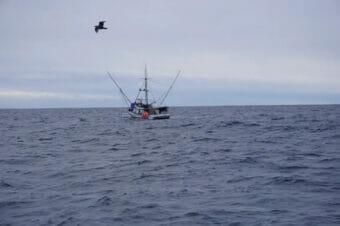
A boat in the Dillingham harbor on April 21, 2020. (Isabelle Ross/KDLG)
Bristol Bay’s commercial salmon fishery can be fast-paced and competitive. Many local fishermen support a longstanding regulation they say keeps competition in check by limiting the size of the boats.
Commercial drift gillnet boats must measure 32 feet or less to fish in the bay. And the fleet got a finger-wagging from the Alaska Wildlife Troopers earlier this year — a reminder to keep their boats within that limit.
Wildlife trooper Capt. Aaron Frenzel said they fielded more complaints than usual about big vessels last year. So after the season, they went over to boat yards in King Salmon and Naknek to see what was going on.
“A lot of the stuff is below the waterline that we can’t see… while we’re out on the water inspecting vessels,” he said. “So we started seeing some areas that just kind of expanded.”
Those boats were a little bigger than what’s allowed in regulation, and troopers decided to raise awareness among the fleet ahead of this season. In February, they published a public letter outlining exactly what is included in the 32-foot measurement.
Frenzel said they hope fishermen will bring their boats into regulation this year. For some of the vessels, the extra length comes from equipment meant to help with safety or increase the quality of the fish — like ladders or refrigerated seawater systems. But troopers won’t be targeting boats for transgressions due to safety or quality equipment, he said.
Instead, they will focus more on what Frenzel calls “performance enhancing” additions, like hull extensions.
“Maybe a vessel that’s actually 34 feet in length, or has some kind of adaptation that provides a significant performance benefit to the vessel that’s beyond the allowable length,” he said. “Those are the type of vessels that we’ll be taking a closer look at this summer and determining if we need to take enforcement action on.”
Bristol Bay’s 32-foot rule has been a point of debate in many Board of Fisheries meetings over the years. Some fishermen argue that bigger boats could allow for safer seasons, more efficient harvests, better quality and more money. But others say they would disenfranchise the local fishermen, who may have smaller boats and may not be able to buy into a more competitive fishery.
Rep. Bryce Edgmon of Dillingham is among those who want to keep the status quo. Edgmon said he and Sen. Lyman Hoffman of Bethel met with Alaska Wildlife Troopers and the commissioner of the Department of Public Safety to ensure there was follow-through to protect the 32-foot rule.
“Myself and the senator, we’re going to, you know, really go to the mat on this issue if there were any attempts to deviate from that regulation,” Edgmon said.
Frenzel said people probably started calling out bigger boats last year because they’ve gradually gotten bigger; he said one fisherman compared Bristol Bay boats to accordions.
“It got stretched out here and there, until all of a sudden, there were some vessels that were so stretched out, that the flag started being flown by other fishermen,” he said. “And that’s what we started looking at.”
Frenzel said the fishery has also changed a lot in the past 20 years — newer boats have equipment that may make them bigger.
“The vessels are just a different breed now. So they’re doing things that one would never have thought was possible before,” he said. “So I think that has a lot to do with it is just the new equipment that’s being put on it. And the new engines, the outdrives that are on them, things have just changed. And the regulation just didn’t change with it.”
This isn’t the first time troopers have focused on the issue.
Tom Glass, a commercial fisherman who lives in Dillingham, said troopers cracked down on the 32-foot limit in the early 90s, when he was working as a deckhand. And some fishermen went to drastic measures to comply by shortening the bows of their boats.
“Some would just grind off a couple inches and others would cut off like two feet,” he said. “They were too long by two feet or maybe more.”
At one point, Glass said, someone took a cut-off boat nose and threw it in the brush near the Alaska Commercial grocery store in downtown Dillingham.
“And after a while there was a whole pile up in that area there, of noses from the boats. It’s just kind of funny,” he said, “everybody getting their noses cut off that season.”
Glass said some of those boats are still around – some of the fiberglass vessels have caps bolted on with the help of some sealant, and aluminum boats are welded up.
Today, Glass said, he’s happy with the 32 foot limit, although he could use a few extra feet in his already-crowded engine room.
Troopers say anyone with questions about their boat can call the post in King Salmon at 907-246-3307, Dillingham at 907-842-5351, Kodiak at 907-486-4762 or Capt. Aaron Frenzel at 907-334-2501.
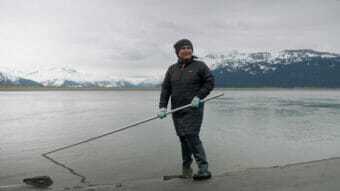
Mary Peltola has been fishing on the Kuskokwim since she was a child. (Photo by Liz Ruskin/Alaska Public Media)
Alaska’s subsistence fishing advocates want to change the nation’s primary fishing law to crack down on the accidental catch of salmon by the Bering Sea trawl fleet. Changing the law is looking increasingly unlikely, but there might be another way.
Congresswoman Mary Peltola focused on revising the Magnuson-Stevens Act since the start of her campaign. But she said it’s not in the cards now.
“I think everybody recognizes that there’s a very slim chance that Magnuson-Stevens will be authorized this year” or next, Peltola said in a recent video call arranged by a public affairs firm called Ocean Strategies.
Rather than change the law, the new strategy is to change a set of guidelines for the law that’s already on the books.
It’s a fallback position. It’s not likely to yield quick results. But this year is shaping up to be another grim one for chinook and chum runs on the Yukon and Kuskokwim rivers. Peltola and other salmon advocates say it’s important to take some kind of action now to preserve the possibility of a return to salmon abundance.
Magnuson-Stevens is a complex law. It includes 10 national standards, akin to fundamental management commandments. They say things like fish allocations must be “fair and equitable,” and bycatch must be minimized “to the extent practicable.” The guidelines refine those standards.
Last week, the National Marine Fisheries Service announced that it’s begun revising three of the guidelines, dealing with fairness, community dependence on fish and minimizing bycatch.
Peltola sees an opportunity. She calls it a “workaround.”
“If the only change we can make in the 118th (current) Congress is to take another look at these national standards, we’ve got to do it. And we’ve got to do it now,” Peltola said.
By one means or another, she and other advocates hope to rein in the ocean-going trawl fleet. The trawlers catch thousands of king and chum salmon in the Bering Sea in their nets as bycatch — unintentionally — while they fish for pollock.
Meanwhile, along the Yukon, Alaska Native communities that have relied on salmon for thousands of years weren’t allowed to take a single chinook for the dinner table last year or the year before. And 2023 is shaping up to be another dire one for subsistence chum and chinook fishing on the Yukon and Kuskokwim rivers.
Getting at the problem by changing the guidelines is “totally wonky” and will take a while, said Hannah Heimbuch, a commercial salmon fisherman and a consultant at Ocean Strategies.
As Heimbuch sees it, the process allows for a “conversation” about bycatch, among other things. She said new guidelines could reset the priorities for the North Pacific Fishery Management Council so that it’s more responsive to near-shore and in-river fishermen.
“I think that it’s an opportunity to kind of be frank about some of the ways that the management plans, as they exist now, aren’t able to manage bycatch in a way that is sustainable in the long term,” she said.
Brett Paine, executive director of United Catcher Boats, believes the focus on the trawl fleet as the culprit is unwarranted.
“The amount of salmon, in terms of numbers, relative to the numbers of pollock we catch is de minimis,” he said.
His organization represents about 70 trawlers working in the Bering Sea, Aleutians and Gulf of Alaska. He says the Bering Sea fleet is already successful at limiting bycatch.
“For us to catch 1.2 million metric tons of pollock, and to only catch 6 (thousand) to 9,000 chinook, I say, we’ve done a pretty good job,” he said.
Paine acknowledges that a bycatch of 6,000 chinook sounds like a lot to Yukon River fishermen who can’t catch any. But he points to research showing that a lot of those fish weren’t bound for the Y-K Delta, and not every fish was going to survive to maturity anyway. He says trawl bycatch is not to blame for the collapse of Western Alaska salmon runs.
Salmon advocates say several factors are harming salmon populations, chiefly climate change. But they say that makes it even more important to take action where possible, like against bycatch.
The National Marine Fisheries Service is accepting public comment on new guidelines through Sept. 12.
Sitka troller Eric Jordan helped found the Alaska Marine Conservation Council, and was on the board of directors of the Sitka Conservation Society for 20 years. (Courtesy Bethany Goodrich/Sitka Conservation Society)
Barring a stay, or a successful appeal, or other eleventh-hour legal action, there will be no troll fishery for king salmon in Southeast Alaska either this summer or winter.
The fisheries have been canceled by order of the U.S. District Court of Western Washington on largely procedural grounds. According to the ruling they stem from a violation of the Endangered Species Act, and the failure of the National Marine Fisheries Service to fully address the impact of Alaska’s king salmon trollers on an endangered population of orcas in Puget Sound called Southern Resident killer whales.
No other salmon species or commercial gear group or sport fishery – anywhere on the entire Pacific Northwest coast – is affected by the order, just commercial trolling for king salmon in Southeast Alaska.
Heading out every July 1 in search of Alaska’s most valuable salmon – also called chinook – has been an annual ritual across the region since before statehood.
Shortly after the court order came down, KCAW’s Robert Woolsey met with trollers Eric Jordan, Jacquie Foss, and Jim Moore to discuss what no king salmon season will mean for them, personally and professionally. This is their conversation, in three parts.
Part 1: The practical implications of a summer without Chinook
Foss: The cost of a boat exists whether or not the king salmon fishery happens or not. You have to pull it out of the water, you have to maintain your zincs. There’s work that you have to have just to make sure your boat stays fishing. And so that’s still happening for us. How we’re gonna pay for it is less certain.
Moore: I’m confident that we’re going to have a season. I’m confident that the king salmon season is going to open July 1st. I feel that we have so much support. Our congressional delegation is working behind the scenes. The State of Alaska is throwing its full weight into the fight. The Alaska Trollers Association are [intervenors and] co-defendants with the National Marine Fisheries Service and the State of Alaska. And everybody’s working pretty hard to make sure that we’re out on the water this summer. I don’t know exactly how it’s going to happen. It’s a legal court case. And so different parties hold their cards close. But I’m confident we’re gonna go ahead. So I’m planning on going ahead.
Foss: I always appreciate sitting next to Jim and his optimism, because I don’t always go there. The decision last week (May 3, 2023) was a gut punch. And fishing is how I can afford to raise my family in Sitka. So it’s really affected me in sort of a more existential way: Who are we if we’re not fishermen? Who are we if we’re not catching king salmon on our boat?
Jordan: It’s already affected boat values. I just had a survey on my boat, on what I would say as a very optimistic estimate. Even though I’ve made improvements since the last survey, [my boat] has lost about 20% of its value. Right away. People can’t sell their boats. I spent a whole week before this latest [court] decision preparing to sell gear at the Fisherman’s Flea Market because I’m getting ready to retire and I have thousands of dollars of really good surplus gear that’s basically worthless right now, except for the chum troll and coho gear. But thousands of dollars of king salmon plugs and spoons are just basically worthless.
Emotionally, I have to call my crew and tell them the situation. Some of them just love fishing king salmon. We do really well chum trolling, and Jim [Moore] and I helped pioneer that, but I’ve had crew members cry when I’ve told them that we’re gonna go chum fishing instead of king salmon fishing.
Foss: You know, it’s more of a spiritual problem than a financial one. Because fishermen are scrappy people. We will always figure out how to make expenses somehow. It’s just…we’d be broken in some way doing that, if that makes sense?
You know, not catching king salmon has a huge, huge impact to our financial bottom line: 40% of our income. And so there’s the argument, “Well, you can find the other 40%.” That 40% allows us to make the other 60%. So it’s not like you can just make up that amount of income somewhere else on the water or in some other fishery. It’s really holistic.
Jordan: There’s a miraculous, wondrous thing about catching king salmon and pursuing them all over the coast, from Dixon Entrance – like Jim’s fished – from Forrester Island to Cape Suckling. And the chum troll fishing is not going to save us. It’s gonna help.
Moore: Having fished a long time, I’ve seen a lot of changes in the fishery. And I have to say that when I bought my first boat, people said, “There’s no future in it. It’s over. It’s had its heyday and it’s going down.” But I’ve seen this cycle of boom and bust, optimism and pessimism several times. And that’s one reason why, you know, if we’re looking at grief over this court case, I’m in the first stage: denial.
Part 2: The importance of king salmon to the identity of trollers
Jacquie Foss trolls with her family aboard the Axel. Fishing for kings is a core part of her family’s identity. (Erin McKinstry/KCAW)
Jim Moore bought his troller in 1970. This summer will mark his fifty-third year as a professional salmon fisherman. Eric Jordan wasn’t born on a troller, but when he was still an infant, his parents rigged a bunk for him in the cabin of their boat, a 32-foot double-ender named “Salty,” and he could watch them fish for king salmon through a porthole. Having fished every year since, Jordan is about to turn 73 years old.
Jacquie Foss doesn’t yet have that kind of seniority, but she might one day. She and her husband fish as a family, with their 8- and 10-year old children on board.
These three Sitka-based trollers are typical of the Southeast Alaska fleet: They have exceptional longevity in a difficult profession, and a multi-generational investment in their businesses.
Foss: Every year the fish – it’s exactly the same and nothing alike. You’re in the water, you’re dragging hooks. But are they going to hit the herring this year? Or is it going to be this spoon? Or is it gonna be the spoon that you have buried in there that worked 10 years ago that might work now? It’s about the puzzle. And it’s about the fact that our entire year really starts July 1. That’s our New Year: our whole life is centered around that July 1 opener.
Moore: I’m just so blessed to have found a livelihood doing something so interesting and creative. Every single day is different. And it presents a whole new set of problems to solve. “You know, I think I’ll try that green thing that I used 15 years ago,” and then have them hit it – that’s a tremendous feeling: success.
Foss: And it’s just this anticipation and joy, and just the puzzle of king salmon, because they could be where they’ve always been, they could not be there, you could have a 10-fish day, you could have a 300-fish day. That’s 300-fish day is a feat. One hundred is a lot – just your arms are tired, but you’re not tired. It’s hard to come up with the words.
Jordan: What I said in my deposition on this Wild Fish Conservancy suit: because we handle each fish individually, our connection with them is strong. And we care about them, we respect them. And that comes from my friend Amy Gulick’s book captures, The Salmon Way in Alaska from the Indigenous origins thousands of years ago, right to the present. We honored these creatures, and in trolling, especially those that offer themselves to us, for us to sustain our bodies with the finest food on Earth. But we also sustain them by fighting to protect their spawning grounds, their passageways, their lives. And that’s what breaks our heart because we are fighting for them. And now we’re being excluded from their harvest.
Foss: It’s hard to not develop a connection, when you are intimately involved with ending a creature’s life. And it’s not something that anyone takes lightly. And you’re right… you’re right there. And it’s not easy, but it’s good. Because you know that you’re taking care of the creature quickly, as painlessly as you can. If you’re going to take life and you’re going to extract a resource and you’re going to eat meat, it’s really important to do that as respectfully to the creature that you’re taking it from as possible.
Jordan: Let me tell you, there’s a lot of grief in the troll fleet. A lot of grief, and families and people need help. So not only do we have to think about making financial arrangements so people can make or delay their payments with the state or CFAB [Alaska Commercial Fishing and Agriculture Bank] or whoever else. Banks. We also need to think about mental health counseling for people who are devastated and don’t know how they’re going to feed their families – literally.
Moore: You know, I’m proud of the product that we produce. This whole battle, this court battle with Wild Fish Conservancy trying to shut down a food-producing industry, without considering: there’s 300 million people right now – not killer whales – 300 million people are starving to death. There are 2 billion people that are “food insecure,” as they say. And I just feel sick about all of the energy being spent, all the resources being spent, just to try to be able to continue to produce food for people.
Part 3: Trollers and conservation
Jim Moore slips by Point Amelia in his troller Aljac. (Courtesy Eric Jordan)
In a state where fish landings are most often measured in the millions of pounds and millions of fish, the Southeast Alaska troll catch of king salmon is a small fraction of the overall harvest. This coming season – if there is a season – Southeast trollers will take just 149,000 chinook salmon.
Those fish are mixed into a salmon pie that is shared by Alaska, Washington, Oregon, and Canada – a pie that is sliced by an international agreement called the Pacific Salmon Treaty. Over the past couple of decades, Southeast trollers have accepted smaller slices of the pie to preserve the health of salmon stocks covered by the treaty, and they’ve even accepted deep cuts in the harvest of kings which originate in Alaska’s rivers – and aren’t subject to the treaty – to make sure that those stocks thrive.
In short, Southeast trollers have nothing to gain and everything to lose if king salmon don’t survive. They are conservationists, whether or not they use the label.
Foss: I want to make it very clear that trolling is (a) 100-year old fishery, and if it was not sustainable for a long period of time, it would be evident. And I have not ever seen another resource extraction group begrudgingly-but-willingly not go fishing to ensure the longevity of the species. Is that the right thing to do? Absolutely. When it became apparent that we were going to take a hit on king salmon in the last (Pacific Salmon) Treaty cycle for political and conservation purposes, we could weather it because the emphasis is making sure there’s fish in the future.
Jordan: Trollers have been the allies of conservationists for decades. Salmon fishermen all over this state fight things like Pebble Mine, things like the borax mine in Misty Fjords. Trollers have worked to protect the salmon habitat throughout the region from mines in British Columbia. I’ve written op-ed editorials on those mines, working with Salmon State and others. We are the greatest allies of people who want to conserve king salmon and other salmon species. And for us to be vilified and attacked is just plain wrong.
Foss: It’s really easy to look at a problem and decide that someone else should pay for it. It’s really, really hard to look internally to see what you’re doing and how you’re contributing to that problem. And I really feel like that’s what’s happening here [with the Wild Fish Conservancy lawsuit].
Moore: This fishery is the poster child for sustainability. There’s never been – that I know of – any run of salmon that’s been wiped out by a hook-and-line fishery. When I first started fishing, there was the criticism that it’s too inefficient. Well, we’re not hearing that much anymore (laughs). But anyway, we’re hearing these narratives that are just outright lies. Like “the increase in greedy corporate fishing.” My kids grew up on the back deck of the boat, you know, this is “greedy corporate fishing,” you know. They learned that they could work hard and produce something tangible. And your success depends on being able to understand and connect with something you can’t see directly. From that standpoint, it’s like science. I can’t decide whether it’s more like art or like science. It’s both.
Jordan: And one of the things that happens, as both Jim and Jacquie have mentioned, is the connection you develop with these places, the ocean, the ecology, the fish that you’re pursuing. It’s really a love affair.
Foss: You just love it. You love everything about it.
Moore: You know, I love the killer whale. I’m connected with the killer whale. This is not about saving the killer whale, this battle. It’s about destroying this industry. That’s the stated agenda: the Wild Fish Conservancy, they want to eliminate ocean fishing, mixed-stock fishing, and they want to eliminate the hatchery program. That’s a small minority viewpoint – a very small minority viewpoint. They had an opportunity to move their agenda, and they took it. But it’s an immoral decision. It makes me sick.
Crewmembers on the Diamond V after a haul during the 2022 season. (Photo Courtesy Of Nick Rahaim)
Bristol Bay fishermen harvested a record-breaking 60 million sockeye last summer, flooding the market with a surplus of salmon.
Early this month, the U.S. Department of Agriculture agreed to help with the glut by purchasing $119.5 million of canned and fileted Alaska sockeye and Pacific groundfish. It’s a win for the state’s marketing branch, which had some help from Alaska’s congressional delegation. But the purchase won’t totally clear out the storehouses and shelves.
“As far as, you know, fixing the problem of such a giant harvest from last year, it’s not going to fix anything,” said Bruce Schactler, the Alaska Seafood Marketing Institute’s global food aid director. “But it’s certainly going to help in a big way — in a really big way.”
Schactler said ASMI asked the USDA to buy Alaska seafood for their food assistance programs last fall, when they knew there would be surplus.
“It kind of got stalled, for whatever reason,” he said. “So we asked the three members of our congressional delegation to provide some encouragement to hurry this along. And that was clearly successful.”
Sens. Lisa Murkowski and Dan Sullivan, and Rep. Mary Peltola submitted a joint letter to the USDA at the end of March. They asked the department to commit to buying millions of pounds of Alaska sockeye and pollock. The request included 5 million pounds of frozen sockeye filets, along with hundreds of thousands of canned salmon and 50 million pounds of pollock.
The USDA agreed to buy up to $67.5 million of Alaska sockeye and $52 million of whiting, rockfish and pink shrimp from West Coast fisheries, according to Schactler.
The pressure from the delegation helped cut through the competition, he said, since there’s only so many federal dollars to go around.
“The folks up in the Northeast Atlantic, they want to sell fish, and they do, and the catfish guys, and the Gulf shrimp guys and the West Coast groundfish people,” he said. “Then you’re also competing with those same dollars with walnuts, pistachios, and fruits and vegetables.”
The federal process of buying and distributing food can be cumbersome. It took eight months for the USDA to agree to make the purchase. And as for when the fish will be distributed, Schactler isn’t sure.
“There’s a lot of things that need to happen now,” he said. “They got to decide where they’re going to ship it, how much they’re going to ship, when they’re going to ship. Is it going to be to Omaha in October? Is it going to be Los Angeles in June?”
Still, Schactler said, the announcement will “provide some relief” to the industry just in time for the summer fishing season. The Copper River fishery is gearing up, and fresh sockeye will soon be on the market.
President Biden celebrated his conservation record Thursday in a Rose Garden address, leading with his administration’s decision blocking the development of the Pebble Mine at the headwaters of Bristol Bay. Alannah Hurley, executive director of the United Tribes of Bristol Bay, introduced him. (C-SPAN screenshot)
President Joe Biden celebrated his conservation achievements Thursday with a Rose Garden address. The No. 1 item on his list? Blocking the Pebble mine, a proposed open-pit gold and copper mine upstream from the sockeye-rich waters of Bristol Bay.
“Bristol Bay is an extraordinary place, unlike anywhere in the world,” the president said. “Six rivers meet there, traveling through 40,000 miles of tundra, wetlands and lakes, collecting freshwater and salmon along the way … making this the largest sockeye salmon fishery on all the earth.”
Biden announced no new developments in the ongoing Pebble saga. His speech cited scores of sanctuaries and safeguards his administration created, from the mountains of Nevada to the Pacific Ocean. But the primacy he gave to this one part of Southwest Alaska shows how committed Biden is to stopping Pebble, and how he sees it as a centerpiece of his environmental record.
United Tribes of Bristol Bay Executive Director Alannah Hurley was invited to Washington, D.C., to introduce the president. In a blue print kuspuk, she spoke of how her salmon-centered community has lived with a threat looming over them for 20 years.
“But our people stood up and fought back to protect what we hold sacred. President Biden heard our voices,” she said. “He and his team listened to Bristol Bay and our many partners across the nation. And together we stopped the Pebble Mine.”
Biden said he listened to stakeholders and scientists and determined the mine – specifically the dam that would have to hold the waste rock in perpetuity – was too risky.
“In the end, we used our authority under the Clean Water Act to ban the disposal of mine waste and Bristol Bay watershed, period,” Biden said, to cheers from the invited guests. “That means the mine will not be built.”
President Biden holds 2-year-old Mancuaq Mann, of Dillingham, Alaska. Her mom, Alannah Hurley, says Mancuaq did well at the White House event despite missing nap time. (C-SPAN screenshot)
Biden spoke of the mine as dead, but Hurley said mine opponents are still seeking “permanent, watershed-wide protections” through an act of Congress.
At least for now, the federal government is blocking the mine on two fronts. The Army Corps of Engineers denied Pebble’s permit application, and Pebble is appealing.
The larger problem for the mine developers is that the Environmental Protection Agency has essentially vetoed all plans to use the proposed mine site for rock disposal, meaning Pebble can’t just design a different dam and re-apply. The appeals of that decision could last years.
Hurley said there’s more work ahead. More than 20 other mines are proposed in the Bristol Bay watershed, and the EPA veto only protects two river systems. Still, she said, it was a day to relish victory. About a dozen Bristol Bay kids were at the White House for the ceremony.
“This is everything our people have been fighting for: To make sure that our children will know who they are, and will be able to continue to be Native people in Bristol Bay for generations to come,” she said. “So to see our kids with the president today, celebrating this monumental, historic victory for us was just profound.”
A Pebble spokesman declined to comment, but the company maintains the dam design is state-of-the-art and that the project doesn’t pose a risk to the fisheries.