Fisheries

Listen: Peltola touts Willow Project, defends ranked choice voting

U.S. Rep. Mary Peltola in KTOO’s studio on Saturday, Jan. 27, 2024. (Katie Anastas/KTOO)

Alaska’s sole U.S. representative, Mary Peltola, visited Juneau over the weekend as part of a series of meet-and-greets she hosted across the state to kick off her reelection campaign. 

Peltola, a Democrat, spoke with KTOO about her first term, why she thinks FEMA needs an overhaul, and more.

Listen:

This interview has been edited for length and clarity.

Mary Peltola: One of the things I’m very proud of is the work that my office has done in really leading the charge to convince the FTC not to approve the mega merger between Albertsons and Kroger. This really will affect every Alaskan household. Even if you’re in the bush, this will affect you. …

And of course, working on Willow. Willow is something that our leaders have been working on in Alaska for over a decade. And I am proud of the fact that I helped bring it across the finish line. I was the one who worked with the leadership in my caucus, to really insist that Joe Biden meet with us. That was not a sure thing. And it was really a coup that we were able to get a meeting with him and John Podesta and two of his other staff. And the senators and I made very compelling cases. And I do feel like I singularly did push that forward. …

One other thing I’m really proud of is the executive order that came out a few weeks ago, banning illegal Russian trawling, where they’re poaching our salmon, and marketing them through China using slave labor, Uyghur labor, driving down our prices. And that will affect fishermen in Southeast tremendously. If we can get those fish prices back up where they need to be, we can keep fishing. We can have fishing families that can continue to fish and make a profit. 

Clarise Larson: The Alaska House Judiciary Committee advanced a bill earlier this month that would repeal ranked choice voting and open primaries. There’s also a group hoping to put the repeal question on the 2024 ballot. How has ranked choice voting shaped your campaigns, and what are your thoughts on these repeal attempts? 

Mary Peltola: You know, a lot of people projected onto me that I was polite and didn’t slam other people because of ranked choice voting. That is like muscle memory for me. The 10 years that I worked in the legislature, that was a real take-home lesson that I learned, that you need to have 59 best friends if you want to get anything done. And I really have that just built into my habits, so that was natural. And it worked well for ranked choice voting. And I think that Americans and Alaskans want more civility and more middle-road candidates. It’s really interesting to me to hear very, very conservative people blasting ranked choice voting, because with ranked choice voting, we also elected the most conservative governor in the United States, Mike Dunleavy. … I do hope that other states look at this and see the success that it has brought, and it is not a complicated system. It’s very, very simple. And I’m very optimistic that ranked choice voting can help bring more middle of the road candidates forward who will put their names forward and work in a more collaborative way. 

Clarise Larson: In Southeast and across Alaska, we’re seeing an increasing number of disasters that could be made more common or severe by climate change. What role can you play in helping Alaskans better prepare for that future? 

Mary Peltola: FEMA needs a systemic overhaul. They were designed to accommodate six natural disasters a year. I believe last year, we had about 28. The size and scope of our natural disasters have compounded so much, and FEMA hasn’t really kept up with that in terms of their systems. So that is something that long-term needs to be addressed, and I’ll be happy to work on. …

We have seen in Southeast Alaska three very concerning mudslides, one in Haines, one in Sitka, and one in Wrangell. I was able to go to Wrangell and see firsthand the impact of the slide, talk to one of the victims, an amazing woman who survived the slide. I was able to talk with folks from the municipality and people who are there rescuing that night. And one of the things that we need to be working on in Alaska is really partnering with universities to get things like soil stability samples, taking a much closer look at areas that are of concern in Wrangell. The folks there on the ground said that there were multiple other sites that they would have guessed would have had a mudslide before the site that had it. So even for the folks who’ve lived there all their lives or have families who’ve lived there their whole lives, it’s really hard to tell where these mudslides might happen. And it’s really important as Alaskans for us to start getting a better ability to predict where these are and get out of harm’s way before a disaster happens.

Clarise Larson: To a lot of Americans, Congress seems pretty dysfunctional, with very little getting passed. And it seems like national politics are about as far as they could get from the kinds of bipartisan models we’ve seen in Alaska politics. Do you have any hopes left for a more productive Congress or thoughts on how that could come about?

Mary Peltola: I’m always hopeful. And I do believe that Alaska has so much to teach the rest of the nation in terms of working collaboratively and working across party lines and setting partisanship to the side to solve our problems. Nowhere else in America are you going to see a tripartisan House Minority and a tripartisan House majority, and I think that that is so reflective of Alaska. 

Case brought to Supreme Court by herring fishermen may gut federal rulemaking power

The U.S. Supreme Court will hear arguments Wednesday in a case that could imperil the ability of federal agencies to make rules. (Catie Dull/NPR)

The U.S. Supreme Court will hear a case Wednesday that could eviscerate the way the federal government regulates, well, everything. A system in place for decades has governed how judges review curbs on air and water pollution, gun safety measures and workplace protections.

But all of it could be upended by a conservative supermajority on the court at the request of an unlikely set of plaintiffs: a group of herring fishermen based in Cape May, N.J.

One of them is Bill Bright, a first-generation fisherman whose family has followed him to the sea.

My boys are working on the boats,” Bright said. “And my daughters, we have a shoreside business and they run that. So we’re all, the whole family is, in the seafood business 100%.”

Bright said he welcomes regulations to keep the herring population strong in the Northeastern United States. But he said the fisheries service went too far when the government mandated that vessel owners like him had to pay for observers on the boats to make sure they’re following the rules.

“We have this hanging over our head and we’re not under any illusion,” Bright said. “Once they start charging us for the monitor, that’s never going away.”

A case with broad implications

The case has implications far beyond the fishing industry and has attracted support from conservative legal foundations, the Gun Owners of America, and a trade group for electronic cigarette-makers, among others.

David Doniger, a senior attorney at the Natural Resources Defense Council, a nonprofit advocacy group, said those organizations have a specific goal in mind.

“The real purpose of it is to enfeeble the federal government so that we don’t have the capacity to deal with modern problems, and the billionaires and big companies can just do what they want and not be checked,” Doniger said.

In 1984, Doniger argued — and lost — an environmental law case involving the energy giant Chevron and the Environmental Protection Agency at the Supreme Court. Then, the court upheld a move by the Reagan-era EPA.

But the facts of that case are overshadowed by a system it enshrined, about the way judges evaluate federal regulations under legal challenge. It’s come to be known as the Chevron doctrine.

Judges are supposed to follow a two-step procedure. First, they’re supposed to ask whether the law is clear when someone challenges a federal rule. Then, if the law is not clear, if there’s an ambiguity, the court is supposed to defer to the agency interpretation if it’s reasonable.

In practice, that’s meant that courts often defer to people inside federal agencies who are experts on things like pollution, banking and food safety.

Whom to defer to?

Paul Clement, a former solicitor general in the George W. Bush administration, has argued more than 100 times before the Supreme Court. He represents the herring fishermen.

“Can’t think of a better way to mark the 40th anniversary of the Chevron decision than with an overruling,” Clement said. “In our view, this really has gotten out of control.”

He said the current system means Congress never has to weigh in and reach a compromise on the toughest policy questions, because one side or the other can just wait for a change in the executive branch every four or eight years, and the rules will swing back and forth based on the views of the political party in power.

“I think it’s really as simple as this: which is when the statute is ambiguous, and the tie has to go to someone, we think the tie should go to the citizen and not the government,” Clement added. “And one of the many problems with the Chevron rule is it basically says that when the statutory question is close, the tie goes to the government, and that just doesn’t make any sense to us.”

Conservatives on the Supreme Court, including Justices Clarence Thomas and Neil Gorsuch, have been critical of the Chevron approach for years now. Gorsuch even wrote that Chevron deserves a “tombstone.”

Don McGahn, the White House counsel for former President Donald Trump, made deregulation a top priority.

McGahn told a conservative audience during the Trump years that Gorsuch’s writings on the administrative state drew the attention of the White House —and that Trump nominated other judges who shared that outlook.

“There is a coherent plan here, where actually the judicial selection and the deregulatory effort are really the flip side of the same coin,” McGahn said.

An integral part of the law

The Biden administration is defending the fishing regulation and the Chevron doctrine as a “deeply ingrained” part of administrative law — one that people rely on for crucial health and safety regulations.

The current solicitor general, Elizabeth Prelogar, said in court papers that the monitoring program for the herring fishermen is not operating due to a lack of funds and that vessels that already paid for monitors have been reimbursed by the federal government, so the actual stakes for the herring fishermen may be low.

Overruling that 1984 case would represent a “convulsive shock to the legal system,” she added.

Doniger, the environmental advocate, said this case is about far more than fishing regulation. The hidden agenda, he argued, is protecting big oil, big gas, and big financial industries.

“The herring boats are just, you know, they’re just a front,” he said. “I mean, they’re kind of a red herring.”

A decision by the Supreme Court is expected this summer.

Copyright 2024 NPR. To see more, visit https://www.npr.org.

Tribal groups applaud Alaska Native appointments to federal fisheries advisory panel

Crew members shovel pollock on the deck of a Bering Sea trawler last year. (Nathaniel Herz/Alaska’s Energy Desk)
Crew members shovel pollock onboard a trawler on the Bering Sea in 2019. (Nat Herz/Alaska Public Media)

Amid alarmingly low salmon returns in Western Alaska, calls have grown for tribes to have a greater say in the way fisheries are managed. Many say that the recent appointment of three Alaska Native members to the panel tasked with advising the top regional federal fisheries council could be a step in the right direction.

A recent press release from the Arctic-Yukon-Kuskokwim Tribal Consortium, representing 98 tribes directly impacted by salmon crashes in Western Alaska rivers, said that it was encouraging to see more Alaska Native faces than ever before on the North Pacific Fishery Management Council’s Advisory Panel. But it also called out the council for having a “voting majority with an economic interest in the trawl fleet,” as well as a total lack of Alaska Native representation.

“It’s something that we’ve been fighting for and asking for for many years. The fight for Alaska Native subsistence rights is getting a lot of attention right now because things are crashing,” said Eva Dawn Burk, who was recently appointed to a three-year term on the advisory panel, holding its first-ever designated Alaska Native seat.

“I sit on at least four Alaska Native advisory councils, and it’s like, yeah, I’m an advisor, but I don’t have decision-making power,” Burk said.

Burk is Dene’ Athabascan, from Nenana and Manley Hot Springs, and currently holds advisory positions with both the Alaska Department of Fish and Game and the Federal Subsistence Board. She has also spearheaded multiple educational projects in her region aimed at preserving traditional knowledge and ensuring food security.

“It kinda was naturally like this is the next thing to kind of bring all those perspectives together,” Burk said.

The first appointee to the tribal seat now occupied by Burk was Shawaan Jackson-Gamble, who is Lingít and Haida from Kake. He resigned the seat just months after being selected amid sexual assault charges stemming from a 2019 incident in Washington state.

Not all of the current Alaska Native members of the advisory panel are fresh faces. Mellisa Johnson has served on the panel since 2020 and was reappointed for a three-year term in December 2023. She is Iñupiaq and a member of the Nome Eskimo Community. In 2023, she was passed over by Gov. Mike Dunleavy for a voting seat on the 11-member council she currently advises.

The third Alaska Native appointee is newcomer Tiffany Andrew, assigned a one-year term. She is a Yup’ik tribal council member of the lower Yukon River village of Alakanuk, and handles government affairs for the Yukon Delta Fisheries Development Association, a non-profit corporation with a vested interest in the Bering Sea pollock fishery.

This is thanks to a long-standing federal community development quota program aimed at boosting the economic and social prospects of Western Alaska communities. The program allocates a percentage of the allowable commercial catch of various federally managed fisheries to non-profit corporations like Andrew’s.

According to her resume, Andrew is a lifelong subsistence harvester, growing up fishing for salmon on a river that in recent years has been nearly completely closed to salmon fishing. But she also represents a CDQ group with proven results stimulating the region’s economy, largely thanks to its stake in a pollock fishery accused of fueling the salmon crisis. She said that bringing together different points of view is critical.

“There’s too much subsistence needs not being met, and CDQ issues going on as well that we all need to see from all perspectives,” Andrew said.

US Supreme Court rejects Alaska’s attempt to litigate Pebble case

Braided wetlands and tundra in the Bristol Bay watershed are seen from the air on July 26, 2010. Seen here is Upper Talarik Creek, which flows into Lake Iliamna and then the Kvichak River before emptying into Bristol Bay. The U.S. Supreme Court rejected the Dunleavy administration’s petition that sought to overturn last year’s decision by the Environmental Protection Agency barring the Pebble mine from being developed in the region. (Photo provided by U.S. Environmental Protection Agency)

The U.S. Supreme Court on Monday rejected the state of Alaska’s request to consider its arguments for overturning a Biden administration decision that bars development of the controversial Pebble mine project.

The court, in a single line on a list of orders, denied the state’s attempt to bring the case directly to it without pursuing the complaint through the lower courts.

The administration of Gov. Mike Dunleavy had made the unusual request for direct Supreme Court deliberation in a petition filed in July.

The administration argued that the Environmental Protection Agency’s Jan. 30, 2023, determination blocking permitting of the Pebble project violated the state’s rights and would deprive the state of resource income.

Alaska Attorney General Treg Taylor, in a statement Monday, referred to those arguments.

“The EPA set a dangerous precedent when it issued a preliminary veto of a project on State land. I swore an oath to uphold Alaska’s Constitution, which requires developing and conserving all of Alaska’s natural resources for the maximum benefit of its people. Due to the national significance of the EPA’s veto, we went to the Supreme Court directly asking it to take up this case so the issue can be resolved as quickly as possible,” Taylor said in the statement.

The state will file its complaint elsewhere, Taylor continued.

“While SCOTUS did not pick up the case at this time, it does not indicate how the Supreme Court will ultimately rule on the merits. All this decision means is that we will take the more traditional route and file first in the federal district court. We will continue fighting for Alaska’s right to develop its resources through the federal court system,” he said in the statement.

Alaska Native, conservation and fishing groups that oppose the Pebble project welcomed the Supreme Court’s rejection but expressed worries about the state’s continued efforts to overturn EPA’s protections for the Bristol Bay region.

A spawning male sockeye salmon is seen in July 2010 in the Wood River, part of the Bristol Bay watershed. Bristol Bay holds the world’s largest sockeye salmon runs. (Photo by Thomas Quinn/University of Washington, provided by the Environmental Protection Agency)

“Although we are glad to see the Supreme Court refuse to entertain Governor Dunleavy’s frivolous lawsuit challenging the EPA’s Clean Water Act veto of the Pebble Mine, we should have never gotten to this point in the first place,” Delores Larson, interim executive director of United Tribes of Bristol Bay, said in a statement. “Governor Dunleavy’s lawsuit was – and will continue to be – a massive waste of taxpayer money that only represents the interests of the company behind the Pebble Mine. The Tribes, fishermen, and local communities were just celebrating the EPA’s Clean Water Act protections for Bristol Bay, just to be thrown back into uncertainty less than a year later.”

The Bristol Bay Regional Seafood Development Association, another group opposed to the mine, also released a statement criticizing the Dunleavy administration’s legal move.

“While we are relieved and happy to see the Supreme Court dismiss Governor Dunleavy’s unreasoned attempt to challenge the EPA’s Clean Water Act veto of the Pebble Mine, as an Alaskan fisherman I am concerned about the amount of public money that was wasted to push this frivolous case,” Mark Niver, a board member of the commercial fishing association, said in the statement. “Unfortunately we know that this is not the end of the attacks on Bristol Bay and we will not stop working to defend our irreplaceable fishery. We need our elected officials to work with us to pass legislation to permanently protect Bristol Bay and all that the watershed supports in order to end the uncertainty that’s loomed over us for decades.”

The proposed Pebble mine would be a huge open-pit copper and gold project located in the uplands of the Bristol Bay watershed. The Bristol Bay region holds the world’s largest sockeye salmon runs, supporting major commercial, subsistence and sport fisheries. Broad opposition to the mine focused on anticipated impacts to Bristol Bay salmon and the people and wildlife that depend on it.

To pursue the Pebble argument at the Supreme Court, the Dunleavy administration used a Virginia-based firm that is known for advocating for conservative causes. The firm, Consovoy McCarthy, was first contracted by the Dunleavy administration in 2019 to pursue a legal fight against public employee unions; it later got a $600,00 contract that proved controversial.

Consovoy McCarthy also represents the Dunleavy administration in its legal fight against the federal government rural priority for subsistence fishing in the Kuskokwim River, a place where salmon runs have dwindled. The state’s position dismayed many Native groups, and the Alaska Federation of Natives and others intervened in favor of the federal government’s subsistence management.

In his budget released last month, Dunleavy proposed another $2 million appropriation to the Alaska Department of Law for such “statehood defense” efforts. At the Dec. 14 news conference on the budget, Taylor said the Legislature has already appropriated $11.5 million over the past few years for such efforts, about half of which has been spent. Ultimately, Taylor said then, about $15 million is expected to be spent on those legal fights.

This story originally appeared in the Alaska Beacon and is republished here with permission.

State’s high court rules against Sitka Tribe of Alaska’s herring claim

Herring eggs. (Katherine Rose/KCAW)

After over a year of consideration, the Alaska Supreme Court has sided with the state in a lawsuit over the management of the Sac Roe Herring fishery in Sitka. The five-justice panel upheld a 2021 ruling by a Superior Court judge who denied a claim by the Sitka Tribe of Alaska that Department of Fish & Game managers had violated the state constitution.

The Sitka Tribe of Alaska first sued the state in 2018, alleging that the commercial fishery management put herring stocks and traditional harvesting in jeopardy. After winning on statutory and regulatory claims, the Tribe argued that the Alaska Department of Fish and Game had a constitutional obligation to provide the “best available information” which it failed to do when it did not provide an independent scientific report to the Alaska Board of Fisheries. The report recommended a number of improvements for the method the department uses to estimate fish in Sitka Sound. The state countered that the report was highly technical and would not have been directly relevant for the Board of Fish in its decision making.

In 2021, Juneau Superior Court Judge Daniel Schally determined that the state hadn’t broken any constitutional rules by not providing the report, as there was no requirement in the “sustained yield clause” of the state’s constitution for the state to provide the “best available information.” The Tribe appealed the decision before the Supreme Court in December of 2022.

In a 23-page opinion issued on Dec. 29, the Court upheld Judge Schally’s decision to deny Sitka Tribe of Alaska’s constitutional claim. Law already requires agencies to provide all “relevant information” in resource management issues, and by not releasing the report to the Board of Fish, the Court said the Department of Fish and Game was exercising its own discretion.  The Court also denied Sitka Tribe of Alaska’s request for a preliminary injunction under the “public interest,” and upheld Judge Schally’s decision to deny the Tribe’s attorney fees for its earlier claims. The Court determined that neither the state nor the Tribe had “bested” the other since both achieved victories in the case. Determining the prevailing party in a case, the Supreme Court wrote, is at the Court’s discretion.

In a press release, Tribal Council Chair Lawrence “Woody” Widmark responded to the ruling, saying, “While we are disappointed that the Supreme Court did not agree that the Alaska Constitution requires the state to use the best available information in fisheries management, the Tribe’s litigation still resulted in substantial improvements in management of the commercial sac roe herring fishery in Sitka Sound.”

“And while we will not receive attorney fees, we do not regret using our resources to defend the Tribe’s sovereignty over natural resources in our traditional territory,” he continued. “Our people have stewarded and protected the yaaw (herring) since time immemorial, and we will continue to do so.”

In a press release from the Alaska Department of Law, Attorney General Treg Taylor applauded the Court’s decision, “supporting the Department of Fish and Game’s work to provide the Alaska Board of Fisheries with guidance that is helpful and well-grounded in science, so that our fisheries will continue to produce for generations to come.”

And ADF&G commissioner Doug Vincent Lang wrote that the department takes its constitutional mandate to manage ‘consistent with sustained yield principle’ as its cornerstone. “It’s refreshing to see the courts recognize us for those efforts,” Vincent-Lang said.

Alaska’s newest Supreme Court Justice Jude Pate, who is from Sitka and is a former public defender and tribal attorney, was not on the court when the case was argued a year ago.

Southeast chinook stocks expected to be low again in ’24

Chinook Salmon (Photo by Pacific Northwest National Laboratory)

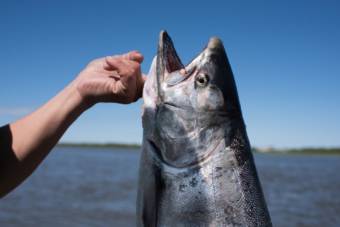
It’s likely to be another weak year for king salmon returns to the major river systems of Southeast Alaska in 2024.

The Alaska Department of Fish & Game issued its 2024 Southeast Alaska Chinook Salmon forecasts last week.

Of the 11 chinook stocks in the region, only the Chilkat River is expected to have an adequate number of chinook returning to spawn. Nevertheless, this number – known as escapement – is still in the middle of the range, and could be lower depending on how many fish are harvested before they get to the river.

The Alaska Department of Fish & Game has adopted action plans to try and limit the catch of king salmon bound for Southeast Rivers, but some are always intercepted.

However, ADF&G Assessment Biologist Philip Richards says overharvest is probably not the problem.

“There is some level of harvest for all of our Southeast stocks,” said Richards. “However, in the past five years in particular, the harvest rates have been extremely low for all of our stocks. That indicates that the harvest is not driving the low abundance – it’s most likely marine conditions.”

Marine survival remains “the million-dollar question” according to Richards. Many factors could be at work in the ocean, but Southeast’s chinook runs have dipped before, and the cause is unclear.

“Some of our chinook escapement projects started in the early 1970s. And at that time, escapements were extremely low,” Richards said. “Once again, we don’t know why. But that was a period (of low escapements). And we don’t know how long that lasted, you know, prior to us starting the stock assessment projects.”

In addition to the Chilkat, only the Unuk River in southern Southeast is expected to reach its escapement target – but just at the lower end with 1,800 kings returning to spawn. The Taku River near Juneau should see a return of just over 17,000 large fish, which is 2,000 below minimum. The department had insufficient data to forecast the run for the Stikine River near Wrangell, but it’s expected to be far below the minimum of 14,000 fish.

The Alaska Board of Fisheries has designated seven of Southeast Alaska’s wild chinook runs as “stocks of concern.” They are the Chilkat, Taku, King Salmon, Stikine, Unuk and Chickamin rivers and Andrew Creek.

Site notifications
Update notification options
Subscribe to notifications