Fisheries

NOAA denies emergency request to close red king crab savings areas

""
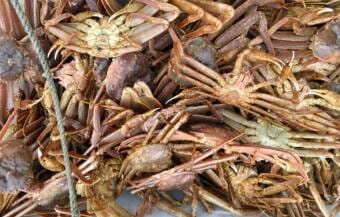
The red king crab savings area was established in 1996 and is permanently closed to bottom trawling, but it remains open to midwater — or pelagic — trawlers, pot fishing and longlining. (Bri Dwyer/Alaska Bering Sea Crabbers)

The National Oceanic and Atmospheric Administration has denied an emergency request Friday to close crucial habitat for Bristol Bay red king crab to all types of commercial fishing.

That comes after Alaska Bering Sea Crabbers petitioned in late September for a closure of the red king crab savings areas to protect the species during a time of historically low stocks.

The nonprofit, which represents independent crab harvesters, requested that the grounds be closed to all fishing gears from Jan. 1, 2023 through the end of June.

The Bristol Bay red king crab fishery has been closed to fishing for two years due to low population. Biologists have seen declines in recruitment and stocks for more than a decade. It’s not abundantly clear what is causing the crash, but some theories suggest climate change and warming ocean conditions may be in part to blame.

The savings area was established in 1996 and is permanently closed to bottom trawling, but it remains open to midwater — or pelagic — trawlers, pot fishing and longlining. Bottom trawling is allowed, however, in a small section within the savings area — known as the savings subarea — when Bristol Bay red king crab is not open to directed fishing.

Jamie Goen is the executive director of Alaska Bering Sea Crabbers. In a letter addressed to the North Pacific Fishery Management Council in December, she argued that pelagic trawling — or midwater trawling — has similar impacts to the sea floor as bottom trawling. She urged council members to consider closing the king crab savings areas for roughly 180 days of the year, when crab stocks are most vulnerable.

While the council said that the closure “could provide habitat benefits through reduced bottom contact by trawl gear and potentially reduce Bristol Bay red king crab mortality,” they argue those effects are uncertain and rely on assumptions that the closure would move fleets into areas with lesser impact to crab stocks. The council also said a provided analysis shows that the closure could negatively affect other species, like salmon and halibut.

Ultimately, despite Goen’s and about 25 other comments, the agency chose not to recommend the proposed emergency action.

And on Jan. 20, NOAA Fisheries announced that they had denied the petition and would not close the savings areas. Their reasoning: the emergency regulations wouldn’t address the low stocks or declining trends of mature female crab. They said taking emergency action and changing the rulemaking process isn’t worth it.

According to Alaska Bering Sea Crabbers, harvesters are “dismayed and deeply disappointed that NOAA Fisheries denied protections for dwindling crab stocks on the same day they opened pollock fisheries with increased harvest limits.”

The council is considering alternatives to the emergency action, including implementing an annual closure of the savings area and subareas to all commercial groundfish fishing gears through a normal rulemaking process — that would not include non-pelagic trawling.

NOAA is working to facilitate quick relief funding for various fishery disasters, including the most recent king crab and Bering Sea snow crab closures.

Historically, that kind of funding has taken years to reach the hands of fishermen.

Gov. Mike Dunleavy estimated a loss of more than $287 million to the red king crab and Bering Sea snow crab fisheries over the last two years.

Bering Sea crab crash jeopardizes St. Paul Island’s emergency medical services

St. Paul in 2015 (Ian Dickson/KTOO)

The collapse of the Bering Sea crab fisheries has put St. Paul Island at risk of losing some of its essential services.

The city’s economy is about 90% dependent on the harvest of snow crab, which closed for the first time in the fishery’s history in October. Without Bering Sea snow crab or Bristol Bay red king crab — which has been closed since 2021 — the City of St. Paul is estimating a roughly $2.7 million hit.

In light of those anticipated losses, St. Paul’s city government declared a cultural, economic and social emergency in late October following the fishery closures, and subsequently implemented budgetary cuts, hiring freezes and other measures.

Now, the Pribilof Island community faces the loss of its emergency medical services.

The community of about 350 people has one emergency medical technician — who is currently off island. And according to City Manager Phil Zavadil, there is only enough funding to employ them through the rest of the month. After that, the remote community will have to rely on local volunteers.

“Essentially, if something were to happen, we’ll go grab somebody in the ambulance and take them to the clinic, and that’s pretty much the extent of what can be done,” Zavadil said. 

He said that’s not ideal, but “with 60% of tax revenue gone, with no crab season, you have to make those tough choices.”

The city hires EMTs rather than relying on volunteers through the police force, which they had done previously, until the entire force resigned in late 2021, citing a vaccination requirement for city workers. It costs about $160,000 a year for the EMT contract, according to Zavadil.

He said there are emergency trauma technicians on the island, but they don’t have the extensive training of an EMT, who is certified by the state to perform various lifesaving procedures.

Zavadil estimates that the city has a budget deficit of roughly $900,000, and he said city officials are working to avoid overspending now, which could eventually lead to mass layoffs and bankruptcy later on.

We’re in a difficult spot,” he said. “As I talk to our staff and others, I have to caution them of overspending because we don’t know how long the crab crash is gonna last.”

The city is relying on donations to keep its medical services. The Aleut Community of St. Paul Island and the Central Bering Sea Fishermen’s Association have donated enough money to keep the city’s contracted emergency medical services through the end of January.

Southeast Alaska’s porpoises have separate populations, and one may be vulnerable

A harbor porpoise swims in Alaska waters on July 7, 2016. DNA analysis and other information shows that Southeast Alaska’s porpoises have separate populations, and the more southern population appears to be more vulnerable to bycatch. (Photo provided by National Oceanic and Atmospheric Administration/Alaska Fisheries Science Center)

There are at least two distinct populations of harbor porpoises in Southeast Alaska waters, and one of them appears to be particularly vulnerable to deaths from entanglements in commercial fishing gear, according to newly released information from National Oceanic and Atmospheric Administration scientists.

The breakdown of Southeast Alaska’s porpoises into separate northern and southern populations contrasts with current management, which treats the region’s porpoises as a single population.

The more precise population definition, which is based on DNA analysis and other information, could affect management of Southeast Alaska’s commercial gillnet salmon fisheries.

At issue, said Alex Zerbini, lead author of both the NOAA report on genetics and related information and a recent study on population size, is bycatch: the accidental drownings of porpoises tangled in fishing nets.

“Either they’re going for the fish or sometimes they’re just traveling, and they can’t see the nets,” said Zerbini, who is with NOAA’s Alaska Fisheries Science Center and the University of Washington. “They hit the nets and they die.”

NOAA manages porpoises under the Marine Mammal Protection Act, and human activities like fishing are regulated according to that act’s conservation requirements.

The northern population, estimated at 1,619 animals swimming in Glacier Bay, Icy Strait and Cross Sound, appears to be resilient to current levels of bycatch, a term describing when fishers catch species other than those they’re targeting. But the southern population, swimming around Zarembo Island and Wrangell and estimated at 890 animals, might be already subjected to more bycatch than it can absorb.

The study by Zerbini and his colleagues, published in the journal Frontiers in Marine Science, quantified population estimates and “potential biological removal,” or the levels of bycatch deaths that each group could withstand. That came out to losses of 12 animals a year for the northern population and 6.1 animals a year for the southern population.

Current bycatch-caused deaths for the southern population were calculated at 7.4 animals per year, beyond the danger threshold. The estimated losses happening in the northern population, however, came out to only 5.6 animals a year, below that threshold.

A harbor porpoise swims in the Glacier Bay. The porpoises here and in other areas of northern Southeast Alaska were found to be genetically distinct from porpoises in more southern parts of the region. Porpoise numbers in northern Southeast Alaska have also bee more steady. (Photo provided by the National Park Service)

Exactly how much bycatch of porpoises is currently happening is unclear. A five-year NOAA report released in August documented only two cases from 2016 to 2020.

However, documented reports could miss actual cases. The gillnet harvests are not monitored through any mandatory observer program. A pilot program conducted by NOAA in 2012 and 2013, the Alaska Marine Mammal Observer Program, was able to monitor numerous interactions between the fleet and porpoises.

It’s possible that fishing crews do not even see dead porpoises caught in nets, Zerbini said.

The idea is that the porpoises in northern and southern waters of Southeast Alaska emerged from varying population trends, he said. If it were a single population, the trends would be similar, he said.

DNA analysis to confirm the difference was difficult. Typically, DNA analysis of marine mammals is done through analysis of tissue samples. But porpoises are so elusive that scientists turned to “environmental DNA” — samples of water into which the porpoises are frequently shedding small bits of skin, Zerbini said.

Meanwhile, there appears to be a third, completely different population of porpoises swimming in the outer waters around Yakutat. Much less is known about those animals, Zerbini said. “It is very likely that there are multiple different stocks within that unit, but we just don’t have the data to demonstrate that,” he said.

The emerging demographic pattern for Southeast Alaska fits with demographic patterns for porpoise elsewhere, where populations tend to range in small areas, he said. There are multiple defined population stocks in waters off California, for example.

Any formal determination separating northern and southern Southeast Alaska porpoise population stocks would be done through NOAA’s stock assessment review process. A draft assessment is pending, and there will be a public comment period before any final assessment is released, said Maggie Mooney-Seus of NOAA’s Alaska Fisheries Science Center.

This story originally appeared in the Alaska Beacon and is republished here with permission.

Kodiak fishermen sit out opener as dispute over crab prices continues

Boats stacked with empty crab pots sit in Kodiak’s St. Paul Harbor. (Brian Venua/KMXT)

Fishermen should have been setting their gear on Sunday morning for the opening of Kodiak’s biggest tanner crab fishery since 1986. But the harbor was almost full, with dozens of boats stacked high with empty crab pots. At the coffee shop near the docks downtown, fishermen lined up for free coffee instead.

Frank Miles owns the Sumner Strait — it’s a 58-foot limit seiner — and has fished commercially for nearly 50 years. His first tanner season around Kodiak was in the early 80s, when he chopped bait for a local boat.

“I’ve parlayed it into a very good livelihood,” he said. “I’ve raised three kids in this town on the back of fishing income, and it’s been a beautiful thing.”

Miles normally fishes pot cod and longlines for halibut and black cod. He also tenders salmon. He sat out the beginning of this cod season so he could go out for tanners instead. He didn’t think prices would be quite as high as last year’s record of more than $8 per pound.

“But I never in my wildest dreams thought that we’re gonna get offered $2.50. It really is a slap in the face,” Miles said.

That’s how much all of Kodiak’s processors offered ahead of the scheduled opener for the tanner crab fishery.

Miles says he understands that processors’ expenses have gone up, but so have his. Fuel and bait costs have increased, it’s more expensive to replace or repair crab pots, and he’s losing money staying tied up. Miles said it costs $63,000 to insure his boat — which is one of two that he owns — plus $15,000 in moorage fees for the Sumner Strait alone.

Skippers and crew from Kodiak, Chignik and the South Peninsula have been holding out for better price before they go fishing (Brian Venua/KMXT)

Kodiak’s entire fleet sat out the season opener on Sunday, and they aren’t planning on fishing anytime soon. That includes fishermen in Chignik and the South Peninsula.

“Nobody’s pulling any pots as far as we know,” said Kevin Abena, the secretary and treasurer for the Kodiak Crab Alliance Cooperative, which represents about 120 permit holders in the fishery.

It’s a diverse group that includes 32-foot gillnetters to 118-foot crabbers.

He said they’re still negotiating with the canneries in town, but so far, the best offers are coming from processors out the Aleutian Chain.

“We are actively finding tenders right now, working with the processors out west to formulate a plan to move all this crab out west,” Abena said.

As of Monday, that decision wasn’t final, but it’s a serious option. Abena said the cooperative is in talks with Peter Pan in King Cove to process crab from Kodiak.

Canneries to the west are offering close to $4 per pound for Bering Sea tanners. But Kodiak tanner crabs are about an inch bigger. That’s another sticking point for local fishermen, who say the crab around Kodiak is more valuable than what’s currently on the market.

Abena said both the community and fishermen from other parts of the state have reached out to express their support of the stand-down. At this point, he says the soonest the fleet would go fishing is Wednesday, Jan. 18.

“The amount that we stand to gain, everybody understands it is much greater than what we’re losing right now for standing down for a day, two, three, four – a week – whatever it takes,” he said.

Fisherman Frank Miles said whenever they get a fair deal, he’ll be ready.

“I can’t wait to go fishing, man, I think everybody’s ready to go,” he said. “I’ve never seen a fleet so ready.”

In the meantime, he and the others will continue to wait.

As of Monday morning, processors in Kodiak either could not be reached by phone or had no comment.

Brian Venua contributed to this reporting.

Kodiak fishermen stand down to protest low tanner crab prices

Kodiak’s commercial fishing fleet has been preparing for the area’s biggest tanner crab season since 1986. (Brian Venua/KMXT)

Kodiak’s biggest tanner crab fishery in nearly 40 years is set to open on Sunday, but the fleet is standing down. Fishermen say they won’t go fishing for the prices offered by local canneries. It’s the latest wrinkle on a winter fishing season already impacted by closures and strikes.

Processors in Kodiak offered $2.50 per pound for tanners when negotiations started earlier this month. Kevin Abena is the secretary and treasurer for the Kodiak Crab Alliance Cooperative, which represents about 120 permit holders in the fishery. He said since then, all of Kodiak’s canneries haven’t budged from their initial price.

“We haven’t been given anything to consider. $2.50 isn’t the number that we’ll consider,” Abena said.

Last year, fishermen were paid a record of more than $8 per pound. The tanner crab fishery was closed in 2021, but back in 2020, prices still were more than $4.

This year’s harvest levels for the Kodiak fishery are the biggest they’ve been since 1986, at 5.8 million pounds. That’s more than five times the size of last year’s quota. Combined with the fisheries in Chignik and the South Peninsula, 7.3 million pounds total of tanners are up for grabs in the Westward Region.

Last year, the state Department of Fish and Game estimates the Kodiak region alone was worth over $10.1 million.

The big quota this year also means more boats are participating. Last year, 87 vessels fished for tanners. This year, 109 were registered as of Friday morning. That includes some Bering Sea crabbers, whose seasons have been canceled because of crashing snow crab and king crab populations.

Abena says some processors out west have been offering around $4 per pound for tanner crabs. That doesn’t help the local fleet though, most of whom can’t make the trip out the chain. And it doesn’t help the community, which collects municipal taxes off of seafood landings.

“This is a community deal,” he said. “Everybody in the fleet has spent a lot of money on getting ready to do this fishery, everybody has invested money.”

Abena declined to call it a strike, but the action is similar to a strike in another fishery earlier this year. Bering Sea fishermen successfully pushed up the price per pound for Pacific cod after striking.

Abena says the entire fleet – including fishermen in Chignik and the South District — is holding out until local processors offer better prices.

“The feeling of unity is really strong, and it’s pretty special,” he said. “It’s hard to get a diverse group like we have here on board, everybody has things that they want to move on to after crab. Some boats go cod fishing, some boats go dragging for pollock. Some guys will be going right into black cod or halibut fishing.”

When reached by phone Friday morning, Pacific Seafoods had no comment. Other processors, including Trident, Ocean Beauty and Alaska Pacific Seafoods, could not be reached.

The cooperative’s next meeting with permit holders is Saturday. Abena said if they get the right price, the soonest they’d go fishing is Monday, Jan. 16 – a day after the scheduled opener.

Correction: A previous version of this story said the Kodiak area fishery was worth $1.2 million. Fish and Game estimates it was worth over $10.1 million. 

Sitka Assembly considers helping Southeast trollers in legal fight that could shut down fishery

Trollers in Sitka’s Eliason Harbor. Extended king closures worry many. “There’s so much down time that a guy’s got to get another job,” troller Caven Pfeiffer told the Sitka Advisory Committee. (KCAW file photo)
Trollers in Sitka’s Eliason Harbor. (KCAW file photo)

Southeast trollers turned out at a Jan 10 Sitka Assembly meeting to voice concerns about a court case that could shut down commercial salmon trolling in Southeast Alaska. The lawsuit is about Washington killer whales and Alaskan king salmon. Fishermen and representatives from the Alaska Trollers Association asked the local assembly to consider contributing $25,000 to their legal defense fund.

The Seattle-based environmental group Wild Fish Conservancy wants to stop the Southeast troll fisheries, which they say harm an endangered population of orcas. The group has argued the government failed to adequately address the impact of Alaska’s king salmon harvests on Southern Resident Killer Whales, whose population in the Puget Sound area of Washington has dropped to critically low levels.

And in December, a federal judge in Washington issued a report that puts the fisheries at risk of closure. The Alaska Trollers Association is a defendant in the 2020 suit against the National Marine Fisheries Service.

Sitka fisherman Matt Donohoe is the president of the Trollers Association. He says they object to the report and expect their legal expenses to increase.

“Anyone claiming that Southern Resident killer whales are starving because Alaska trollers were taking food from the mouths of their babies would be laughed out of court. That’s what we thought,” Donohoe said. “Yet a judge is recommending that the historic Southeast Alaska troll fishery, which for 100 years has never closed, will shut down this winter. If that happens, the industry will die, and so will a large part of Southeast Alaska’s economy.”

Around a dozen fishermen asked the assembly to help with the organization’s legal defense fund. And it’s not just trollers. Linda Behnken leads the Alaska Longline Fishermen’s Association– both her group and the trollers drafted a report outlining research into the decline of Southern Resident orcas. She said the lawsuit ignores a large body of science, which indicates that pollution, not fisheries, are the biggest threat.

“Everything they eat is coming out of waters that are polluted. They’re struggling with habitat issues, they’re struggling with what’s been done in the world around them. They’re in Puget Sound,” Behnken said. “It’s not even fisheries, let alone the fishery is 1000 miles away up here, and that our fishermen have worked for years to keep the resources up here healthy, to keep our rivers clean, and to take care of the whole ecosystem and to now have this overreach by an area that’s not done their job to take care of that habitat, I think, really illustrates who else will be at risk if this lawsuit perseveres.”

When it came time for the assembly to consider the proposal, there was support, and some said they’d be interested in giving more than $25,000. Assembly member Chris Ystad, who is a fisherman himself, said he saw it as an investment.

“I think the Sitka troll fleet produces more than $25,000 in tax revenue every year to the city. So I don’t think it’s too much for them to ask for some of that back to fight their battles,” Ystad said. “It’s an investment for us to make sure that the troll fleet is still able to operate.”

Assembly member Crystal Duncan suggested calling for other Southeast communities to throw in money, noting that like Sitka, communities of Craig and Petersburg had donated to the fund previously.

“I’m just wondering, if this is a Southeast wide problem, rather than us take and elevate that number beyond $25,000…I guess the question is have we reached out to say, ‘Here’s what has happened since. Here’s how much we’re requesting of Sitka. Can you match that?” Duncan said.

She also wondered whether the assembly would be setting a precedent that would lead other industry groups to request money to help with legal fees. Sponsor Thor Christianson didn’t take issue with that.

“I am hard pressed to think of [an] event that has threatened to wipe out a huge portion of our economy in one fell swoop,” Christianson said. “That is the definition of emergency. So if somebody came forward with a similar issue, yes, we would discuss it.”

And then there was a question of where the money should come from. City Administrator John Leach and municipal attorney Brian Hanson said the Fisheries Enhancement Fund could likely be used. But Mayor Steven Eisenbeisz preferred the money come from the city’s general fund. As for whether the assembly could offer more than $25,000, Eisenbeisz noted that while no one at the meeting spoke against the measure, the assembly had received some negative feedback in their inboxes.

“It’s it’s going to be shocking to the people in this room, it was actually kind of surprising to myself, that the assembly actually had a lot of pushback in our emails from donating even this amount,” he said. “I didn’t expect that. But it’s, for better or for worse, what we saw. So I think we should start here. And then as things develop, keep an eye on the pulse on that. From the people in this room and the strength of the people in this room, I have no doubt that we will be continued to be informed on that.”

The Sitka assembly didn’t take a vote at the meeting. Assembly members Christianson and Kevin Mosher, who co-sponsored the discussion item, said they’d bring an ordinance to the table for the assembly to vote on at the next regular meeting, Jan. 24.

Site notifications
Update notification options
Subscribe to notifications