Fisheries

Bering Sea cod fisherman fights for better catch price amid slow fishing seasons

""
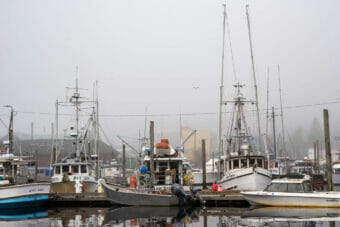
Rather than head out right away to the fishing grounds and set their gear like they usually do on the New Year, nearly 30 boats dropped their anchors or docked up in port, waiting on better news. (Maggie Nelson/KUCB)

What was once the bread and butter for many Bering Sea and Aleutian Islands fishermen now rests like a distant memory among Alaska’s commercial fishing industry.

The Bristol Bay red king crab fishery has been closed for two years, and along with it, Bering Sea snow crab have abruptly disappeared, causing another complete closure.

Together, the fisheries generally bring in millions of dollars to the fleet and the coastal Alaska communities that rely on them. Since 2021, when king crab closed and snow crab saw a huge decline in harvest numbers, fishermen have taken an estimated $287.7 million hit.

Without those fisheries and without that revenue, more and more boats are relying on other work like fishing for cod and small amounts of bairdi crab or summer tendering gigs just to make ends meet.

So when a group of Bering Sea fishermen recently heard they’d be getting paid less than they hoped for cod this winter season, they figured they couldn’t afford to just sit by. But that’s exactly what they did. When the season opened, they didn’t go out to fish — and it worked.

A fisherman stands by a cod pot that's mostly full of fish.
Fishermen on the F/V Confidence haul cod pots in the Bering Sea. (Courtesy Tacho/F/V Confidence)

Rather than head out right away to the fishing grounds and set their gear like they usually do on the New Year, nearly 30 boats dropped their anchors or docked up in port, waiting on better news.

“Trident posted a substantially low price for cod this season, but no other processors would post anything,” said Chris Studeman, captain and co-owner of the 104-foot fishing vessel Kevleen K. “And they all expected us to just go fishing with the good faith that they’ll make it right in the end. And you can’t really run an operation with the hope that somebody will make it right in the end.”

Studeman got on his phone and struck up a conversation with other fishermen in the cod fleet. Ultimately, about 26 boats joined Studeman and his crew in the informal strike. There’s likely somewhere around 40 to 50 boats total that are fishing federal cod this season. That includes both the above and below 60-foot sectors.

Studeman said he didn’t go in planning anything specific, but just wanted to gather some fisherman and talk. However, they soon organized and decided they wanted a better idea of what most of the canneries would offer them for their catch before they started dropping their gear.

“We never really put a name or a label on it,” Studeman said. “We were just trying to make sure we got the price to come out before we all went fishing. 40 cents wasn’t going to work.”

40 cents a pound was what the fleet heard Trident would pay for cod, but hadn’t received word from most other processors on price. That’s not unusual, though. Fishermen often head out to catch cod before they know for sure how much they’ll be making per pound.

Studeman — who’s been fishing in the Aleutians for about two decades — said that’s just how it goes.

“The cannery has kind of always held all the power because they put out a price and everybody goes fishing, and the only way we can stop that is to get together as a group, as a whole,” he said.

This New Year, that worked. Studeman said he hopes both the small and larger sectors of the fleet can continue to work together to advocate for one another and work with the processors.

“Because we’re able to get the small boats and the big boats both to be on the same page, I hope in the future that we can get organized the first week of December and then be talking with the processors before we even attempt to come up,” he said. “And hopefully we can have a price that everybody can agree on before we even leave our homes.”

Cod flopping in the bottom of a cod pot
The boats stood down for just about three days. By Jan. 4, they’d gotten word from most processors on prices. (Courtesy Tacho/F/V Confidence)

The boats stood down for about three days. By Jan. 4, they’d gotten word from most processors on prices.

Ultimately, Studeman said they posted a price of about 45 cents per pound across the board. That’s less than last year, but in the current climate and with increased costs for fuel, parts and labor, the five-cent jump up from the original 40 cents makes a difference.

“Pretty much all the crab fisheries that we’ve been fishing with this boat are gone,” he said. “We don’t have a lot left on the table. We got cod fish and some bairdi to go catch this year, and then salmon tendering… so everything’s pretty tight for all of us.”

A lot affects the price for cod, including changes at the processing level. And processors are also seeing increased operating costs. Tom Enlow, President and CEO of UniSea — a fish and crab processing plant in Unalaska — said the price for an entry-level processor has gone up 14% since last year.

“The market’s not the same as it was a year ago,” Enlow said. “So if we pay fishermen the price that we paid a year ago, we’re going to lose money.”

Still, Enlow said he understands where the harvesters are coming from. If he were in their Xtratuf boots, he said he’d probably do the same. And ultimately, he’s glad the company could come to an agreement with the fleet.

“It’s just a little bit of us revisiting our calculations and making sure that we can pay the harvesters with what they’d like to get paid, and still make money,” Enlow said.

UniSea is offering 46 cents per pound. And like most other processors, they also give volume incentives to their harvesters. So as the fishermen deliver more product, the price they get for that fish goes up.

As for harvest amounts, boats larger than 60 feet have 5,168 metric tons of cod to catch for the 2023 “A” season. The smaller boats have less than half that, with 2,413 metric tons. That doesn’t include the reallocation the under-60 fleet will get from the jig gear sector.

Those harvest numbers have been on a downward trend for the past several years.

Maine lobster industry wins reprieve but environmentalists say whales will die

A man carrying a black tote off a docked lobster boat named Lil More Tail
The lobster fishing industry in Maine caught more than 100 million pounds of the crustaceans in 2021 valued at more than $725 million. (Kevin Miller)

PORTLAND, Maine — Lobsterman Curt Brown had already logged a full day on the water by the time he pulled up to a fishing wharf just blocks from downtown Portland restaurants bustling with lunchtime diners.

The 250 to 300 pounds of lobster he had hauled up from the cold Maine waters could land on a plate just up the street — or in a restaurant on the other side of the globe. And on this chilly December day, Brown was feeling more hopeful about the prospects for Maine’s iconic lobster industry.

“I think our industry, for the first time in a long time, can see a ray of sunshine and feel optimistic that the hard work we have been doing is being recognized,” Brown said.

Just a day earlier, the lobster industry had received welcome news in the fishery’s years-long battle with environmental groups over protections for the endangered North Atlantic right whale.

The state’s congressional delegation — which has locked arms with Maine’s billion-dollar lobster industry — had pulled off a procedural end-run by inserting a 6-year delay on new federal fishing regulations into a $1.7 trillion spending bill.

For Maine’s 5,000 licensed commercial lobstermen, it meant a reprieve from rules that they warned could destroy their industry — and decimate coastal communities — by forcing them off the water in some areas for months at a time and eliminating the vertical lines of rope connecting a string of traps on the bottom to a buoy on the surface. Those lines can become wrapped around whales’ fins or lodged in their mouths. But “ropeless” fishing gear, which relies on technology to allow fishermen to call a trap up to the surface, is still in development and is not available on a wide scale commercially.

“If you take away three months, four months, five months of the ability to go out and harvest lobster, you are not only going to impact harvesters,” Brown said. “You are going to impact many, many other businesses as well.”

a man in a hoodie and coveralls gesturing with gloved hands
Curt Brown contends the lobster industry already has adopted safer fishing methods to protect right whales. (Kevin Miller)

Conservation groups fighting to save the North Atlantic right whale, meanwhile, predicted the delay could put the endangered whale on an irreversible slide toward extinction.

“Is there a chance that we can save the right whale in 2028? Yeah, sure,” said Brett Hartl of the Center for Biological Diversity. “It maybe was a 50-50 proposition before. Now it’s like 95 percent to 5 percent against.”

Right whales are in danger

Slow-moving and measuring up to 50 feet long, North Atlantic right whales were hunted nearly to extinction more than a century ago. There are just 340 left in the world and biologists say their biggest threats are collisions with ships and entanglement in fishing rope. The migratory whales’ territory stretches the entire Atlantic coastline, from their calving grounds along the Florida and Georgia coast to their foraging grounds off of New England and the Canada.

Groups such as the Center for Biological Diversity and the Conservation Law Foundation have used the Endangered Species Act and the Marine Mammals Protection Act to force federal regulators to impose stricter regulations on the fishing industry.

But there has never been a right whale mortality tied to the Maine lobster fishery and no injuries traced back to the industry since 2004.

Environmentalists contend that’s because it’s often impossible to trace rope wrapped around a whale to a specific fishery. But Maine’s political leaders said it is evidence that those involved in the state’s lobster fishery are good stewards.

“In the 25 years that I’ve been privileged to represent Maine in the United States Senate, I have never seen a worse case of regulatory overreach to address a problem and blame an industry that is not at all responsible for a problem,” said Maine Sen. Susan Collins, a Republican.

The lobster industry was the second-largest fishery in the United States in 2019 in terms of economic value, according to the most recent federal data. Maine lobstermen hauled in more than 100 million pounds of the crustaceans in 2021 valued at more than $725 million.

Politicians support the lobster industry

Maine’s Democratic, Republican and independent political leaders have united behind an industry that contributes more than $1.5 billion to the state’s economy when factoring in jobs within the fishing industry, restaurant or food sales and lobster-related tourism. In addition to delaying any new regulations, the budget bill passed by Congress contains millions of dollars to research how often right whales are entering prime lobstering grounds in the Gulf of Maine and to speed up development of ropeless lobster gear.

“It merely pauses that economic death sentence until we have time to know how to navigate the solution and what the real definition of the problem is,” said Sen. Angus King, an independent.

But Erica Fuller, senior attorney with the Boston-based Conservation Law Foundation, said after the delay was announced that members of Congress who voted for it had “the blood of a magnificent endangered species on their hands.

“The science is clear: Humans are killing right whales faster than they can reproduce, and entanglement in lobster gear is a leading cause,” Fuller said.

While the National Oceanic and Atmospheric Administration lists entanglement in fishing gear as a primary cause of mortality and injury among right whales, there has never been a death traced back to the Maine lobster industry and only one documented injury from lobster gear since 2004.

But conservationists and scientists point out that injuries and deaths often can’t be traced to any particular fishery.

According to NOAA statistics, of the 34 North Atlantic right whales known to have died between 2017 and 2022, nine were attributed to entanglements in fishing gear, 11 to collisions with ships and 14 were of unknown origin.

Back on the Portland waterfront, lobsterman Curt Brown contends that his industry has done more to protect whales by switching to break-away rope, sinking rope and more traps per line. Brown, who is also a marine biologist for a lobster retailer, added that he’s never seen a right whale during his 30 years of lobstering.

“We are the largest fixed-gear fishery on the East Coast,” Brown said. “If we were entangling right whales, we would know. Someone would be seeing it and it would be documented. And we’re just not seeing it.”

Copyright 2023 MPR News. To see more, visit MPR News.

An 8-bridge fish passage project near Gustavus has been finished

""
With beginnings in Glacier Bay National Park and an end in Icy Strait, the Good River is like many Southeast Alaska rivers — a nursery for fish, cold, and relatively short (for Alaska standards). According to the U.S. Fish and Wildlife Service, it’s groundwater fed and makes a lazy traverse across a relatively recent outwash plane. (Photo courtesy of USFWS)

An eight-bridge project over the Good River near Gustavus has finally drawn to a close. It’s part of a national fish passage program that received $40 million in last year’s federal infrastructure law. The project in Southeast Alaska should help juvenile fish maneuver through the waterway.

The land around Gustavus doesn’t stay still. It’s constantly rising from what’s known as isostatic rebound. Basically, as a nearby glacier retreats, the pressure on the land lessens and it rises. The land in Gustavus is rising faster than anywhere else in the world – about an inch a year.

“And it’s been doing that for 200 and whatever years,” said Mike Halbert, longtime fishing guide in Gustavus.

Since the mid-1700s, to be more precise.

“I’ve been fishing there for 30 years,” Halbert said. “So yeah, I’ve seen three, four or five feet of difference, and you can see it on charts since it was charted in the 60s.”

The rising land is one reason the federal government spent the last decade fixing eight bridges over the Good River and its tributaries. The funding comes from the U.S. Fish and Wildlife Service’s National Fish Passage Program which received $3.5 million for Alaska projects in the bipartisan federal infrastructure law.

The Good River runs from Glacier Bay National Park to Icy Strait. In recent decades, while the land continued to rise, so did the metal culverts. But the streams kept cutting into the land, causing the culverts to overhang the water. That’s a problem when they’re home to salmon, dolly varden, and cutthroat trout.

“If the water where it came out of the culvert, if it was creating a waterfall, [USFWS] considered a hindrance for the young coho to move upstream, they’d be reluctant to jump like the adults,” Halbert said.

Two culverts, both hanging a little above the streams that run out of them.
A culvert on a tributary to the Good River has become “perched” over time (1999 left; 2021 right). According to the U.S. Fish and Wildlife Service, fish have a hard time navigating the resultant low flow through the culvert and small/juvenile fish have difficulty jumping into the now-hanging pipe. (Photo courtesy of USFWS)

Halbert says the Good River doesn’t have a lot of fish in it. It isn’t nearly as big as the nearby Salmon River where most locals and tourists go. The Good River is small and runs along roads, past town, and through a mud flat.

Another local fly-fishing guide, Natalie Vax, says mostly kids fish the Good River for salmon and trout.

“Kids catching cutthroats and dollies and pinks and silvers on that little culvert side ditch thing on the side of the main road, but it is not a ton,” she said. “There are a few spots where sometimes fish do gather.”

The U.S. Fish and Wildlife Service hopes the new bridges will allow more fish to spawn in the smaller stream.

U.S. Assistant Secretary of the Interior, Shannon Estenoz, oversees fish, wildlife and parks.

“These projects are all about kind of what the name suggests — removing barriers to flow, removing barriers to fish passage, often updating, you know, either outdated or malfunctioning infrastructure that are impeding fish passage,” said Estenoz.

Estenoz is a civil engineer. She says when engineers are designing infrastructure like culverts and bridges, they can’t always predict what will happen decades later. Sometimes the material fails or outlives its useful life.

But the fish passage projects aren’t just about saving fish, she says.

“They often fix multiple problems at once,” Estenoz said. “I’m finding as I’m traveling across the country, that we might be helping fish, but we’re often also improving flood protection — we’re making it safer for folks to paddle the river to, you know, fish on the river. And apparently, this has been an ancillary benefit for the Good River as well.”

Fishing guide Mike Halbert doesn’t see the local bridges making much difference for his industry but he says it’s a huge improvement for traffic across the waterways. And he says it’s also provided jobs for road workers building the bridges.

“Obviously, the people that are working on the construction, it was a big benefit,” Halbert said.

The infrastructure law included $600,000 for the Good River’s final bridge. The entire fish passage project totaled $1.76 million.

Other fish passage projects in Alaska that received federal infrastructure funding included $1.3 million for the Little Tonsina River in the Valdez-Cordova Borough and $1.6 million for the Tyonek Creek on the Kenai Peninsula.

Fishery disaster aid and nearly $500 million worth of Alaska projects included in omnibus budget bill

A red king crab, underwater
A red king crab is seen in the water at Kodiak in 2005. The collapse of the red king crab fishery in Bristol Bay was one of the Alaska events that prompted a series of official fishery diaster declarations last week — and Congressional approval of $300 million in aid. (Photo by David Csepp/National Oceanic and Atmospheric Administration)

Aid to Alaska fishermen, companies and communities was included in the year-end omnibus appropriations package that won final passage on Friday.

The $300 million in aid funding follows official disaster declarations issued last week by U.S. Commerce Secretary Gina Raimondo for Alaska salmon and crab fishery failures dating back to 2020, as well as some salmon failures in Washington state dating back to 2019.

“This will be relief for commercial, recreational, subsistence harvesters, all those who were directly impacted by the fishery stock crashes,” Sen. Lisa Murkowski, who helped write some sections of the legislation, said in an online news conference Friday.

The disaster aid also supports research and communities that lost fish-tax revenues and it includes a provision, the Fishery Resource Disaster Improvement Act, that aims to improve administration of disaster funding and gets money to the affected parties, the Alaska Republican said.

“We recognize that it’s one thing to get the disaster declaration. It’s another thing, then, to get the funding. And it is yet another step to get the funding out to those who have been impacted,” Murkowski said.

The money is a relief to those affected, one fishery organization said.

The $300 million in total disaster aid “is a great start for much-needed money to help fishermen and communities pay their bills,” Jamie Goen, executive director of Alaska Bering Sea Crabbers, said in a statement. “We commend the Secretary of Commerce, NOAA Fisheries, and members of Congress, particularly the Alaska and Washington delegations, for their swift action and attention to this issue affecting so many hard-working Americans and family fishing businesses.”

Alaska Bering Sea Crabbers is one of the groups affected by the first-ever closure of the Bering Sea snow crab fishery and the second consecutive year of closure for the Bristol Bay red king crab fishery. In both cases, stocks are too low to support any harvesting.

Aside from the disaster relief, there is money in the bill for fishery initiatives, including research and monitoring in the Yukon and Kuskokwim river drainages and in the Bering Sea, sites where fish returns have been disastrously low.

Those provisions were among more than 130 Murkowski-endorsed Alaska projects totaling nearly $500 million that were included in the package as “congressionally directed spending,” what was in past years referred to as earmarks. Because Murkowski was the only member of Alaska’s three-person delegation to push for those projects, her office handled all of the requests from around the state. ‘

To winnow down the approximately 1,600 requests received, Murkowski said she focused on the items that appeared to address the most critical needs, largely water, sanitation, health and even trash management.

Her message to the requesting communities, she said, was simple: “We want to focus on the things that make your community healthier and safer.”

Among the projects that cleared the bar were those related to water in rural Alaska, including water, wastewater and garbage-handling improvements in the Pribilof Islands, drinking-water and wastewater improvements in Nome and upgrades to wastewater treatment on the North Slope.

There are numerous Arctic-specific provisions in the omnibus bill, some of them included as Congressional Directed Spending Projects, such as the $5 million for Ilisaġvik College’s work to complete design of a new campus in Utqiagvik, and some of them meeting needs specified in the National Defense Authorization Act, such as additional funding for the Ted Stevens Center for Arctic Security Studies.

Included in the omnibus package are updates to the 19th century-era Electoral Count Act. Murkowski was part of a working group that wrote the Electoral Count Reform and Presidential Transition Improvement Act, which she said will “make sure that we never have another Jan. 6, we never have the uncertainty that comes to what is the role of the vice president in verifying an election, what is the threshold for challenging state’s electoral submissions.”

This story originally appeared in the Alaska Beacon and is republished here with permission.

Nearly 3 years after deadly sinking, debris from the Scandies Rose finds its way to a family in Kodiak

A photo of the Scandies Rose, taken from another boat.
Debris from the F/V Scandies Rose, which sunk on Dec. 31, 2019, recently was found by a fisherman from Chignik. (Photo courtesy Gerry Cobban Knagin)

Seven men were on board the F/V Scandies Rose when it went down during stormy weather in the waters off Sutwik Island – near Chignik – on New Year’s Eve, 2019.

Two survivors were plucked from the water in the hours after the vessel sank by Coast Guard rescue crews. But five crew members were never found and presumed dead. Those included the ship’s captain, Gary Cobban Jr. and his son David Cobban, both from Kodiak.

Gerry Cobban Knagin is Gary Cobban Jr.’s sister. She said in the years since, the family sent a remote operated vehicle down to the seafloor to survey the wreckage.

“I have a whole video of the boat on the bottom with the pots and the buoys popped up out of the pots and made like a kelp forest of buoys,” she said.

The ship, a 130-foot crabbing boat, was enroute from Kodiak to fishing grounds in the Bering Sea and stacked with 198 crab pots when it sank.

Now, nearly three years later, those buoys and other pieces of the ship have started washing ashore, bringing closure to Knagin and some of the other family members of the crew members lost.

Knagin said her family was contacted earlier this month by a fisherman from Chignik, who found two buoys and a bait tow. He flew them back to the family in Kodiak.

“That was just such a heartfelt moment to know that this fisherman, he recognized them for what they were and then he didn’t have Facebook, so he used somebody else’s Facebook page to get in touch with me,” said Knagin. “And then I met them here in Kodiak and picked them up and that’s just like, thank you. I can’t thank him enough for that.”

Knagin said they’ve received some of her brother’s personal belongings from storage yards in Kodiak and Dutch Harbor over the years, but finding something from the ship was different.

“When I touched those buoys it was like getting a hug from my brother. It was a pretty emotional moment,” said Knagin.

report from the National Transportation Safety Board later concluded that inaccurate stacking instructions – particularly in icing conditions – for the ship’s crab pots and more extreme weather than predicted likely caused the Scandies Rose’s sinking. The NTSB made a series of recommendations to multiple agencies, including the Coast Guard, National Oceanic and Atmospheric Administration, National Weather Service and the North Pacific Fishing Vessel Owners’ Association based on its findings.

Just last week, members of the Coast Guard’s Marine Safety Detachment were walking the docks in Kodiak to make sure boats heading out for the upcoming tanner crab fishery were loading pots correctly. Knagin said weather forecasting has also gotten better in the area where her brother’s ship went down. Education and outreach to fishermen has also improved; there’s an upcoming Alaska Marine Safety Education Association course in Kodiak on vessel stability and emergency procedures.

Knagin said she plans to reunite washed-up items from the sunken vessel with the family members of the other men who went down with the ship.

Her brother was color blind, so the big buoys from the Scandies Rose are lime green for him to pick them out on the sea. They have the letters “SR” written on them in black with the ship’s Fish and Game number, 35318. There’s also smaller buoys with the Fish and Game number on them that may float to the surface.

“Some of those are trailer buoys, some of those are red and some of those are white,” she said.

She said anyone who finds something they think is from the ship can find her on Facebook and send her a message, or contact her via email, that’s gdknagin@gmail.com.

Commerce Secretary approves new disasters for Alaska salmon and crab fisheries

Crew from the Silver Spray empty snow crab pots while fishing in the Bering Sea. (Courtesy of Bill Prout)

The U.S. Secretary of Commerce has approved six fishery disaster designations for the state of Alaska, including the Yukon-Kuskokwim and Chignik salmon fisheries for last year. Crabbers will also see relief for this year’s Bristol Bay red king crab and Bering Sea snow crab fisheries. The Alaska Department of Fish and Game announced this fall that both fisheries would remain closed for the season due to low population numbers.

Alaska’s congressional delegation applauded the disaster approvals in a joint statement Friday.

Gabriel Prout is a Bering Sea crab fisherman from Kodiak. He owns the F/V Silver Spray with his family. He says there’s still uncertainty in the fleet about the road ahead, but Friday’s announcement is a big step forward.

“Definitely brings a little bit of some type of psychological relief that they’re working and taking this disaster seriously and what the fishermen are going through,” said Prout.

Alaska Bering Sea Crabbers Executive Director Jamie Goen said in an email that the trade group “looks forward to Congress acting swiftly to appropriate the necessary funds to help America’s fishermen and coastal communities weather these crises and to fund research to help avoid them in the future.”

Researchers say they aren’t certain what caused the snow crab’s population collapse, which led to the fishery’s closure, but they believe climate change was a factor. Changing ocean conditions due to climate change are also likely contributing  to salmon declines in parts of western Alaska.

Congress still needs to allocate funding for each disaster designation, and fishermen have to apply for financial relief. The process often takes years to get money to skippers and their crews.

The U.S. Secretary of Commerce issued determinations that disasters occurred in these fisheries:


  • 2021-22 Bristol Bay red king crab and Bering Sea snow crab fisheries
  • 2021 Kuskokwim River salmon and Norton Sound chum and coho salmon fisheries
  • 2021 Chignik salmon fisheries
  • 2020 Copper River/Prince William Sound coho and pink salmon fisheries
  • 2020-21 Norton Sound red king crab fisheries
  • 2022-23 Bristol Bay red king crab and Bering Sea snow crab fisheries
Site notifications
Update notification options
Subscribe to notifications