Economy

Judge dismisses Telephone Hill eviction cases pending outcome of lawsuit

Juneau District Court Judge Kirsten Swanson speaks during an eviction hearing on Wednesday, Nov. 19, 2025. (Photo by Clarise Larson/KTOO)

A District Court judge has dismissed the eviction cases against three tenants refusing to vacate their rentals in the historic Telephone Hill neighborhood in downtown Juneau. 

Instead, a Superior Court judge presiding over a lawsuit filed by tenants against the city late last month will decide the outcome. The lawsuit seeks to stop the city’s demolition of the historic neighborhood and stop the evictions. The city plans to demolish the houses on the hill later this winter to make way for newer, denser housing to combat the city’s housing crunch. 

The court hasn’t yet scheduled any hearings for that lawsuit. 

City Attorney Emily Wright said it’s unclear if or how the dismissals may impact the city’s plan to move forward with demolition of the homes this winter. She said the city is disappointed in the District Court judge’s ruling and plans to ask that the lawsuit in Superior Court be expedited. 

“We’ll work with the tenants and their attorney in the other superior court case to look at the best options for them and for the city. But once you’ve moved into court, it can be a very long process to get a resolution,” she said. 

The tenants’ lawsuit, which has three plaintiffs, claims that the city improperly evicted people on the hill, illegally phased the redevelopment and that the project fails to comply with federal and state historic preservation acts. The city denies these claims.

Joe Karson called the eviction dismissals a win. Karson, a plaintiff in the lawsuit and one of the tenants who hasn’t vacated,  said he plans to continue to live in his apartment on the hill as long as possible. 

“I want to stay in my home, of course,” Karson said. “Just because you rent doesn’t mean that it’s not your home, and that’s my home.”

Fred Triem, the tenants’ attorney, said the tenants continuing to live in the old homes as the weather gets colder helps preserve them.

“Our ultimate goal is to preserve the old buildings, especially the telephone switchboard and that building constructed in 1882,” he said. “That’s the short of it — historic preservation.”

Under the Alaska Uniform Residential Landlord & Tenant Act, the city cannot take retaliatory action against the tenants, like turning off the utilities, while they wait for the outcome of the lawsuit. 

New offshore drilling plan opens almost all federal water off Alaska

map showing Alaska and zones of the ocean around it with various dates
This map shows offshore areas the Trump administration wants to open for potential oil and gas leases. (Bureau of Ocean Energy Management)

WASHINGTON — The Trump administration proposes to open nearly all of the oceans off Alaska to potential oil and gas drilling.

The draft offshore leasing plan includes the Bering Sea, the Gulf of Alaska and other areas important to the fishing industry. It’s part of a national proposal that includes the entire coast of California, where drilling is fiercely unpopular.

“By moving forward with the development of a robust, forward-thinking leasing plan, we are ensuring that America’s offshore industry stays strong, our workers stay employed, and our nation remains energy dominant for decades to come,” Interior Secretary Doug Burgum said in an emailed announcement.

The top Democrat on the U.S. House Natural Resources Committee, Rep. Jared Huffman of California, pledged to fight, in court and in Congress. Huffman said it doesn’t make sense for Alaska either.

“I just think it’s incredibly reckless,” he said. “I mean, we know what the seafood economy means to the state of Alaska.”

The plan goes beyond what Alaska advocates of offshore development have favored in the past. In 2018, Alaska’s all-Republican delegation to Congress praised an offshore plan that included lease sales in Cook Inlet and the Chukchi and Beaufort seas. But they asked the first Trump administration to remove the Bering Sea and the Gulf from consideration.

The plan released Thursday is a “first analysis,” with two more planned before final approval. If it survives, the first lease sale would be in the Beaufort.

It’s not clear oil companies would be interested. Shell spent 10 years and $7 billion trying to drill there before giving up on offshore Arctic exploration.

Disaster relief applications open for captain and crew affected by 2021-22 and 2022-23 crab seasons

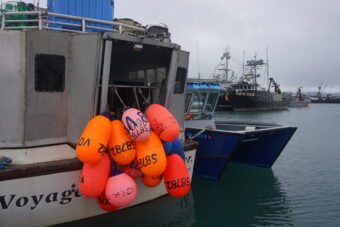
Fishing boats lined up at the Spit Dock in Unalaska's Port of Dutch Harbor, Nov. 19, 2025.
Fishing boats lined up at the Spit Dock in Unalaska’s Port of Dutch Harbor on Nov. 19, 2025. (Theo Greenly/KUCB)

Financial relief is finally reaching Alaska fishermen, roughly four years after the crab crash hit the Bering Sea fleet.

The payments cover Bristol Bay red king crab and Bering Sea snow crab fisheries from the 2021-2022 and 2022-2023 seasons, when stocks collapsed and the fisheries remained closed.

The trade group Alaska Bering Sea Crabbers coordinated with harvesters, processors and communities to ask Gov. Mike Dunleavy to request a federal disaster declaration, which the U.S. Secretary of Commerce approved in May 2023.

Relief money started going out earlier this year, first for community members and seafood processors, and now for captains and crewmembers. But Jamie Goen, the executive director of Alaska Bering Sea Crabbers, says fishermen should not have to wait years for relief.

“It needs to be within six months so that it’s useful for these families that are trying to make monthly payments,” Goen said. “Waiting four-to-six years to get your paycheck, that just doesn’t work for most families.”

Crab stocks have been recovering from the crashes a few years ago. The season that opened last month looks promising, but the rebound has been slow.

Dunleavy submitted another, separate disaster declaration for last season, which saw only minimal improvement from the previous year. But Goen says the goal isn’t more relief — it’s a stable fishery.

“We want to be fishing,” Goen said. “We don’t want to be asking for fisheries disasters.”

Eligible captains and crew have until the end of the year to apply for aid. Applications and information are available online.

Judge denies Southeast Alaska tribes’ effort to dismiss Metlakatla fishing rights case

Metlakatla Mayor Albert Smith exits the courtroom at the Robert Boochever U.S. Courthouse in Juneau, Alaska following oral arguments in a fishing rights case on Feb. 15, 2024.
Metlakatla Mayor Albert Smith exits the courtroom at the Robert Boochever U.S. Courthouse in Juneau, Alaska following oral arguments in a fishing rights case on Feb. 15, 2024. (Eric Stone/Alaska Public Media)

A lawsuit from Alaska’s only Native reservation will proceed over the objections of other Southeast Alaska tribes. A federal judge last week declined a request from a coalition of tribes, including the largest in Southeast, to throw out Metlakatla Indian Community’s lawsuit challenging the state’s authority to regulate its fishermen.

Metlakatla Indian Community asserts in its five-year-old lawsuit that the state has no right to regulate the tribe’s fishermen. Its attorneys say that’s because when Congress created Metlakatla’s reservation in 1891, Congress implicitly included a federally guaranteed right to fish in nearby waters.

The state disagreed, saying Metlakatla members should be subject to the same rules governing the rest of Alaska’s fishermen. A panel of the Ninth Circuit Court of Appeals, though, sided with Metlakatla and sent the case back to U.S. District Court to determine where exactly Metlakatla’s members have the right to fish.

The case was headed for trial when a coalition of tribes, including the Central Council of Tlingit and Haida Indian Tribes of Alaska, weighed in, arguing it should be dismissed outright.

“They felt this was something that should be resolved between the tribes and not by a federal judge,” attorney Richard Monkman said in an interview.

The tribes argued granting Metlakatla’s members the right to fish in waters near Ketchikan and Prince of Wales Island would violate their rights to their cultural property.

“We would analogize this to other cultural rights, like dances, stories, carvings, other types of rights that all sort of fall under the general category of at.oow, in the Lingít language, or cultural rights, which belong to the clans and belong to the houses within clans,” Monkman said.

Metlakatla’s attorneys, however, argued that the right to fish in those areas wasn’t legally protected — in part because of the Alaska Native Claims Settlement Act. Chris Lundberg is an attorney representing Metlakatla.

“With the exception of Metlakatla, all Alaska Natives participated in that act,” Lundberg said. “In exchange for releasing all claims to aboriginal rights-type claims and claims to land and fishing areas, the tribes received compensation.”

There’s still a long way to go, and it’s unclear when it might go to trial — for one thing, the state has filed a motion to end the case without a trial — but Lundberg said the decision from Judge Sharon Gleason puts the case back on track.

Metlakatla Indian Community Mayor Albert Smith said in an interview he was pleased with the decision and is optimistic about the road ahead.

“Now we are excited about getting back to the main issue: restoring the community’s reserved fishing rights,” he said.

‘Let’s get ugly’: Tenants continue to fight Telephone Hill eviction cases as judge delays decision

A sign in the Telephone Hill neighborhood on Wednesday, Nov. 19, 2025. (Photo by Clarise Larson/KTOO)

A district court judge has delayed the pending eviction hearings of three tenants who have refused to vacate their residences in Juneau’s downtown Telephone Hill neighborhood until at least Friday morning.

That’s so the judge can review a motion filed late Tuesday by the tenants’ attorney. 

The motion asks the court to delay the evictions pending the outcome of a lawsuit filed by tenants against the city. The lawsuit seeks to stop the city’s demolition of the historic neighborhood and reverse the evictions. 

The city had given the tenants living in the homes until Nov.1 to move out. The city plans to demolish the houses on the hill later this winter to make way for newer, denser housing to combat the city’s housing crunch. However, some tenants are refusing to leave and the city earlier this month filed legal action to evict them. 

At the courthouse on Wednesday morning, John Ingalls, one of the tenants who hasn’t vacated and is a plaintiff in the lawsuit, said he’s going to fight tooth and nail to stop the evictions.

“They’re just gonna make people pissed off at them. They’re gonna make people angry because I don’t think they have what’s right on their side, and I think people are going to stand up for what’s right,” he said. “I’m not worried about it. If they want to take my stuff. Fine, take it. Go ahead. If you want to be really ugly, let’s get ugly.”

An attorney from the city’s law department argued that the late filing of the motion was an intentional delay tactic and requested that the judge proceed with the hearing. The judge instead pushed Wednesday’s hearings back till Friday morning at 8:15 a.m. 

City Attorney Emily Wright said if the evictions are approved on Friday morning, the city plans to take swift action. She said the city gave the tenants more than enough notice and time to move out of the homes before taking legal action to force them out.

“If the city were given immediate possession of the homes on Friday, we would change the locks,” she said. “We would take possession of the homes, and we would work with the tenants to get their belongings out of the homes as soon as possible.”

In response to the tenants’ lawsuit, the city denies the claims that it improperly evicted people on the hill, illegally phased the redevelopment and that the project fails to comply with federal and state historic preservation acts.

30,000 messages urge British Columbia to address transboundary mining

Red Chris Mine’s tailings waste facility and open pit in the headwaters of the Iskut River, a major tributary of the salmon-bearing Stikine River. (Photo courtesy of Colin Arisman)

Southeast Alaska tribes and environmental groups have delivered nearly 30,000 messages to British Columbia lawmakers about transboundary mining.

Earthjustice, the international conservation organization Re:wild and the tribal commission said the letters encourage British Columbia to pause mining developments in the headwaters of the Stikine, Unuk and Taku Rivers that drain into Southeast Alaska.

The Southeast Alaska Indigenous Transboundary Commission represents 14 tribal nations downstream from the mines. Executive Director Guy Archibald said it wasn’t just Alaskans who sent the letters.

“It was people from all over the country and all over the world that recognize that Southeast Alaska is a very unique and valuable place in the world for climate protections, for cultural protections and diversity,” he said.

The environmental groups urged British Columbia officials to freeze “mining activity in this region until SEITC member tribes are given free, prior and informed consent.”

They said the messages point to growing concern over mining in the region. This includes at least eight proposed and operating mines that threaten the transboundary watersheds.

Four mines in the Stikine River watershed

Archibald said there’s many active explorations going on with mines in British Columbia and eight is just the minimum. There are four mines the groups are concerned about in the Stikine River alone. They are Red ChrisGalore Creek, Schaft Creek and Red Mountain Mines.

“These mines pose a significant risk to the Stikine River, and so far, they’ve been permitted without any adequate consultation with the Southeast tribes,” he said.

Previous studies have shown that minimal regulation of mines leads to polluted watersheds. This affects where people who survive on subsistence food can hunt and fish.

British Columbia say they take their obligations ‘very seriously’

The Inter-American Commission on Human Rights agreed in 2023 that British Columbia may be violating fundamental human rights.

The British Columbia Environmental Assessment Office wrote in an email that they take their obligations “very seriously – including with tribes in the U.S.” They said they will continue to fulfill their constitutional obligations by consulting with U.S. tribes when mining practices impact aboriginal rights under the Canadian Constitution. Currently, the office said seven mines are permitted in the transboundary area.

This includes two fully operational mines — Premier Mine and Brucejack Mine — and five permitted for exploration or that have limited construction — Eskay Creek Mine, KSM Mine, Skip Mine, Scottie Gold and Galore Creek.

Site notifications
Update notification options
Subscribe to notifications