Economy

Alaska’s furloughed feds take on ‘lemonade’ projects amid stress and uncertainty

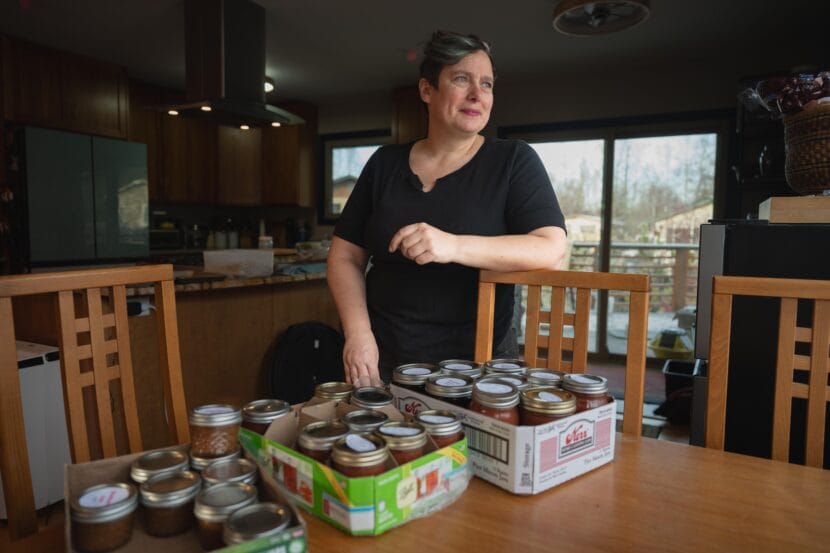
A woman in a black shirt poses with home made jam in her kitchen.
Liza Sanden spent the first weeks of the government shutdown jarring jam and freezing homegrown kale at her Anchorage home. Then anxiety set in. She’s taken up substitute teaching while she waits. (Matt Faubion/Alaska Public Media)

Liza Sanden put the first weeks of the government shutdown to good use with end-of-summer chores at her East Anchorage home. She pickled beets. She made jam.

“These last two weeks, though, have definitely been – the anxiety has been tripping up,” she said. “When are we going to go back to work? When am I going to get a paycheck again?”

As the government funding lapse became the longest in U.S. history, Sanden is one of thousands of federal workers in Alaska who are on furlough and not getting paid. Thousands of other Alaskan civil servants are working without pay.

Alaska, more than most states, is highly dependent on the federal government, for the services the employees provide and the money that fuels the economy. The state is home to some 15,000 federal workers and the shutdown affects each differently. Many we contacted for this story said they didn’t want to give their names. A few mentioned a silver lining: On furlough they don’t feel as much stress from layoff threats and working in an administration that has low regard for civil service.

One furloughed employee in Anchorage said he has traded the feeling of besiegement for new financial stress as he runs up his credit cards.

Sanden, an employee of the National Oceanic and Atmospheric Administration, considers her family luckier than some. She’s taken a furlough gig as a substitute teacher. Her husband collects a pension. They aren’t in danger of losing their house. But without her regular paycheck, the family is economizing. Sanden said her kids are old enough to understand the situation and have pared their Christmas lists.

“When your teenagers ask for $20 LEGO sets, as opposed to Xboxes and new cell phones, I appreciate them, you know, trying to be reasonable,” Sanden said.

She did not want to discuss the politics of the shutdown. Others didn’t mind.

“Even before the shutdown, national parks were facing the biggest staff and budget cuts in history,” said Jason Rogers, a National Park Service archaeologist.

Jason Rogers, shown here on a work trip to the Seward Peninsula, is an archeologist for the National Park Service. He’s on furlough. (Courtesy of Jason Rogers)

He blames the Trump administration and the Republican leadership in Congress, for the funding lapse and more.

“The administration has imposed new rules censoring what park employees can say about things like gender, like sexual orientation, like basic facts about American history,” he said. “So yes, I’m scared of retribution. But at this point, it’s too important, and I feel like I need to speak out.”

Rogers said the loss of federal pay has cascading effects, beyond the federal workforce.

“My landlord, who doesn’t necessarily pay much attention to politics at all, is suddenly concerned because, of course, he’s worried if I’m going to be able to pay my rent,” Rogers said. “And I’m worried if I’m going to be able to pay my rent.”

The government, he said, has a legal obligation to send backpay when the shutdown ends, but he noticed that the Trump administration is also suggesting that it might not.

“I think at this point, nobody has any guarantees,” he said.

Stephanie Rice, who works for the Bureau of Land Management, has a lot to say. But first her caveat: “I am giving this interview in my personal capacity,” she said, enunciating carefully, “expressing my personal views on a matter of public concern.”

Rice, president of her local union, said that shows she’s exercising her right to free speech and, in theory, shouldn’t face retribution. She doesn’t think her job is safe. Still, she’s calling for action against those in the administration who aren’t spending money as Congress directed.

“They have to impeach these officials,” she said. “If these officials will not follow the law, that is the answer. That is the solution. And Congress has that power.”

Rice and her colleagues are keeping their spirits up by sharing photos of themselves hiking and engaged in hobbies — making, as she put it, lemonade of the furlough.

“They’re really leaning into their volunteer activities,” she said of her co-workers. “They’re getting house projects done. They’re able to spend a little more time with their kids. But it’s still very stressful.”

An extra stress on Interior Department employees is that the administration has already said it intends to fire a lot of them. A judge stopped the government from laying off workers during the shutdown. But once the money starts flowing again, Rice said her particular office within the BLM, which is part of Interior, is slated for a 50% reduction.

“If all we do is hide under our desks — they’re gonna lay me off anyways, so I might as well go down swinging,” she said.

At the U.S. Capitol this week, senators are discussing how to end the shutdown. Senate Majority Leader John Thune told reporters key details are nearing completion.

Senators, like their House counterparts, are slated to be off next week.
Federal agency designates Alaska’s Donlin gold mine for fast-track permitting

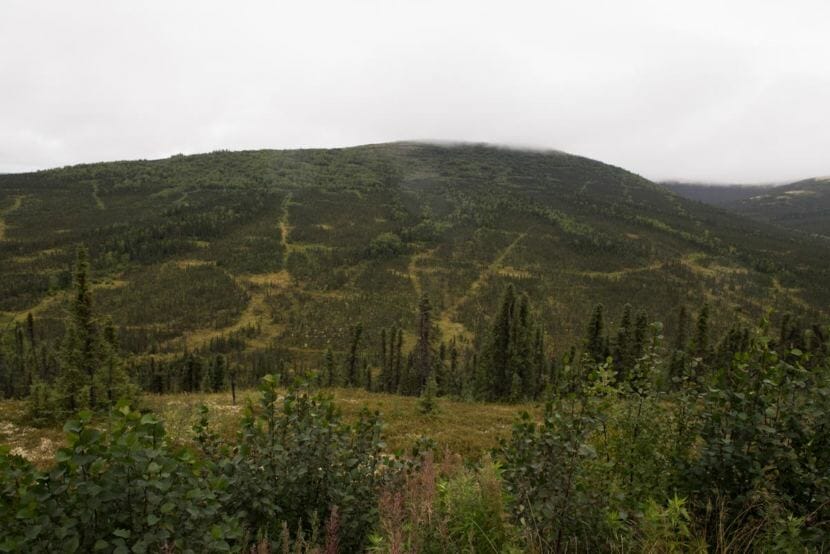
The proposed Donlin mine could be one of the biggest in the world — if completed.
The proposed Donlin mine could be one of the biggest in the world — if completed. (Katie Basile/KYUK)

The long-planned Donlin Gold mine in Southwest Alaska is the latest Alaska project to gain the support of a federal agency seeking to streamline permitting.

The Federal Permitting Improvement Steering Council announced in late October that it had added the massive proposed open-pit mine to a list of projects covered by an obscure Obama-era law meant to speed development, the Fixing America’s Surface Transportation Act. It’s part of a larger push by the Trump administration to expand resource development in Alaska and around the country.

In an interview, Donlin Gold’s environmental and permitting manager, Enric Fernandez, said the designation will likely not accelerate the mine’s timeline. But the so-called FAST-41 designation gives the company more confidence that it’ll be able to move toward a final investment decision in 2027, he said.

“What the program is going to provide is more certainty on the permitting schedule, you know, and also, you know, accountability for the agencies and transparency on the process,” Fernandez said.

The designation does not allow the mine to skip any steps in the lengthy process to make the mine a reality, he said. Work will begin soon on an updated environmental analysis ordered by a federal court to evaluate the possible impacts of a large spill of mine waste, or tailings, he said.

The project has been in the works for years — the company submitted its first federal permit back in 2012, Fernandez said. The head of the Federal Permitting Council, Emily Domenech, said in an interview that the designation was in line with the Trump administration’s resource development and national security goals.

“Up until this administration, the average time to complete a mine to get through the full federal permitting process was just shy of 30 years, which is just completely unacceptable and makes it impossible for us to really effectively compete with China and other adversaries looking to develop critical minerals around the world,” she said.

The project is controversial. Mine tailings would be stored approximately 10 miles from the Kuskokwim River near the village of Crooked Creek, upstream from communities that depend on the river’s salmon for their food supply. More than a dozen tribal governments and a regional tribal consortium, the Association of Village Council Presidents, have opposed the mine, and some have challenged it in court citing the potential for contamination.

“This insensitive federal action is particularly inappropriate while our region’s Tribes are waiting on the mine’s federal permitting agencies to address flaws identified by a federal court and, more importantly, responding to the humanitarian crisis following the hit our region took from Typhoon Halong,” the Mother Kuskokwim Tribal Coalition said in a statement. “A rushed permitting process threatens to override critical environmental protections and silence Yukon-Kuskokwim communities who depend on healthy rivers for survival.”

Some other tribal groups have backed it — notably, the Calista Corp. which owns the resources the mine would target. The company says it would generate royalties for the Native corporation and its shareholders across the region and Alaska Native corporation shareholders across the state, and improve the region’s economy.

Environmental groups have also opposed the mine. Lindsey Bloom with the group SalmonState said in an interview the fast-track designation was inappropriate for a gold mine.

“Gold is not a critical mineral,” she said. “There’s plenty of it already, and … whether or not we develop Donlin will have no effect on our national security.”

Bloom said she saw the designation as an effort to make the project more attractive to investors.

Telephone Hill tenants file lawsuit as city plans next steps for redevelopment project

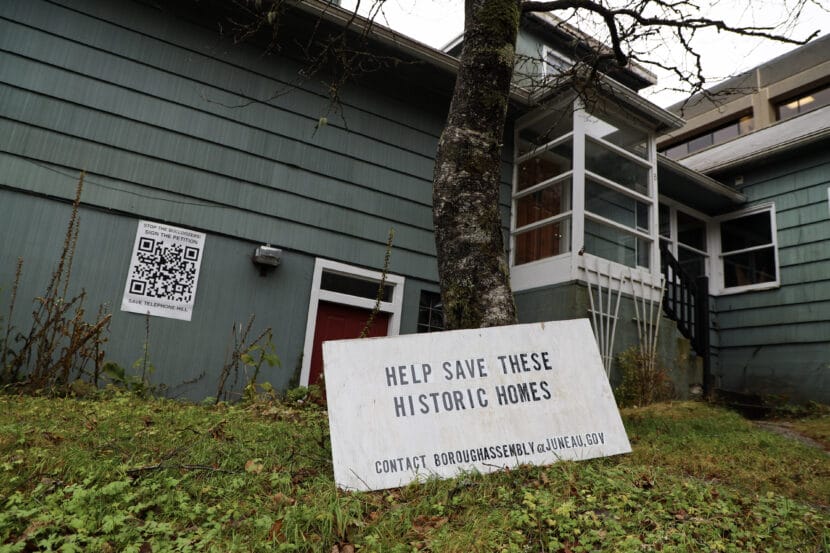
A sign leans against a tree in the Telephone Hill neighborhood on Tuesday, Nov. 4, 2025. (Photo by Clarise Larson/KTOO)

Tenants living in Juneau’s historic Telephone Hill neighborhood had until last weekend to move out.

But some didn’t, and three of them are now suing the city to reverse the evictions. At the same time, city officials are discussing the next steps for the downtown neighborhood’s redevelopment into new, denser housing.

The city’s Nov. 1 eviction date for Telephone Hill tenants has come and gone, and now, the city is laying out the plan for what lies ahead for the neighborhood.

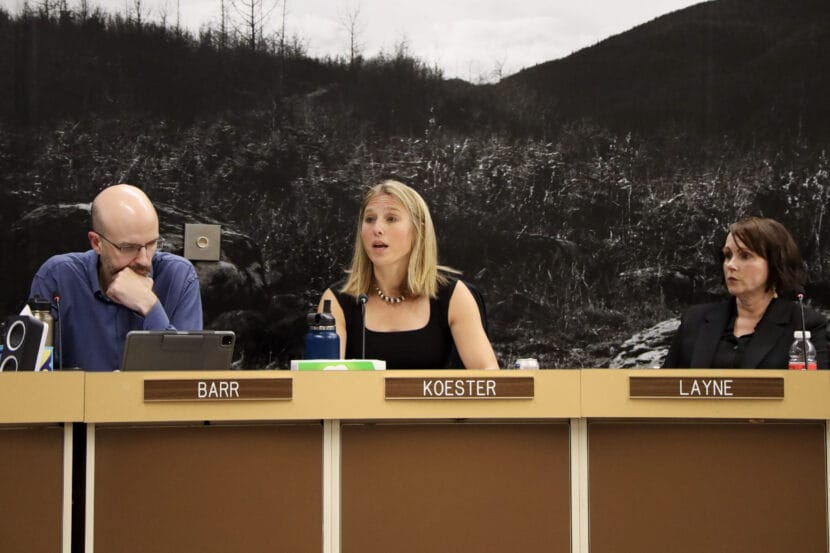
“It is really the only piece of property that is large enough to be able to support maximum density housing and really move the needle on housing in Juneau,” City Manager Katie Koester said at a Juneau Assembly committee meeting Monday night.

She and Assembly members discussed what’s next for the controversial redevelopment project.

City Manager Katie Koester speaks during a Juneau Assembly committee of the whole meeting on Monday, Nov. 4, 2025. (Photo by Clarise Larson/KTOO)

The discussion came just days after three tenants living on Telephone Hill filed a joint civil lawsuit against the city on Halloween, seeking to reverse the evictions. City leaders did not mention the lawsuit at the meeting.

The plaintiffs claim the city improperly evicted people on the hill, illegally phased the redevelopment and that the project fails to comply with federal and state historic preservation acts.

Joe Karson is one of the plaintiffs. He’s 80 years old and, as of Tuesday, hadn’t moved out of his apartment on the hill.

“They came and told me today that I have to be out by eight o’clock tomorrow morning, and I won’t be,” Karson said.

He says he plans to fight the evictions and demolition as long as possible. He pointed out that the city doesn’t have a developer lined up yet.

“The idea is that at some point, someone will build something — that’s their idea of a project? What on earth is that?” he said.

City Attorney Emily Wright says the city’s law department is reviewing the lawsuit and plans to file a response shortly. She says the city believes it has no merit.

All of the residents of Telephone Hill were renters and had been since the state took ownership of the neighborhood in the 1980s. The state transferred ownership to the city in 2023. Last year, the Assembly voted to redevelop the neighborhood to build denser housing on prime downtown real estate to ease Juneau’s housing crunch.

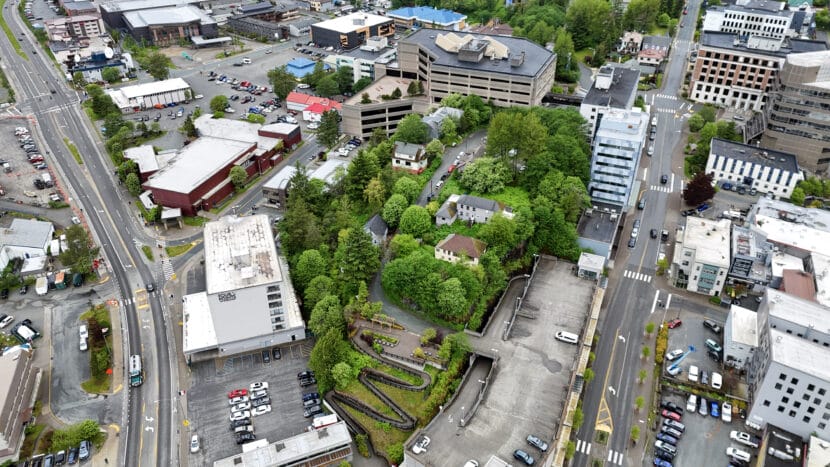
The city wants to find a developer willing to build four mid-rise apartments, which could create an estimated 155 new housing units. But, right now, there’s no developer signed onto the project.

“This is a unique gem that a community doesn’t get an opportunity very often to have property so centrally located with utilities with infrastructure in their community,” Koester said.

Trees outline the Telephone Hill neighborhood in downtown Juneau on Monday, June 9, 2025. (Photo by Clarise Larson/KTOO)

According to a 2024 assessment, Juneau is in immediate need of at least 400 new housing units.

The project has come with a lot of pushback from local advocates. That’s in part due to the history of the hill — it was home to Alaska’s first commercial telephone service, and many of its houses were a part of the original Juneau townsite in the late 1800s. All seven structures are slated for demolition this winter.

This past spring, the Assembly approved spending $5.5 million to tear them down and prepare the land for new buildings. The Assembly chose to front that cost in order to attract developers and tack on some affordable housing requirements.

Koester said the city plans to select a developer early next year so that construction can begin in 2027.

At Monday’s meeting, she spoke to an audience filled with advocates against the plan. She said that the decision to redevelop the neighborhood is not an easy one, but added it has the potential to dramatically move the needle on the city’s lack of housing availability and affordability.

“Telephone Hill really does represent some of the most developable property, well-located in our community, and it’s been really hard to struggle with those decisions,” Koester said.

According to Wright, as of Tuesday tenants are still occupying three residences on Telephone Hill. The city plans to take legal action against those tenants on Wednesday.

Kenai Aviation suspends service, citing financial woes

Cars park outside the Kenai Aviation office on Monday, Nov. 3, 2025 in Kenai, Alaska.
Cars park outside the Kenai Aviation office on Monday, Nov. 3, 2025 in Kenai, Alaska. (Ashlyn O’Hara/KDLL)

Kenai Aviation announced Monday that it was ceasing all flight operations. The company said in a Facebook post it was “financially insolvent” after accruing debt during the pandemic, and would stop flying by the end of the day.

Since 2022, the airline has offered more than a dozen daily flights between Anchorage and the Kenai Peninsula, including to Kenai, Homer and Seward. Before Monday, it was one of three airlines serving the Kenai Municipal Airport, alongside Grant Aviation and Aleutian Airways, after Ravn pulled out of the region.

Joel Caldwell and his brother, Jacob Caldwell, purchased Kenai Aviation in 2018. Neither immediately responded to requests for comment Monday.

On Facebook, Joel Caldwell said he was “devastated,” writing: “We need capital, we need partners, we need a lifeline. That investor is out there, we just need to find them.”

Kenai Aviation serviced eight communities across Alaska with its mixed fleet of Beechcraft Super King Air and Tecnam Traveller P2012 aircraft.

Earlier this year, the federal Department of Transportation picked Kenai Aviation to run its essential air service route to Seward. That contract was expected to run through 2027. Around the same time, it also picked up the federal route between Anchorage and Unalakleet, near Nome. It was the only regularly-scheduled passenger airline serving the route. But in August, Kenai suspended flights after its only King Air plane was down for maintenance.

The company’s Facebook post said the grounded King Air compounded its financial troubles.

Interim Airport Manager Mary Bondurant said the the City of Kenai will collaborate with its remaining airlines to meet passenger demand and explore other airlines that may be interested in offering passenger flights to Kenai.

Cut off from their jobs at home, Alaska typhoon evacuees have alternative income options

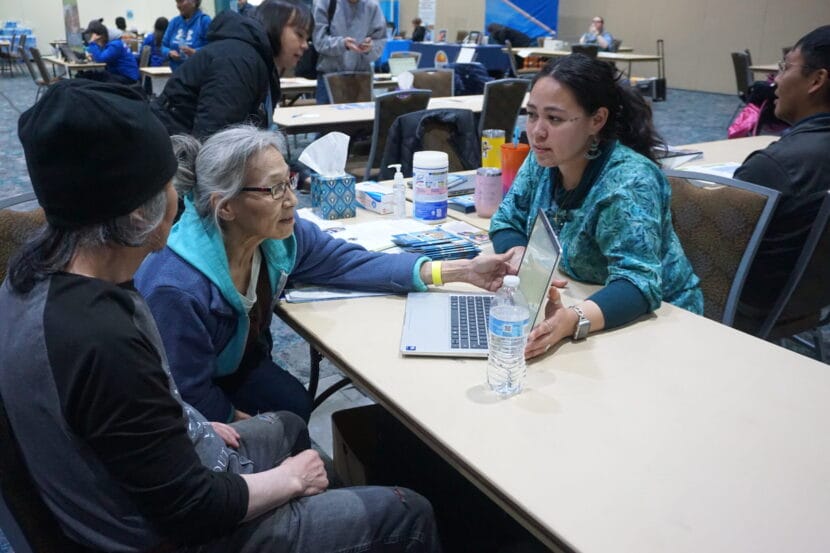
Regina Qussauyaq Therchik, manager of workforce and shareholder development at Calista Corporation, shows information on a laptop on Oct. 29, 2025, to Stephanie and Carl Anaver of Kipnuk. Therchik was among the Calista representatives participating in a workshop at the William A. Egan Center in Anchorage that connected evacuated Yukon-Kuskokwim residents with temporary employment and job-training opportunities. The Anavers have been staying in Wasilla with a relative since being evacuated from their home region. The Egan Center has been serving as a temporary shelter and assistance hub for the hundreds of Yukon-Kuskokwim residents flown to Anchorage after their villages were devasted by the remants of Typhoon Halong. (Photo by Yereth Rosen/Alaska Beacon)

For wage-earning Alaskans who were displaced by the remnants of Typhoon Halong, a powerful storm that lashed the western coast of the state earlier this month, qualifying for one special type of federal assistance could be a cinch.

The U.S. Department of Labor’s Disaster Unemployment Assistance program provides financial benefits to people who cannot perform their normal jobs because of disaster interference. One qualification for the benefits — $153 to $370 per week for up to 27 weeks, according to the Alaska Department of Labor and Workforce Development — is an inability to reach normal worksites.

Among the hundreds of Yukon-Kuskokwim region residents who were evacuated by military flights to Anchorage, nearly 500 miles to the east of their home villages, those that held wage-earning jobs in their home villages easily meet that requirement.

Beyond that weekly benefit, many evacuees will need to earn income over what might be a prolonged period away from home. To meet that need, companies and government agencies are seeking to place evacuees in temporary jobs and training programs.

At the forefront of those efforts is Calista Corporation, the Alaska Native corporation for the Yukon-Kuskokwim region. It has a series of programs underway to help displaced residents find work and training.

Cleanup and recovery work is a logical opportunity for people from storm-damaged villages, said Thom Leonard, Calista’s vice president for corporate affairs. But there are some obstacles to starting those recovery jobs.

“One of the challenges is: When are they going to go, and where are they going to stay if they are able to go back to the villages?” he said. Villages that lack power, water and other basic services might not yet be able to house the people who would do the cleanup and recovery work to make those villages habitable again, he said. “It’s kind of a chicken-and-egg situation,” he said.

Bradley Cupluaraq Lake, a workforoceo and shareholder development specialist with Calista Corporation, holds up a brochure on Oct. 29, 2025, with information about the program. Calista is the regional Native corporation based in the Yukon-Kuskokwim region. Lake was one of the Calista representatives at the William A. Egan Center in Anchorage helping shareholders who have been evacuated to Anchorage from villages ravaged by the remnants of Typhoon Halong. Calista and other organizations are coordinating efforts to place evacuees in temporary employment or job-training programs. (Photo by Yereth Rosen/Alaska Beacon)

Calista’s construction and environmental services subsidiary, Calista Brice, has been enlisted in the disaster response and is hiring people from affected villages, Leonard said.

More generally, Calista and other partners held a career workshop on Wednesday for evacuees at the William A. Egan Civic and Convention Center in Anchorage, and more such events are planned. Through those events, Calista’s workforce and shareholder team, which operates a year-round program, is connecting displaced residents with job-training opportunities.

Calista has also offered temporary office space to tribal governments from Kipnuk and Kwigillingok, the coastal villages most heavily hit by the storm. The Kipnuk tribal government has taken Calista up on that offer, Leonard said.

Among the individuals getting help from Calista at the Egan Center on Tuesday were Carl and Stephanie Anaver of Kipnuk.

Stephanie inquired about the possibility of working as a home health care aide for her aged sister, and Carl was seeking a building maintenance job similar to the work he was doing at the Kipnuk Clinic. Regina Therachik, manager of Calista’s workforce shareholder development program, counseled them in Yup’ik.

Anchorage was not their first choice for a relocation spot, Stephanie Anaver said. “I wanted to stay in Bethel. But since Bethel was full, they brought us here,” she said in a brief interview.

Rather than staying in Anchorage, the couple has made a temporary home in Wasilla with a family member, she said.

The time in Southcentral Alaska is shaping up to be a period of limbo for the couple. Exactly when the couple will return to Kipnuk, or even if that is possible, is unknown, Stephanie said.

“If they relocate Kipunk to higher ground, yeah, I’ll go back to Kipnuk,” she said.

Haines and Skagway both oppose Cascade Point ferry terminal. Juneau hasn’t taken a stance.

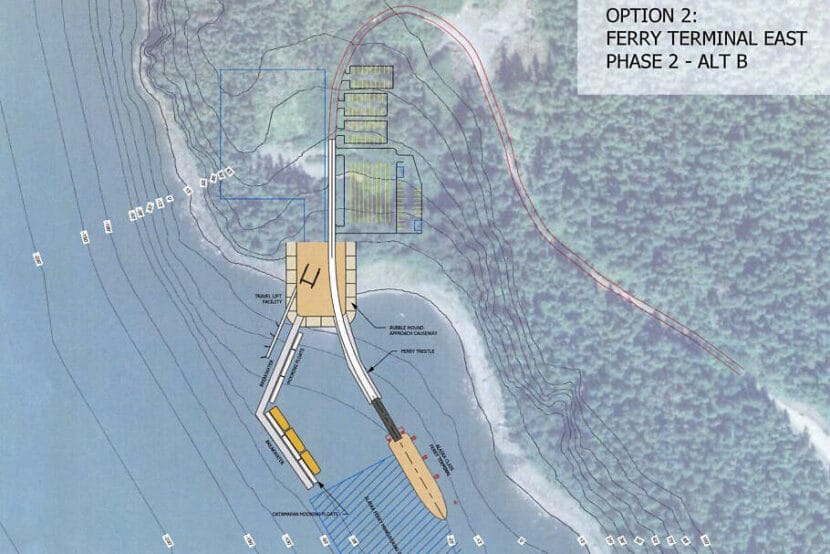
This is a concept design drawing of a new ferry terminal facility in Juneau at Cascade Point. (Alaska Department of Transportation and Public Facilities)

The Juneau Assembly doesn’t plan to take a stance on whether it’s in favor of the state’s proposed Cascade Point Ferry Terminal north of Juneau. That’s despite Haines and Skagway openly opposing the project.

The new ferry terminal would be located beyond where the road ends in Juneau on land owned by Goldbelt Incorporated, a local Alaska Native Corporation. The project is slated to cost tens of millions of dollars. 

Juneau already has a ferry terminal in Auke Bay. The new terminal would be about 30 miles north of the Auke Bay terminal. The state has been pushing for the new terminal for several years, saying it would benefit travelers by reducing operating costs and travel time between Juneau, Haines and Skagway. 

But in an interview, Juneau Mayor Beth Weldon said that the Assembly has other priorities to focus on right now. 

“I don’t think we ever took a stance on it because we just had other, more pressing issues, like the flood,” she said. “We’ve been dealing with that for three years now, and now we’re dealing with budget cuts and everything else, so I don’t see it coming back on our plate for quite some time.”

Multiple Assembly members declined to share where they stood on the topic. Member Paul Kelly said he is “not yet convinced that this is the best solution to help Juneau and other communities in Southeast Alaska improve our interconnectivity.”

The state department of transportation has already signed a $28 million contract for the project’s first phase in July and construction could begin next summer. 

An economic analysis released earlier this month by the department weighed the financial merits. Overall, it portrayed it as having more pros than cons. That’s despite its high price tag and criticism from regional officials and members of the Alaska Marine Highway Oversight Board.

The analysis concluded the project would allow for flexible travel in the region and would play a key role in bringing a proposed new gold mine in Juneau to fruition. Canadian mining company Grande Portage wants to develop an off-site ore terminal at the new ferry dock in partnership with Goldbelt. 

The state began soliciting public comment on the first phase of the project last week. The comment period runs through Nov. 28.

Site notifications
Update notification options
Subscribe to notifications