Economy

A developer’s plan to build dozens of new downtown apartments failed. He blames the city.

This is a drawing of the proposed Gastineau Lodge Apartment complex in downtown Juneau. (Courtesy/City and Borough of Juneau)

A project meant to bring more than 70 units of new workforce housing to downtown Juneau is dead before it could even break ground. The developer blames the city for stopping it. The city says the project was a risk to public safety.

In late 2023, the city’s planning commission approved a conditional land-use permit for the construction of a 72-unit apartment building downtown.

The six-story building was set to be located on three vacant lots on Gastineau Avenue, just uphill from the downtown library. It was meant to be workforce housing – all furnished and ready to go by the summer of 2025. 

But it’s been nearly two years, and the summer of 2025 has come and gone. The lots where the development was supposed to be are still empty. Steve Soenksen, the private developer behind the project, said it’s the city’s fault.

“We don’t have a stuck market. We have a stuck municipality — and they’re stuck on saying no,” he said. 

A sign sits at the site of a future 72-unit apartment building downtown on Wednesday. The project was OK’d for a conditional land-use permit by the city planning commission on Tuesday, Dec. 12, 2023. (Clarise Larson/KTOO)

The project was approved by the commission despite several safety concerns brought up by some neighbors, city officials and the fire department because of its hazardous location — an area subject to landslides — and lack of easy access for emergency services. 

But while the planning commission approved that permit in a 7-1 vote, in order to get a building permit from the city’s Community Development Department, he needed to agree that the project could meet the city’s fire and life code.

Gastineau Avenue is a dead-end street, and it’s hard to turn a vehicle around there. The project’s site is also on a downhill slope toward South Franklin Street on the Mount Roberts hillside, close to where multiple landslides damaged homes and displaced residents in recent years. 

“Most every section in the fire code was written because there was some kind of disaster that necessitated it,” said Capital City Fire/Rescue Chief Rich Etheridge.

He said the fire code requires at least two access points for a road that has more than 100 units. The new construction would push Gastineau over that threshold. 

“Housing is needed and we support development as much as we can,” he said. “We do have to hold the fire code — it was written for us to enforce, not for us to decide whether it’s legitimate or not.”

A potential second access point would go through privately owned land south of Gastineau Avenue. Soenksen argues that the city should help create that second access point, but he said it’s unwilling to work with him. He said the secondary access wouldn’t just benefit his project, but the entire street, which is prone to hazards. 

“A big part of our housing crisis is that the city’s been making unrealistic requirements on housing projects for 40 years that I can count,” he said.

This is a photo of the site for a future 72-unit apartment building downtown on Wednesday. The project was OK’d for a conditional land-use permit by the city planning commission on Tuesday, Dec. 12, 2023. (Clarise Larson/KTOO)

Jill Lawhorne, the director of the Community Development Department, said Soenksen was aware of the code requirements throughout the process, and he was the one unwilling to accept the requirements that came with developing at that location.

“Not all land is appropriate for housing if it can’t be made safe,” she said. “I think egress is that bare minimum of safety that we would want to see for housing and for our residents.”

She also pushed back against his allegations that the city is to blame.

“It’s not our Community Development’s responsibility to make a project happen,” she said. “We can help you through the process. We can help you obtain the permits if you meet the requirements of code, but it’s on the developer to bring their development to fruition.”

The project’s planning commission permit has since expired, and Soenksen said he has no intention to keep trying to make the project happen.

“I had plans for over 220 apartments to go in downtown,” he said. “But once they killed this one, I have no resources to try and do anything else, nor desire, because of the treatment I got with the city.”

Despite that, he’s on the hook to repay a quarter of a million dollars from a predevelopment loan he received from the city’s affordable housing fund in 2022.

Skagway gets first look at possible plans for expensive and complicated rock fall mitigation

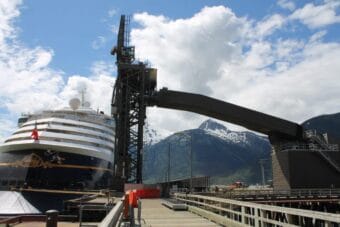
The Norwegian Jewel berths below the Railroad Dock in Skagway on Friday, Sept. 6, 2024. (Photo by Clarise Larson/KTOO)

A major rockslide has been threatening Skagway’s busiest cruise ship dock in recent years. Numerous industry experts were in town recently to present options for long-term mitigation. None of the choices were easy or cheap.

A rockslide above Railroad Dock in 2022 prompted a study by the geological firm Shannon & Wilson. That report stated the firm’s opinion that “the slide mass will eventually fail and the consequences of such failure will be catastrophic in nature with significant risks to life and property.”

Since then, the municipality has been doing routine scaling work, which is basically removing loose rock. Crews installed additional fencing and netting and instruments to measure ground movement. During tourist season, they send someone up the mountain each morning to take photographs. But, these are all admittedly short-term solutions.

“Nobody wants the big failure to happen and then not be ready for it,” said Kyle Brennan, project manager for Shannon & Wilson.

Brennan said the mountain needs long-term mitigation.

“We’re able to keep track of what’s happening up there. And right now, we have safe operation of the facility at the bottom,” he said. “But it’s time to move forward and take care of this larger hazard with these unstable rock masses at the top of the slope. Because predicting when that failure will eventually happen … is very difficult. And so right now, we have time. To be proactive about these things and take care of them is in the best interest of the community and everybody else.”

Shannon & Wilson presented four options. Option one concedes that the rock is too difficult to move and will therefore remain in place. The dock and everything below would be moved to a safer distance. Option two is excavating the unstable rock and sending it down the slope, where it is collected and hauled off-site. Option three leaves the rock mass in place and attempts to stabilize it. Brennan says this would be a “case study.” Option four would excavate the rock mass and move it up the slope, leaving it on the mountain.

The team wholeheartedly prefers option two.

“We’re looking at modifications to the dock,” Brennan said. “But for the most part, it’s just simply excavation and removal and letting gravity move the rock for part of it, and then picking it up and putting it somewhere else. This seems to be like our lowest risk option right now.”

The municipality was awarded a nearly $20 million grant for the project from the Federal Emergency Management Agency. But a majority of that money dissipated with President Donald Trump’s administration, leaving only the funds for the design portion of the project.

However, the municipality chooses to move forward, and however they manage to pay for the multi-million-dollar project, Brennan said it’s not going to be easy.

“It’s a tender site,” he said. “It’s going to take a lot of TLC to get that rock down. And so we want to make sure we’re doing it in a purposeful manner that’s safe, that’ll achieve the goal without catastrophe. The last thing I want to do is stand up here in front of you guys in a couple years and try to explain why everything went sideways…”

Skagway resident Lynne Davison was one of many intently listening to the presentation.

“And so I hear you talking about these alternatives and when the decision is made,” she said. “But how and who? How is that decision going to be made?”

“The decision, the ultimate decision is not one that Shannon & Wilson and our design team will make independently of anybody else,” Brennan answered. “The city will be involved with that decision. And ultimately will likely be the ones to make that decision based on our input and based on all of your input.”

Brennan said there will be at least two more public meetings before the construction phase. If funding is procured, that could start in 2026 and would take place between tourist seasons.

Project options can be found at Skagway.org.

Billionaire seeks controlling interest in GCI, regulatory filings show

A GCI van parked in Kotzebue. (Wesley Early/KOTZ)

Alaska’s largest residential internet provider may soon come under the control of billionaire businessman John Malone, one of America’s biggest private landowners and wealthiest people.

On Oct. 3, Malone filed paperwork with the Regulatory Commission of Alaska asking for permission to take majority ownership of GCI Liberty Inc., the parent company of GCI Communications, Alaska’s largest internet company.

Malone already owns a majority of GCI Liberty’s voting shares, according to RCA filings, but until now has been limited by agreements that hold his voting power below 50%.

According to the filings, Malone is asking for authority to increase his voting power to “a level that would constitute control of GCI Liberty and its certificated subsidiary GCICC.”

The filings also state that both GCI Liberty and Malone have asked for a waiver that would allow them to keep their financial documents confidential.

Under state law and regulation, those documents would ordinarily be available for public inspection as part of regulators’ approval process.

Public comments on the request for secrecy are due to RCA by Tuesday, Oct. 28, and the state regulator is expected to review the takeover request after that date.

The takeover would also affect United Utilities, which provides telephone and internet service in rural Alaska, including much of the Yukon-Kuskokwim river delta region, filings show.

New online art directory seeks to promote, connect Alaska Native artists across the state

Britt'Nee Brower of Utqiagvik peers through hanging jewelry at her table at the Alaska Federation of Natives convention on Oct. 16, 2025. Brower creates works of art out of a variety of media. Among her skills is carving, sewing, beading, etching, fashion design and poetry. She is among the artists listed in the Alaska Native Arts Directory.
Britt’Nee Brower of Utqiagvik peers through hanging jewelry at her table at the Alaska Federation of Natives convention on Oct. 16, 2025. Brower creates works of art out of a variety of media. Among her skills is carving, sewing, beading, etching, fashion design and poetry. She is among the artists listed in the Alaska Native Arts Directory. (Yereth Rosen/Alaska Beacon)

A new online statewide directory has been launched to showcase and connect Alaska Native artists across disciplines.

The Alaska Native Arts Directory is the work of the nonprofit Alaska Native Arts Foundation. Listing is free. The directory went live last week, timing that coincided with the Alaska Federation of Natives annual convention in Anchorage.

As of Monday, about 200 artists were listed, most of them with photos and biographical information. The Alaska Native Arts Foundation said it is seeking to expand that number to more than 1,000 by next year.

The Anchorage-based foundation said it also has a goal of holding a first-ever Alaska Native Arts Economic Summit next year, bringing together artists, policymakers and other partners to work on building the Indigenous creative economy.

There are other artists’ directories in Alaska, some of them with a focus on Indigenous artists. One, the Collective49 Marketplace, enables member artists to promote and sell their work online. And there are numerous local artists directories, such as those in Ketchikan and Homer.

The Alaska Natives Art Directory, however, is intended to be more comprehensive. Along with being statewide, the directory includes writers, musicians and other performing artists along with those who create carvings, paintings and other physical works of art. It includes contemporary art forms as well as traditional Indigenous arts.

“The Alaska Native Arts Directory celebrates the full spectrum of Alaska Native creativity, visual and written arts, performance, design, and traditional practices, reflecting the diversity and vitality of Alaska’s Indigenous cultures,” Gail Schubert, chair of the Alaska Native Arts Foundation, said in a statement.

Launch of the Alaska Native Arts Directory represents a renaissance of sorts for the Alaska Native Arts Foundation.

The foundation was created in 2002 and for several years operated an ecommerce site and a gallery in Anchorage. But it shut down those operatioons in 2016 after losing state funding and encountering other financial problems.

The directory project and other new activities now have a variety of funding sources, according to the foundation’s statement. The effort is backed by grants and other support from organizations that include the Rasmuson Foundation, the U.S. Small Business Administration, the office of U.S. Sen. Lisa Murkowski, R-Alaska, the Alaska State Council on the Arts and the Municipality of Anchorage, among others, according to the statement.

Interior Dept. advances Ambler mining road, King Cove road and ANWR drilling in signing ceremony

US Department of Interior Sec. Doug Burgum at a news conference with Gov. Mike Dunleavy, Alaska’s congressional delegation US Sen. Lisa Murkowski, Rep. Nick Begich, and Sen. Dan Sullivan, announcing several actions advancing resource development projects in Alaska on Oct. 23, 2025 (Screenshot)

The federal government is proceeding with efforts to expand drilling in the Arctic National Wildlife Refuge, mining in northwest Alaska, and construction of a road between King Cove and Cold Bay on the Alaska Peninsula, US Interior Secretary Doug Burgum announced Thursday.

At an event in Washington, D.C. that was dubbed “Alaska Day” by the federal department, Burgum signed a series of documents pertaining to all three projects as well as an ongoing effort by the federal government to give land to the families of Alaska Native Vietnam War veterans.

“This is our first, this won’t be our last, Alaska Day. We have a lot more things to accomplish, a lot more things to celebrate going forward,” said Burgum, flanked by Gov. Mike Dunleavy and all three members of the state’s congressional delegation.

“I told the president, it’s like Christmas every morning,” said Dunleavy. “I wake up, I go to look at what’s under the proverbial Christmas tree to see what’s happening. And here’s another example of more presents for not just Alaska, but for this country.”

Tribal and environmental groups opposed to the three development projects saw Thursday’s action differently, with Defenders of Wildlife, a national group, dubbing the event “Alaska Sellout Day.”

“Today’s announcements are the latest step in Donald Trump’s plan to sell out our wildest landscape and natural heritage to corporate polluters,” said Dan Ritzman, director of conservation for the Sierra Club.

What was done on Thursday

Burgum signed previously announced permits for the 211-mile Ambler Road, which is intended to connect the Dalton Highway with a series of potential mine sites in the Brooks Range of northern Alaska.

He also signed a record of decision for the federal government’s oil and gas drilling program in the coastal plain of the Arctic National Wildlife Refuge of northeast Alaska.

That re-establishes a program that had been in place during the first term of President Donald Trump but which was subsequently reversed by President Joe Biden.

Burgum also reversed the Biden administration’s decision to suspend oil and gas leases issued by the federal government in 2020 to the Alaska Industrial Development and Export Authority.

Barring further litigation, that move clears the way for AIDEA — Alaska’s state-owned development bank — to begin seismic surveys that could reveal the amount of oil available within parts of the Arctic refuge’s coastal plain.

While the Ambler and ANWR actions effectively took the projects back to where they stood in 2020, the King Cove road is now closer to construction at any point in its decades-long development process.

Envisioned as a gravel road between King Cove and an all-weather airport at Cold Bay, the road would pass through the Izembek National Wildlife Refuge, a nationally important bird sanctuary.

Eleven miles of new road are needed to link existing roads to the two towns, but those 11 miles would pass through a wilderness area.

On Thursday, Burgum signed documents that complete a land exchange between King Cove Corp., the local Alaska Native corporation, and the federal government. King Cove Corp. gives up about 31,200 acres to expand the refuge, and in return, it receives the 490 acres of refuge land needed to complete the road.

In a move with more limited statewide impact, Burgum signed paperwork awarding three Alaska Native Vietnam War veterans with 160-acre plots of land under a federal allotment program. As of March, 453 veterans and their families had requested plots authorized under legislation authored by Alaska Sens. Lisa Murkowski and Dan Sullivan.

For King Cove, a medevac-avoiding road moves forward

King Cove’s airport is frequently closed by bad weather, and since 2014, there have been more than 100 Coast Guard medevacs from the community because regular air ambulance service was unavailable.

Murkowski, who has previously vowed to complete the road, noted that this is the third time that the federal government has embarked on a land exchange for the road, with the prior two attempts blocked and reversed by litigation.

“We’ve reached a point with the King Cove exchange that we haven’t yet before, and that’s actually the official patent being issued to KCC, so we’re one step further. I think that’s important,” she said.

The road, though supported by local residents, is opposed by some Yukon-Kuskokwim river delta tribal leaders and subsistence bird hunters who fear its effects on wildlife.

“Surely, the people of King Cove can see the value of leaving the habitat for so many species intact would be far more valuable than any road could be,” said  Angutekaraq Estelle Thomson, Traditional Council President of the Native Village of Paimiut, one of several communities that have supported lawsuits seeking to prevent road construction.

Rebecca Noblin, an attorney with the Center for Biological Diversity who has fought the road on behalf of several area villages, said Thursday that “we have significant questions about the legality of the exchange. We, along with the Native Villages of Hooper Bay and Paimiut, expect to bring those issues to court soon. Road construction will also require additional permits, including an Army Corps 404 permit and Endangered Species Act consultation, so this is far from a done deal.”

With Ambler and ANWR, a triumph of economics over environment

On the first day of his second term in office, Trump issued an executive order seeking to encourage oil and gas development, mining and logging in Alaska.

US Rep. Nick Begich, R-Alaska, US Dept. of Interior Sec. Doug Burgum, and Alaska Gov. Mike Dunleavy pose for a photo at a news conference announcing advancements to several resource projects, including oil drilling in the Arctic National Wildlife Refuge on Oct. 23, 2025 (Screenshot)

Elected officials said they see Thursday’s actions in line with that decision.

Alaska Republican Rep. Nick Begich said projects like the Ambler Road and ANWR drilling matter because they create jobs.

“We need the jobs. We need high-paying, good jobs, and these resource industry jobs fit that bill completely. And so whether it’s mining, timber, oil and gas development or other resources, these are necessary for the functioning of Alaska’s economy,” he said.

The coastal plain of the Arctic National Wildlife Refuge is believed to contain billions of barrels of recoverable oil that could be sold on global markets.

Sullivan noted that previous North Slope oil development has been good for the region’s residents.

“The life expectancy, mostly of the Native people in our state, has increased in the North Slope and the Northwest Arctic Borough and by dramatic numbers … and a lot of that is due to the benefits that come from responsible resource development: jobs, revenues, water and sewer, gymnasiums, health clinics. So it’s a real life and death issue,” he said.

The predominantly Alaska Native town of Kaktovik is located on Barter Island, within the refuge.

“Developing ANWR’s Coastal Plain is vital for Kaktovik’s future,” said the town’s mayor, Nathan Gordon Jr., in a written statement. “Taxation of development infrastructure in our region funds essential services across the North Slope, including water and sewer systems to clinics, roads, and first responders. Today’s actions by the federal government create the conditions for these services to remain available and for continued progress for our communities.”

To date, no oil companies have shown interest in drilling within the refuge, leaving only Alaska’s state-owned development bank, which won leases in a 2020 sale, to work there.

So far, no actual work has taken place because of repeated lawsuits seeking to overturn the sale.

The bank, which has filed several lawsuits over federal restrictions on drilling within the refuge, did not respond to a request for comment on Thursday.

Several legal challenges to the 2020 ANWR plan of development — which was restored Thursday — are still pending in federal court.

Some of those challenges revolve around the possible effects that ANWR development and the burning of those fossil fuels will have on climate change.

Thursday’s announcement came just a week after the remnants of Typhoon Halong devastated coastal communities in southwestern Alaska. Experts say that storm was worsened by climate change.

Murkowski said she does not shy away “from the fact that the impact of that typhoon was made more fierce and more destructive because it was able to travel over a large body of what is now warmer, open ocean with lack of ice. I get that, and I call it climate change.”

At the same time, people worldwide are continuing to consume fossil fuels. Murkowski said that for her, the choice is straightforward: Will they get those fossil fuels from Alaska or some place with worse environmental standards?

“I’d much rather be producing in Alaska, than just across the Bering Strait there, over in Russia, where I don’t think that they respect the same level of environmental standards and safeguards,” she said. “So is it complicated? Yes. But am I proud of how Alaska has led in terms of meeting environmental standards that are amongst the highest in the world? I am.”

What comes next for Ambler, King Cove and ANWR?

All three development projects boosted by the federal government on Thursday are a long way from construction, both supporters and detractors say.

In all three cases, proponents need to obtain additional federal permits and will have to cope with lawsuits brought by opponents.

The environmental law firm Earthjustice has repeatedly been involved in lawsuits against the federal government over the issue of arctic refuge drilling.

“Interior has re-adopted the maximally destructive plan from President Trump’s first term,” said Earthjustice attorney Erik Grafe, by email on Thursday. “That plan was unlawful in 2020 and is still unlawful today. The bedrock environmental laws that protect the Arctic Refuge’s irreplaceable natural resources remain despite Congress passing reconciliation bills on leasing in the refuge.”

The Gwich’in Steering Committee, represented by attorneys from Trustees for Alaska, is among the organizations that have repeatedly sued to block drilling in ANWR.

The committee is concerned about the effect that refuge development would have on local caribou herds used by subsistence hunters. In a statement, the committee’s executive director, Kristen Moreland, implied that further litigation will come.

“This action by the Trump administration is a direct attack on the Gwich’in, who have for decades been a voice for the caribou and stood against the destruction of the Arctic Refuge. A leasing program that would open the entire Coastal Plain completely ignores the impacts that oil and gas development would have on the land, on wildlife, and on our communities,” she said.

“We condemn these efforts by the Trump administration to exploit the calving grounds of the Porcupine Caribou herd for short-term gain, and we know that we are not alone. We will continue to raise our voices and fight for the protection of this sacred land and for our way of life.”

This Alaska town gets weekly barges. So why do people use Instacart to fly in groceries?

Skagway resident Katie Auer said she hasn't grocery shopped at the local store in more than a year due to concerns over store quality and prices.
Skagway resident Katie Auer said she hasn’t grocery shopped at the local store in more than a year due to concerns over store quality and prices. (Avery Ellfeldt/KHNS)

This is the second story in a four-part series from the Alaska Desk called Shelf Life, which looks at food security in Alaska.

In the very back corner of Skagway’s only grocery store, a laminated sign boasts: “LOCAL GROWN.” Above it sits a container with bundles of radishes. Next to them, a few boxes of greens.

But that’s all there is. Everything else in the store is shipped in from very far away – and it shows. While walking the aisles of the AC Fairway Market earlier this month, resident Katie Auer picked up a bag of partially wilted and bruised mini peppers.

“You’re telling me I’m going to pay 9 dollars and 29 cents for a bag of peppers, that I’d have to throw away over half of them?” she said, shrugging.

Grocery chain Alaska Commercial Company bought the store in 2021 from long-time local owners. And Auer is among those who contend that the store is expensive, the shelves aren’t well stocked and the produce rots quickly.

Greens and radishes fill the small section of Skagway’s store that carries locally grown produce, pictured above in early October. (Avery Ellfeldt/KHNS)

Locals say that’s particularly true during summer – and that things are better in Haines, Skagway’s closest neighbor.

“Why is our produce so much more expensive?” Auer asked. “Why is our food in general so much more expensive than Haines, when it’s 13 extra nautical miles to get here? Why is it so much more rotten?”

A few factors drive those challenges, including shipping costs and the drastic seasonal population swings that come with hosting cruise ships in the summer.

Both make it harder to keep the store well stocked and profitable.

In response, some residents seem to be doing what they can to avoid the store entirely – including getting same-day grocery deliveries by small planes.

A catch-22 

Skagway’s supermarket woes are not unique in Alaska, where communities across the state struggle to access affordable, fresh food.

But Skagway has some advantages other remote communities don’t. For starters, it’s connected to an international highway. And like much of Southeast, it’s on the barge route, which is perhaps the most efficient way to transport food.

“Certainly, within the data I see, as Southeast compares to the rest of the state and off-road Alaska, it’s a significantly lower quantity of food that actually spoils in transit to a store,” said Mike Jones, a food systems economist at the University of Alaska Anchorage.

But different communities face different challenges. In Skagway, they largely revolve around one main issue. The town’s wintertime population hovers around 900 people. Then, in the warmer months, it booms amid an influx of tourism workers and, on some days, more than 10,000 cruise ship passengers.

Lee McKinney has managed the local store since 2021, when it was purchased by Alaska Commercial Company. (Avery Ellfeldt/KHNS)

That sets the store up for a complicated guessing game: ordering, storing and stocking enough food to last through the week without shipping in so much that products rot in storage or on the shelves.

“In the summer, I don’t have enough space to maintain all the produce I could sell,” Lee McKinney, the Fairway manager, said. “But the other side of the coin is, if I do, a larger portion of that produce is going to go bad and have to be thrown out before I do sell it. It’s a catch-22.”

During the off-season, meanwhile, people complain that store shelves appear empty and that there are plenty of products the store doesn’t offer at all. Auer noted she prefers to drink skim milk, but that the store doesn’t carry it.

Brooke Jasky-Zuber, another local, said the store has limited organic products and few meat substitutes for her partner, who is vegetarian.

McKinney said he does what he can to meet folks’ needs, including ordering entire cases of certain products if a customer says they’ll buy all of it. But he added that he has to order specialty and more popular products based on what will actually sell.

“If I bring in that full shelf load, 90% of it’s going to date out before it sells and means I’ve got to write it off and throw it away,” he said.

“We got to make sure to make money with that space,” he added.

Skagway resident Brooke Jasky-Zuber shows off tomatoes grown at the local farm run by the Skagway Traditional Council. (Avery Ellfeldt/KHNS)

Quality and cost concerns

It’s less clear why the quality of food in Skagway would be worse than in Haines or Juneau. Jones, the food systems economist, said there could be a few factors at play.

He said stores could use different quality distributors. But they don’t. The Fairway in Skagway and the two Haines stores all use Rhode Island-based United Natural Foods Inc. for general grocery items. For produce, both the Fairway in Skagway and Olerud’s Market Center in Haines use a Seattle-based distributor called Charlie’s Produce.

Another factor could be the length of time food sits on the barge. But it doesn’t take that much longer for food to get to Skagway than it does to Haines or Juneau.

Product turnover could also help explain the problem. Consider a minimum shipment of lemons. It would likely take longer to sell those lemons in Skagway than in larger communities like Juneau or Haines.

“The big challenge is maintaining your product and not seeing everything date out on you because you don’t turn it fast enough,” McKinney said.

A container of hummus at Skagway’s AC Fairway Market rang in at $7.29 early this month. (Avery Ellfeldt/KHNS)

Then there’s the issue of prices, which fluctuate frequently and are determined by factors including freight costs, corporate pricing structures and more.

KHNS compared eight products at one store in Skagway to the same products at Howsers IGA Supermarket in Haines, including milk, various greens, and shelf-stable groceries. Everything was cheaper in Haines except spinach.

Jones, the economist, said that checks out.

“Skagway is on the high end within Southeast in terms of the prices that I can see for a couple products that happen to be right in front of me,” he said. “That’s not necessarily unreasonable, because they are farther up the barge away from Seattle.”

Grocery shopping by small plane

The challenges in Skagway underscore that even in communities with better access and infrastructure, struggles abound. And for some, the situation has reached a tipping point.

Auer, the Skagway local, said she hasn’t shopped at the Fairway in more than a year. Instead, she hits stores in Canada, Juneau and Haines when she can.

And she ships a lot of her food from out of town, including via Instacart — from Juneau.

Instacart is a service that allows people to order their groceries online and have someone pick them up at the store and deliver them to their doorstep.

In rural Alaska, it looks a little different. Customers can place their weekly orders from Skagway. Then, a driver in Juneau heads to Costco or Fred Meyer, shops, and delivers the food to the airport. From there, it’s loaded onto a flight and flown in – typically the same day.

“You can get two dozen free range organic eggs for $8 from Costco,” Auer said. “And they are $10.50 including shipping, including paying Instacart, tipping my driver and $1 per pound shipped here from Juneau.”

That day at the Fairway, there were two options for eggs: one cost $12 a dozen, the other about $9.

Brooke Jasky-Zuber walks through the Skagway Traditional Council’s farm in early October. (Avery Ellfeldt/KHNS)

Flying food around southeast Alaska is far from new. But reliance on Instacart seems to be. Data provided by the company indicates that annual Instacart deliveries to the Juneau airport have more than doubled since 2019.

Jasky-Zuber is among those who said that relying on the local store to fill her fridge and pantry just doesn’t make sense any more. For the last four years, she’s managed the local tribe’s farm, which is where the locally grown radishes and greens in the store came from.

Jasky-Zuber said she sources most of her produce from the farm in the summertime. But otherwise, she stocks up on bulk items in Whitehorse, Canada – and ships plenty in from Juneau.

“Not because I don’t want to support our grocery store. I do,” Jasky-Zuber said. But ultimately, she added, “I find mostly other ways to get the bulk of what I need.”

Site notifications
Update notification options
Subscribe to notifications