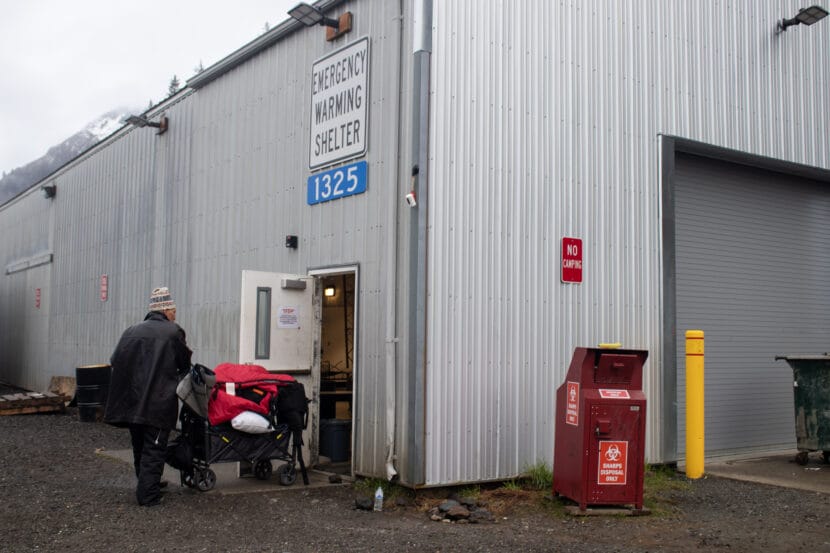
A patron walks out of Juneau’s emergency warming shelter on its last morning open for the season on Wednesday, April 16, 2025. (Photo by Clarise Larson/KTOO)
It’s the third year the shelter will be located in a warehouse in Thane, about a mile from downtown. It’s funded by the city and operated by staff from St. Vincent de Paul, a local nonprofit that works to help people affected by homelessness.
Jennifer Skinner is the executive director of Juneau’s St. Vincent de Paul chapter. She said the shelter is critical to keeping people alive during the cold winter months.
“The most important part of having this option for our unhoused population is that it gives them a safe, dry, warm place to be overnight, where otherwise they would be out in the elements,” she said.
The shelter accepts anyone who comes in search of a place to sleep, as long as they aren’t disruptive to other patrons. City officials say it’s a stopgap and meant to be a last resort for unhoused people when the weather gets cold.
Last season, the shelter saw an average of 45 people per night. But, some nights, staff saw up to 70 people in need of shelter.
This summer, Juneau saw an influx of encampments throughout the borough, particularly near the Glory Hall shelter in the Mendenhall Valley. That’s in part due to the closure of the city-run campground near downtown two years ago.
The increase in campers this year led the Glory Hall to reduce its services in late August due to what staff say was a deteriorating and unsafe environment in the neighborhood. The Juneau Assembly grappled with several ideas this summer to address the larger issue of homelessness in Juneau.
Skinner said she expects many campers near the Glory Hall shelter to head to the emergency shelter in Thane as the temperatures in Juneau begin to fall.
“It kind of just takes that lift and that burden off of our unhoused population, and allows for them to have a little bit of peace of mind for six months out of the year, knowing that there’s always a place open,” she said.
The shelter will be open every day starting Wednesday from 9 p.m. until the early morning. There will also be free shuttle transportation from the Mendenhall Valley and downtown to the shelter. The shelter will stay open through April of next year.
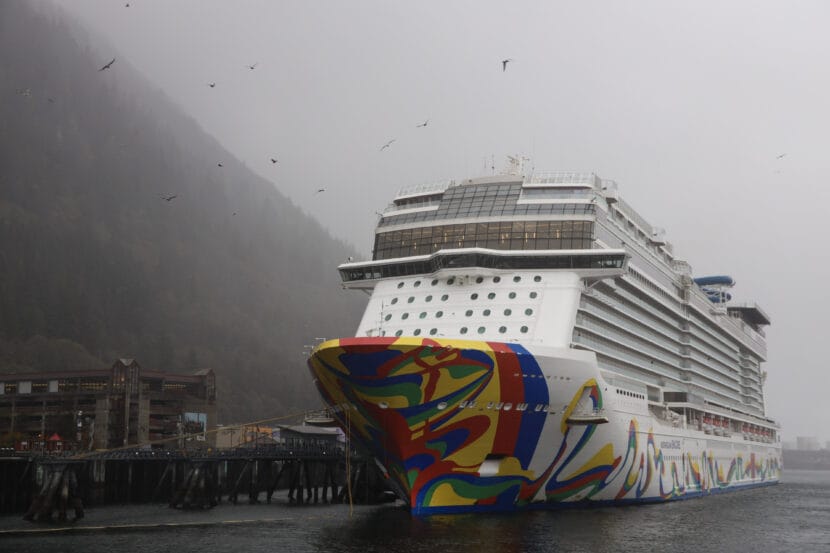
The Norwegian Encore berths in downtown Juneau on Tuesday, Oct. 14, 2025. (Photo by Clarise Larson/KTOO)
The Norwegian Encore departs Juneau Tuesday night. It’s the last cruise ship of 2025, and it marks the end of a nearly 200-day tourism season.
This year’s cruise season kicked off amid a lot of uncertainty. It began as the Trump Administration’s tariffs shook the global economy and dozens of residents in Juneau lost their jobs in waves of federal firings, leaving the Mendenhall Glacier Visitor Center with reduced staffing.
The glacier is Juneau’s most popular tourist attraction, drawing more than 1 million people last year. The layoffs left the center barebones. But, Juneau’s Tourism Director Alix Pierce said other organizations stepped up to help U.S. Forest Service staff keep visitors safe this summer.
“The situation at the glacier out there was really a testament to community collaboration and also how important that asset is to our community and visitor industry,” she said.
The final tally of passengers who stepped off cruise ships into Juneau this year hasn’t been released yet, but Pierce said it’s expected to be between 1.6 and 1.7 million. Next year will be about the same, she said, but new measures are going into place to curb future growth.
The 2026 season will be the first time that the city’s negotiated daily cap on passengers is in place. That will limit cruise ship visitors to 16,000 people on most days and 12,000 people on Saturdays. Right now, Juneau sees up to 21,000 visitors on the busiest days. Cruise ship companies also agreed to shorten Juneau’s season to exclude most of April and October.
Pierce said the conversation on how to best manage cruise tourism in Juneau is far from over.
“I think not having to brace for year-over-year growth and kind of understanding what the season is going to look like as we go into it has been helpful,” she said.
Votes are still being counted for this year’s municipal election, which included a ballot question to create a seasonal sales tax starting next year. In preliminary results, voters appear to be rejecting the proposed increase during the summer months.
The log storage facility would be located in Haines’ Lutak Inlet, pictured above in August 2025. (Avery Ellfeldt/KHNS)
A company under contract for a major timber sale in Haines is trying again to secure a permit to store harvested logs in Lutak Inlet, a key piece of its proposed operation.
As part of that process, the company conducted a required survey this spring that says the storage site is appropriate and would not affect sensitive marine habitat.
But some community members remain unconvinced. The area Fish and Game Advisory Committee submitted a comment letter on Friday that says the intertidal area of the inlet is a “sensitive habitat” for species including salmon, eulachon, or hooligan, and crab.
The committee argues the permit should not be granted absent more information about potential repercussions.
“These species provide an essential source of food security as well as cultural continuity for local residents who rely on the Inlet for subsistence harvests,” the committee wrote. “Any degradation of these habitats would directly impact the community’s ability to access traditional and sustainable food resources.”
Oregon-based Northwest Forest Products Inc. won a contract years ago to carry out the Chilkat Valley’s largest timber sale in decades, known as Baby Brown.
The timber harvest hasn’t begun. But last spring, the company’s local operator, NSEA Inc., applied for a five-year permit for log storage with the Alaska Department of Natural Resources.
Then, the agency pulled the application after realizing it skipped a crucial step: requiring a survey of the sea floor.
“We don’t have a ton of log transfer facilities anymore. So I believe that kind of just slipped through the cracks,” said natural resource manager Tony Keith. “And that was our bad, so that’s why we did pull it.”
NSEA conducted the survey in April. That entailed using a device with underwater GPS, video and mapping software to examine current ocean floor conditions.
The survey report, which was submitted with the new permit application, concludes that the site is “suitable” for the facility. And it says no sensitive or critical habitat was documented.
Then NSEA re-applied for the permit in late September. The application proposes a log transfer facility and storage area on a 12-acre site about four miles out of town, off Lutak Road. The facility would be used to transfer logs into the inlet, near the shore, where they would be stored until they’re loaded onto ships.
The survey report explains that those ships will head overseas to the export log market “because there are no in-state purchasers for logs in the northern part of southeast Alaska.”
The company has indicated it plans to begin logging the timber sale in the spring of 2026 and wrap it up before the end of 2028.
Area management biologist Nicole Zeiser said the proposed facility would directly interfere with local fishing.
“Especially with the mooring buoys that may be installed. I’m not sure how many or exact location, but that would significantly reduce access for both subsistence and commercial gillnet fishermen, but crab fishermen as well,” she said.
State Forester Greg Palmieri previously told KHNS the storage site would be about 1,700 feet long. The new permit application says it would take up about 2,500 feet parallel to the shore. In an email on Friday, he said log rafts have been used in the Lutak Inlet historically – and that facility use can easily be managed to avoid fishing impacts.
NSEA President Polly Johannsen did not respond to a request for comment.
The public has until Oct. 13 to comment on the permit application. Comments can be submitted to muriel.walatka@alaska.go.
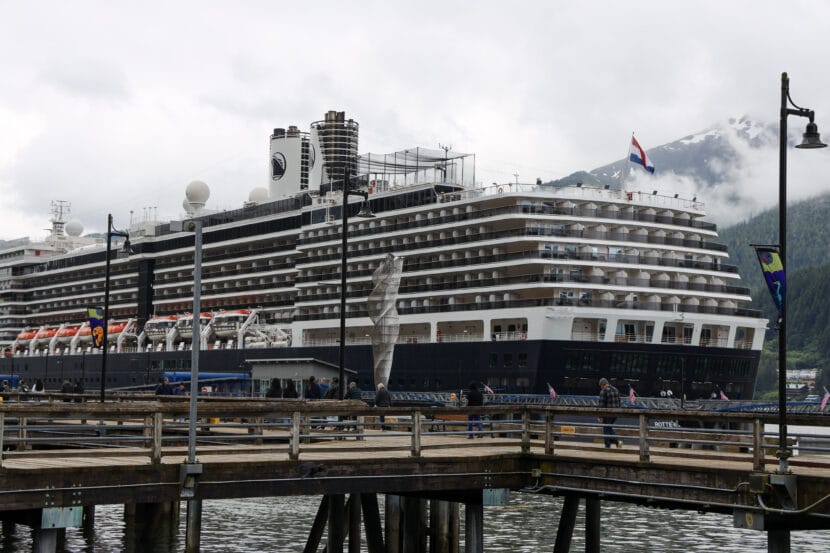
Holland America’s Noordam cruise ship in Juneau on Wednesday, July 9, 2025. It operates an open-loop exhaust scrubber and was found to violate federal water quality standards on 30 days in 2024, according to an EPA data analysis by SEACC. (Photo by Clarise Larson/KTOO)
Listen to this story:
Some Alaskans are fired up about water pollution from heavy fuel oil burned on large cruise ships. At a panel discussion in Juneau on Wednesday, members of tribes and conservation organizations said there’s a solution: using cleaner fuel.
Heavy fuel oil is the stuff from the bottom of the barrel — the waste product at the end of the oil refining process. It’s cheaper than distillate fuels and is used widely by most of the large cruise ships that travel along Alaska’s coastline every year.
When it’s burned, heavy fuel oil exhaust releases sulfur oxide into the air, which can cause heart and lung disease and lead to acid rain. In 2020, the International Maritime Organization, or IMO, required ships that burn heavy fuel oil to use scrubbers, which filter the exhaust through seawater.
Aaron Brakel is a clean water campaigner at the Southeast Alaska Conservation Council, which organized the panel. He said scrubbers didn’t solve the pollution problem — they just moved it into the ocean.
“They spray the water, transferring pollutants from the air into the water from the exhaust,” he said. “Most of the scrubbers worldwide, most of the ones here in Alaska, are open-loop systems.”
That means they pump seawater infused with toxic exhaust back into the ocean instead of storing it and disposing of it at an onshore facility.
Nearly 80% of the cruise trips made in Alaska last year burned heavy fuel oil through open-loop or hybrid systems. Hybrid scrubbers can switch between dumping the effluent or storing it, depending on discharge regulations in the waters the ship is passing through.
Brakel probed into U.S. Environmental Protection Agency records and found that between 2023 and 2024, 17 ships using open-loop scrubber systems reported more than 700 water quality violations off the coast of Alaska, as Alaska Public Media reported last month.But the data doesn’t show exactly where the violations happened.
Kay Brown is the Arctic policy director at Pacific Environment, an advocacy nonprofit. Last year, she and her colleagues published a literature review of studies around the world on the negative effects of scrubbers.
“The big takeaway here is that scrubber pollution is toxic to marine life at very low concentrations,” Brown said.
One study found scrubber wastewater at a concentration of 5% killed tiny crustaceans called copepods within one day, and called the wastewater a “witch’s cauldron” of toxic compounds. Another study found that exposure to scrubber discharge affected the reproduction success of some mussel and sea urchin species at even lower concentrations.
Several Southeast tribes have passed resolutions calling for cleaner fuel, including the Yakutat Tlingit Tribe, the Organized Village of Kake, the Organized Village of Kasaan and the Ketchikan Indian Community.
Ilsxilee Stáng Gloria Burns is president of the Ketchikan Indian Community. She said she wants cruise lines to take initiative.
“This practice of fuel dumping makes the cruise ships an extractive industry,” she said.
Burns said the onus is on the cruise industry to build a relationship of reciprocity instead.
Linda Behnken is the executive director of the Alaska Longline Fishermen’s Association and board president of Alaska’s Sustainable Fisheries Trust. She’s fished commercially for 40 years and says the statewide seafood marketing strategy is built on telling the story of Alaska’s healthy, pristine waters.
“To have this information, to me, where we know sort of that dirty secret, I feel like we’re being disingenuous by continuing to build our reputation on this,” she said.
Behnken said Alaskans have a responsibility to protect the water from pollution.
Cruise ships that burn heavy fuel oil are equipped to switch between fuel types.
Some regulations have already taken effect in U.S. waters. Last year, the IMO banned heavy fuel oil in Arctic waters, with some fuel tank exceptions. Scrubber discharge is restricted in Hawaii’s waters and banned within the Port of Seattle. California has long required ships to burn cleaner fuels upon entering its waters.
Sen. Jesse Kiehl, D-Juneau, attended the panel. He said he’s concerned about water pollution from scrubbers, but hasn’t decided on a policy path yet.
He said he’s been meeting with a lot of people about it, including cruise companies.
“We had some serious conversations and they presented some research, some of which I bought and some which I didn’t,” Kiehl said.
Cruise Lines International Association Alaska represents the cruise industry.
“There is no scientific basis to support a ban on [scrubbers],” CLIAA spokesperson Lanie Downs wrote in an email, adding that they “remain an important compliance option as the maritime sector continues to reduce air emissions.”
Alix Pierce, Juneau’s visitor industry director, said in an interview that there’s a long-standing voluntary commitment from the cruise lines to switch to marine gas oil when they’re in Gastineau Channel, while in Juneau’s cruise port and upon departure.
“All we can do is make agreements and ask that they be followed, and even if we did have legislation, I don’t know what our compliance program would look like,” Pierce said.
She said the city has no reason to believe ships aren’t honoring the commitment. But in 2019, Gov. Mike Dunleavy axed state funding for the Ocean Rangers program that had observers aboard cruise ships, so there is no longer oversight on oil slicks. The state’s wastewater permits and ship inspectors only address sewage and grey water, not scrubber wastewater dumping.
Pierce said the city is working to help find alternative shipping fuels through a partnership between ports and cruise lines called the Pacific Northwest to Alaska green corridor project.
“We’re excited to see how we can kind of continue to try to drive change in the alternative fuel space, because that’s really the future,” she said.
She said the group will publish a report in the next few months looking at the feasibility of transitioning cruise ships to another fuel type called green methanol, which can be produced from municipal or agricultural waste. The IMO suggests it could cut carbon and sulfur oxide emissions. Pierce said the effort could move the needle beyond the scrubber problem and meet IMO’s goal to make shipping a net-zero emissions industry by 2050.
Juneau’s last cruise ship of the 2025 season will depart next Tuesday.
Correction: The panel discussion was on Wednesday.
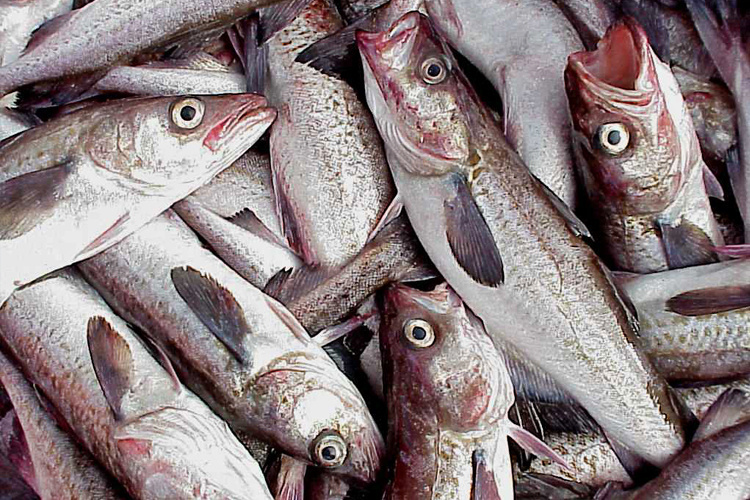
Alaska pollock, shown here from a harvest, make up the nation’s top-volume single-species commercial seafood catch. Each December, the North Pacific Fishery Management Council sets the next year’s harvest levels for pollock and other groundfish. Those decisions are based on scientific analysis that could be compromised this year by the federal government shutdown. (Photo provided by the National Oceanic and Atmospheric Administration)
For the organization that oversees commercial fisheries in federal waters off Alaska, the most significant impact of the federal government shutdown might materialize in December.
That is when the North Pacific Fishery Management Council is scheduled to issue harvest limits for Alaska pollock – the nation’s top-volume commercial harvested species – and other types of groundfish harvested in the Bering Sea and Gulf of Alaska, such as Pacific cod and sablefish.
The Bering Sea and Gulf of Alaska pollock harvests start in January.
To set the groundfish harvest levels, the council relies on federal scientists’ analysis of fish stocks in the ocean, work that is based in large part on scientific surveys conducted over the summer.
But during the shutdown, most National Marine Fisheries Service employees, including the scientists who analyze survey data to assess the conditions of commercially targeted fish stocks, are furloughed.
On Wednesday, the last day of the council’s October meeting, the members considered how to deal with scientific uncertainty if the government shutdown prevents completion of the detailed analysis that is usually provided in time for the December meeting.
Council member Nicole Kimball referred to a warning issued eight days prior by Bob Foy, director of the NMFS Alaska Fisheries Science Center, the organization that does the stock assessments. Foy said then that a shutdown lasting more than five days would compromise the ability to complete stock assessments and that a shutdown beyond 15 working days would “dramatically impact” those assessments.
The 15-day threshold is not too far away, Kimball said.
“How does the council and the public understand what to expect in December, in between the October and December meeting, relative to stock assessments?” she asked.
Diana Evans, the council’s deputy director, said impacts are yet to be determined, but the public will be notified of them as soon as possible.
“We don’t think we can answer that until we have a better sense of exactly where we land and how many days of work are remaining between the time that government workers are back and able to resume that work and the meeting,” she said.
Advocates with environmental organizations said they worry about shutdown effects on scientific information needed for harvest decisions, which would add to the effects of mass firings and retirements at NMFS and other agencies.
“I’m terrified at the prospect of flying blind into the next fishing season, especially as the Trump administration has decimated the ranks of scientists who monitor the health of our oceans,” Cooper Freeman, Alaska director of the Center for Biological DIversity, said by email. “I’m especially worried about fisheries like the massive pollock trawl fleet that has been harvesting millions of tons annually at the expense of the larger ecosystem.”
“The first challenge with this shutdown is the instant level of uncertainty it creates. Normal processes face delays that can easily impact or inhibit active fisheries. Potential staff losses will exacerbate that,” Michelle Stratton, executive director of the Alaska Marine Conservation Council, said by email.
“But beyond the concern for continuing day to day services, are those major efforts — like stock assessments and (total allowable catch) setting — that rely on substantial NMFS staff input, data processing and expert analysis. If this continues to the point where we are unable to set catch limits for the start of the 2026 seasons, we’ll be in seriously uncharted territory, and could well see massive economic impacts to our fishing communities and fleets,” she said.
The shutdown forced the council to rearrange its October meeting because federal representatives were unavailable to present information.
One major agenda item was postponed: review of a work plan for assessing essential fish habitat. Other items on the agenda were abbreviated.
The shutdown has already affected fishery management operations to some degree, said council member Jon Kurland. As Alaska regional director for NMFS, Kurland is one of a small group of agency employees remaining at work during the shutdown.
Kurland, in comments last week at the start of the meeting, said some services have been unavailable during the shutdown, such as the processing of harvest quota transfers.
NMFS is still doing basic management of ongoing fisheries, monitoring and closing them as needed, and is supported by contractors, he said. But that level of work has its limits, he said.
“If there are significant unforeseen problems, we will have limited ability to address those. Fingers crossed,” he said then.
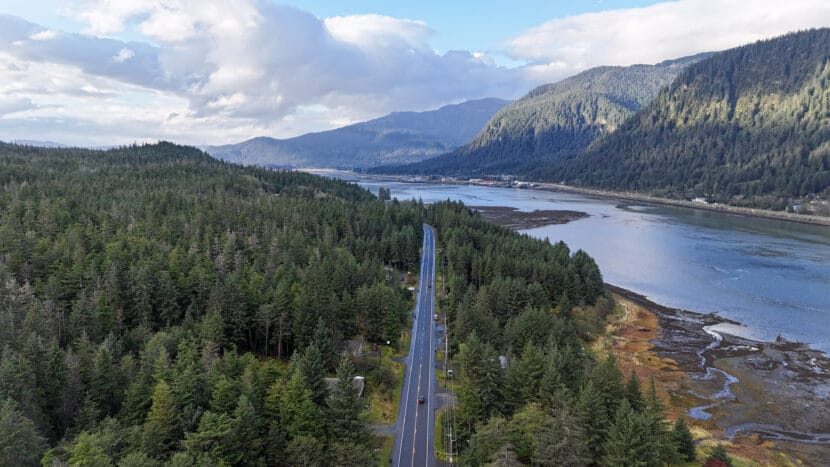
North Douglas Highway near Grant Creek on Monday, Oct. 6, 2025. (Photo by Clarise Larson/KTOO)
The Juneau Assembly upzoned more than 200 acres of city land for sale earlier this year in hopes of creating more housing opportunities throughout the city and borough.
The rezones included land north and south of Grant Creek and west of the Bonnie Brae and Blacktail Subdivisions on Douglas Island, and some land in the Auke Bay area.
The hope was that by allowing for denser housing in those areas, it would entice private developers to build units there. But so far, nobody’s biting. That might be because a lot more work needs to be done to make the land buildable, and that work could be expensive.
Dan Bleidorn, the city’s lands and resources manager, said the rezoning is just another strategy the city is using to try and tackle Juneau’s chronic housing shortage.
“The goals of the rezones were to initiate a process in which those properties could be disposed of by the city, and developers could acquire them, or people could acquire them to build housing on,” he said.
That’s especially needed as a U.S. Coast Guard Icebreaker is slated to be homeported in Juneau, bringing more than 100 crewmembers and their families to town in the coming years. It also comes as annual glacial flooding of the Mendenhall River threatens homes in the Mendenhall Valley, and major development projects are being proposed on North Douglas.
High-density, multi-family is generally cheaper to buy or rent than a traditional single-family home. According to a study by the Alaska Department of Labor and Workforce Development, Juneau has had the highest average sale price for a single-family home in the state for the past two years.
“I think the rezones are important because it provides opportunity that wasn’t present prior to the rezones,” he said.
Bleidorn said the rezones are just the first step in a long process to get housing built in those areas. But, just because the land is technically now up for sale, it doesn’t necessarily guarantee developers will want — or be able to afford — to build there. Bleidorn said just preparing the land to be developable will be a significant investment.
“I think some of the barriers to development include the fact that there’s no road frontage on a lot of these properties, and utilities are far away in some cases,” he said.
That, paired with high interest rates and the cost of materials, continues to block developers from breaking ground on new projects.
For other city housing projects like the redevelopment of the Telephone Hill neighborhood downtown, the Assembly controversially chose to front millions of dollars to fund the first phase of demolition and site preparation in order to entice developers to build housing there. The city does not yet have a developer signed on to the project. Demolition is scheduled to begin in December.
The Juneau Assembly similarly infused millions of dollars to spur the development of the Pederson Hill subdivision in 2017 to create more housing. Since then, private developers and individuals have bought some of the 86 lots to build single-family homes.
Both projects have been met with skepticism, with people questioning the city’s role in influencing the housing market. Deputy City Manager Robert Barr said public subsidies on projects like these are a way to tuck in affordability requirements.
“If it’s just left up to developers to kind of front all that principle, all that cash, that investment on their own, we’re gonna end up with one type of housing, right? Housing that they can make a profit on,” he said.
Bleidorn said it’s not clear which direction the Assembly will choose to go on the land it rezoned. It depends largely on the interest – or lack thereof — from the private sector. He said, regardless, the rezones lay the groundwork for a future Juneau where more housing could finally be on the horizon.
“I really do think that these rezones will make a difference,” he said. “Maybe they’re more mid-term to long-term projects, but I think lining them up for future development is key.”
Close
Update notification options
Subscribe to notifications
Subscribe
Get notifications about news related to the topics you care about. You can unsubscribe anytime.