Economy

Advocates collect more than 600 signatures to halt looming Telephone Hill evictions

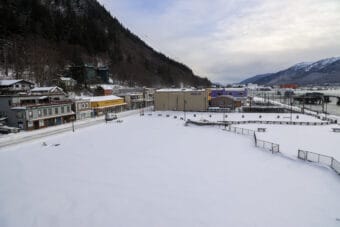
The Telephone Hill neighborhood in downtown Juneau on Wednesday, Oct. 22, 2025. (Photo by Clarise Larson/KTOO)

Local advocates have gathered more than 600 signatures in an effort to pause the looming evictions and demolition of the historic Telephone Hill neighborhood in downtown Juneau. 

The petition is called “Stop the Bulldozers on Telephone Hill.” The city plans to demolish the houses on the hill in December to make way for newer, denser housing in response to the city’s housing crunch. Renters on the hill have until Nov. 1 to move out, but a developer has not signed on to the project. 

Mary Alice McKeen is one of the advocates leading the effort. She said the petition asks for the city and Juneau Assembly to consider postponing the project until they have a more credible plan that includes things like clearer cost estimates. 

“We think they are really putting the cart before the horse. After the buildings are demolished, that is irrevocable,” she said. “So, before we think they should pause what they’re doing until they have a credible plan for the future of telephone Hill.”

McKeen said advocates intend to present the signatures and testify at the Juneau Assembly’s upcoming meeting on Monday night. That’s when its newest member, Nano Brooks, will be sworn in. Brooks openly campaigned against the demolition plan. 

The eviction of renters on the hill was originally slated for Oct. 1, but the city postponed it until Nov. 1 due to a legal hiccup. 

City Attorney Emily Wright said the signatures themselves can’t stop the plan from moving forward — it’s up to the Juneau Assembly.

“In general, the signature gathering push and initiative is fully within the political realm and putting pressure on the Assembly to rescind their action or change where things go,” she said. “But it doesn’t have any weight legally to stop the eviction.”

A majority of the nine-member Assembly would have to be on board with rescinding the evictions in order for a motion to pass. However, at a meeting last month, many Assembly members stood behind their decision.

Demolition is slated to begin in December. City officials say they hope that a developer will begin construction as soon as next summer.

‘We got hope’: The few who remain in storm-ravaged Kipnuk race to rebuild

Debris sits in a pile in storm-ravaged Kipnuk, Alaska on Oct. 19, 2025, a week after the remnants of Typhoon Halong brought catastrophic flooding and hurricane-force winds to the village.
Debris sits in a pile in Kipnuk, Alaska on Oct. 19, 2025, a week after the remnants of Typhoon Halong brought catastrophic flooding and hurricane-force winds to the village. (Eric Stone/Alaska Public Media)

It’s Sunday in Kipnuk.

And like a lot of folks on Sundays, Tony Paul is headed to the hardware store.

“We’re making progress every day, seems like,” he said.

Unlike a lot of folks, he needs a boat to get there.

“It floated away,” he said, gesturing upriver. “There’s a couple stores down past that way, a bunch of houses.”

A week earlier, on Sunday, Oct. 12, Kipnuk endured the worst storm anyone can remember. It’s one of dozens of communities in Western Alaska working to restore essential infrastructure and repair damaged homes after the remnants of Typhoon Halong devastated coastal communities.

According to preliminary damage assessments, Kipnuk fared the worst.

The few residents who remain are determined to rebuild — but the task ahead is immense, and the future is unclear.

Homes and other buildings that floated off their foundations in Kipnuk, Alaska rest on tundra miles upriver on Oct. 19, 2025, a week after the remnants of Typhoon Halong brought record flooding and high winds to the Western Alaska village. (Eric Stone/Alaska Public Media)

In this village, four miles from the Bering Sea on the east bank of the Kugkaktlik River, Halong’s high winds and storm surge left a catastrophe. Halong’s hurricane-force winds pushed seawater more than six and a half feet above the normal high tide line.

Water poured into houses. It lifted homes off their foundations and deposited some of them miles away. It toppled four-wheelers and snowmachines, and left freezers full of food for the winter without power.

The state Department of Transportation estimates that 90% of the structures in the community were destroyed. Most of Kipnuk’s residents evacuated on military helicopters in the days after the storm.

Now, Kipnuk is in ruins. Piles of debris are everywhere.

Houses and other buildings sit jumbled and surrounded by debris in Kipnuk on Sunday, Oct. 19, a week after the remnants of Typhoon Halong brought record flooding and high winds. (Eric Stone/Alaska Public Media)
A building sits on a boardwalk among other debris on Oct. 19, 2025 in Kipnuk, Alaska, a week after the worst storm on record. (Eric Stone/Alaska Public Media)
An all-terrain vehicle sits overturned on a boardwalk in Kipnuk on Sunday, Oct. 19, a week after the remnants of Typhoon Halong washed ashore. (Eric Stone/Alaska Public Media)

Anna Kashatok was with her boyfriend, his family and her two kids when the storm hit.

“We floated away pretty far,” she said. “A mile or two.”

They escaped from a window and trudged to the community’s school. She recalled seeing the destruction for the first time.

“So heartbreaking, devastating,” she said. “Kipnuk’s not Kipnuk anymore.”

Kashatok was only back in town for a couple days, retrieving some belongings and important documents from her parents’ house. It also floated away with them inside. She evacuated to the hub community of Bethel with her boyfriend, parents, and two children.

Only a handful of people remain in this village that just a week ago was home to 700.

In spite of the widespread destruction, the school remains a place of refuge. It escaped major flood damage. It’s elevated on pilings with a dedicated backup generator.

All-terrain vehicles and a dog sit outside the Chief Paul Memorial School in Kipnuk, Alaska on Oct. 19, 2025. (Eric Stone/Alaska Public Media)


Supplies sit in the lobby of the Chief Paul Memorial School in Kipnuk, Alaska on Oct. 19, 2025, a week after the remnants of Typhoon Halong devastated the community. (Eric Stone/Alaska Public Media)

James Paul III sat at a table in the cafeteria, speaking with a local Yup’ik teacher.

“It happened so fast. Everything changed, like in a day,” he said. “The rest of their lives are changed in one day.”

The school remains, but the kids are gone. Many evacuated to Anchorage. Others are with friends and family in Bethel, surrounding villages or other communities around the state.

So for now, the Chief Paul Memorial School is a hub for the recovery effort. Packaged food lines the walls. Cafeteria workers prepare hot meals — chili was on the menu for dinner.

The state Department of Transportation told Paul some heavy equipment was on the way, he said, things like small excavators, skid-steers and all-terrain vehicles. That would help crews working to connect the school and a water treatment plant to power, he said.

“That’s our main objective right now,” he said.

James Paul III poses for a photo in the cafeteria of Kipnuk’s Chief Paul Memorial School on Oct. 19, 2025. Paul is one of a handful of residents racing to rebuild Kipnuk after the remnants of Typhoon Halong struck a week earlier. (Eric Stone/Alaska Public Media)

But time is running short. Winter is well on its way. Bits of frost lined ponds on the tundra. That, and an oily sheen.

State emergency officials say they believe the fresh water supply is contaminated. A stiff breeze brought some relief Sunday from what residents said had been a lingering stench of fuel and sewage.

A big question looms ahead: Can evacuees return before winter — or at all?

“The way that their houses are right now, I don’t think they want to come back, especially people whose houses were pulled off their foundation,” Paul said.

There are a few dozen homes built on pilings that survived the storm and are still livable. They number 40 or 50, Paul estimated.

Paul wants to stay in Kipnuk if he can, he said. He’s spent most of his life here.

“Kipnuk means family, (it) means values, traditions. It’s my culture. I grew up here, and my dad taught me to hunt and live off the land here,” he said. “I do know some about city life, but I’d rather be here.”

From left to right, Tony Paul, Anna Kashatok, Benjamin Kugtsun, Logan Paul and Joshua Dock stand outside the Chief Paul Memorial School in Kipnuk, Alaska on Oct. 19, 2025. (Eric Stone/Alaska Public Media)

Outside the school, standing with a group of young men working to restore basic services to the community, Benjamin Kugtsun was unequivocal.

“We’re going to stay here in the winter,” he said. “We can survive. How did our ancestors survive? Without nothing. But they did.”

But when — or whether — large numbers can return is unclear. Gov. Mike Dunleavy, in a request to the federal government, said some evacuees from villages across the vast, low-lying Yukon-Kuskokwim Delta might not be able to return for 18 months.

For now, Kugtsun and his crew are taking it one day at a time. One task at a time. One boat ride to the hardware store at a time.

But he’d like to see more residents return to help out.

“With teamwork, it can happen,” he said. “We got hope.”

Last year’s Alaska tourism season was a record year — but just barely

The Norwegian Joy docks in downtown Juneau on Saturday, April 26, 2025. (Photo by Clarise Larson/KTOO)

Over 3 million people visited Alaska during the tourism season that ended in April 2025 marking a new record for the state, according to data released at the Alaska Travel Industry Association’s annual convention in Anchorage Tuesday.

The Alaska Visitor Volume report includes data over the 12-month period starting in May 2024. It shows 33,000 more visitors came to Alaska compared to the previous travel season, an increase of 1.1%.

The association’s president and CEO, Jillian Simpson, said the increase was driven by the cruise sector, and that a few smaller communities saw big increases in visitation.

“There are some ports of call outside of Seward and Whittier that actually saw really big jumps in cruise visitation, and that is Kodiak, Alaska. But they were outdone by, can you guess who? Unalaska,” Simpson said.

Data in the report was gathered by McKinley Research Group. It found 88% of travelers that came to Alaska did so in the summer. Over half of visitors arrived on a cruise ship, followed by airline travel.

Juneau’s port had the highest number of passengers at 1.7 million – almost 4% higher than the previous year, according to the report. The majority of people who flew to the state came into Anchorage.

Winter travel to Alaska has been increasing over the long-term, but it dipped 5.5% last year, according to the report. Simpson said it’s the first decline since the association started tracking winter visitors in 2006. Fewer than 400,000 people came to the state during the winter months – a decline of 21,700 winter travelers from the previous season.

It’ll be months before tourism data for summer 2025 is available, but Simpson said early indicators show a slight decrease in cruise visitors and airline travel.

“On the cruise sector side, we did see essentially flat this year, which is what we were predicting with capacity,” she said. “It was ever so slightly down.”

The tourism sector supported 48,000 jobs in Alaska last year, according to the presentation.

Correction: This story previously has an incorrect byline. 

In Alaska’s most remote villages, 1 missed plane can mean bare grocery shelves

One of Nikolski's five greenhouse domes in front of St. Nicholas Church in August 2025.
One of Nikolski’s five greenhouse domes in front of St. Nicholas Church in August 2025. (Theo Greenly/KUCB)

The Aleut Community Store is the only shop for the Bering Sea village of St. Paul’s 300 or so residents, so most people just call it “the store.”

You can get everything you need there, from produce and cereal to kitchen appliances and fishing supplies — even a Yamaha four-wheeler.

But in June, the barge that was supposed to bring groceries canceled its trip because of rough weather. Meanwhile the cloud ceiling remained too low for planes to land. When planes can’t land and deliveries don’t make it in, shelves go bare.

“Eggs were shorted, and then milk, too. Stuff like that,” said Ben Bourdukofsky, the store’s manager.

In all, 20,000 pounds of groceries got stuck in Anchorage for over a month. When the planes finally did arrive, a lot of that food had spoiled. The tribal government, which runs the store, estimates it had to throw away about a quarter of it.

The food shortage this summer was uncommon, but it wasn’t unheard of. The Pribilofs are some of the most remote communities in the nation, and freight can be logistically difficult, expensive and unreliable.

St. Paul’s 300 residents went without many major staples in June when travel disruptions led to a food shortage on the island, photographed here in September 2025. (Theo Greenly/KUCB)

In 2020, the Aleutian and Pribilof Islands Association partnered with the U.S. Department of Agriculture to survey community members across the region and assess their local food systems. They found that most residents rely on local stores, but that fresh, healthy options are often limited and expensive.

The survey also found that subsistence is the second most common source of food for families in the region.

The COVID-19 pandemic made things worse, exposing strains in Alaska’s food supply. A 2021 report from the National Oceanic and Atmospheric Administration found that Alaska Native communities felt the brunt of that.

In 2022, Gov. Mike Dunleavy created a food security task force to advise lawmakers on how to strengthen local production and distribution — most of what you find on grocery shelves throughout Alaska still comes in from the Lower 48.

The task force’s main recommendation was to establish a state Department of Agriculture, which it said would bolster private agriculture in the state and reduce Alaska’s reliance on imports. Farmers and agricultural groups backed the proposal, but lawmakers rejected it during this year’s legislative session, largely on procedural grounds.

A response to the pandemic

Nikolski is another island village, about 300 miles south of St. Paul. Roughly 20 to 30 people live in the village, which also has a single store. The community otherwise relies largely on subsistence.

Tribal Administrator Tanya Lestenkof says they have experienced situations similar to this summer’s food shortage in St. Paul, notably in 2007.

“Our weather was so bad that we didn’t see a plane for like, four months,” she said.

Nikolski’s subsistence practice revolves around salmon fishing and hunting the roughly 5,000 reindeer that live on the island.

“The only food that I had in the house was the reindeer that I had put up and the salmon, but I had dogs, so the dogs got all the salmon, and I ate all the reindeer. And now I can’t eat reindeer anymore,” Lestenkof said.

The community responded by building a geodesic dome for a community garden.

Lily Stamm is a project coordinator for the tribal government. She says the community ramped up their investment in greenhouses after the pandemic’s supply chain disruptions further exposed the community’s vulnerable food supply.

Lily Stamm is a project coordinator for the Native Village of Nikolski, the community’s tribal government. (Theo Greenly/KUCB)

“We realized we were going to have a much greater need for food security out here,” she said.

Today, they have five greenhouses, housing everything from community gardens to a sauna and a small pool.

Stamm says Nikolski has made food security and food sovereignty a community project.

“In this village, they’ve really prioritized it and started some really neat projects,” she said.

Subsistence is still critical to food security

But not all community investments in food security work out. In the Aleutians and Pribilofs, high winds and poor soil make growing things very difficult.

St. Paul has tried greenhouse projects, too — including a hydroponic grow center the community built on the ground floor underneath the Aleut Community Store. It ran for several years but eventually shut down.

Robert Melovidov, right, serves fur seal at a community cookout on Labor Day 2025. (Theo Greenly/KUCB)

Today, there aren’t any large-scale growing efforts on the island.

The shelves are full in St. Paul’s store now. But Bourdukofsky says this summer’s food shortage wasn’t the first time something like this happened, and it might not be the last. The challenges of isolation and weather aren’t going away

People in St. Paul also rely on fur seals for food. Richard Zacharof has helped organize that subsistence harvest for 40 years. He says they’d be lost without it.

“It puts food in the freezers for the winter months for people to enjoy their subsistence foods that we live on,” he said. “You know, it’s all part of our DNA.”

Will Juneau regulate short-term rentals any time soon? Probably not.

Downtown Juneau on Friday, Aug. 29, 2025. (Photo by Clarise Larson/KTOO)

The mayor’s task force on short-term rentals wrapped up four months ago. It was mostly made up of homeowners, not renters. And its findings offered no immediate recommendations on regulations or restrictions for the Juneau Assembly to consider. 

Juneau has been grappling with a housing shortage for decades — studies pointing to Juneau’s acute lack of it date back to the 70s. 

City officials have tried finding ways to create new housing for long-term renters. In recent years, there’s also been a push to crack down on short-term rentals, like Airbnbs and Vrbos. City data and other analyses suggest there are likely around 300 to 400 short-term rentals in Juneau, but that the number could be even higher.

“There is very distinct opinions on it — and some people are for them, and some people are against them,” said Mayor Beth Weldon.

Right now, short-term rentals are largely unregulated, although the city started requiring people to register them in 2023. Weldon launched a short-term rental task force in January to assess the market and make recommendations that improve housing availability.

Of the 11 members, only one was a renter. The group concluded its meetings in early June and offered some imprecise recommendations to the Assembly. But, Weldon said she had hoped for clearer direction. 

“They were pretty benign recommendations, and if that’s what the Assembly wants, that’s good. But I was hoping to see a little bit more,” she said.

Assembly member Wade Bryson, who chaired the committee, said one positive change that did come out of the task force was requiring rental sites to take care of sales taxes on behalf of local operators. The Assembly approved that change back in May.

The task force also recommended non-regulatory actions for the Assembly to take, like conducting an economic impact study on short-term rentals.

But members couldn’t agree on what else to implement, or when. Bryson said the committee faced a lot of hurdles. Not everyone on the 11-member task force showed up to every meeting. He says that made it hard to gauge a consensus and led to a lot of split votes. 

“It was difficult to get support to take such a hard stance one direction or the other,” he said. 

He said he thinks a better use of city time and resources is to focus on creating new housing opportunities, like the Telephone Hill redevelopment project. 

“The data says they’re not causing the housing crisis, and even if we restrict them, that’s not going to move the needle and get more houses into the market,” he said. 

The task force suggested basing its recommendations on Juneau’s rental vacancy rate — the overall number of vacant rental units. In a final report shared with the Assembly, it concluded that the current 3.9% vacancy rate is low — meaning there isn’t enough open housing to go around. But, they left it up to the Assembly to decide what rate would justify taking action.

The City and Borough of Juneau’s rental vacancy rate between 2010 and 2024. (City and Borough of Juneau)

If at some point the Assembly decides on what that threshold is and that it has been met, then the task force recommends two things: the city institute a fee for permits and cap the number of rentals permitted to a person or business. But, it also didn’t recommend a specific fee rate or cap to consider. 

Bryson said it’s unlikely that the Assembly will pick this topic back up any time soon. 

“It did not appear with the data that we were in a crisis mode because of short-term rentals,” he said. “It just isn’t making that level of impact.”

Assembly member Alicia Hughes-Skandijs also served on the task force. In a text message, she said she “wasn’t satisfied by the amount of outputs from the task force” and intends to take the topic back up in the coming years.

In Haines and Skagway, the feared Canadian boycott never quite materialized

A group of people standing outdoors holding signs supporting Canada and disapproving of tariffs.
Haines residents carry signs showing support for Canada during a rally and march through downtown in April. (Avery Ellfeldt/KHNS)

Escalating tensions between the U.S. and Canada last winter fueled fears that Canadians would respond by canceling cross-border visits to Alaska this summer, potentially hitting local economies.

New data shows fewer people did cross the Canadian border near Haines and Skagway this year compared to last year. Still, a full-scale boycott never seemed to materialize – at least in the upper Lynn Canal.

Skagway tourism director Jaime Bricker said she was concerned that Skagway would see fewer Yukoners specifically this season. In some cases, she did hear about people canceling trips to southeast Alaska’s northernmost town. But overall, her worries didn’t come to fruition.

“The majority of people that I’ve talked to have made a special exception to visit Skagway,” she said. “The south Klondike Highway feels like family — it doesn’t feel like one country versus another.”

That comes in sharp contrast to what happened across the country amid intensifying frustration in Canada over President Donald Trump’s trade war and his claims that the country should become the 51st state.

Nationwide border crossings from Canada into the U.S. between May and August of this year dropped by about 24% when compared to last year, according to U.S. Customs and Border Control data published last month by the federal Department of Transportation.

But in Skagway, not much changed at all, the data shows. The nearby port of entry sits just north of town. Between May and August this year, more than 68,000 passengers entered the U.S. there in personal vehicles. That marks about a 4% decrease from the same time period last year.

Bricker noted that she receives border data directly from customs agents stationed in Skagway. According to those figures, border crossings are actually up this year compared to last, not slightly down, as the data published by DOT showed. The reason behind the discrepancy is unclear.

Haines

The situation played out differently in Haines. The Dalton Cache Port of entry is about 40 miles outside town. And CBP data suggests 3,700 fewer people entered the U.S. there between May and August of this year. That represents a nearly 16% decrease.

Haines Borough Tourism Director Reba Hylton said she observed the dip, including at the local visitor center.

“We were definitely negatively impacted,” she said. “And we saw a lot less, not only Canadian travelers, but international travelers in general.”

The local economic impact is less clear. Alaska Sport Shop employee Gabe Long, for instance, said the fishing and outdoor gear store saw plenty of Canadians who have been coming to Haines for years – if not generations. But typically, they also serve a lot of younger Canadians visiting for the first time. That demographic, he said, didn’t seem to arrive in full force.

“We had about eight Saturdays where we had significantly less people than I’ve had last year,” Long said.

But it’s hard to say if that hurt sales, Long added. That’s due in part to the fact that two of the shop’s main competitors were closed this summer.

Haines Brewing owner Paul Wheeler, meanwhile, did notice a drop in business. One month over the summer, he said, sales were down about 20%. He said he observed fewer Canadians than normal, but also fewer Germans. He thinks that’s because German airline Condor canceled their direct flights to Whitehorse.

Other business owners said they really didn’t notice a shift at all. Ramie Carlson Clayton owns Ampersand, a local art gallery and said the season was business as usual. Rhonda Hinson, owner of local store Alaska Rods, echoed that point.

“The Canadian traffic this summer, I’d say, was pretty steady,” Hinson said. “I had folks in pretty much every weekend, and a lot of times throughout the week.”

Site notifications
Update notification options
Subscribe to notifications