Economy

Fueled by trade tensions and foreign wars, a rush for an obscure mineral heats up in Alaska

A sign warns of a sled dog crossing along Old Murphy Dome Road outside Fairbanks. The road leads to a site where an Australian company called Felix Gold could begin mining antimony. (Max Graham/Northern Journal)

Alaska hasn’t produced antimony — a shiny mineral used in weapons, flame retardants and solar panels — in almost 40 years.

That could change this summer, according to the executives of a Texas company that has snatched up more than 35,000 acres of mining claims in Alaska.

Dallas-based U.S. Antimony Corp. is looking to the state as a new source of antimony for its smelter in Montana, the only plant in the United States that refines the mineral.

Alaska’s antimony, the company says, could help the U.S. overcome a recent ban on exports of the mineral from China, the world’s top antimony producer. Antimony is among several minerals — many of which are used in renewable energy — that the U.S. has sourced primarily from China and other countries in recent decades. Efforts to build more mines in the U.S. have accelerated amid worsening trade tensions and growing demand.

With no active antimony mines, the U.S. in recent years has imported roughly 60% of its antimony from China. Meanwhile, need for the mineral has surged as antimony-laden arms flow to wars in Ukraine and the Middle East.

The price of the mineral has quadrupled in the past year, rising from around $13,000 to $55,000 per ton.

U.S. Antimony is now expanding its Montana smelter and rushing to find more ore to supply it. Alaska is its “primary focus” for boosting production, an executive said in an interview last week.

In the past eight months, a U.S. Antimony subsidiary, Great Land Minerals, has acquired claims in three different areas of Alaska’s Interior: outside Fairbanks; near the small town of Tok; and along the Maclaren River off the Denali Highway, a scenic road that runs outside the national park.

U.S. Antimony says it’s looking to truck antimony ore some 2,000 miles from Alaska to its processing plant in Montana. That operation could start as soon as September, executives said on a recent call with investors.

“We can’t get that antimony from Alaska to Montana fast enough,” Joe Bardswich, U.S. Antimony’s chief mining officer, said on the call.

A chunk of stibnite, which contains more than 70% antimony, from Felix Gold’s Treasure Creek project near Fairbanks.
A chunk of stibnite, which contains more than 70% antimony, from Felix Gold’s Treasure Creek project near Fairbanks. (Max Graham/Northern Journal)

The company’s plans coincide with a separate effort by an Australian company to start up its own small-scale antimony mine near Fairbanks.

Felix Gold is seeking to restart production this year at a long-shuttered antimony mine that sits within a few miles of a residential subdivision, Hattie Creek.

The company also is eyeing prospects near the hamlet of Ester on the outskirts of Fairbanks — where U.S. Antimony’s subsidiary has claims, too.

The potential developments are generating a mix of responses locally.

Some residents worry about environmental impacts of mining and its potential to transform tranquil Fairbanks-area neighborhoods into noisy industrial sites.

“I don’t want to be all NIMBY. But it literally is my backyard,” said Lisbet Norris, who lives in Hattie Creek, about 10 miles north of downtown Fairbanks. “It’s just so close.”

Norris, a dog musher, runs sled tours on trails that cross Felix Gold’s claims on state land, and she’s concerned that mining might impede her business. She’s also worried about heavy industrial use of the dirt road that connects her neighborhood — and Felix Gold’s potential operations — to the rest of town.

Other Fairbanks residents, however, say they support mining in the area; some cite the town’s early history as a gold mining town and the potential economic benefits of new mines.

“It’s because of mining that Fairbanks is what it is,” said Roger Burggraf, a local prospector who owns some of the claims that Felix Gold has leased to study the feasibility of antimony mining.

Roger Burggraf is leasing mining claims to one of the companies looking for antimony in the Fairbanks area.
Roger Burggraf is leasing mining claims to one of the companies looking for antimony in the Fairbanks area. (Max Graham/Northern Journal)

Burggraf said he understands the concerns of people who live near gold and antimony prospects. But when they bought their properties, “they should have realized that if a mine developed, that might change their lifestyle,” he added.

Felix Gold has a permit only for mineral exploration, not active mining.

The company aims later this year to apply for additional state permits, and to finish studying the profitability of developing a small antimony mine near the Hattie Creek subdivision.

U.S. Antimony also has applied only for a permit to search for antimony, though it hopes to apply for more permits and start mining within a year. If its exploration efforts show a mine would be profitable, it would propose an underground operation, said Rodney Blakestad, U.S. Antimony’s vice president of mining.

The footprint would be small, more similar to the family-run placer mines in the area than to a large-scale hardrock mine, according to Blakestad.

“We’re not Fort Knox,” he said, referring to Fairbanks’ huge open pit gold mine.

But before U.S. Antimony begins mining, it wants to buy antimony ore from existing placer gold mines.

Antimony often appears alongside more-valuable gold, and gold miners have typically thrown it aside.

Now that antimony prices are surging, though, U.S. Antimony representatives say every little bit is valuable. A 25-ton truck could carry some $600,000 worth of minerals, Bardswich said in an interview.

That means small loads of antimony ore from shallow, exploratory trenches that the company intends to dig at its Alaska prospects this summer also could be worth driving 2,000 miles to the Montana smelter, company executives said.

In the meantime, they intend to launch an advertising campaign to share their interest in buying the mineral from placer miners.

“People don’t realize this: Gold is not the best mineral to be mining, if you’re looking for really good value,” said Blakestad. “Antimony is.”

Northern Journal contributor Max Graham can be reached at max@northernjournal.com. He’s interested in any and all mining related stories, as well as introductory meetings with people in and around the industry.

This article was originally published in Northern Journal, a newsletter from Nathaniel Herz. Subscribe at this link.

NOAA firings and cuts will reduce services used to manage Alaska fisheries, officials say

Commercial fishing vessels docked in the St. Paul Harbor in Kodiak; Feb. 6, 2023 (Brian Venua/KMXT)

Trump administration job cuts in the National Oceanic and Atmospheric Administration will result in less scientific information that is needed to set and oversee Alaska seafood harvests, agency officials have warned fishery managers.

Since January, the Alaska regional office of NOAA Fisheries, also called the National Marine Fisheries Service, has lost 28 employees, about a quarter of its workforce, said Jon Kurland, the agency’s Alaska director.

“This, of course, reduces our capacity in a pretty dramatic fashion, including core fishery management functions such as regulatory analysis and development, fishery permitting and quota management, information technology, and operations to support sustainable fisheries,” Kurland told the North Pacific Fishery Management Council on Thursday.

NOAA’s Alaska Fisheries Science Center, which has labs in Juneau’s Auke Bay and Kodiak, among other sites, has lost 51 employees since January, affecting 6% to 30% of its operations, said director Robert Foy, the center’s director. That was on top of some job losses and other “resource limitations” prior to January, Foy said.

“It certainly puts us in a situation where it is clear that we must cancel some of our work,” he told the council.

The North Pacific Fishery Management Council, meeting in Newport, Oregon, sets harvest levels and rules for commercial seafood harvests carried out in federal waters off Alaska. The council relies on scientific information from NOAA Fisheries and other government agencies.

NOAA has been one of the targets of the so-called Department of Government Efficiency, or DOGE, which has been led by billionaire Elon Musk. The DOGE program has summarily fired thousands of employees in various government agencies, in accordance with goals articulated in a preelection report from the conservative Heritage Foundation called Project 2025.

NOAA’s science-focused operations are criticized in Project 2025. NOAA Fisheries, the National Weather Service and other NOAA divisions “form a colossal operation that has become one of the main drivers of the climate change alarm industry and, as such, is harmful to future U.S. prosperity,” the Project 2025 report said.

The DOGE-led firings and cuts leave Alaska with notably reduced NOAA Fisheries services, Kurland and Foy told council members.

Among the services now compromised is the information technology system that tracks catches during harvest seasons — information used to manage quotas and allocations. “We really have less than a skeleton crew at this point in our IT shop, so it’s a pretty severe constraint,” Kurland said.

Also compromised is the Alaska Fisheries Science Center’s ability to analyze ages of fish, which spend varying amounts of years growing in the ocean. The ability to gather such demographic information, an important factor used by managers to set harvest levels that are sustainable into the future, is down 40%, Foy said.

A lot of the center’s salmon research is now on hold as well.

For example, work at the Little Port Walter Research Station, the oldest year-round research station in Alaska, is now canceled, Foy said. “We’re talking about the importance of understanding what’s happening with salmon in the marine environment and its interaction with ground fish stocks,” he said.

NOAA’s Little Port Walter Research Station is seen in this undated photo. (Photo by Heather Fulton-Bennett/NOAA Fisheries)
NOAA’s Little Port Walter Research Station is seen in this undated photo. This year’s research at the station, located south of Juneau, has been canceled. (Photo by Heather Fulton-Bennett/NOAA Fisheries)

Much of the work at Little Port Walter, located about 85 miles south of Juneau, has focused on Chinook salmon and the reasons for run declines, as well as the knowledge needed to carry out U.S.-Canada Pacific Salmon Treaty obligations.

As difficult as the losses have been, Kurland and Foy said they are bracing for even more cuts and trying to figure out how to narrow their focus on the top priorities.

Despite the challenges, Foy said, the Alaska Fisheries Science Center has managed to cobble together scheduled 2025 fish surveys in the Bering Sea and Gulf of Alaska, which produce the stock information needed to set annual harvest limits. Some of the employees doing that work have been pulled out of other operations to fill in for experienced researchers who have been lost, and data analysis from the fish surveys will be slower, he warned.

“You can’t lose 51 people and not have that impact,” he said.

It was far from a given that the surveys would happen this year, Foy said. The science center team had to endure a lot of confusion leading up to now, he said.

“We’ve had staff sitting in airports on Saturdays, not knowing if the contract was done to start a survey on a Monday,” he said.

Pressure for bigger harvests

At the same time the Trump administration is making deep cuts to science programs, it also is pushing fishery managers to increase total seafood harvests.

President Donald Trump on April 17 issued an executive order called “Restoring American Seafood Competitiveness” that seeks to overturn “restrictive catch limits” and “unburden our commercial fishermen from costly and inefficient regulation.”

Federal fishing laws, including the Magnuson-Stevens Fishery Conservation and Management Act, require careful management to keep fisheries sustainable into the future. Unregulated fisheries have collapsed in the past, leading to regional economic disasters.

Part of the impetus for the executive order, a senior NOAA official told the council, is the long-term decrease in overall seafood landings.

Prior to 2020, about 9.5 billion pounds of seafood was harvested commercially each year, said Sam Rauch, NOAA Fisheries’ deputy assistant administrator for regulatory programs. Now that total is down to about 8.5 billion pounds, Rauch said.

He acknowledged that the COVID-19 pandemic played a role in the reduction, as did economics.

At their Newport meeting, council members raised concerns that the push for increased production might clash with the practices of responsible management, especially if there is less information to prevent overharvesting.

Juvenile Chinook salmon, also known as king salmon, are seen on July 12, 2006, swimming in the water in Togiak National Wildlife Refuge in Southwest Alaska. (Photo provided by U.S. Fish and Wildlife Service)
Juvenile Chinook salmon, also known as king salmon, are seen on July 12, 2006, swimming in the water in Togiak National Wildlife Refuge in Southwest Alaska. Cuts to the NOAA’s Alaska Fisheries Science Center have drastically reduced the ability of scientists there to analyze the ages of fish swimming in waters around Alaska, officials say. (Photo provided by U.S. Fish and Wildlife Service)

Nicole Kimball, a council member and vice president of a trade organization representing seafood processors, cited a “disconnect” between the goal of increased seafood harvests and the “drastically lower resources” that managers normally rely upon to ensure harvest sustainability.

The typical approach is to be cautious when information is scarce, she noted. “if we have increased uncertainty — which we’ll have with fewer surveys or fewer people on the water — then we usually have more risk, and we account for that by lowering catch,” she said at the meeting.

In response, Rauch cited a need to cut government spending in general and NOAA spending in particular. That includes the agency’s fishery science work, he said.

“We have to think about new and different ways to collect the data,” he said. “The executive order puts a fine point on developing new and innovative but also less expensive ways to collect the science.”

Even before this year, he said, NOAA was struggling with the increasing costs of its Alaska fish surveys and facing a need to economize.

The agency had already been working on a survey modernization program prior to the second Trump administration.

The Alaska portion of the program, announced last year, was intended to redesign fisheries surveys within five years to be more cost-effective and adaptive to changing environmental conditions.

Foy, in his testimony to the council, said job and budget cuts will now delay that modernization work.

“I can almost assuredly say that this is no longer a 5-year project but probably moving out and into the 6- or 7-year” range, he told the council.

Since Alaska accounts for about 60% of the volume of the nation’s commercial seafood catch, it is likely to have a big role in accomplishing the administration’s goals for increased production, council members noted.

Alaska’s total volume has been affected by a variety of forces in recent years. Those include two consecutive years of the Bering Sea snow crab fishery being canceled. That harvest had an allowable catch of 45 million pounds in the 2020-2021 season but wound up drastically reduced in the following year and shot down completely in the 2022-23 and 2023-2024 seasons because of a collapse in the stock.

Another factor is the shrinking size of harvested salmon.

Last year, Bristol Bay sockeye salmon were measured at the smallest size on record. The total 2024 Alaska salmon harvest of 101.2 million fish, one of the lowest totals in recent years, had a combined weight of about 450 million pounds.

Past years with similar sizes harvests by fish numbers yielded higher total weights. The 1987 Alaska salmon harvest of 96.6 million fish weighed a total 508.6 million pounds, while the 1988 Alaska salmon harvest of 100.6 million fish weighed in at 534.5 million pounds, according to the Alaska Department of Fish and Game.

Juneau Assembly approves Telephone Hill demolition plan that will evict residents this fall

Trees outline the Telephone Hill neighborhood in downtown Juneau on Monday, June 9, 2025. (Photo by Clarise Larson/KTOO)

The City and Borough of Juneau plans to evict all residents of the historic downtown Telephone Hill neighborhood by Oct. 1.

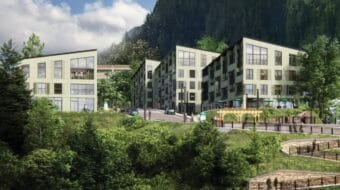
It’s part of a plan that will demolish existing homes and clear the area for newer, denser housing in response to the city’s housing crunch this fall. But no developer has signed onto the project.

Tenants living there now have about four months to move out and find new housing before demolition begins.

The Assembly’s approval of the redevelopment project on Monday was a decision years in the making. The only Assembly member to vote against the plan was Paul Kelly. 

Assembly member Christine Woll said she recognizes the decision was a difficult one. 

“I wish we could sign an agreement with a contractor today that said we aren’t kicking out these families until we have a plan to get 10 times more people in that place — that’s not possible,” she said. “I’m excited to move forward on investing resources that we’re going to need to build that high-density, affordable housing in this place.”

The Assembly approved spending roughly $5.5 million in city dollars — pulled from a few different sources  — to fund the first phase of demolition and site preparation for the area. The total project cost is estimated at $9 million. 

But the city has not yet secured a developer to construct new housing there.

This is a preliminary concept drawing of what the Telephone Hill neighborhood redevelopment could look like. (Courtesy/City and Borough of Juneau)

Some residents, like Tony Tengs, who lives downtown, said the Assembly had already made its decision long before the vote even occurred. 

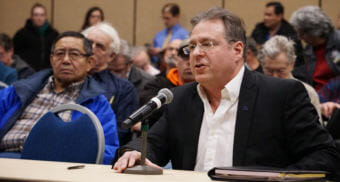
“This will be a very visible $9 million scar in the heart of downtown and the subject of much ridicule,” he said. “You may go down as the most notorious Assembly in the history of Juneau, if your big gamble doesn’t pay off.”

The city plans to get the land ready for a developer to then come in and start building housing next summer. But, as Douglas resident Mark Whitman points out, no developer has signed onto the project yet. 

“You are waiving a $9 million carrot, hoping someone will buy into this — and no clear takers,” he said. “A bad gamble with our money. This is not fiscal responsibility.”

The neighborhood gets its name because it was home to Alaska’s first commercial telephone service. The hill and many of its houses were a part of the original Juneau townsite in the late 1800s.

All the people living on Telephone Hill are renters, and have been since the state took ownership of the neighborhood in the 1980s. It was originally intended to be redeveloped back then to build a new Capitol complex there —  but that didn’t happen. 

The state then transferred the land to the city in 2023. Last year, the Assembly voted to redevelop the neighborhood and add more than 100 new housing units there in response to Juneau’s ongoing housing crunch. 

Assembly member Wade Bryson said the Assembly’s decision shouldn’t be a surprise.

“People who are living on Telephone Hill, how much time would be enough? Because this action, this night was talked about five years ago, four years ago, three years ago, two years ago, a year ago,” he said. “This was not a surprise, or it certainly should not have been a surprise to anybody that eventually it would come to this.”

Demolition is slated to begin between October and December, and city officials say they hope that a developer could begin construction as soon as next summer. 

Feds ask court to dismiss timber industry lawsuit that aims to increase Tongass old-growth logging

The Tongass National Forest covers more than 80% of the land in Southeast Alaska. (Photo by Katie Anastas/KTOO)

Listen to this story:

The largest timber companies operating in Southeast Alaska want the Tongass National Forest to sell them more old-growth timber, and they’re suing the federal government to get it. The Department of Justice asked the court to throw the case out in May.

The Alaska Forest Association along with two of their members, Viking Lumber and Alcan Timber, filed the lawsuit in March, alleging that the U.S. Department of Agriculture failed to fulfill a promise to supply the companies with enough timber to meet market demand. But the government filed a motion to dismiss the case, writing that it didn’t make such a promise.

The case comes after President Trump issued two executive orders aimed at expanding logging in the Tongass this March, and follows decades of legal disputes over Tongass timber. 

Frank Garrison is an attorney with Pacific Legal Foundation representing the timber industry. He said the industry has faced a 30-year decline, and that Viking and Alcan are struggling. 

“They’re on the brink of collapse,” he said. 

He said the companies rely almost completely on old-growth timber offered by the Tongass National Forest.

The government argues in the motion that it is only required to “seek to” provide enough timber to meet market demand while balancing other forest uses and ensuring their sustainability — as written in the 1990 Tongass Timber Reform Act. The law eliminated an old requirement for the Tongass to supply 4.5 billion board feet of timber per decade. The DOJ argues that the agency is not legally required to provide a specific amount of timber to companies.

The DOJ also writes in the motion that the timber sale objectives in the 2016 Tongass National Forest Management Plan are aspirational goals, not binding commitments that can be challenged in court. Furthermore, the government asserts that plaintiffs don’t point to a specific agency action or rule that has been violated. 

But Garrison said that the management plan gave timber companies an expectation that they would have roughly 15 years to transition their businesses from old-growth to new growth trees, and provided estimated amounts of old-growth timber that they could expect to buy. 

“The timber industry, including our clients, relied on the management plan when they were figuring out how they were going to run their business for the next decade,” Garrison said.

When the Forest Service announced the Southeast Alaska Sustainability Strategy in 2021, which proposed to end old-growth logging, Garrison said the agency abandoned its commitment to a slow transition.

The Forest Service has not met its annual target for timber sales in Alaska since 2014, according to a U.S. Government Accountability Office report published last year. Demand for forest products from the Tongass between 2015 and 2030 is estimated to range from roughly 41 to 76 million board feet per year, according to a Forest Service study published in 2016, the most recent market analysis. Between 2020 and 2023, the Forest Service offered sales for a total of 14 million board feet.

Garrison said he hopes that two recent Supreme Court decisions will tip the lawsuit in the industry’s favor. The first is DHS v. Regents, a 2019 case that set a precedent that federal agencies must consider whether those benefiting from a policy rely significantly on its continuation before upending it.

The second case is Loper Bright Enterprises v. Raimondo, which overruled a legal doctrine called Chevron deference last year. The doctrine directed courts to defer to federal agency interpretations of ambiguous laws. Now, the courts must use their independent judgment to interpret laws that agencies administer. It’s unclear whether these new precedents on agency discretion will factor into this case.

Nonprofit environmental law firm Earthjustice is representing a group that seeks to intervene in the case. It includes the Organized Village of Kasaan, the Organized Village of Kake, a boat tour company called The Boat Company, Alaska Longline Fishermen’s Association, Natural Resources Defense Council, Southeast Alaska Conservation Council, and The Wilderness Society.

Earthjustice Attorney Kate Glover agrees with the DOJ that the case should be thrown out because the industry hasn’t challenged a specific agency action. She said that timber companies are looking for a wholesale policy change.

“The timber industry plaintiffs are asking the court essentially to order the region to take a step backwards — to go back to a long-gone era of large timber sales, large clear cuts, where we make that the priority for the use of old-growth forests,” Glover said.

Joel Jackson is president of the Organized Village of Kake, a tribe based on Kupreanof Island. He said the forest’s health is vital to support an abundance of salmon, deer and moose. Since heavy logging moved out, he said the tribe’s food security has improved. Jackson does not want to see old-growth logging scale back up. Instead, he wants the old-growth to be preserved for future generations to experience it as he has. 

“It’s like walking into one of the most beautiful cathedrals you could ever walk into anywhere in the world,” Jackson said of the forest.

The tourism industry brings significantly more money into Southeast Alaska than the timber industry. Jackson said the two are at odds because visitors come to see one of the last protected temperate rainforests in the world, not clear-cut logging in the mountains. 

Maggie Rabb is the Executive Director of the Southeast Alaska Conservation Council, one of the environmental groups trying to intervene in the case. She said that the timber industry’s demands are out of line with what most Southeast Alaskans want for the Tongass.

“They want nuanced, science-based, responsive management. And that does not look like one logging company telling the Forest Service how much they need, and letting that drive decisions about how we manage our forests,” Rabb said.

The Tongass National Forest is undergoing a revision to its management plan, which will update timber sale objectives. The new plan is expected to be completed in 2028. 

The USDA, DOJ and Forest Service declined to comment. The timber industry must file a response to the DOJ’s motion to dismiss the case by June 24. 

Clarification: This story has been updated to include the name of the boat tour company seeking to intervene in the case. 

Juneau’s new Coast Guard icebreaker is on its way to Alaska

The U.S. Coast Guard icebreaker Storis on May 22, 2025. (Photo courtesy of the U.S. Coast Guard)

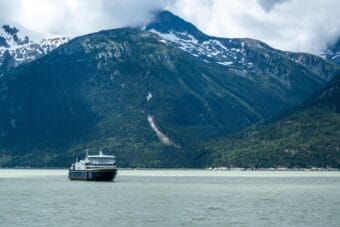
A polar icebreaker is destined for what will eventually be its new home port in Juneau. It set out on Tuesday from Pascagoula, Mississippi, on its maiden voyage as an official U.S. Coast Guard vessel, according to a news release. 

The 360-foot ship is built to operate in the Arctic and is meant to increase U.S. presence in the region. The Coast Guard estimates it will bring hundreds of Coast Guard personnel and their families to Juneau in the coming years.

The ship was previously named the Aiviq. It was renamed the Storis in honor of another Coast Guard ship that was stationed in Juneau in the 1950s.

The Storis is intended to serve as a stopgap while the Coast Guard builds a new fleet of icebreakers called Polar Security Cutters. It’s the first icebreaker the Coast Guard has acquired in more than 25 years.

It’s not a new ship —  the Coast Guard bought it for $125 million from a private entity late last year. Alaska’s congressional delegation tucked the funding to purchase it in a spending bill signed by President Joe Biden last year. 

A ProPublica investigation of the ship published earlier this year found it has a design problem and a history of failure.

The Coast Guard announced last summer that Juneau would be the vessel’s homeport. It’s currently headed to San Diego, according to a vessel tracker. It’s expected to arrive in Juneau this August, but it will leave again to be temporarily berthed in Seattle until the necessary shore infrastructure is finished in Juneau. 

British Columbia wildfire disrupts traffic on the Alaska Highway

A planned ignition lit by British Columbia firefighters near the Alaska Highway to contain the Summit Lake Wildfire, seen on June 3, 2025. (Photo by B.C. Wildfire Service)

A wildfire in northeastern British Columbia has led to intermittent closures on the Alaska Highway since it started burning last week.

The 70-mile stretch of highway west of Ft. Nelson had reopened to single-lane traffic as of Wednesday afternoon, but the BC Wildfire Service says circumstances could change quickly depending on how the Summit Lake Wildfire behaves.

Cell service is limited in much of the burn area. The wildfire service urges travelers to prepare for delays and consider downloading the BC Wildfire app for updates on conditions.

The fire has torched over 6,000 acres in the Northern Rockies since it started on May 28, and it’s nowhere close to being contained, according to the fire service.

Forty-seven firefighters are on the scene with helicopter support. The wildfire service suspects that lightning ignited the fire, which has spread quickly due to a multi-year drought.

There are a number of other fires in the area, and the wildfire service expects them to spread farther as windy weather moves in later this week.

Site notifications
Update notification options
Subscribe to notifications