Timber

Juneau crowd questions forest service on new roads in the Tongass

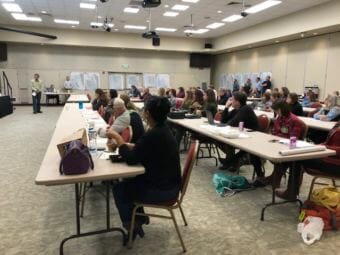
the meeting was held at Elizabeth Peratrovich Hall on Sept. 14, 2018. (Photo by Elizabeth Jenkins/Alaska's Energy Desk)
The meeting was held at Elizabeth Peratrovich Hall on Sept. 14, 2018. (Photo by Elizabeth Jenkins/Alaska’s Energy Desk)

The U.S. Forest Service is on a tour through Southeast Alaska and Anchorage to talk about the prospect of building new roads in wilder parts of the Tongass National Forest. The controversial initiative, which was announced in August, is up against a November deadline. That’s when the state hopes to have a proposal ready for environmental analysis.

On Thursday, Sept. 13, the forest service held its first public meeting in Juneau.

The forest service wasn’t taking any formal public comment from the crowd of more than 50 people. Instead, there were maps stuck to walls with blue tape to spur discussion.

After some presentations from the forest service, the floor was opened up for a roughly 40-minute Q&A.

In 2016, a forest service plan for the Tongass included moving away from old growth logging.

It was created with years of community input from people on both sides of aisle, including conversation groups and the timber industry.

Meredith Trainor, the director of the Southeast Alaska Conservation Council, wondered how the possibility of new road building in the Tongass would alter previous plans like the one from 2016.

The prospect of new road building wasn’t on the table then. It’s not for most national forests in the United States.

Alaska has been fighting this for decades, and this latest attempt to green light new roads in the Tongass could potentially change that earlier management decision.

Some in the audience questioned whether that seemed like a good idea.

“It’s a guaranteed slippery slope,” said Bart Koehler. He says he pretty much came out of retirement to make that point.

He used to work for the Southeast Alaska Conservation Council during the heyday of large scale industrial logging.

During his career, he says he saw some positive changes in the way the Tongass was managed, the Roadless Rule being one of them.

Koehler says he’s upset with how the forest service is conducting its current reevaluation.

“This meeting format is a bunch of B.S. — just a pile of bear scat,” Koehler said. “You come, you’re interested and you want to say something and none of these conversations are being recorded.”

Koehler did get his questions in, though, and he’s going to submit a written comment by Oct. 15 when the deadline closes.

A lot of people attending the Juneau meeting wore green stickers that said, “Keep roadless in the Tongass.” Eric Nichols from Alcan Forest Products in Ketchikan wasn’t one of them.

“I’ve been up looking at timber in other places so Juneau was a stopover because of the plane schedule,” Nichols said.

Nichols acknowledged there didn’t seem to be much representation from industry in the room. But he says these issues extend beyond Juneau, to small communities where people are still employed by logging. It’s estimated there are few hundred timber jobs left.

However, Nichols doesn’t think that will be the case for long — if there isn’t easier access to trees.

“We’ve lost the balance. The balance is totally off the scale,” Nichols said. “We’ve got everything in protection for conversation, but very little for what’s going to generate economic activities.”

The next forest service meeting on road building in the Tongass will be in Ketchikan on Sep. 17. The governor’s office still needs to appoint an advisory committee to help inform the decision.

Southeast Alaska’s forests yellow from insect outbreak

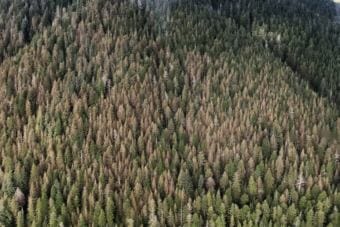
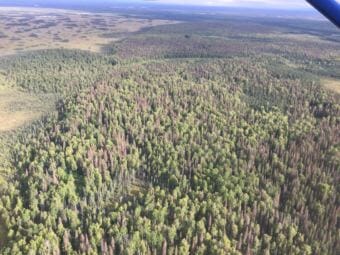
Yellowish hemlock trees are seen from an airplane in Southeast Alaska. The color comes from sawfly larva eating and killing some of the leaves. (Photo courtesy Elizabeth Graham)

Some parts of the forests in Southeast Alaska are a little off color.

Hemlock trees are turning yellow and brown from a sawfly outbreak. But scientists say there’s not much to worry about.

The U.S. Forest Service started getting a lot of calls this month about yellowish trees on hillsides in Southeast Alaska. The color is from dying hemlock leaves, which were damaged by an insect. So, they got their experts to look into it.

Elizabeth Graham is an entomologist who works with the Forest Service in Juneau in a division called Forest Health Protection.

She’s really into bugs.

“This year has just been extraordinary to see the amount of activity,” Graham said. “They are just so cool; the things that insects can do.”

The sawfly’s larvae — which look like tiny green caterpillars — are feasting on hemlock leaves as part of their short life cycle.

They gorge on leaves just before creating their cocoons.

As they eat, the leaves turn yellow and fall off.

“When they’re feeding in this great abundance like this, it’s almost like you’re standing in the woods and it can sound like it’s raining,” Graham said. “But it’s not actually raining. Larvae are feeding and going to the bathroom.”

The feeding frenzy damages the trees but it doesn’t kill them.

A sawfly larva eats leaves on a hemlock tree in Southeast Alaska. (Photo courtesy Elizabeth Graham)

The sawflies only eat old needles leaving new growth alone.

Graham and other scientists have flown aerial surveys and taken samples on several islands — Mitkof, Kupreanof, Prince of Wales and Admiralty.

They did see a sawfly infestation. But they’re not that concerned.

The main reason is sawflies are native to the region. They’re part of the normal ecosystem, which means other species keep the sawfly populations in check.

One is fungi, which infect the larvae but this summer’s hot, dry weather hasn’t been a good year for them so sawflies have flourished.

Another natural sawfly control comes later in the cycle and that’s the parasitoid wasps.

“Which are really, really cool. They actually lay their eggs inside these pupal cases and so the parasitoid wasp is feeding on the pupae inside the case and then they will eventually burst out of the case, sort of like an alien,” Graham said, laughing.

Graham hopes some of those alien wasps will emerge from the sawfly cocoons soon.

She’s collected several of the cases to take back to her lab to observe.

Another insect can pair up with the sawfly to cause problems: the western black-headed budworm, which eats the trees’ new growth.

An outbreak at the same time as the sawfly can actually kill the trees. But scientists haven’t seen that this year.

It would take a few years in a row of the sawfly’s population to go unchecked for there to be a cause for concern. And the bugs do play an important role in the forest.

“Birds eat them, rodents, small mammals, it’s an abundant food source,” Graham said. “It’s not something we would want to eradicate.”

This fall, the sawfly pupae will emerge from their brown cases as tiny wasps, but not the kind that sting.

They’ll mate up, then lay eggs, which overwinter and hatch in the springtime.

Graham and her colleagues will continue to monitor them.

Forest fire burning north of Ketchikan road system

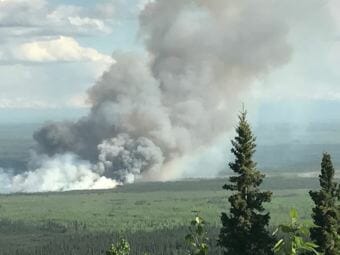
U.S. Forest Service crews are fighting an approximately 2-acre forest fire, burning north of Ketchikan’s road system.

The fire started about 4 p.m. Monday on state land in the Moser Bay area,  Forest Service spokesman Paul Robbins Jr. said Tuesday morning.

“We had firefighters out last night and they were out there overnight, a five-person forest service crew,” he said. “Even though it’s on state land, we’re helping with that because we still have some jurisdiction. We were also assisted by the North Tongass borough fire crew. They were in the water, spraying from there.”

Division of Forestry state forester Chris Maisch confirmed that the Forest Service is the suppression agency in the region, and referred questions about the Moser Bay fire to that agency.

Robbins said the north end of the fire has been knocked down. Crews were focusing efforts on the south end. He said additional crew members are arriving from the Chugach National Forest.

As of Tuesday morning, the fire was not yet contained.

Southern Southeast Alaska has experienced unusually dry weather this year, which has increased fire danger for the surrounding forest.

Robbins said forest fires are not that unusual in Southeast Alaska, even during a normal-rain year.

“We don’t get fires like the Lower 48, hundreds and thousands of acres like we’re seeing in California, but we’ve had over a dozen fires in Southeast Alaska this year,” he said. “They’re usually started by campers not putting out their campfires properly, not dousing them the way they should, or somebody burning trash in a barrel, and the wind picks up some of it and takes it to a nearby tree or brush that’s just dry enough to start.”

Robbins said the average size of a forest fire in Southeast Alaska is a tenth of an acre. Two acres is large for this area.

He said it’s unclear how long it will take to put out the Moser Bay fire. The crew from the Chugach will add 12 more firefighters to the five already there.

North Tongass Fire Department is offering assistance.

Tongass National Forest Facebook page is providing updates about the fire.

Commercial firewood sales proposed for Mitkof Island forest land

The U.S. Forest Service is proposing to offer trees for commercial firewood sales on Mitkof Island.

Personal use firewood cutting already is allowed. But commercial sale of that wood is something that local residents have sought on Mitkof.
“The people in Petersburg and really all over Southeast are allowed to take a tree or couple trees, small volumes of firewood for personal use but the public in Petersburg has expressed an interest in being able to harvest firewood and sawlog material for commercial purposes and they told us that during some public meetings for the Central Tongass Landscape Level Analysis,” said Paul Robbins, a spokesman for the Forest Service on the Tongass National Forest. “In order to be responsive to their requests, the ranger district is seeking a categorical exclusion in order to allow for the harvesting for commercial use within a 70 acre area.”

Federal law requires the agency to analyze impacts from timber cutting and other uses of the forest.

Forest Service will be looking into whether the program can be done without causing a significant impact on the forest land on the island, Robbins said.

“If we can establish that then we don’t have to go through a full environmental analysis or environmental impact statement and we can just move forward with the process of trying to get folks out there getting the wood that they need,” he said. “What’s happening right now is we’ve got all of our, not all of ‘em but we’ve got silviculturists, wildlife biologists, hydrologists and bunch of other experts out there in the field going over these acres to analyze and make sure that if we allow this activity that there will be no significant impact.”

A program of commercial use firewood permits already is offered on the Wrangell District.

Robbins said other micro timber sales have been offered in the Petersburg area before but the volume has been larger than the firewood cutting that residents have asked for.

It’s possible the firewood program could be in place this year, depending on whether a larger analysis is needed.

The proposal could mean harvest of both live and dead trees on an area no larger than 70 acres.

The agency is also considering individual tree sales on the Mitkof road system.

There are five areas on the island proposed for firewood cutting, although the 70 acres extends beyond those five areas.

One site is near Frederick Point. Others are near the 40,000 Road, off the Three Lakes Loop Road and near Woodpecker Cove.

State’s wildfire season ‘largely uneventful,’ according to officials

The smoke plume of the Livingston Fire approximately 15 miles southwest of Fairbanks in the Rosie Creek area as seen from Mile 339 of the Parks Highway early Sunday evening, July 8, 2018.
The smoke plume of the Livingston Fire approximately 15 miles southwest of Fairbanks in the Rosie Creek area as seen from Mile 339 of the Parks Highway early Sunday evening. (Photo by Don Anderson/Alaska Division of Forestry)

A shed and an outhouse.

Those are the only structures that have burned in Alaska’s wildfire season this summer, according to officials.

Wildfires have burned just 270,000 acres in the state this year. That’s far short of the 1.2 million acres that burn during a normal season.

“In the press release I’m just writing up, I used the word ‘largely uneventful,’” said state Division of Forestry spokesman Tim Mowry.

The division is one of several state and federal agencies responsible for fighting wildfires in Alaska.

On Tuesday, those agencies said they’re sending 100 of Alaska’s wildland firefighters out of state. Five crews are flying to Idaho to be dispatched to fires around the Western U.S.

The main cause for this year’s slow fire season? Mowry said there haven’t been any long periods of hot, dry weather.

There have still been 288 fires in Alaska this year. And they’ve burned 425 square miles — more than a third of the area of Rhode Island.

But most of those fires have been far from densely populated areas.

Two blazes are currently getting serious attention from firefighters. They’re outside the tiny village of Chalkyitsik. That’s about 170 miles northeast of Fairbanks.

James Nathaniel is Chalkyitsik’s tribal administrator.

“Everybody was getting excited because you could actually see the smoke coming from the fire,” Nathaniel said.

Lightning started the two fires in early July.

Officials said the area where they’re burning, the Yukon Flats, is among the driest in the state. But firefighters are now making progress in getting them under control.

Even without fires threatening urban areas, the state has still budgeted about $23 million for firefighting and prevention this year.

Some crews have been fighting fires. Others have been working on projects to create barriers, to make it easier to stop fires when they start in the future.

Mowry said it’s worth paying to have crews on hand in case a major blaze breaks out.

“That’s how this business works is, you can’t just flip a switch and have people there, ready to go,” Mowry said. “There’s a lot of planning and training and everything every year that goes into this.”

Spruce beetles take flight in search of new host trees

Spruce beetle outbreak in the Mat-Su Valley seen during the 2017 aerial detection survey. (Photo courtesy U.S. Forest Service)

Spruce beetles may be native to Alaska, but they can still devastate a spruce forest.

The past two years, an outbreak concentrated in Southcentral Alaska’s Susitna River drainage and northwest Kenai Peninsula affected more than 500,000 acres of forest.

It’s the worst infestation since the 1990s.

A combination of factors causes a population to grow to the level of an outbreak, said Jason Moan of Alaska’s Division of Forestry.

“Spruce beetle favors large-diameter, slow-growing trees,” Moan said. “If we have wind events or things like that where a large number of trees might be blown over, you know, beetles tend to favor that material. They’re able to build up populations.”

Warm summers can also play a role because beetles tend to reproduce faster in warmer weather.

It takes one to two years for the beetles to complete their life cycles, and when the weather warms above 60 degrees, female beetles begin to take flight in search of new host trees, sending out pheromones to attract others when they’ve found a tree.

Larger, unhealthy trees are more susceptible to infestations.

“Folks can start keeping an eye on the spruce that they do that are not attacked,” Moan said. “Keeping those watered if they need it. Avoiding damage to those trees.”

Signs of an infestation include clumps of sap and sawdust where the beetles have bored holes in the bark as well as pieces of bark scattered at the base of the tree.

Discolored needles can also be an indicator but not always.

Once a tree is infested, Moan said not much can be done other than to remove it.

Pesticides can be effective in preventing beetles before they take flight but not after.

“In the current part of the beetle flight period, which usually runs from late May to somewhere into July, you know, we would just suggest avoiding cutting green trees,” Moan said. “Unless you’re going to be processing that soon.”

Beetle-killed spruce can be used for firewood and for lumber.

Beetles tend to live on the underside of a tree’s bark.

Moan said that over time, they’ve served as a natural part of forest ecosystems, making room for healthier younger trees, but many landowners want to manage outbreaks to limit the amount of destruction to their properties.

The Division of Forestry and their partners currently are working to develop new tools to help.

Site notifications
Update notification options
Subscribe to notifications