Timber

Crafting a story of romance and resiliency with Tongass bowls

xx
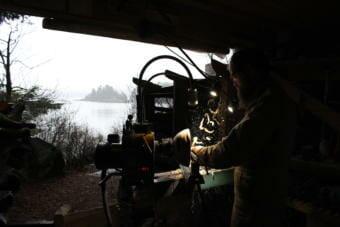
Zach LaPerriere’s workshop in Sitka. (Photo by Elizabeth Jenkins/Alaska’s Energy Desk)

There are very few products made in Alaska from lumber produced in state. That’s despite an ongoing battle over how the Tongass National Forest should be managed.

While timber sales have declined for decades, there are some new initiatives on the table now that could open up more logging.

But one Sitka craftsman doesn’t want that to happen. He’s content using dead old growth, and he makes his living creating bowls from the Tongass without cutting down living trees.

Zach LaPerriere has heard some surprising comments about the wooden bowls he sells at markets.

People reach out to touch them, admiring the detail of an exposed scar and the smooth curves.

“Some would say even sensual,” LaPerriere said with a chuckle. “They’re not my words. I’m just repeating them. I’ve think I’ve heard even more racy words than that,” LaPerriere said.

LaPerriere makes his bowls in an open-air workshop below his cabin, overlooking the water.

Before his creations made customers blush, he was employed as a carpenter.

But he said those skills didn’t necessarily translate when he took up professional woodturning five years ago.

“It really took me a year to become even mildly proficient,” he said.

For starters, the wood is spinning.

While shaping a gnarly chunk of alder into a bowl with a sharp tool, LaPerriere had to think in three dimensions. He spotted a scar that looked like pair of lips, and ribbons of alder went flying.

“I have to walk that line between being efficient and being creative,” he said.

In Southeast Alaska, not many people do this kind of work for a living. There are plenty of hobbyists, but LaPerriere is spending a thousand hours a year creating wooden bowls. He helps support a family of five this way.

Though one of his bowls can fetch up to $1,500, he admitted it’s not always a lucrative business.

Still, LaPerriere said taking this huge career leap aligned with his values.

He wanted to show people what’s inside the trees from nation’s largest national forest and help translate that story.

“Being deeply in love with our rainforest here, I want to understand what’s going on in the tree,” LaPerriere said. “I look for whatever is most unique. It might be a scar. It might be tiny little ambrosia beetles.”

Beetles that leave tiny black holes in the tree. Those are the kind of imperfections LaPerriere wants to highlight when he’s turning a piece of wood. He’s found bullet holes, axe marks from the turn of the century and one of his favorites: buck rubs. Those are the antler markings of a deer looking for a mate.

“Hunters are always looking for buck rubs,” he said. “To see a buck rub from 20 or 30 years ago, that’s an exciting thing!”

Especially spotting it as you dig into a salad bowl.

So the characteristics of the trees vary wildly. But there’s a type of wood LaPerriere said he wouldn’t consider using.

“There’s no need to cut a living tree,” he said.

xx
Some of the bowls LaPerriere creates will dry up to a year or longer before he can bring them to market, depending on the type of wood. (Photo by Elizabeth Jenkins/Alaska’s Energy Desk)

All of the wood piled up in his workshop comes from dead and down trees, which LaPerriere scavenges off the beach or hauls out of the forest himself. He has to goes through a permitting process to be able to do that on national land.

Today, there’s less large-scale industrial logging happening in the Tongass. However, recent changes at the federal level could open up new sites.

That doesn’t sit well with LaPerriere.

“I would liken it to selling your furniture to make your credit card payment,” LaPerriere said.

Instead, he imagines a future where fewer trees are harvested from the national land. And the old growth that is cut down is made into things produced in-state. Things people will want to buy and cherish. That was also identified as a priority by a former Tongass Advisory Committee, which included timber industry representatives.

Even so, LaPerriere recognizes creating wooden bowls like his isn’t the boost to the region’s economy the state is looking for. After all, he’s just one guy. But he thinks there’s something to the model.

“You know, I’m a logger, and I feel great about that because it’s something I can believe in,” LaPerriere said.

Back at his workshop, LaPerriere prepared his alder bowl for a long hibernation in the drying shed. He scribbled the location of where he found the wood on the rim.

In another six months or so, he’ll pull it out again and sand it — putting the finishing touches to get it ready to sell.

He said he likes the idea of bringing beauty into people’s lives with trees from the Tongass. Or, as some customers see it, a little romance.

Shutdown not stopping review of Alaska’s Roadless Rule

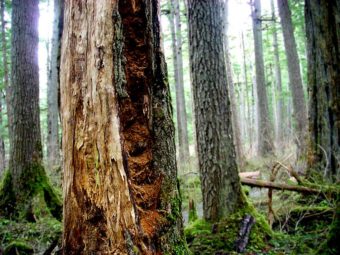
A fire left its mark on this Tongass National Forest tree trunk, as seen in 2008.
The Tongass National Forest. (Creative Commons photo by Xa’at)

The bulk of federal employees will miss two paychecks by Friday, Jan. 25, as the partial government shutdown continues. But the U.S. Forest Service is dedicating paid staff to a controversial initiative in Alaska.
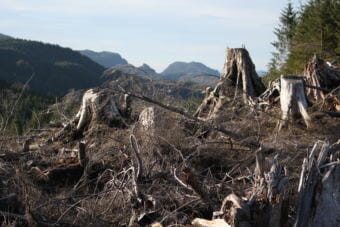
The agency released an update on its website earlier this week, saying it’s still working on “high-priority projects,” such as reviewing how the Roadless Rule applies to Alaska. The rule is a federal regulation most states have to follow, which makes it difficult to build new roads on wilder parts of national lands. Alaska has asked for an exemption to the rule.

It’s been a decades-long battle in the state — centered mostly on the timber industry and energy development in the Tongass National Forest.

In August, the Forest Service said it would review the state’s ask and deliver a draft environmental impact statement by the summer of 2019. Now, despite limited staffing, the agency is still working to meet that deadline.

The Forest Service is using leftover federal funds from last year to pay its employees.

Recently, conservation groups in Alaska criticized the agency for planning a timber sale during the shutdown and for a lack of transparency.

Despite the shutdown, it’s been a dizzying week for a Southeast Alaska timber sale

Logging from the Big Thorne Timber Sale. (Photo by Elizabeth Jenkin/Alaska's Energy Desk) 12/18/17
The Prince of Wales Landscape Level Analysis Project would dwarf the Big Thorne timber sale pictured above. (Photo by Elizabeth Jenkins/Alaska’s Energy Desk)

Despite the partial federal government shutdown, some U.S. Forest Service staffers are still working on a plan for a large timber sale in Southeast Alaska.

Those who oppose the logging are worried their concerns aren’t visible enough during the shutdown. Leaving them to wonder how the agency can keep up with the public record when it’s not fully staffed.

The Southeast Alaska Conservation Council, or SEACC, opposes a federal timber sale that could take place on Prince of Wales Island.

The group wanted to file its objections by the December deadline and managed to submit its complaints the day before the government shutdown.

Buck Lindekugel, SEACC’s attorney, assumed the proceedings would be on ice. After all, dozens of Forest Service staff in Alaska aren’t receiving a paycheck, and many of them aren’t even at work.

“We were surprised there was any activity going on with the Forest Service,” he said. “Particularly with this controversial timber sale.”

According to the Forest Service’s website, work that should be prioritized during a government shutdown includes protecting public safety and assets.

For example, there’s avalanche forecasting still happening in the Chugach National Forest. On Prince of Wales, some Forest Service employees are responding to a recent landslide.

On Tuesday, SEACC received an invitation confirming another thing. Forest Service staff are continuing to work on the timber sale SEACC objected, and the project is seemingly on schedule.

The Forest Service planned to hold a public meeting next week in Klawock to address the objections to the plan — basically, another milestone that moves the process along. But there’s no notification of it on the agency’s website.

Lindekugel said there’s also another thing missing.

He tallies up the people who’ve submitted some kind of objection. Their names are visible from the Forest Service’s website, but not the content of their objections.

“The way for the general public to participate in this process is to go onto this page and click on these objections,” Lindekugel said. “And see what the problems people have with this proposal, and they can’t.”

Lindekugel said it makes it difficult for his organization, too. How do you prepare for a meeting that’s a week away when you don’t have all the information?

Owen Graham, the executive director of the Alaska Forest Association, said that’s not an issue for him.

“There’s not an opportunity to sit around and talk with the other objectors and horse trade or bargain,” Graham said.

Graham represents a timber industry group. He has objections to the Forest Service’s plans, too. He doesn’t object to the sale itself, but he wants to see a different version of the sale to go through.

So he’s glad things are moving along, and he wants the meeting in Klawock to happen.

“If they delay these objection meetings, then it will be that much longer until we get a timber sale,” Graham said. “And there will be greater risk that people will be out of work because of it.”

The Forest Service did send Lindekugel the other objections this week after he requested them.

Still, he believes important documents are slipping through the cracks that would inform a public meeting.

“Call a timeout on this damn thing,” Lindekugel said. “Slow down. There’s not need to rush ahead. Push the clock back to where it was before before the shutdown occurred.”

On Thursday, Lindekugel received yet another email from the Forest Service. It said next week’s objection resolution meeting in Klawock is canceled. It didn’t give a reason why or provide another timeline.

A spokesperson for the Forest Service said they’ll update the website about other happenings on Prince of Wales Island soon.

Amid environmental grief, finding hope in a graveyard of yellow cedar

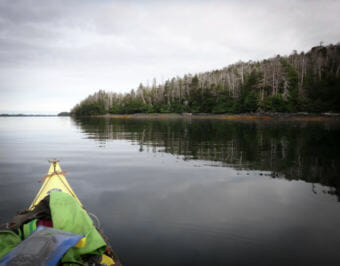
Lauren Oakes paddles to a research site in the West Chichagof-Yakobi Wilderness of Southeast Alaska. (Image credit: Lauren Oakes)
Lauren Oakes paddles to a research site in the West Chichagof-Yakobi Wilderness of Southeast Alaska. (Photo courtesy of Lauren Oakes)

Scientists have known for a while why yellow cedar is dying across its range. Without a blanket of snow in the spring, the roots can freeze during cold snaps.

Climate change has been linked to killing at least a million acres of trees across the Pacific Northwest. So one ecologist wondered, for the yellow cedar forests and the people who care about them, what comes after environmental loss?

Lauren Oakes says a dead standing yellow cedar tree looks out of place, like a telephone pole on the landscape.

Over time, the branches fall off. What you’re left with is a ghostly hull. It’s the kind of image that leaves an impression.

“It made climate change that much more real to me,” Oakes said. “It often seems like it’s something future or far off or not affecting me yet.”

 Oakes is an ecologist, and she calls yellow cedar “the canary tree.” As in that old saying, “The canary in the coal mine” — a sign of impending danger. However, Oakes is quick to point out she doesn’t see yellow cedar’s fate as a doom-and-gloom story.

“It is a story of loss. But it’s also a story of regrowth,” Oakes said.

Yellow cedar is an iconic species that grows from the top of California all the way to Prince William Sound. It has been used for centuries by indigenous carvers and weavers. And commercially, it’s some of the most valuable timber for harvest. But yellow cedar is declining across its range, and that decline is expected to continue. The U.S. Fish and Wildlife Service is considering listing it as “threatened” under the Endangered Species Act.

Oakes says the science on why the decline is happening is pretty much settled: Warming is largely to blame. So, as part of her doctoral research, she traveled to Southeast Alaska with a different set of questions in mind: “How is the forest community changing in response to the death of these trees, and how might people be coping with those changes in their community?”

That is, how could she still find hope in a forest that’s turning into a graveyard?

To answer her first question — how the ecosystem itself is changing — Oakes set out to survey dead stands of yellow cedar across the region. A task she said was overwhelming because of the volume.

But she found the forest was adjusting: New tree species were growing in the newly-opened understory, and shrubs were coming up that deer like to eat. Oakes said focusing on that regrowth gave her some hope.

She also interviewed people affected by the loss and found they were adjusting, too. Oakes spoke to the late Tlingit weaver Teri Rofkar. During their conversations, Rofkar referred to yellow cedar as the “tree people.”

She appears in this Rasmuson Foundation video from 2013, gathering materials outside for weaving.

“So you look for an areas where there’s just moss starting to mature,” Rofkar explains.

In the video, Rofkar is looking for spruce roots. She explained to Oakes she was using them more in her weaving as a substitute for yellow cedar.

Rofkar thought yellow cedar could use “a break,” due to climate change.

“She was someone who had a real emotional tie to these trees,” Oakes said. “(She) certainly talked of the grief she was experiencing. But it was also something that inspired her to not only share with others the importance of offering some restraint for these trees, themselves, but then educate others about climate change.”

Like Oakes, other scientists are also starting to document more examples of environmental grief to understand how humans are adapting to a warming planet.

Oakes said acknowledging a personal loss — in this case, a culturally valuable tree species — may lead to less apathy and potentially more individual action.

It can spark a feeling of, “Wow, this is bigger than me. This is hitting home. How can I cope with that?”

Oakes recently wrote a book about this feeling called “In Search of the Canary Tree,” which is about her time spent doing research on yellow cedar in Southeast Alaska.

She said despite the tremendous loss, life is still growing. She thinks people can still change the narrative.

Why Mount Jumbo won’t be logged anytime soon

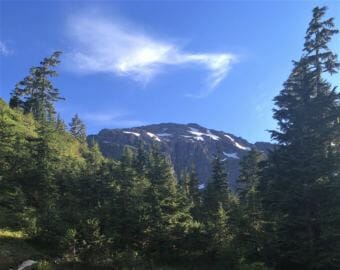
Mount Jumbo, also known as Mount Bradley, from the trail. (Photo by Adelyn Baxter/KTOO)
Mount Jumbo, also known as Mount Bradley, seen from the trail. A land exchange between the Alaska Mental Health Trust Authority and the U.S. Forest Service will transfer ownership to the federal government. (Photo by Adelyn Baxter/KTOO)

The Alaska Mental Health Trust Authority board approved its largest land exchange to date Thursday.

Through the deal, up to 40,000 acres of land in and around Southeast communities will change hands between the Trust and the U.S. Forest Service.

The land exchange is the culmination of more than a decade of work by stakeholders and took acts of both Congress and the Alaska Legislature to make it happen.

Once all is said and done, about 18,000 acres of land owned by the Alaska Mental Health Trust Authority will be swapped for roughly 20,000 acres of U.S. Forest Service land.

“We don’t know the exact acreage because it’s based upon equal value, so we’ll see in the end,” said Wyn Menefee, executive director of the Trust Land Office.

The Mental Health Trust owns land all over Alaska, and its goal is to use them to generate money to pay for services for beneficiaries.

Often, that means earning funds through logging and mining. But some of the trust’s lands in Southeast border residential neighborhoods and sites for outdoor recreation.

That includes 2,689 acres around Mount Jumbo, also known as Mount Bradley, a scenic hiking destination in Juneau.

The same goes for Deer Mountain overlooking Ketchikan and similar parcels near Petersburg, Sitka and Wrangell.

Those lands will now be owned and protected by the Forest Service.

“All the lands that we’re receiving are going to be lands that people can access or recreate on,” said Forest Service spokesman Paul Robbins Jr. back in November. “Whether it’s remote recreation or semi-remote recreation, we are supposed to manage these lands for that, including the development and maintenance of recreational trails.”

In exchange, the trust receives federal lands on Prince of Wales Island for logging. They also have a contract with Viking Lumber on Prince of Wales — one of the last working sawmills in Alaska.

With that deal, the trust expects the 10-year sale of old-growth timber to generate up to $15 million for the trust.

But that’s just some of the land involved. Menefee said the entirety of the land they’re getting from the Forest Service will generate millions more in the decades to come.

He said the exchange is a win-win — they gave up lands communities did not want to see logged, and now they can use existing logging infrastructure on Prince of Wales.

“So this puts us in a situation where we can actually make revenues from lands that we get through this exchange, which will help the beneficiaries,” Menefee said.

While residents in those communities may be relieved that nearby lands will be protected, some on Prince of Wales view the exchange as just another instance where they bear the burden of resource development.

Cheryl Fecko has lived in Craig, Alaska, for nearly 40 years. She said she and many of her neighbors are concerned by the impact logging has on species like salmon and deer, which many people rely on for food in the remote community.

“We have over 1,000 miles of road and a patchwork of clear cuts in various stages of regrowth, but honestly I think that’s kind of reason to maybe not go immediately to Prince of Wales instead of always using it as the ‘sacrificial lamb of the Tongass,’” Fecko said.

Menefee said the smaller first phase of the land exchange — which involves two mountains near Ketchikan and timber lands on Prince of Wales — should finalize later this month.

He said Viking could begin processing lumber by February.

Alaska’s top forester talks timber in Southeast

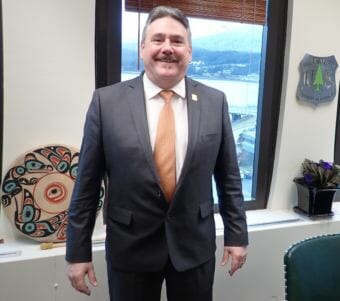
Dave Schmid, photographed at his Juneau office on Dec. 12, 2018, has been the U.S. Forest Service’s regional forester for Alaska since April 2018. His appointment was made permanent in November. (Photo by Jacob Resneck/CoastAlaska)

The appointment of the U.S. Forest Service’s top official in Alaska was recently made permanent. Dave Schmid oversees 22 million acres in the Tongass and Chugach national forests.

He replaced Beth Pendleton who spent eight years in the job.

Schmid didn’t tip his hand to where he stands on proposals to roll back back the federal roadless rule in Tongass National Forest.

The state of Alaska has repeatedly taken the agency to court over the rule, though public hearings held in recent weeks were largely packed with roadless rule supporters.

He said six alternatives are currently under consideration by his agency.

“One of those is the ‘no action’ alternative, and bookending the other is a full exemption (to the roadless rule),” Schmid said.

Asked about the balancing act required for managing the Tongass and Chugach national forest lands, Schmid spoke of his office’s commitment to all facets of the region’s economy, including timber.

“Recreation, tourism, fishing are a vital part of our economy, as is mining and timber development,” Schmid said in an interview. “And right now, the mill at Viking Lumber on Prince of Wales is kind of of the last of the moderate-sized mills. And while it’s not very big it’s a very important piece of those communities.”

Schmid also reaffirmed that the agency seeks to eventually move away from old-growth timber sales. But he said it’ll be a gradual process; indeed, a new old-growth sale was recently announced.

“Regeneration is not a problem in this part of the world,” Schmid said. “And if you walk through some of these legacy, larger clear-cuts, trying to manage those into the future is really important. And so trying to actively thin for wildlife and habitat is really important.”

He also said the Forest Service is moving to improve the work environment for its staff at all levels.

The Forest Service’s chief in Washington resigned earlier this year over allegations of serial sexual misconduct.  A subsequent investigation found widespread complaints at the regional level.

“We’ve spent time internally with our employees,” he said. “We’ve done a number of things, including chartered an employee advisory group, that I meet with regularly to hear from a cross-section of folks, and we have taken several steps both nationally and in the region for our work environment.”

Schmid had served as the acting regional forester for Alaska since April before being made permanent in November. He was previously the deputy regional forester for the Northern Region. That region manages over 25 million acres of federal forestland in five states. Much of his agency career has been in Alaska. He worked 23 years in both the Chugach and Tongass national forests.

Site notifications
Update notification options
Subscribe to notifications