Timber

US-China trade dispute stalls timber sale negotiations in Haines

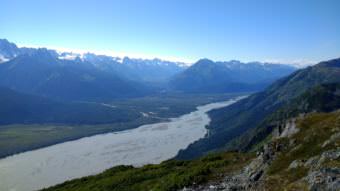
The Chilkat River as seen from Mount Ripinsky in summer of 2017. (Photo by Emily Files/KHNS)
The Chilkat River as seen from Mount Ripinsky, north of Haines, in summer of 2017. (Photo by Emily Files/KHNS)

Negotiations between the University of Alaska and a Chinese buyer ground to a halt last month as a result of an escalating trade war between the U.S. and China. The sale is on hold until there is a change in tariffs.

Morgan Howard from the University of Alaska Land Management office said the potential buyer is still interested in a timber contract. But not right now.

Tariffs on American timber headed to China have put the university’s negotiations on hold.

“The potential bidder for the timber sale does not see this time as a good time to engage with the tariffs being as high as they are,” said Howard. “So we’ll see what happens in the future, but we don’t see negotiations resuming until there is a change in the tariffs.”

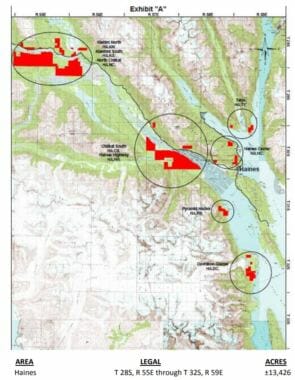
The 13,426 acres is scattered throughout the Haines Borough. (Map courtesy of the University of Alaska)

The current tariff on spruce logs exported to China is 25%. Howard said they are still looking at infrastructure, permitting and potential markets for the spruce and hemlock on 13,000 acres of university land around Haines.

Conservation groups want to keep the forests standing. So the clash between the President Donald Trump’s administration and China is working in their favor.

“It’s amusing to say the least,” said Jessica Plachta, the director of Lynn Canal Conservation.

Plachta said she’s opposed to the sale because of logging’s ecological impact, especially to wildlife and subsistence resources. She said from an economic standpoint, the university could actually make more money trading their trees on the carbon market than cutting them down.

“The carbon credit market is turning out to be more reliable than global export for timber,” she said.

The university timber sale could make about $10 million over 10 years — if tariffs go down. A study put together by Takshanuk Watershed Council, another local conservation group, said a carbon sale of the university’s land could earn millions of dollars up front, followed by yearly earnings in the hundreds of thousands of dollars after that.

Those earnings would not be affected by tariffs. In fact, Plachta predicts the value will only go up as the need for carbon sequestration increases.

“If it was me, I would say, ‘Let’s see less effort, more money.’ Right?”

Carbon credits are something the university’s land management office is considering. Howard said they are still in the early stages of conversation on the subject, and it hasn’t been ruled out for the land near Haines. But he hasn’t given up hope that a regional timber industry could thrive.

“Initially, there was a vision for the Chilkat Valley that all of the landowners would work together in regard to harvesting timber,” he said. “If they all work together, then there could be a long-term timber industry put into place.”

That vision is on hold until trade conditions improve.

Is the USDA now leaning toward a full exemption of the Roadless Rule in Alaska?

Lena Loop trail near Juneau in the Tongass National Forest.
Lena Loop trail near Juneau in the Tongass National Forest. (Creative Commons photo by Gillfoto)

President Donald Trump is pushing for a full exemption of the Roadless Rule in Alaska, according to a Washington Post story published this week.

It’s what Alaska Gov. Mike Dunleavy and U.S. Sen. Lisa Murkowski, R-Alaska, have been advocating for. But it’s a big departure from what most people say they’d like to see happen in the nation’s largest national forest.

Recently, the president made a dad joke about Dunleavy on a phone call at a private political event in Soldotna. But he also referenced a few of the governor’s priorities.

“He’s doing something with your logging and all your other things.” Trump said. “We’re working on that together, and that’s moving along now.”

The U.S. Department of Agriculture is deciding right now if new roads should be built in the Tongass National Forest and to what degree. It could increase access to new stands of old-growth trees and, Murkowski says, renewable energy projects.

One option is to fully roll back the Roadless Rule in Alaska. But that’s one extreme.

The Roadless Rule has been in place for two decades across the country. And it makes it difficult to build new roads on national lands.

Niel Lawrence, a senior attorney with the Natural Resource Defense Council, thinks fully exempting the Tongass from the Roadless Rule is a bad idea.

“I think what we would see, as a practical matter, is a substantial increase in road building,” Lawrence said.

Lawrence doesn’t think repealing the Roadless Rule would restore Alaska’s struggling timber industry. Despite an increase in access, he said it’s not easy to make federal timber sales pencil out.

“Southeast Alaska is a really challenging, difficult, terrible place to run a logging industry,” Lawrence said. “It’s one giant wetland. It’s remote.”

But he said a full exemption could open up the floodgates for other types of environmental damage. For example, the agency could be allowed to build roads in areas designated as important habitat for deer or salmon.

Read more coverage on Alaska’s Roadless Rule debate

Murkowski thinks that’s jumping to conclusions.

“If you were to have a full exemption, it doesn’t mean that all of a sudden anywhere anyone wants to put something, it’s going to happen,” Murkowski said. “I think it’s reactionary, and I would just urge greater caution.”

Residents in the Organized Village of Kake are concerned sweeping changes could affect the habitat in their backyard.

Kake Tribal President Joel Jackson said the salmon streams in Kake are still healing from the industrial logging of the past. He doesn’t want the see a full exemption being considered today, though he suspects it might be a possibility.

“As we move forward here and the economy gets tighter and tighter, it’s going to be more important to our community that we have food security,” Jackson said.

In an emailed statement, the U.S. Forest Service said it was still looking at a “range of alternatives to roadless management.” The agency expects a draft environmental impact statement to be released this fall and a final decision in 2020.

Murkowski supports a ‘complete exemption’ for Tongass from Roadless Rule

U.S. Sen. Lisa Murkowski, R-Alaska, answers questions in a studio at KTOO on Aug. 13, 2019, in Juneau, Alaska. (Photo by Rashah McChesney/KTOO)

A decision by President Donald Trump’s administration over exempting the Tongass National Forest from the Roadless Rule is expected soon.

That’s according to U.S. Sen. Lisa Murkowski, R-Alaska, who said Tuesday that rolling back restrictions to roadbuilding is crucial for Southeast Alaska’s economy.

“I, very early on, went to the Trump administration and said as we look to the state of Alaska and the application of the Roadless Rule, we have to be able to have a plan that is specific to us,” she said Tuesday.

The head of the U.S. Forest Service was directed by U.S. Department of Agriculture Secretary Sonny Perdue last summer to initiate an Alaska-specific rule for the Tongass.

A 90-day comment period last fall received over 144,000 comments, and the majority expressed opposition to rolling back protections. According to the Forest Service’s summary, a minority of comments supported a full exemption from the Roadless Rule for Alaska — which is what Murkowski is advocating.

“I think complete exemption from the Roadless (Rule) is what is best suited for Alaska,” Murkowski said. “We’re encouraging the secretary of Agriculture as he is moving forward with these decisions to include a full exemption as one of the preferred alternatives. At this moment in time, we’re still waiting. In fairness, I thought we would already have it by mid-August.”

The next step for the Forest Service is the release of a draft environmental impact statement. That could include a full exemption or some hybrid rule for the Tongass.

Another public comment period would be held before a final report is released in 2020.

Conservationists are concerned that exempting the Tongass from the Roadless Rule would open up large tracts to commercial old-growth logging.

Forest Service chief makes quiet visit to Tongass National Forest

Sen. Lisa Murkowski and U.S. Forest Service Chief Vicki Christiansen visited Naukati July 6 on Prince of Wales Island where the forest service completed a land swap with the Alaska Mental Health Trust. (Photo courtesy of Senate Energy & Natural Resources Committee)

Sen. Lisa Murkowski recently hosted the U.S. Forest Service’s top official in a visit to Tongass National Forest. The delegation kept a low profile during its visit to Southeast Alaska.

Back in a mid-May budget hearing, Murkowski quizzed Forest Service Chief Vicki Christiansen. She wanted to know why recent timber sales in Tongass National Forest had no takers. And what was the Forest Service doing about it?

“It is a challenge and I’d be glad to work with you more even come up to Alaska that we can roll up our sleeves and really look at this,” Christiansen replied.

Murkowski — who chairs the powerful Senate Energy & Natural Resources Committee — acted on this opening.

“I welcome you up to this state any time summer, winter, spring fall,” she said.

Christiansen chose summer. She spent July 6 and 7 in Wrangell, Ketchikan and Prince Wales Island as part of a flying visit with Alaska’s senior senator.

At a Saturday morning meeting in Wrangell, the delegation heard from the timber industry and its boosters.

“There was discussion about making sure that we’re able to keep the one remaining mill in Southeast operational,” Wrangell Borough Manager Lisa Von Bargen told CoastAlaska on Friday.

That would be Viking Lumber Mill on Prince of Wales Island which employees a few dozen people.

“And they’re struggling to get enough wood to keep going,” said Frank Roppel, a veteran figure in Southeast Alaska’s logging industry who sat in on the meeting.

The octogenarian was a top Alaska Pulp Corporation executive. In its day, the company was a top regional employer, operating a sawmill in Wrangell and a pulp mill in Sitka from the 1950s until the ’90s.

Roppel told CoastAlaska that the forest service chief asked good questions and was receptive to concerns over timber supplies for commercial logging.

“We were encouraged that there’s some interest and willingness to try and help the industry,” he said.

The exclusive gathering in Wrangell included about 10 business people and civic leaders and discussed the Trump administration’s controversial effort at crafting an exemption from the 2001 Roadless rule that would allow logging in more undeveloped parts of the Tongass.

But at a roundtable of tribal leaders in Ketchikan the delegation heard a different perspective.

“We prefer that there is no change the forest plan and I think most of the tribes are going that way,” said Ronald Leighton, president of the Organized Village of Kasaan on Prince of Wales Island.

He says he used the audience with the Forest Service delegation to press for preferential access to old growth red cedar for traditional carvers.

“When we did our longhouse we were having trouble finding quality cultural logs for that,” he said. “So, in fact, we had to buy from Sealaska.”

None of the meetings were publicized in advance. The visit was only announced nearly a week later in a July 12 press release.

But if it had been, the delegation would likely have gotten an earful from opponents to old growth logging in the Tongass.

“We’re really sorry that Lisa Murkowski and chief Christiansen missed the Turnout for the Tongass Rally on June 22 in Juneau where 150 Alaskans turned out in support of the national roadless rule,” said Dan Cannon, Tongass Forest program manager for Southeast Alaska Conservation Council, an environmental group.

Past public hearings and written comments have been overwhelmingly supportive of keeping the roadless protections for approximately 9.2 million acres in place.

The Forest Service is expected to hold public hearings to a draft environmental impact statement for an Alaska-specific Roadless Rule later this year.

“I would hope that Chief Christensen comes back during the public comments and the public meetings to actually hear from Alaskans,” Cannon said, “and travel to places beyond Ketchikan and Wrangell and go to Juneau go to Sitka and hear from larger swath of Southeast Alaskans.”

Secretary of Agriculture Sonny Perdue, left, and U.S. Sen. Lisa Murkowski talk July 5 with Kirk Dahlstrom at the Viking Lumber mill in Klawock. The mill is the largest private employer on Prince of Wales Island. (Photo by Leila Kheiry/KRBD)

The delegation also visited Naukati on Prince of Wales Island where the Forest Service completed a land swap with the Alaska Mental Health Trust.

There was a Saturday visit to Staney Creek where the delegation met with the local branch of The Nature Conservancy which has partnered with the agency to undertake watershed restoration.

“We talked about past work and collaboration between the Nature Conservancy in the Forest Service,” said Michael Kampnich, the nonprofit’s field representative on Prince of Wales Island.

Commercial logging didn’t come up in those discussions, he said.

The trip was almost exactly a year after Sen. Murkowski brought Agriculture Secretary Sonny Purdue to tour the Viking Lumber mill on Prince of Wales Island. That visit had the usual fanfare with media in tow.

This time around, the Forest Service chief opted to keep a low profile in Alaska. But why?

“This was a relationship building visit with Senator Murkowski in the State of Alaska,” Babete Anderson, a spokeswoman for the Forest Service in Washington, D.C. said in a statement in response to questions from CoastAlaska.

Tonya Parish, a spokeswoman for the Senate committee that organized the trip, said in a statement that current protocol is to almost never give advance notice of visiting high-ranking officials and that the itinerary didn’t allow for public meetings or media interviews.

She declined further comment.

With additional reporting from KFSK’s Joe Viechnicki in Petersburg.

Escalating tariffs, lingering questions hamper University of Alaska timber sale in Haines

The University of Alaska announced a timber sale in the Haines area last year. That contract remains unsigned.

There are various factors slowing the 10-year timber sale the University of Alaska announced last March.

“There is no contract signed yet,” said Morgan Howard, the Liaison for the University of Alaska Land Management office. “The potential buyer is still estimating the overall volume and looking at the infrastructure that’s needed, such as log transfer facilities, also monitoring potential tariffs.”

This map shows 13,426 acres of land scattered throughout the Haines Borough that the University of Alaska owns and is negotiating a timber sale of.
This map shows 13,426 acres of land scattered throughout the Haines Borough that the University of Alaska owns and is negotiating a timber sale of. (Courtesy of the University of Alaska)

The Land Management office previously announced it would hire a local caretaker for the land, but Howard says that is on hold until a contract is signed.

This isn’t the first delay. In November of last year, Land Management cited a slowdown in negotiations.

This time, Howard says that timing and infrastructure are the issue. He says the university wants to time the harvest with adjacent landowners: the state and the Mental Health Trust. That way they could share resources.

“The vision was this could be a continuous long term employer in the Chilkat Valley. A small industry that could be viable if everybody worked together. So far it’s just us that’s moving forward,” Howard said.

And though the harvest would eventually require a log transfer facility in the Haines area, he says they could get started without one.

But the last big issue is one that the University really can’t control: the market. The tariffs that Howard says the university are monitoring are part of what’s been called a trade war between the U.S. and China. Tariffs are important here because Howard has said the timber from the Haines sale would go to China.

Rose Braden says the top U.S. markets are Canada, Mexico, China and Japan. She’s the executive Director of the Softwood export council in Portland, Oregon. She keeps tabs on the $950 million U.S. export market for softwoods—including the spruce, hemlock, and lodge pole pine that grow around Haines.

Last year, the Trump Administration placed a tariff on many Chinese imports. The Chinese government answered back with a 10 percent tariff on certain U.S. products, including timber.

Braden says the market for softwoods has been relatively stable for the last four or five years. But softwood exports to China?

“If you look at first quarter 2018 versus first quarter 2019 we had a 54 percent decline,” Braden said.

Fifty four percent is significant. And that’s a decline after the imposition of ten-percent tariffs. This month China increased the tariff to 25 percent.

Back at the Land Management office, Howard says he can’t predict what may happen with trade between now and the sale. And again, that cooling market is one of many factors.

He didn’t acknowledge any causality, but now the University is looking at what kind of money it could make by keeping trees in the ground. Last year they dismissed a suggestion from the community to consider selling carbon credits instead of harvesting timber. That’s a program where big polluters in California can offset their impact by buying credits, which represent real carbon sequestering things like trees. Sealaska made a multi-million dollar deal to do that last year.

“We’re working with everybody knowledgeable in Southeast in regards to carbon credit. There are a couple firms we’re talking to we’re talking to a couple of landowners that have already has sales,” Howard said.

He says participation in the program is still a few years out. It wouldn’t just be for the Haines area—it’s on the table for all university land. In the meantime, they’re still moving forward with the timber sale. But he says ten years is a long time, so some of the land in the Chilkat Valley could potentially be sold in the carbon credit program.

This ice cream stand was constructed out of local wood. Here’s why that’s unique.

Marc Wheeler, the owner of Coppa, is enthusiastic about ice cream and wood. He has a couple of pieces constructed from old growth trees at his brick and mortar store. But he's not in favor of large scale industrial logging. He opted to use young growth wood at his latest location. (Photo by Elizabeth Jenkins/Alaska's Energy Desk)
Marc Wheeler, the owner of Coppa, is enthusiastic about ice cream and wood. He has a couple of pieces constructed from old growth trees at his brick and mortar store. But he’s not in favor of large scale industrial logging. He opted to use young growth wood at his newest location. (Photo by Elizabeth Jenkins/Alaska’s Energy Desk)

Some big decisions are being made right now that could affect how the Tongass National Forest is managed. The conversation has largely centered on old growth logging.

Should the U.S. Forest Service move away from selling its oldest trees? Originally, the plan was to transition to a different type of timber economy altogether: young growth.

But there are still questions about how to make that industry viable.

One business owner wants to have that talk over ice cream.

Lately, there’s been a bit of a building frenzy at a new Juneau food cart alley. It’s tucked away from the typical bustle of cruise ship passengers.

But you can still spot them with cameras wrapped around their neck.

One of the flagship carts wants those visitors sample a taste of Alaska. It’s an unusual way to eat a salmon.

“You know, it’s kinda fun to think of, ‘Oh, when you’re in Juneau, you have to have the salmon ice cream,’ right?”

Marc Wheeler is the co-owner of Coppa. Other selections from his cart include spruce tip and devil’s club ice cream.

He wants his customers to consider where these flavors come from: the Tongass National Forest. And today, Wheeler is taking another step to reinforce that message.

A flatbed truck arrives carrying a large wooden arch. It’ll be the focal point for Wheeler’s operation. A kind of mini-carport for the ice cream stand, where customers can lick their spoons without getting caught in the rain.

What sets this structure apart is the material it’s being built from: locally milled spruce trees that are only about 50-years old. On an ecological scale, that’s a young tree.

For Wheeler, it was about more than creating something from a niche product. It’s a statement.

He doesn’t think there should be large scale old growth logging in the Tongass.

“Being a business owner, you have all these ways to have a positive impact,” Wheeler said. “These choices of how you buy things can make a big difference.”

Wheeler intentionally sought this wood out and found one family sawmill near Tenakee Springs producing the material.

To be clear, you can run down to any hardware store and buy two-by-fours made out of young growth trees. The lumber just won’t be from Alaska.

That’s something Conor Reynolds from The Nature Conservancy would like to see changed.

“Maybe it’s idealistic or optimistic. But it’s a nut that needs to be cracked,” Reynolds said.

Right now, the nation’s largest national forest is at a crossroads. Federal old growth timber sales were supposed to be phased out over the span of 16 years.

But recent efforts by the State of Alaska and Sen. Lisa Murkowski could undo that. A top federal official is making a decision this summer that could impact transitioning the region’s economy to young growth.

Still, Reynolds thinks the already struggling timber industry can’t sustain itself on a supply of old growth trees forever.

“The death knell is kind of sounding on it,” he said.

He says much of the old growth in the Tongass has already been logged. And the Forest Service has had trouble making the timber sales it does offer pencil out. There’s also ongoing litigation from environmental groups.

So, if there’s going to be a timber industry in Southeast Alaska at all, Reynolds believes cutting young growth trees is the future.

But he acknowledges there are challenges, like convincing investors to take the leap in an already crowded market.

“Some entrepreneur up here would have to find a product that they can make from it that isn’t in direct competition with a place, you know, in Shelton, Washington that’s going through half a billion board feet a year.”

Some small sawmills are creating products in limited runs — making items like shingles and lumber to be sold in state. But, Reynolds says creating more jobs from this is still in its early days.

Back at the food cart alley, builder Steve Klinger is drilling red corrugated metal on top of the young growth wood.

The showpiece — an arch which will be the gateway to Coppa’s ice ice cream stand — has been charred with fire.

Klinger explains it’s a Japanese technique called shou sugi ban that prevents the wood from molding. But another one of the design elements isn’t intentional.

One of the pieces of lumber warped in the sun. There’s a reason young growth typically fetches a cheaper price than old growth. Younger trees have fewer rings in them, which means the wood isn’t always as strong as its counterpart.

Klinger says that might faze some builders.

“An older guy that’s cut wood his whole life would look at it and sort of probably kind of spurn it a little bit,” Klinger said.

But Klinger just saw it as a happy accident. It’s now the curved top of the arch, where customers can nibble bites of spruce tip ice ice cream under what was once a young spruce tree.

A note of disclosure: Marc Wheeler serves on the Alaska Public Broadcasting Commission.

Site notifications
Update notification options
Subscribe to notifications