Timber

Two of Alaska’s biggest exports are caught up in the US-China trade dispute

salmon-displayed-in-a-seafood-restaurant-in-china (Photo C/O Sea Grant)_
Salmon displayed in a seafood restaurant in China. (Photo courtesy Alaska Sea Grant)

As President Donald Trump’s trade dispute with China continues to drag out, some of Alaska’s biggest exports expect to be hit with even steeper tariffs than they’ve seen in recent months.

Now the timber and seafood industries are trying to figure out how to do business as the pressure mounts.

The Alaska Seafood Marketing Institute is always on the lookout for innovative ways to create demand for the state’s catch. Sometimes that includes sending salmon to influencers on Instagram.

Other times, it’s strategizing how to get more of the product into the global market. Jeremy Woodrow, a director at the organization, said that’s what they’ve always done.

“But the urgency is probably greater than it has been in recent years,” he said.

That’s because some types of fish caught in Alaska could be 25% more expensive when the product is sent to the markets in China — a country that buys about a quarter of the state’s seafood by value.

Earlier this week, China’s Ministry of Finance announced it would be increasing tariffs — a move prompted by Trump’s latest wave of tariffs imposed on Chinese goods.

The tariff increase cuts both ways. Processed seafood that’s exported back to the U.S. could be subject to a 25% tariff imposed on China.

President Donald Trump speaks to more than 100 Airmen, Sailors, Soldiers, Marines and Coast Guardsmen at Joint Base Elmendorf-Richardson, Alaska, Feb. 28, 2019. The president was at the base to meet with service members after returning from a summit in Hanoi, Vietnam. His plane refueled before continuing to Joint Base Andrews, Maryland.
President Donald Trump speaks to more than 100 Airmen, Sailors, Soldiers, Marines and Coast Guardsmen at Joint Base Elmendorf-Richardson, Alaska, Feb. 28, 2019. (Public domain photo by Staff Sgt. Curt Beach/U.S. Air Force)

Woodrow said that’s created some uncertainty for Alaska’s seafood industry.

“When a product is now subject to increased tariffs, that makes that product more expensive to consumers,” Woodrow said.

And those consumers might just go for a cheaper alternative to Alaska’s wild-caught fish. But Woodrow said the industry is already thinking about some workarounds. Right now, Alaska seafood is processed and sold in China. That’s where the tariffs stack up.

But having the fish processed in Poland could be a way to avoid that.

So Woodrow doesn’t think it’s all doom and gloom.

“There is reason to be concerned,” Woodrow said. “However, I don’t think the sky is falling yet.”

But the situation is very different for Eric Nichols at Alcan Forest Products in Ketchikan.

“We don’t have many options to put that log in another marketplace,” Nichols said. “And so we’re very dependent upon what happens with that Chinese market.”

Nichols will be on the hook for a 20% tariff for spruce trees shipped to his biggest customer: China.

His company sends mostly barges of young-growth trees harvested from Southeast Alaska to the country, and he said that’s the problem: He doesn’t have enough high-value product to help ride out the volatility.

“When we don’t have the access to old-growth anymore, then we don’t have those diversity of markets,” Nichols said. “So if we have one interruption like these tariffs, then it puts you in a situation where you got to decide whether you’re going to be able to stay in business or not.”

That’s a big concern among Southeast Alaska’s small, struggling timber industry.

A few efforts underway could result in more old-growth trees being harvested in the region. But in the meantime, Nichols is trying to get by now, and he said this trade dispute is making it harder.

Still, he’s not ready to stop his operations just yet.

“You want me to lay off everybody?” he asked. “I have bank payments. I have equipment payments. I have employees that depend on us for a very regular paycheck.”

The tariffs increase on U.S. exports could take effect June 1 if a deal between the White House and China isn’t reached.

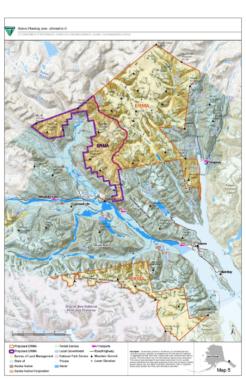
Bureau of Land Management seeks public comment on management plan for land around Haines and Skagway

(Image courtesy of the Bureau of Land Management)

The Bureau of Land Management is accepting public comment on changes to its Resource Management Plan for land surrounding Haines and Skagway. The department took public comment on the plan in 2018. This year they released three new potential management strategies using that feedback.

The bureau oversees more than 320,000 acres of land in the Haines and Skagway areas. They are seeking public input on what is called the “Haines Amendment” of their regional land management plan. Essentially, this is a contract with the public on how the land will be managed. It will guide land use decisions over the next 15-20 years.

The BLM crafted three plans that represent different ways to balance conservation and recreation uses of the land.

“Alternative G provides for the most balance in the resource needs and uses of the public land,” said Marnie Graham, the Field Manager at the Glennallen BLM office.

“That’s where we landed on the alternative. We looked at all the different stakeholder input and we feels this provides the most balanced approach.”

The big decisions on the table are whether to increase permitted helicopter landings, whether to add special land designations, and if they will lift monitor and control areas for wildlife studies.
Alternative G is the agency’s preference. It significantly increases the number of helicopter recreation landing permits available and opens up previously buffered areas to helicopter recreation. Permitted helicopter landings would eventually increase to 11,000 per year. The agency plans to slowly increase the number of permitted landings over time to monitor the impact on mountain goat health.

Haines heli-ski tour operator Scott Sundberg says his company could make use of additional landing permits on BLM lands.

“On a busy day for us we can have up to fifty landings,” he said. “We have had to reach across the permit aisle to our competitors to ask for their landings because we are the primary users of BLM land.”

Sundberg says the company doesn’t have conflict with mountain goats. He says skiers seek higher altitude slopes with deeper snow packs.

“The real life turn on goats is most of they time they are lower in elevation and in the timber and on Eastern, Southern, or Western slopes where they have more food, sun, and shallower snow packs,” he said. “We’ve never really had this conflict where it’s like ‘Oh, there’s goats here again, we can’t ski out here’ It’s really rare that we actually bump into them out there.”

Yet members of the community, environmental groups and tribal leaders advocated for continued limits on helicopter use to protect the mountain goat population back in 2018.

Goats are also involved in another management choice—whether or not to designate an Area of Critical Environmental Concern, or ACEC.

An ACEC recognizes an area is of cultural significance to federally recognized tribes. In this case, that’s the Tlingit use of mountain goat wool for weaving. Land previously considered for ACEC designation will be managed for recreational use under the agency’s preferred plan. Helicopters will not be permitted in this area in the preferred plan.

Graham says this management plan will maintain the availability of mountain goats and their wool.

“We envision managing this area for back country recreation. Compatible uses would be hunting, wildlife viewing, snowshoeing, and cross country skiing. We wouldn’t have helicopter or drone use, but we would allow transporters like fixed wings,” she said.

Graham says they want to complete the public comment process before the end of this year and begin permitting helicopter landings in 2020. She says the most useful comments include how the issue affects the user: “Not just ‘I like it’ or ‘I don’t like it’ we need to know why. How is it impacting someone? We hope people will give us detailed comments we can really work with,” she said.

BLM is accepting comments now through August 1, 2019. They will host an Open House event in Haines this summer.

Find more information at www.blm.gov/alaska/rof-haines-amendment

Conservation groups sue over Prince of Wales Island project

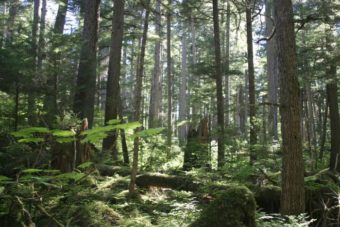
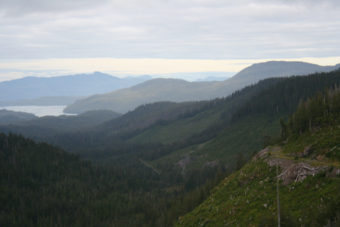
Clearcuts and old-growth forests are part of the view of Indian Valley on Prince of Wales Island.
Indian Valley on Prince of Wales Island. (Creative Commons photo by Nick Bonzey)

Eight conservation groups filed a lawsuit against the U.S. Forest Service in federal district court last week over the controversial sale of thousands of acres of trees on Prince of Wales Island.

In March, the Forest Service signed off on the final environmental review for what could be the largest logging operation in more than a decade in a national forest.
But the agency has maintained the project is intended for more than just timber, saying it will fulfill a variety of objectives, like stream restorations and the construction of new hiking trails and public use cabins.

The plaintiffs say that the Forest Service hasn’t provided a detailed map of the areas that could be logged and therefore can’t adequately assess the environmental impact of the project for the public to weigh in.

Tom Waldo, an attorney at Earthjustice, says the project shouldn’t be allowed to move forward.

“This is a brazen attempt by the Forest Service to rewrite the rules for timber sales,” Waldo said. “And it comes at the expense of a vast amount of habitat on Prince of Wales Island, that’s important for wildlife and for people and communities.”

Historically, large-scale industrial logging has taken place on the island. It’s where Alaska’s last mid-sized sawmill resides.

The Forest Service is expected to offer a timber sale in the area this summer.

A page on the agency’s website with more details about the project appeared to be down Tuesday. But the page has since been restored.

This story has been updated as new information has become available. 

Tongass old growth timber sale gets go-ahead despite habitat concerns

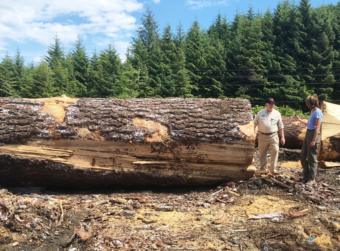
U.S. Secretary of Agriculture Sonny Perdue and Sen. Lisa Murkowski look at some old-growth logs in the yard at Viking Lumber in Klawock. The two toured Prince of Wales Island on July 5, 2018. (Photo by Leila Kheiry/KRBD)

The U.S. Forest Service is moving ahead with one of the largest old growth timber sales Southeast Alaska has seen in years. The federal agency plans to make its decision official Saturday at a signing ceremony in Craig.

The Forest Service announced in 2016 it would largely phase out old growth timber sales in the Tongass over 15 years.

But this latest Prince of Wales Island LLA project projects harvesting as much as 225 million board feet of old growth lumber.
Alaska Forest Association Executive Director Owen Graham said young growth timber might employ seasonal lumberjacks but it’s the big trees that keep Southeast’s remaining mills open.

“The old growth portion will provide mill jobs and the young growth portion will almost exclusively end up getting shipped overseas,” Graham said. “But it’s providing jobs, those are good jobs.”

But he objected to some constraints imposed by the Forest Service. It won’t allow more than 100 acres of clear cut at a time.

Conservationists are alarmed by any new old growth logging.

“It’s going to be controversial any time the Forest Service plans a large old growth timber sale like this,” said Trout Unlimited in Alaska’s policy and legal director Austin Williams.

“If the Forest Service really wants to be responsive to people in Southeast Alaska, it’s going to have to figure out a way to stick to its plan to transition away from large scale old growth logging and get into more sustainable forest management.”

Trying to defining what “sustainable forest management” looks like goes to the heart of debate over the Tongass.

This project uses a new approach for the federal agency in Alaska. It specifies what could be authorized without pinpointing specifics areas.

That frustrates critics like Williams.

“It’s just really hard to tell exactly what this project might look like on the ground moving forward,” he said.

Even the timber industry agrees on that point.

“It’s disconcerting to people like me and others that were used to seeing projects that have a much higher level of detail,” Graham said. “But that doesn’t mean it is a bad project.”

The Alaska Department of Fish and Game raised concerns over losses to habitat. The state agency asked the Forest Service to minimize old growth clear-cuts to save deer. It also asked for buffers around known wolf dens.

Neither approach was included in the final plan.

“Removing the old growth forest tends to reduce habitat quality for deer in some cases quite dramatically,” said Tom Schumacher, regional supervisor for Fish and Game’s Division of Habitat in Southeast.

The Forest Service proposes to thin young forests to stimulate more undergrowth for deer to eat.

But he says when forests are thinned, it leaves a lot of debris on the ground.

“All that slash makes it very difficult for deer to access the area,” Schumacher said. “It’s a real obstacle course with all the trunks and limbs. So if you produce food there, we don’t know if it’s available to deer.”

Less deer means less food for wolves. That’s another concern for state wildlife biologists.

“Wolf conservation on Prince of Wales has been a controversial topic for decades and we’ve had two endangered species petitions to list wolves in that area,” Schumacher noted. “Both have been found unwarranted, but we suspect we’ll see another one at some point. So we want to be very careful with management of wolves in that area.”

The Forest Service’s landscape level analysis also describes up to 200 miles of in-stream restoration and as many as three new cabins and a dozen shelters plus hiking trails.

That’s welcomed by conservationists.

“The future of the Tongass is going to be in recreation, fishing, hunting, tourism, as well as I think we can have a robust forest products industry,” Williams said. “But it’s going to have to be based on young growth forest products.”

Which the logging industry argues does little for keeping the hundred or so remaining sawmill jobs in Southeast.

And so the Tongass debate continues. An official signing ceremony is slated for Saturday, March 16 in Craig.

The Alaska Roadless Rule decision is moving along. Some tribal governments say it’s moving too fast.

The Tongass National Forest near Wrangell, Alaska, 2016.
The Tongass National Forest near Wrangell, Alaska, in 2016. (Creative Commons photo by Rob Bertholf)

The U.S. Forest Service quietly hit another milestone in its ongoing efforts to consider building new roads in the Tongass National Forest. Last month, it received comments on an important document from cooperating groups.

The state has been providing feedback that could shape the outcome of the new rule, and so have Southeast Alaska tribes.

But some of the tribal governments say the timeline has felt rushed for a decision that could have a major impact on rural Alaska.

Joel Jackson, the tribal president of the Organized Village of Kake, said it’s impossible to separate the Tongass National Forest from the dinner table.

“That’s the way I was taught from my father,” Jackson said. “He never liked the word ‘subsistence’ either. He always explained it to me, it’s our way of life.”

And Jackson feels like that way of life could be threatened if new roads are built in the national forest surrounding Kake. Historically, large-scale industrial logging in the region damaged deer habitat and salmon streams.

Jackson said the village can’t afford to have its main food source jeopardized again.

“We have no other choice but to stand up and say, ‘No more logging. No more road-building in our area,'” Jackson said.

This decades-long battle isn’t centered on the roads themselves. For Alaska’s congressional delegation, it’s about access. Or, as Sen. Lisa Murkowski put it, making sure the Tongass is a “working forest.” Much of the remaining harvestable, old-growth trees are in areas that are hard to get to.

Last summer, Murkowski and a top federal official toured the last remaining large sawmill. And in August, the Forest Service announced it would revisit how — and if — the Roadless Rule should apply to Alaska.

Jackson said he wanted Kake to be a part of that conversation. The plans include Southeast Alaska tribes as cooperating agencies — providing crucial input.

But he said it hasn’t always felt that way.

“That remains to be seen,” Jackson said.

In February, the Organized Village of Kake and the other cooperating agencies received a robust, 500-page document, detailing the various options on the table for the Tongass. From one extreme to the other: from the Roadless Rule staying in place, to the Roadless Rule going away for Alaska. And of course, everything in between.

In any case, Jackson said it was a lot to take in for the small tribal government, and the Forest Service gave them just two weeks to make comments.

“We’re not lawyers or anything. We have to get help to understand a lot of what they’re saying,” he said.

Jackson said he asked the Forest Service for more time — a few more days, so the tribe could sort everything out and make meaningful suggestions.

“They said they had a timeline and they were going to stick to it,” Jackson said.

In an emailed statement, the Forest Service didn’t directly address why it didn’t grant the tribal government the extension. But it said there are other ways for cooperating agencies to participate.

Raymond Paddock, the environmental coordinator at Central Council of the Tlingit and Haida Indian Tribes of Alaska, said he thinks the Forest Service is trying to do its best with the directions it was given.

However, Paddock said, “It was definitely a rushed process.”

Central Council is also a cooperating agency providing feedback on the Roadless Rule.

But ultimately, the tribal government decided not to weigh in on this latest comment period because Paddock said they wanted to defer to the smaller tribes.

“Where we feel those are the most impact areas,” Paddock said.

The Forest Service is shooting for a summer release of its draft environmental impact statement on the Roadless Rule.

As for the Organized Village of Kake, they made the two-week deadline and got their comments in.

But Jackson said it wasn’t without a struggle.

“It just takes a lot of time to go page-by-page,” Jackson said.

Now he’s looking forward to getting back to another big project.

Kake is in the process of restoring a cannery with the hopes of attracting more small cruise ships.

Jackson thinks that’s the future, and he wants those visitors to be able to appreciate the old growth trees that are left.

Forest Service reschedules meeting on Southeast Alaska timber sales

Tongass National Forest
Tongass National Forest (Creative Commons photo by Henry Hartley)

The U.S. Forest Service is allowing more planning time for a series of controversial timber sales that could take place on Prince of Wales Island.

The agency worked on the project during the partial government shutdown, which drew sharp criticism from environmental groups.

A public meeting was announced and then canceled within the same week in January.

Now, the Forest Service has rescheduled that meeting for Feb. 20 in Klawock.

Buck Lindekugel from the Southeast Alaska Conservation Council opposes large-scale logging on these lands. But he’s pleased the Forest Service is taking longer to consider his objections.

“They should have extended it, and they shouldn’t have been working on this when the government was shut down the first time,” Lindekugel said.

An email from the regional forester says that February meeting date is firm — even if another government shutdown happens again.

Site notifications
Update notification options
Subscribe to notifications