Timber

Is there something for everyone in a new vision for Tongass roads?

Tongass National Forest
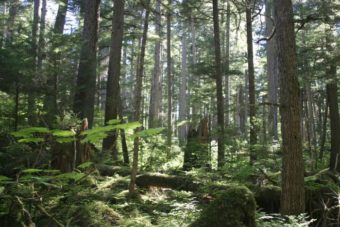
Tongass National Forest. (Creative Commons photo by Henry Hartley)

Over the summer, Alaska got the go-ahead to propose its own alternative to a federal rule most states have to follow. The Roadless Rule prohibits new roads from being built in wilder parts of national lands.

It’s something the state has been battling for decades. But now, the issue seems to be moving forward fast. On Tuesday, a citizen advisory committee released new recommendations, which could shape the future of the Tongass National Forest.

The thing to keep in mind about the four new options being recommended is that they represent a spectrum of ideas about how the Tongass should be managed.

On one end of the spectrum, nothing new would really happen: Things would stay the same, and road-building would remain difficult in some parts of the national forest. On the other end, the national Roadless Rule basically wouldn’t apply to Alaska.

Andrew Thoms, with the Sitka Conservation Society, said the advisory committee weighed these options carefully.

“People saw that Southeast rural communities are facing challenges and there are no easy answers,” Thoms said.

Gov. Bill Walker appointed Thoms and 11 others to the Alaska Roadless Rule Citizen Advisory Committee in October to represent various stakeholders around Southeast Alaska. The state has long maintained the region needs better access to logging, energy and mining opportunities, and that would be easier without the Roadless Rule hanging over the Tongass.

Thoms said the group agreed they’d like to see a sustainable timber industry kept alive. But where do you strike the balance?

“I think new road-building that opens up new areas for logging, especially on landscapes like Prince of Wales that’s already been heavily impacted, could cause some big problems,” Thoms said.

Two of the options on the spectrum would scale back some environmental protections. Right now, the U.S. Forest Service can’t build roads through areas with the top salmon producing watersheds, known as the Tongass 77, or Audubon-designated habitat important for wildlife and fish.

One of the options would do away with both of those protections.

Thoms said the message the committee heard from a lot of the community meetings was this: Keep things as they are. The Forest Service has already received over 140,000 public comments on this. In fact, they’re still combing through them.

But Thoms said the Forest Service hasn’t analyzed the responses yet.

“What we’re hearing from the public … is that they want to keep the Roadless Rule in place,” Thoms said. “And the public testimony seemed to indicate that people were leaning toward a ‘no action’ alternative.”

At the public meeting in Ketchikan, the community input was more split.

Bert Burkart said that’s not surprising. He’s the President of the Alaska Forest Association, a consultant with Viking Lumber and part of the citizen advisory committee.

Burkhart prefers option D — the very end of the spectrum. The one that said the Roadless Rule basically doesn’t apply to Alaska. Still, he said he’d take the closest other outcome.

“But it’s still not what we’re shooting for,” Burkhart said.

It’s not what the state is shooting for either.

Chris Maisch, the state forester, said the state’s perspective hasn’t changed: Alaska shouldn’t have to follow the Roadless Rule.

“But we think the body of work that was done by the committee, it did reflect well what we heard,” Maisch said. “I think everyone that participated could find something about their opinion on this matter.”

Ultimately, it’ll be up to the Forest Service to decide which of the advisory committee’s options will move on for an environmental analysis — with the state acting as a cooperating agency.

It’s expected the public will get another chance to weigh in this summer. A final decision on Alaska’s Roadless Rule is anticipated by 2020.

Feds propose Tongass old growth timber sale

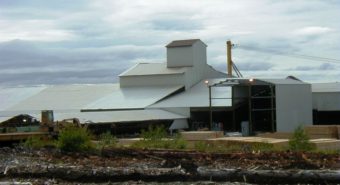
The Viking Lumber Mill on Prince of Wales Island is one of the last operating big sawmills in Southeast Alaska. (Photo by Ed Schoenfeld/CoastAlaska)

One of the largest old growth timber harvests in years has been proposed on Prince of Wales Island. The U.S. Forest Service says old growth logging would help fuel the local economy.

But critics note it’s a reversal of the agency’s 2016 decision to phase out old-growth logging.

The latest Prince of Wales Island proposal envisions as much as 225 million board feet of old growth timber harvested.

At first blush, the Prince of Wales Island project looks big, said the Forest Service’s project manager Delilah Brigham in Thorne Bay. But it’s designed to be a gradual process.

“We’re looking at metering out timber harvest over 15 years,” she said Tuesday. “So yes, the project does offer a larger amount of old growth but it’s not going to be harvested all right now within one year.”

The project would still dwarf the recent Big Thorne Project which was touted as offering nearly 150 million board feet of timber. Also unlike Big Thorne, this proposal doesn’t immediately identity specific areas to be logged. Rather, it covers a patchwork of Tongass National Forest lands on Prince of Wales and surrounding islands.

But Brigham said the purpose remains the same: feed demand of the local industry.

“We had a variety of comments from different sized mills across the project area saying that their businesses rely on a steady supply of timber,” she said.

That’s been met with skepticism by critics.

“There’s no evidence that anything would be milled locally,” said Pat Lavin, an Anchorage-based representative of Defenders of Wildlife, a national environmental group, opposing the plan.  “At least that hasn’t been the trend, and isn’t what one would expect out of this sale, either. Most of the product is exported, unfortunately, and that would probably continue.”

The Forest Service has received push back over concerns about commercial logging’s effects on fish and wildlife habitat.

“Prince of Wales Island has been the site of some of the most intense logging over the past several decades,” said Austin Williams, of Trout Unlimited’s Alaska chapter. “The thrust of our comments were to encourage the Forest Service to really be mindful of impacts to fish and wildlife and to really find a way to move the timber program more towards young growth and away from this old growth logging.”

The Forest Service had considered other alternatives including cutting younger forests. Tongass Forest Supervisor Earl Stewart is the official who signed off on the environmental review and recommended the most aggressive logging plan. He’s unfazed by criticism, saying controversy is part of the process.

“You know, managing of competing interests from all the different programs and elements is always a challenge and is always difficult,” he said.

The Forest Service will officially publish its draft decision on Saturday. That triggers a 45-day window for people to raise objections until mid-December. The agency then reviews those comments before forwarding a final decision to the regional forester’s office.

Petersburg assembly votes down timber resolution

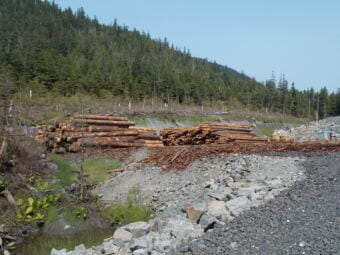
Logs await transport at a sort yard on Kupreanof Island near Petersburg in July of 2013. (Photo by Joe Viechnicki/KFSK)

On Monday, Petersburg’s borough assembly voted down a resolution calling for a forensic audit of two Tongass National Forest timber sales. Back in May, the assembly also voted against sending a letter on lost revenue from the sales and the impact to Petersburg.

The issue has been prompted by a 2016 review by staff in the U.S. Forest Service’s Washington office that noted timber companies were focusing on the more valuable trees. According to that review, the practice resulted in millions of dollars of lost value from the contracts for the Tonka sale on Kupreanof Island near Petersburg and Big Thorne on Prince of Wales Island. The sales are what are called Integrated Resource Contracts, meaning that money would have been kept in the Tongass to pay for stream restoration, culvert repair and other stewardship work.

Becky Knight has been among the local residents asking the assembly to pass such a resolution seeking answers.

“I respectfully ask that you unanimously support the resolution,” Knight told the assembly. “To vote otherwise would send a clear message that not only is the timber industry a sacred cow but there are no budgetary issues facing our community and we are willing to allow millions of dollars to evaporate while suffering the economic and ecological cost with no apparent concern.”

The assembly discussed a draft resolution in April but didn’t vote on it. In May, a short-handed assembly voted down sending a letter to Forest Service officials seeking some of the same answers.

The timber sale problems were highlighted by the group Public Employees for Environmental Responsibility, or PEER, a nationwide watchdog group based in Silver Spring, Maryland. PEER published the 2016 Forest Service review of the sales and sued the agency for documents relating to Tongass timber sale administration and appraisal. PEER says it’s received thousands of pages of Forest Service documents and communications but says it hasn’t seen evidence of change in sale oversight. The Forest Service has said it is implementing a plan to address the Washington office review findings.

Assembly member and retired Forest Service employee Bob Lynn was against the resolution and said he understood the agency was already following up on the problems.

“We need to look at going forward,” Lynn said. “Yeah there’s corrective items here and yeah it needs to be fixed and I don’t disagree with that. But to go back and to ask for another audit that’s already ongoing and one that’s supposed to come to conclusion I don’t think is correct, because all that does is just jam things up really. From a borough standpoint I think we need to look at it from a positive way. And the positive way would be to write a letter asking first of all if we wanted to, maybe the chief of the Forest Service or the Secretary of Agriculture to give us an update on what is going on and when we can expect some results.”

It’s was Lynn’s first meeting back on the assembly. He was off for a year and not a part of the vote in May against sending such a letter.

Assembly member Jeff Meucci asked for the resolution to be back on the agenda at this time.

“This resolution has been before us for quite a while, for like probably a year,” Meucci said. “We had an assembly member here who worked for the Forest Service and this resolution was going to cause him some uncomfort at work. And I didn’t want that to happen. I respected him too much to kind of jam it down his throat and make him vote on it. Now we have an opportunity to kind of move this thing forward. If somebody would like to submit a letter to the Forest Service we can certainly do that but this has been out there for a while. It can’t hurt to ask.”

Current Forest Service employee Eric Castro didn’t run for re-election this year and is no longer on the assembly. Still the votes weren’t there to pass the resolution, only Meucci and Jeigh Stanton Gregor supported it and it failed 2-4.

Roadless advocates pack Tongass hearing

Governor Bill Walker’s advisory panel tasked with recommending ways to relax the U.S. Forest Service’s roadless rule is taking public comment across Southeast Alaska. At a recent hearing in Juneau, most people supported keeping the roadless rule intact in the Tongass National Forest

Part of the Tongass National Forest, between Wrangell and Petersburg, is seen in this view from an airplane in 2014. (Photo by Ed Schoenfeld/CoastAlaska)

Gov. Bill Walker appointed the 12-member advisory committee to make recommendations to the state on where roads could be built inside 7.4-million acres of roadless areas in the Tongass National Forest.

In Juneau, more than two dozen people told the committee they didn’t like the idea of rolling back the roadless rule.

“Expanding roadless areas to make access for logging in Southeast Alaska amounts to a government subsidy of private industry,” said retired federal research chemist Jeff Short.

Juneau resident Carl Brodersen complained that the hearing was announced with little warning and held in the middle of a workday.

“It’s akin to holding a vote on a salmon issue during a king opening,” he told the committee.

Fly fishing guide Mark Hieronymus was among those in the tourism industry who have argued for keeping the roadless rule. He said people from the Lower 48 come to Southeast Alaska, “in greater and growing numbers for the incredible fishing opportunity in natural roadless settings still enjoyed here in the Tongass.”

A pair of supporters for more access also spoke out.

“I feel like I’m a weird duck sitting in here listening to all these people that really don’t know much about what’s going on out there,” Ketchikan City Councilman Dick Coose said. “But that’s beside the point. I’m retired forest service, 35 years.”

Coose was Ketchikan’s district ranger in the 1980s. He said there’s room for managed development in the Tongass.

“And my goal’s very simple: you manage a healthy forest, you have healthy communities and you have healthy businesses,” Coose said.

State Forester Chris Maisch presides over the advisory committee.

“Certainly, the weight of the testimony that we heard was not to change the rule, or in some cases, even to provide more protection,” he said in an interview.

The State of Alaska fought the nationwide 2001 roadless rule in federal court. The Bush administration granted an exemption. But the ninth circuit court of appeals struck it down in 2011.

An appeal filed in 2017 is pending in the D.C. Circuit Court.

Maisch said that makes the state’s position very clear: it’s against the roadless rule.

“And one way or the other the state’s been engaged in trying to overturn the rule since the day it was put in place,” Maisch said.

But on the ground the federal roadless rule is polarizing in Southeast Alaska.

The Tongass National Forest makes up most of Southeast Alaska (Courtesy U.S. Forest Service)

“There’s a lot of passion around this issue,” said Brian Holst, executive director of the Juneau Economic Development Council. He’s one of the 12 appointed to sit on the advisory committee.

Holst said the group hopes to find some compromise. The historic fight has been between keeping the roadless rule intact or doing away with it altogether.

“Our task is not to endorse either of those sides because both of those options are out there,” Holst said, “but is to generate alternatives somewhere in the middle and that’s challenging, that will be challenging.”

The panel doesn’t have much time to deliberate. It’s charged with crafting an Alaska-specific rule that would keep some areas roadless while accommodating areas for road building and development –principally logging – before the end of November.

Before that happens the panel will convene and hold meetings in both Ketchikan from Oct. 24 to 26 and in Sitka from Nov. 6 to 8.

Gov. Walker’s ‘roadless rule’ panel takes shape

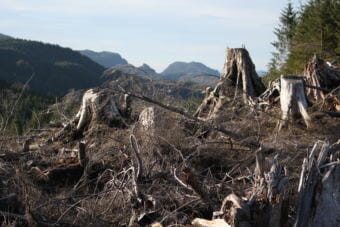
This clear-cut in the Tongass National Forest on Kupreanof Island north of Petersburg is visible from the air in 2014.
This clear-cut in the Tongass National Forest on Kupreanof Island north of Petersburg was visible from the air in 2014. (Photo by Ed Schoenfeld/CoastAlaska)

Gov. Bill Walker had named a dozen Alaskans to weigh in on potential road building in Tongass National Forest. Critics note that none of the appointees work in tourism — one of Southeast’s fastest growing sectors.

The U.S. Forest Service announced this summer it was taking steps to allow road building in Tongass National Forest.

Logging interests say new roads are essential for keeping the timber industry alive.

Eric Nichols, a partner with Alcan Forest Products, was tapped for the panel.

He said Monday he applauds the Forest Service for drawing up a plan, “that relaxes some of the roadless that allows Southeast to have economic, viable communities.”

But conservationists and some tour operators want the Tongass to stay intact.

“Roadless areas protect the core of the visitor experience here in Southeast Alaska and we’re talking about Skagway to Ketchikan,” said Dan Kirkwood, general manager of Pack Creek Bear Tours; he’d applied to sit on the panel but didn’t make the cut.

“We need to protect scenery, fish and wildlife, the things that are bringing a million people – more than a million people – to Southeast Alaska every year,” Kirkwood said.

Another roadless advocate that applied was Austin Williams, a campaigner for Trout Unlimited. He didn’t make it on the panel, either.

“The committee seems to be heavily focused on resource extraction,” Williams said.

When he reads down the list of names he sees logging, commercial fishing and mining.

“Certainly there are some good individuals on the committee and I’m glad to see that,” he said. “But it’s alarming to see that there isn’t anyone specifically advocating for sport fishing or hunting or outfitters and guides. And those are some of the most lucrative and important uses of the forest currently and really need a voice in this process.”

The only appointee tied to tourism is Brian Holst of the Juneau Economic Development Council.

The governor’s press release describes Holst as representing “tourism and other commercial interests on the committee.”

Holst declined to comment.

Conservationists will be represented by Sitka Conservation Society and The Nature Conservancy.

“You can always find somebody who thinks they were left out or there’s a balance one way or too much of the other,” said Michael Kampnich, a Prince of Wales Island-based staffer for The Nature Conservancy, tapped for the committee.

On the whole, Kampnich said he’s pleased with the composition given the tight time frame. But he also noted the lack of professional guides.

“I also hope that there’s some things in there that I can help advocate for,” he said.

Governor’s office spokesman Austin Baird said interest on serving on the panel was high.

“When you had 37 applicants and you had to narrow the field to 12 appointees there were definitely tough decisions that needed to be made,” Baird said.

Native corporations will be represented by Sealaska’s Jaeleen Kookesh; Ralph Wolfe, a member of Yakutat Tlingit Tribe is also on the panel.

The Alaska Roadless Rule Citizen Advisory Committee will get to work immediately.

It’s scheduled to begin a two-day meeting in Juneau on Tuesday.

The committee will advise the State of Alaska. Their recommendations will go toward a state specific roadless rule which could relax road building and logging restrictions in the Tongass.

Anyone interested in attending to calling in or attending the meeting in downtown Juneau’s Centennial Hall can find more information here.

Chinese tariffs hit Southeast Alaska’s struggling timber industry

Logging from the Big Thorne Timber Sale. (Photo by Elizabeth Jenkin/Alaska's Energy Desk) 12/18/17
Logging from the Big Thorne Timber Sale on Prince of Wales Island. (Photo by Elizabeth Jenkins /Alaska’s Energy Desk)

The timber industry in Southeast Alaska has blamed a decline in business on fewer federal timber sales. And now, it risks being penalized by one of its biggest customers.

Tariffs will be placed on trees shipped to China: a response to President Donald Trump’s latest wave of tariffs on Chinese goods.

Eric Nichols says about 80 percent of the trees his Ketchikan-based company harvests in Southeast Alaska goes to China. Alcan Forest Products sells mostly young growth. Spruce trees make up a big part of that, and last week it got 10 percent more expensive to send that timber abroad. The tariff on hemlock went up 5 percent.

Nichols figured the Chinese tariffs were coming. To stay competitive with the global markets, his company is going to have to eat that cost — at a loss of millions of dollars.

It’s a blow in a series of blows, Nichols says. Already, the supply of timber is way down.

“Got no timber coming from the state or the forest service — that’s going to put me out of business. And I got a tariff that’s probably going to put me out of business,” Nichols said. “So which level of worry do I want to worry about first here?”

A big concern, he says, is that the tariff could increase to 25 percent.

The Trump administration has threatened to raise tariffs on Chinese products by early next year. And Nichols worries that China will retaliate with the same, which he says could be the death of Alcan Forest Products.

“How do I make business decisions for today when I don’t know what the tariff level is going to be in January?” Nichols said. “So, it’s almost impossible to run your business beyond a day-to-day basis with the threats of tariffs out there with the products that you sell.”

His company helps employ about 30 people.

As of this morning, Nichols was on his way to a remote logging camp in Southeast Alaska, and he says he hopes this trade war gets resolved soon.

Site notifications
Update notification options
Subscribe to notifications