Timber

University regents advance Chilkat Valley timber sale in 9-1 vote

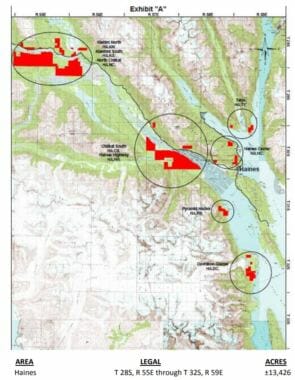
This map shows 13,426 acres of land scattered throughout the Haines Borough that the University of Alaska owns and is negotiating a timber sale of.
This map shows 13,426 acres of land scattered throughout the Haines Borough that the University of Alaska owns and is negotiating a timber sale of. (Courtesy of the University of Alaska)

The University of Alaska is moving forward with a controversial Haines-area timber sale. Amid concerns, the University’s Board of Regents delayed advancing the sale at its last regular meeting.

But, with more information in front of them this week, regents were nearly unanimous in their decision to approve a development and disposal plan.

At a special meeting this week, regents voted 9-1 to approve a development and disposal plan for the sale of timber on 13,400 acres of its land in the Chilkat Valley.

The vote authorizes the university to move forward with contract negotiations for the 10-year negotiated sale, announced in March, estimated to generate 150-million board feet.

Regents heard from University of Alaska President Jim Johnsen.

“In the case of our land development, we can not only look at our regulations, we can look at our history,” Johnsen said. “We can look at actual cases of how we have done land management sustainably and timber harvests sustainably and responsibly.”

Johnsen presented information on the history of the University’s land grants and how those lands have been developed.

He also discussed where that money goes, and recent examples of successful harvests.

The university has about 150,000 total acres in land grants, which fall into different categories.

“It’s frankly, again, not much land,” Johnsen said. “And certainly not much of large commercial value. What little of that we have we seek to monetize.”

Johnsen said the university wants to diversify its revenues, by increasing those coming in from timber. The Haines project is estimated to bring in $10 million.

He said revenue from land development funds things like the Alaska Scholars Program, University of Alaska Press, and Cooperative Extension.

After hearing from Johnsen, Regent Andy Teuber was the only one to vote against the approval.

“I’m generally very supportive of all the recommendations that come from management and from President Johnson as well,” Teuber said. “I’m just not particularly fond of the approach that we’re taking on this for the return that’s deemed to be forthcoming over the course of time. I think it’s somewhat dismissive to the substantial number of comments and concerns that were delivered respectfully to the board of regents.”

Others, like Dale Anderson, spoke in favor of moving forward, particularly because of the economic opportunities for the university and local residents.

“Our fiduciary responsibility as board members is to the University of Alaska and the well-being of that school,” Anderson said. “Of that university. So I encourage all of us to take a very very close look at our intent in our votes, to know that, that’s where our loyalty lies.”

The University estimates the sale would create 55 to 60 new local jobs in its 10-year span.

Regent Karen Perdue, who lived in Southeast for many years, voted in favor of the approval, but said success will come in finding a balance.

“My interest is sort of balanced between understanding that these communities need jobs, we as regents have a fiduciary responsibility,” Perdue said. “But we also are butting up against a pretty significant treasure, which is that (preserve). And also that Haines has extensively worked to promote a tourism economy.”

A portion of the land included in the timber sale falls within the bounds of the Chilkat Bald Eagle Preserve.

However, this harvest would be permitted, because University lands are excluded from restrictions imposed on the preserve.

Johnsen said the University is working to address concerns about eagle habitat, to minimize or eliminate impact. According to his presentation, the timber harvest area could end up being much smaller, depending on environmental requirements.

Regent Lisa Parker said she feels confident in the University’s work on the project.

“We are a university and I think in this case and in anything that we do it’s important for us to lead by example and to set a high standard,” Parker said. “Based on what I’ve seen both previously and in conversations today, I believe that the president and the land department are doing that.”

In the Chilkat Valley, the proposed sale has drawn excitement from residents who see a big economic opportunity for locals.

Many others fear it could alter the land in a way that has real consequences for the environment, including fisheries and other wildlife.

The Haines Assembly continues to have disagreements on the sale.

Some assembly members and the borough manager at a meeting Tuesday expressed concerns that the interactions with and positions of the local government were misrepresented to the regents.

Tom Morphet suggested asking the university to press pause until an advisory vote can be held to gauge local support.

Still, others expressed concerns about the assembly being too adversarial.

Based on feedback from the public and regents, the university has developed a set of guiding principles for moving forward. It also plans to work with a local advisory group.

Once negotiations are completed, the contract will go back to the Board of Regents for approval. That is expected to happen later this summer.

The university is working with the Division of Forestry and Mental Health Land Trust on the project.

A multi-agency review will be conducted through the permitting process, and there will be future opportunities for public comment.

Competitors chop, climb and muck their way through annual Gold Rush Days

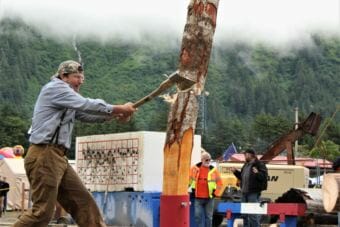
A competitor participates in the men's vertical chopping event on Sunday, June 17, 2018. (Photo by Adelyn Baxter/KTOO)
A competitor participates in the men’s vertical chopping event on Sunday. (Photo by Adelyn Baxter/KTOO)

Juneau residents gathered at Savikko Park this weekend to celebrate the region’s mining and logging industries once again.
According to Gold Rush Days organizers, 76 competitors signed up to take part in the two-day event.

Speed climbing, hand mucking, axe throwing and choker setting are just a few of the contests that test the skills used by miners and loggers past and present.

“It’s basically to keep the history going of what we’re doing and put on a show for the locals,” said Bob Chernikoff, the self-designated “Log Boss” at Gold Rush Days.

He’s been part of the event for more than 20 years and is the vice president of the group that organizes the event, now in its 28th year.

Chernikoff grew up in logging camps in Southeast and now works at Kensington Gold Mine.


He said it takes about two weeks to set up the festival grounds on the softball field.

“Probably my favorite event is watching the log rolling,” Chernikoff said. “I’m not any good at them.”

April Hoy’s whole family competes each year. She came in first in the women’s stock power saw bucking event on Sunday.

She also competed in axe throwing and the speed climbing event, where she donned climbing spurs and a harness to pull herself 25 feet up a log pole. She did it in 55 seconds.

“The Gold Rush Days is a ton of fun,” Hoy said. “I have three teenagers and they have been taking part in this since they were in the children’s events, the teens’ event and now our oldest is 19 and she competes in the adults’ event, the women’s.”

The event is free and family friendly.

All of the logs used this year were donated by Ralph “Animal” Austin.

UA Board of Regents discuss approval process for Chilkat Valley timber sale plans

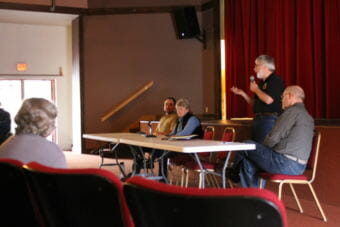
Forest Ranger Jason Anderson, left, University of Alaska Land Management Director Christine Klein, USFS Forester Chris Maisch and Mental Health Land Trust Executive Director Wyn Menefee respond to questions at the timber sale open house. (Photo by Henry Leasia/KHNS)

The University of Alaska’s Board of Regents will review plans for a proposed timber sale in the Chilkat Valley.

The decision on whether the board would approve the development and disposal plan for the sale was postponed at a meeting last month.
University of Alaska announced in March it was working toward a timber sale on 13,400 acres of land in the Haines Borough. The proposed 10-year negotiated sale would produce 150 million board feet.

The Facilities and Land Management Committee for the University’s Board of Regents met at the end of May to review the proposed timber sale.

Some regents raised concerns about the lack of information on the proposed sale.

Regent Jo Heckman questioned the university’s policy on the negotiated sale process and stated that the board was being asked to make a decision with inadequate information.

“When you say the brevity of the document is because that is how it is defined in our policy, are we really proud of that policy?” Heckmen said. “It’s hard for us to make a balanced, informed decision when the information is not there.”

No specific details have been provided about what areas of the university’s lands will be harvested and how the timber would be logged.

Vice Chair John Davies suggested that the board seek public comment further along in the negotiations and submit the final contract to the board for approval.

UA Land Management Office Director Christine Klein opposed this idea, saying it could disrupt the sale.

“It could put us in a situation where the buyer looks at other markets instead of this one,” Klein said.

Davies’ recommendation was voted down 2-1 by the committee, but they did not rule out the possibility of discussing it further when the entire board was present.

The University of Alaska provides a public comment period for its timber sales. The deadline for comments on the sale in the Chilkat Valley was extended twice and ended May 22.

Haines Borough Assembly expressed frustration with the university’s public process.

The Assembly sent a letter in May criticizing the format for its open house on the timber sale. Assembly members requested the university address concerns and answer residents’ questions in public rather than individually.

The university’s timber sales have come under scrutiny before for lacking transparency.

During a previous university timber sale on Mitkof Island, the Petersburg Borough and the City of Kupreanof requested the university suspend the finalization of its contract.

In a 2014 letter, the borough claimed that the Board of Regents made the decision in “the absence of a meaningful public process.”

The university has not provided specific information about where and how the buyer would harvest timber in the Chilkat Valley because they are engaged in a negotiated sale.

Not all terms of the sale will be available until negotiations are complete.

At the open house, the land management office explained that a negotiated sale allows them to secure a purchaser and avoid a deal falling through after years of negotiation.

Director Christine Klein said that even though it speeds up the sale process, once it is set they will be able to better address the community’s needs.

“If we do a negotiated sale, which we can lock in at least the interest in the buyer, then there’s room for flexibility to negotiate things that can be done to meet the community’s needs,” Klein said.

The Facilities and Land Management Committee voted at a May 31 meeting to postpone the discussion of the development and disposal plan in order to allow more time for the university administration to provide a full presentation.

the university’s land management office will begin talks with the buyer, UA Public Affairs Vice President Roberta Graham said, if the board approves the plan.

The administration expects to bring essential terms back to the Board of Regents for review and approval.

Graham noted that a vital process for exchange of input and information is being established by the UA Land Management Office and the Haines community through the on-going development of the Haines Action Committee, a local committee of stakeholders.

The Board of Regents will discuss plans for the proposed sale at a special meeting June 19.

A live stream of the conversation will be available from 9 a.m. to 1 p.m. on the University’s website.

No bids on controversial old growth timber sale … again

In 2014, the U.S. Forest Service repaired streams on Kuiu Island damaged by logging in the 1970s. (Photo by Elizabeth Jenkins/KTOO)

The U.S. Forest Service won’t be facilitating a controversial old growth timber sale in the Tongass National Forest. At least, not in the immediate future. The agency received zero bids on the Kuiu Island timber sale before its closing deadline on Tuesday.

The forest service tried to sell these trees in 2016, but did not receive any offers back then either — even after all of the wood was approved for export.

The agency made changes to this latest version of the sale, reducing it by half and removing some of the more sensitive watershed areas.

But, the sale still faces a lawsuit filed by conservation groups and a tour company over its outdated environmental analysis.

One of the plaintiffs in the case says old growth logging in the Tongass is a practice that needs to end.

UA Regents defer consideration of Haines timber sale plan

This map shows 13,426 acres of land scattered throughout the Haines Borough that the University of Alaska owns and is negotiating a timber sale of.
This map shows 13,426 acres of land scattered throughout the Haines Borough that the University of Alaska owns and is negotiating a timber sale of. (Courtesy of the University of Alaska)

The University of Alaska Board of Regents is delaying a decision on whether to approve the plan for a Chilkat Valley timber sale.
The board was set to approve the development and disposal plan for a major Haines-area timber project at a meeting Thursday.

Instead, regents voted to defer consideration until a special meeting later this month.

The decision comes amid concerns from regents and the public, and a desire for more time to work through those questions.

The university announced the negotiated sale in March. It’s aiming to harvest 150-million board feet from 13,000 acres, over a 10-year period. The area identified for potential harvest is scattered throughout the Haines Borough.

At a Facilities and Land Management Committee Meeting earlier this month, Regent Jo Heckman questioned the amount of information available for the board.

“When you say, the brevity of the document is because that is how it’s defined in our policy? Are we real proud of that policy?” asked Heckman. “I’m just trying to understand, I know you’re justifying it the best way that you have. That here is the information and here is how we’re providing the information. But flip it on the other side and put yourself in our shoes, when we’re not getting what we think we should be getting.”

The yniversity has said more information won’t be available until further along in the negotiation process.

At the special meeting, regents will receive a presentation from the university, with a summary of public comments, more details about the plan, and a set of guiding principles for the project.

That meeting is scheduled for June 19.

This old growth timber didn’t sell last time. Can it attract a buyer now?

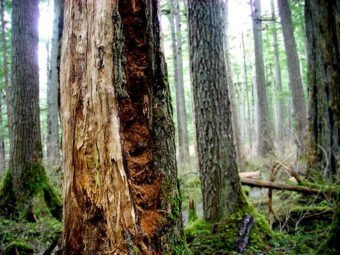
A fire left its mark on this Tongass National Forest tree trunk, as seen in 2008.
The Tongass National Forest. (Creative Commons photo by Xa’at)

A controversial old growth timber sale in the Tongass National Forest has undergone a few changes before coming back on the market. The U.S. Forest Service removed some of the more sensitive watershed areas included in the original offer, which received zero bids back in 2016.

Owen Graham, with the Alaska Forest Association, says he chuckled when he saw the forest service was being sued by conservation groups over this latest version of the Kuiu Island timber sale.

“If somebody did buy it, I hope they could make it work,” Graham said. “But I’d be surprised. It looks like a loser to me.”

A “loser” — in Graham’s words — that he thinks wouldn’t pencil out for a buyer in the domestic or export market.

Kuiu is extremely remote. Plus, the sale is now almost half the size of what the forest service originally planned.

Those factors, Graham says, make it difficult to turn a profit. He thinks the forest service is trying to supply the last few remaining timber jobs.

But increased regulation has limited what areas can be logged, and he says the Kuiu sale reflects that.

“Now, the industry is in jeopardy,” Graham said. “And so, they’re scrambling around to find anything they can to keep the industry alive.”

Buck Lindekugel with the Southeast Alaska Conservation Council agrees with Graham on one thing: this latest attempt by the forest service looks like a scramble.

Lindekugel is a grassroots attorney, and his group is suing the forest service over the sale on Kuiu island. He hopes it discourages a buyer.

“Any purchaser is going to know that we filed this lawsuit before they decide whether they’re going to bid on it,” Lindekugel said.

The forest service started preparing the Kuiu Island timber sale eleven years ago, and it’s original plans probably wouldn’t fly today. The agency has since moved away from selling trees in valuable watersheds next to salmon streams. It dropped some of those areas in the sale this time around.

But Lindekugel says it didn’t update its environmental analysis.

“The previous environmental analysis they did for this over eleven years ago is stale,” Lindekugel said. “[It] doesn’t reflect current conditions and therefore, could not possibly evaluate the effects of this sale in today’s world.”

Lindekugel says the north end of Kuiu island has become a popular spot to take in the scenery for small cruise ships.

Tourism, he thinks, is a better investment for the future of the Tongass.

The forest service is accepting bids on the Kuiu Island timber sale until June 5.

Site notifications
Update notification options
Subscribe to notifications